202009250041 Exercise 5.8.1

Find out if any the asymptote(s) of the curve given by:

y=\displaystyle{\frac{x^2-6x+3}{x-3}}.


Attempts.

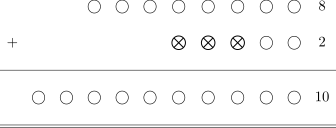
\begin{aligned} & & x & -3 & &  \\\cline{3-5} x & -3 \Big) & x^2 & -6x & +3 & \\ & & x^2 & -3x & & \\ \cline{3-5} & & & -3x & +3 \\ & & & -3x & +9 \\\cline{4-5} & & & & -6 \end{aligned}

The curve is given by

\begin{aligned} y & =\displaystyle{\frac{x^2-6x+3}{x-3}} \\ & = x-3 - \displaystyle{\frac{6}{x-3}} \end{aligned}.


Ans. Of the given curve, x=3 is a vertical asymptote and y=x-3 an oblique asymptote.


Retrospectively, for f(x)=\displaystyle{\frac{x^2-6x+3}{x-3}}, maybe one could also have checked the conditions as follow:

i. \displaystyle{\lim_{x\to 0}}f(x);

ii. \displaystyle{\lim_{x\to 3^{+}}}f(x);

iii. \displaystyle{\lim_{x\to 3^{-}}}f(x);

iv. \displaystyle{\lim_{x\to +\infty}}f(x); and

iv. \displaystyle{\lim_{x\to -\infty}}f(x).


i.

\begin{aligned} \lim_{x\to 0}f(x) & = \lim_{x\to 0} \frac{x^2-6x+3}{x-3} \\ & = \frac{(0)^2-6(0)+3}{(0)-3} \\ & = -1 \end{aligned}

iii.

\begin{aligned} \lim_{x\to 3^{-}}f(x) & = \lim_{x\to 3^{-}} \frac{x^2-6x+3}{x-3} \\ & = \lim_{x\to 3^{-}} \bigg(  x-3-\frac{6}{x-3} \bigg) \\ & = 3^{-} -3-\frac{6}{3^{-}-3} \\ & = (3^{-}-3) + \bigg( \frac{6}{3-3^{-}} \bigg) \\ & \\ \hline & \\ & \because 3^{-} < 3 \\ & \therefore 3^{-}-3<0\qquad \textrm{and}\qquad 3-3^{-}>0 \\ & \dots \textrm{excuse me for writing with no more ado,}\dots \\ & \\ \hline & \\ & = 0^{-} + \frac{6}{0^{+}} \\ & = +\infty \\ \end{aligned}

ii., iv., and iv. are not checked.


Just work with it like whom I was taught:

First, find the slope of tangent to the curve,

\begin{aligned} f(x) & = \frac{x^2-6x+3}{x-3} \\ f'(x) & = \frac{\mathrm{d}}{\mathrm{d}x}\big( f(x) \big) \\ & = \frac{(x-3)(2x-6)-(x^2-6x+3)(1)}{(x-3)^2}  \\ & = \frac{(2x^2-12x+18)-(x^2-6x+3)}{(x-3)^2} \\ & = \frac{x^2-6x+15}{x^2-6x+9} \\ & = 1 + \frac{6}{x^2-6x+9} \end{aligned}

The purpose is to find out any crests or troughs, because at the tip or bottom of a plotted curve, the slope of tangent will be zero, i.e., f'(x)=0.

Secondly, find the change of slope of tangent to the curve,

\begin{aligned} f''(x) & = \frac{\mathrm{d}}{\mathrm{d}x}\big[ f'(x) \big] \\ & = \frac{\mathrm{d}}{\mathrm{d}x} \bigg( 1+\frac{6}{x^2-6x+9}  \bigg) \\ & = \frac{\mathrm{d}}{\mathrm{d}x} \big( 1 \big) + \frac{\mathrm{d}}{\mathrm{d}x} \bigg(  \frac{6}{x^2-6x+9} \bigg) \\ & = 0 + \frac{(x^2-6x+9)(0)+(6)(2x-6)}{(x^2-6x+9)^2} \\ & = \frac{12x-36}{(x^2-6x+9)^2} \\ \end{aligned}

The purpose is to find out if there were any inflexion points (i.e., f''(x)=0) upon which curvature changes sign.


It begins, assuming x\neq 3, I will set f(x)=0:

\begin{aligned} f(x) & = 0 \\ \Leftrightarrow \qquad\qquad x^2-6x+3 & = 0 \\ x & = \frac{-(-6)\pm \sqrt{(-6)^2-4(1)(3)}}{2(1)} \\ & = 3 \pm \sqrt{6} \\ \end{aligned}

The x-intercepts are thus two, 3+\sqrt{6} and 3-\sqrt{6} .

Then I needs set f'(x)=0 with the same assumption x\neq 3.

\begin{aligned} f'(x) & = 0 \\ \Leftrightarrow \qquad \qquad 1+\frac{6}{x^2-6x+9} & = 0 \\ & \\ \textrm{\dots \quad by assumption }x\neq 3 & \enspace \textrm{jump legitimately to the next step\quad \dots} \\ & \\ x^2-6x+9+6 & = 0 \\ x^2 -6x +15 & = 0 \\ x & = \frac{-(-6)\pm \sqrt{(-6)^2-4(1)(15)}}{2(1)} \\ & = 3 \pm \sqrt{6}\, \textrm{i} \end{aligned}

As curvature here permits of no nonreal points, there are neither convex point(s) nor concave point(s).

Besides, there are none any one point of inflexion because if on one hand f''(x)=0 and on the other x\neq 3 be assumed,

\begin{aligned} \frac{12x-36}{(x^2-6x+9)^2} & = 0 \\ \Rightarrow 12x-36 & = 0 \\ \Rightarrow x & =3\qquad\qquad\qquad \bot \\ \end{aligned}

it would have resulted in contradiction.


In conclusion, this exercise was overdone.

202009240421 Problem 2.1.1

For x,\, y\in \mathbb{K} (\mathbb{R} or \mathbb{C}), define

d(x,y)=\mathrm{min}\big\{ 1,\,  |x-y| \big\}.

Prove that d is a metric on \mathbb{K}.


Motivation.

A ruler is marked by rules for the sake of measuring things. Not so much common to a ruler, but well worth the rule for the general, that a metric must measure its metric space, with the metric defined below:

Definition. (metric) Let X be a non-empty set. A function d: X\times X \rightarrow \mathbb{R} is said to be a metric on X if it satisfies the following conditions:

i. d(x,y)\ge 0\qquad \forall\, x,\, y\in X;
ii. d(x,y)=0 \Leftrightarrow x=y\qquad x,\, y\in X;
iii. d(x,y)=d(y,x) \qquad \forall\, x,\, y\in X;
iv. d(x,y)\le  d(x,z)+d(z,y) \qquad \forall\, x,\, y,\, z\in X.


Remark.

i. As is known, distance should be either positive or zero (i.e., non-negative); ii. We are in one only by discrimination; iii. Fair and just from a symmetric point of view; and iv. The straighter the path, the shorter the distance (also known as the Triangle Inequality).


Proof.

Assume x\, ,y\in\mathbb{C} for convenience. (Provided \mathbb{R}\subset \mathbb{C}, the assumption is ready for reduction or extension.)

i.

If the minimum \mathrm{min}\big\{ 1, |x-y|\big\} = 1, condition (i) d(x,y)=1 \ge 0 is seen. If the minimum \mathrm{min}\big\{ 1,|x-y|\big\} = |x-y|, be it called the absolute value, the magnitude, the norm, the modulus, or whatsoever, a complex number is non-negative in norm.


Recall. (Norm of complex conjugate)

A complex number z=x+\textrm{i}\, y contains two parts, the real part x and the imaginary part y. The norm |z| (and the norm |\bar{z}| of its complex conjugate \bar{z}=x-\textrm{i}\, y)
is defined by the formula:

|z|=|x+\textrm{i}\, y|=\sqrt{\big[\textrm{Re}(z)\big]^2+\big[\textrm{Im}(z)\big]^2}=\sqrt{x^2+y^2}.

\dagger It turns out that |z|=\sqrt{(x)^2+(y)^2}=\sqrt{(x)^2+(-y)^2}=|\bar{z}| (where x,\, y\in\mathbb{R}) is positive iff x\enspace\textrm{\scriptsize OR}\enspace y\neq 0, and zero iff x=y=0, but never negative.

\ddagger The sum, the difference, the product, and the quotient of two complex numbers is one another complex number for the complex number field is algebraically closed.

ii.

(only-if) Giving a try straightforth:

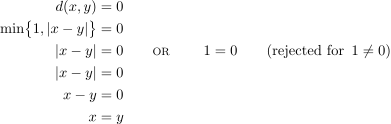
\begin{aligned} d(x,y) & = 0 \\ \textrm{min}\big\{ 1, |x-y| \big\} & = 0 \\ |x-y| & = 0\qquad \textrm{\scriptsize OR\qquad\quad } 1 = 0 \qquad \textrm{(rejected for\enspace }1\neq 0) \\ |x-y| & = 0 \\ x-y & = 0 \\ x & = y \end{aligned}

(if) In reverse from backward:

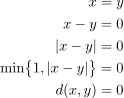
\begin{aligned} x & = y \\ x-y & = 0 \\ |x-y| & = 0 \\ \textrm{min}\big\{ 1, |x-y| \big\} & = 0 \\ d(x,y) & = 0 \end{aligned}

If provided with appropriate explanation, the proof can be shortened by use of the two-way if-and-only-if.

iii.

Suffice it to check whether d(x,y)=d(y,x) is true or not.

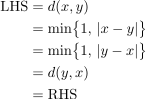
\begin{aligned} \textrm{LHS} & = d(x,y) \\ & = \textrm{min}\big\{ 1,\, |x-y| \big\} \\ & = \textrm{min}\big\{ 1,\, |y-x| \big\} \\ & = d(y,x) \\ & = \textrm{RHS} \end{aligned}


Roughwork.

\forall\, x,\,y \in\mathbb{C}, let x=a+\textrm{i}\, b and y=c+\textrm{i}\, d where a, b, c, and d are real numbers. Then,
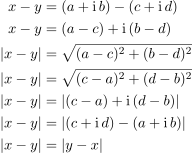
\begin{aligned} x-y & = (a+\textrm{i}\, b)-(c+\textrm{i}\, d) \\ x-y & = (a-c) + \textrm{i}\, (b-d) \\ |x-y| & = \sqrt{(a-c)^2+(b-d)^2} \\ |x-y| & = \sqrt{(c-a)^2+(d-b)^2} \\ |x-y| & = |(c-a) + \textrm{i}\, (d-b)| \\ |x-y| & = |(c+\textrm{i}\, d) - (a+\textrm{i}\, b)| \\ |x-y| & = |y-x| \\ \end{aligned}


iv.

Given here are some equations, I write out all them lest I might forget any:

d(x,y)=\textrm{min}\big\{ 1, |x-y| \big\},
d(x,z)=\textrm{min}\big\{ 1, |x-z| \big\},
d(z,y)=\textrm{min}\big\{ 1, |z-y| \big\}.

RTP (i.e. required to prove):

d(x,y)\le d(x,z) + d(z,y)

\begin{aligned} \textrm{RHS} & = d(x,z) + d(z,y) \\ & = \textrm{min}\big\{ 1,|x-z|\big\} + \textrm{min}\big\{ 1,|z-y|\big\} \\ & = \textrm{min}\big\{ 2,\, 1+|z-y|,\, 1+|x-z|,\, |x-z|+|z-y|\big\} \\ \end{aligned}

If d(x,y)=\textrm{min}\big\{ 1, |x-y|\big\} \stackrel{?}{=}1, so what have I done with?

WTS (i.e. wish to show):

1\le \textrm{min}\big\{ 2, 1+|z-y|, 1+|x-z|, |x-z|+|z-y|\big\}

The following inequalities hold evidently:

\begin{aligned} 1 & \le 2 \\ 1 & \le 1+|z-y| \\ 1 & \le 1+|x-z| \\ \end{aligned}

But 1\le |x-z|+|z-y| has not yet been ascertained.

The Argand diagram above replaces the usual x– and y-axes of the Cartesian plane with the real and the imaginary axes of Argand plane.

Owing to my giving too raw and rude maybe a proof, the problem should have otherwise been treated case-by-case. I.e., they are in either case:

1\le |x-y| \qquad \qquad \textrm{\scriptsize OR}\qquad\qquad 1> |x-y|


Just do it by rote:

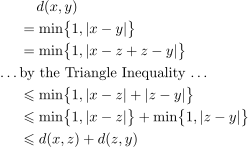
\begin{aligned} & \quad\, d(x,y) \\ & =\textrm{min}\big\{  1, |x-y| \big\} \\ & =\textrm{min}\big\{  1, |x-z+z-y| \big\} \\ \dots \, & \textrm{by the Triangle Inequality}\, \dots \\ & \leqslant \textrm{min} \big\{ 1, |x-z| + |z-y|  \big\}  \\ & \leqslant \textrm{min} \big\{ 1, |x-z| \big\} + \textrm{min} \big\{ 1, |z-y| \big\} \\ & \leqslant d(x,z) + d(z,y) \\ \end{aligned}

d(x,y) \le d(x,z) + d(z,y)

QED

202008190508 Solution to 1973-AL-AMATH-I-1

In calm weather an aeroplane has a speed v and a flying range (out-and-back) R. In a north wind of speed n (n<v) and in a line of flight that makes a constant angle \phi with the north, I wish to know its new flying range.

Assuming that the maximum time of flight is independent of wind conditions, and that the effect of turning round at the end of the outgoing journey can be ignored.

Let \mathbf{v}=v_x\, \hat{\mathbf{i}} + v_y\,\hat{\mathbf{j}} denote the velocity of the aeroplane in calm weather (i.e., zero wind speed).

Then \mathbf{v}=(v_x,\, v_y) = (v\sin\phi , \, v\cos\phi ), where v=|\mathbf{v}| is its speed, and \phi measured anticlockwise from the north.

In a north wind of speed n, the outgoing speed v_{\textrm{out}} of the plane will decrease by (v\sin\phi ,\, v\cos\phi -n), and on its return the speed v_{\textrm{back}} will increase by (v\sin\phi ,\, v\cos\phi +n).

The new range R' is calculated in two parts:

R'_{\textrm{total}}=R'_{\textrm{out}}+R'_{\textrm{back}}.

\because \qquad R'_{\textrm{out}}=R'_{\textrm{back}}

\therefore\qquad R'_{\textrm{out}}=R'_{\textrm{back}}=\displaystyle{\frac{R'}{2}}

If the plane is on schedule, the time of flight t=\displaystyle{\frac{R}{v}} should be kept unchanged.

I.e.,

\begin{aligned} t & = t' \\ t & = t'_{\textrm{out}} + t'_{\textrm{back}} \\ \frac{R}{v} & = \frac{R'_{\textrm{out}}}{v'_{\textrm{out}}} + \frac{R'_{\textrm{back}}}{v'_{\textrm{back}}} \\ \frac{R}{v} & = \frac{R'/2}{\sqrt{(v\sin\phi )^2+(v\cos\phi -n)^2}} + \frac{R'/2}{\sqrt{(v\sin\phi )^2+(v\cos\phi +n)^2}} \\ \frac{R}{v} & = \frac{R'/2}{\sqrt{v^2\sin^2\phi +v^2\cos^2\phi -2nv\cos\phi +n^2}} + \frac{R'/2}{\sqrt{v^2\sin^2\phi +v^2\cos^2\phi +2nv\cos\phi +n^2}} \\ \frac{R}{v} & = \frac{R'/2}{\sqrt{v^2 -2nv\cos\phi +n^2}} + \frac{R'/2}{\sqrt{v^2 +2nv\cos\phi +n^2}} \\ \frac{R}{v} & = \frac{R'}{2}\Bigg\{ \frac{\sqrt{(v^2+n^2)+(2nv\cos\phi )}-\sqrt{(v^2+n^2)-(2nv\cos\phi )}}{\sqrt{(v^2+n^2)^2-(2nv\cos\phi )^2}}\Bigg\} \\ R' & = \frac{2R}{v} \Bigg\{ \frac{\sqrt{(v^2+n^2)^2-(2nv\cos\phi )^2}}{\sqrt{(v^2+n^2)+(2nv\cos\phi )}-\sqrt{(v^2+n^2)-(2nv\cos\phi )}}\Bigg\}  \\ \end{aligned}

Let a=v^2+n^2 and b=2nv\cos\phi.

\begin{aligned} R' & = \frac{2R}{v} \Bigg\{ \frac{\sqrt{a^2-b^2}}{\sqrt{a+b}-\sqrt{a-b}} \Bigg\} \\ R' & = \frac{2R}{v} \Bigg\{ \frac{\sqrt{a^2-b^2}(\sqrt{a+b}+\sqrt{a-b})}{(\sqrt{a+b})^2-(\sqrt{a-b})^2} \Bigg\} \\ R' & = \frac{R}{v}\bigg[\frac{(\sqrt{a-b})(a+b)+(\sqrt{a+b})(a-b)}{b}\bigg] \\ R' & = \frac{R}{v}\bigg[ \sqrt{a-b} \bigg(  \frac{a}{b} \bigg) +\sqrt{a-b} + \sqrt{a+b} \bigg(  \frac{a}{b} \bigg) - \sqrt{a+b} \bigg] \\ \end{aligned}

c^2=a^2+b^2-2ab\cos\theta (The Law of Cosines)

I need a break. To be continued.


After dinner, things are much clearer. Go back to the earlier line:

\displaystyle{\frac{R}{v} = \frac{R'/2}{\sqrt{v^2 -2nv\cos\phi +n^2}} + \frac{R'/2}{\sqrt{v^2 +2nv\cos\phi +n^2}}}.


Now invoke its physical meaning:

i. Let \mathbf{n}= -n\,\hat{\mathbf{j}} (n>0) be the north wind velocity vector pointing in the southerly direction.

ii. Let \mathbf{v}= -v_x\,\hat{\mathbf{i}} + v_y\,\hat{\mathbf{j}} (v_x,\, v_y>0) be the velocity vector of the airplane pointing in the northwesterly direction.

iii. Let \mathbf{s}=\mathbf{n}+\mathbf{v} be the side subtending the angle \phi enclosed by the two vector arrows \mathbf{n} and \mathbf{v}. That is, the bottom of vector \mathbf{s} is touching the arrowhead of \mathbf{v}, and the arrowhead of \mathbf{s} is touching the tip of \mathbf{n}.

iv. The sides \mathbf{n}, \mathbf{v}, and \mathbf{s} form a triangle of perimeter given by n+v+s.

v. s^2=|\mathbf{s}|^2= v^2+n^2-2nv\cos\phi.

vi. 2nv\cos\phi =2\mathbf{n}\cdot\mathbf{v}.


(continue)

\begin{aligned} \frac{R}{v} & = \frac{R'/2}{\sqrt{v^2 -2nv\cos\phi +n^2}} + \frac{R'/2}{\sqrt{v^2 +2nv\cos\phi +n^2}} \\ \dots & = \frac{R'}{\sqrt{4(v^2 -2nv\cos\phi +n^2)}} + \frac{R'}{\sqrt{4(v^2 +2nv\cos\phi +n^2)}} \\ \dots & = \frac{R'}{\sqrt{4(s^2)}} + \frac{R'}{\sqrt{4(s^2 + 4\mathbf{n}\cdot\mathbf{v})}} \\ \dots & = \bigg( \frac{\sqrt{4(s^2+4\mathbf{n}\cdot \mathbf{v})}+\sqrt{4(s^2)}}{\sqrt{4(s^2)(s^2+4\mathbf{n}\cdot\mathbf{v})}} \bigg) R' \\ \dots & = \bigg( \frac{\sqrt{s^2+4\mathbf{n}\cdot \mathbf{v}}+ s}{\sqrt{s^4+4s^2\mathbf{n}\cdot\mathbf{v}}} \bigg) R' \\ R' & = \bigg(  \frac{R}{v} \bigg) \bigg( \frac{\sqrt{s^4+4s^2\mathbf{n}\cdot\mathbf{v}}}{\sqrt{s^2+4\mathbf{n}\cdot \mathbf{v}}+ s} \bigg) \\ \end{aligned}


Roughwork.

\begin{aligned} s^2 & = v^2 + n^2 -2nv\cos\phi \\ s^4 & = (v^2 + n^2 -2nv\cos\phi )^2 \\ \dots & = v^4+n^4+2n^2v^2-4nv^3\cos\phi -4n^3v\cos\phi + 4n^2v^2\cos^2\phi \end{aligned}


Simplifying first the numerator,

\begin{aligned} & \sqrt{s^4+4s^2\mathbf{n}\cdot\mathbf{v}} \\ & = \sqrt{(v^4+n^4+2n^2v^2-4nv^3\cos\phi -4n^3v\cos\phi + 4n^2v^2\cos^2\phi )+4(v^2 + n^2 -2nv\cos\phi )(nv\cos\phi )} \\ & = \sqrt{(v^2+n^2)^2-(2nv\cos\phi )^2} \\ \end{aligned}

then the denominator

\begin{aligned} & \sqrt{s^2+4\mathbf{n}\cdot\mathbf{v}} + s \\ & = \sqrt{v^2+n^2-2nv\cos\phi+4nv\cos\phi } + \sqrt{v^2 + n^2 -2nv\cos\phi } \\ & = \sqrt{(v^2+n^2)+(2nv\cos\phi )} + \sqrt{(v^2 + n^2) -(2nv\cos\phi )} \\ \end{aligned}

Putting them together,

\begin{aligned} R' & = \bigg( \frac{R}{v}\bigg) \bigg( \frac{\sqrt{(v^2+n^2)^2-(2nv\cos\phi )^2}}{ \sqrt{(v^2+n^2)+(2nv\cos\phi )} + \sqrt{(v^2 + n^2) -(2nv\cos\phi )} } \bigg) \\ & = \bigg( \frac{R}{v}\bigg) \bigg( \frac{\sqrt{(v^2-n^2)^2+(2nv)^2-(2nv\cos\phi )^2}}{\sqrt{(v^2+n^2)+(2nv\cos\phi )} + \sqrt{(v^2 + n^2) -(2nv\cos\phi )}} \bigg) \\ \end{aligned}

Unsatisfactory still.

Trimming the numerator again,

\begin{aligned} & \sqrt{(v^2-n^2)^2\bigg( 1 + \frac{(2nv)^2-(2nv\cos\phi )^2}{(v^2-n^2)^2}\bigg)} \\ & = (v^2-n^2)\sqrt{\frac{(v^2+n^2)^2-(2nv\cos\phi )^2}{(v^2-n^2)^2}} \\ \end{aligned}

and then dividing the denominator by \sqrt{\frac{(v^2+n^2)^2-(2nv\cos\phi )^2}{(v^2-n^2)^2}}, or, multiplying the denominator by a factor of

\displaystyle{\frac{v^2-n^2}{\sqrt{(v^2+n^2)^2-(2nv\cos\phi )^2}}}

i.e.,

(\sqrt{a+b}+\sqrt{a-b})\frac{v^2-n^2}{\sqrt{a^2-b^2}}.


Note.

\begin{aligned} a - b & = s^2 \\ a + b & = s^2 -4\mathbf{n}\cdot\mathbf{v} \\ \end{aligned}

(to be continued)


Ans.

\displaystyle{\frac{R(v^2-n^2)}{v\sqrt{v^2-n^2\sin^2\phi}}}

202008190019 Exercise 1.28

In each case, determine all real x and y which satisfy the given relation.

(a) x+\mathrm{i}y=|x-\mathrm{i}y|,

(b) x+\mathrm{i}y=(x-\mathrm{i}y)^2,

(c) \displaystyle{\sum_{k=0}^{100}}\mathrm{i}^k=x+\mathrm{i}y.


Solution.

(a)

\begin{aligned} x + \mathrm{i}y & = |x-\mathrm{i}y|  \\ x + \mathrm{i}y &  = \sqrt{(x)^2+(-y)^2} \\ x + \mathrm{i}y & = \big(  \sqrt{(x)^2+(-y)^2}  \big) + \mathrm{i}(0) \end{aligned}

\therefore y=0 and x\enspace (\geqslant 0)\, \in\mathbb{R} is any non-negative real number.

(b)

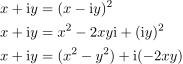
\begin{aligned} x + \mathrm{i}y & = (x-\mathrm{i}y)^2 \\ x + \mathrm{i}y & = x^2 - 2xy\mathrm{i} + (\mathrm{i}y)^2 \\ x + \mathrm{i}y & = (x^2-y^2) + \mathrm{i}(-2xy) \end{aligned}

Comparing the imaginary parts:

\begin{aligned} y=-2xy & \Rightarrow (2x+1)y = 0 \\ & \Rightarrow x = -\frac{1}{2}\qquad \textrm{or}\qquad y=0 \end{aligned}

Comparing the real parts:

\begin{aligned} x & = x^2-y^2 \\ x^2 - x - y^2 & = 0 \\ x & = \frac{-(-1)\pm \sqrt{(-1)^2-4(1)(-y^2)}}{2(1)} \\ & = \frac{1\pm \sqrt{1+4y^2}}{2} \end{aligned}

When y=0, x=\displaystyle{\frac{1\pm \sqrt{1+4(0)^2}}{2}}=0,\, 1.

When x=-\frac{1}{2},

\begin{aligned} -\frac{1}{2} & =\frac{1\pm\sqrt{1+4y^2}}{2} \\ \Rightarrow 2 & = \sqrt{1+4y^2} \\ \Rightarrow y & = \pm \displaystyle{\frac{\sqrt{3}}{2}} \end{aligned}

\therefore \begin{pmatrix} x \\ y \end{pmatrix}\in \Bigg\{ \begin{pmatrix} 0 \\ 0 \end{pmatrix},\,\begin{pmatrix} 1 \\ 0 \end{pmatrix},\, \begin{pmatrix} -\frac{1}{2} \\ \frac{\sqrt{3}}{2} \end{pmatrix},\, \begin{pmatrix} -\frac{1}{2} \\ -\frac{\sqrt{3}}{2} \end{pmatrix}   \Bigg\}.

(c)

\begin{aligned} \sum_{k=0}^{k=100}\mathrm{i}^k & = x+\mathrm{i}y \\ \mathrm{i}^{0} + \mathrm{i}^{1} + \mathrm{i}^{2} + \dots + \mathrm{i}^{100} & = x+\mathrm{i}y \\ \sum_{n=0}^{50} \mathrm{i}^{(2n)} + \sum_{n=0}^{49} \mathrm{i}^{(2n+1)} & = x+\mathrm{i}y \\ \sum_{n=0}^{50} (-1)^n + \mathrm{i}\sum_{n=0}^{49} (-1)^{n} & = x+\mathrm{i}y \\ \end{aligned}

\begin{aligned} \therefore \qquad x & = \sum_{n=0}^{50}(-1)^n \\ & = (-1)^{0} + (-1)^{1} + (-1)^{2} +\dots + (-1)^{50} \\ & = 1-1+1+\dots +1 \\ & = 1 \end{aligned}

\begin{aligned} \therefore \qquad y & = \sum_{n=0}^{49}(-1)^n \\ & = (-1)^{0} + (-1)^{1} + (-1)^{2} +\dots + (-1)^{49} \\ & = 1-1+1+\dots -1 \\ & = 0 \end{aligned}

Sol. \bigg\{\begin{aligned} & x = 1 \\ & y = 0 \end{aligned}\bigg\}.

202008181129 Homework 1 (Q1)

Solve for z\in \mathbb{C} in the following equations:

(a) z^4+z^3+z^2+z+1=0,

(b) 3z^3+29z^2+497z-169=0.


 Attempts.

(a) Take notice that z\neq 1. Try and see having both sides of the equation multiplied by (1-z),

\begin{aligned} 0 & = (1-z)(z^4+z^3+z^2+z+1)  \\ 0 & = 1-z^5  \\ z^5 & = 1 = 1(1+0\,\mathrm{i}) \\ z^5 & = e^{\mathrm{i}(2n\pi)}\qquad \qquad \textrm{where }n=0,1,2,3,4. \\ \end{aligned}

\therefore z=e^{\mathrm{i}(\frac{2n\pi}{5})}.

(n=0 is rejected for z\neq 1=e^{\mathrm{i}(\frac{2(0)\pi}{5})}.)

In polar expression z=e^{\mathrm{i\frac{2\pi}{5}}},\, e^{\mathrm{i\frac{4\pi}{5}}},\, e^{\mathrm{i\frac{6\pi}{5}}},\, e^{\mathrm{i\frac{8\pi}{5}}}.

In trigonometric expression

z=\mathrm{cis}(\frac{2n\pi}{5})=\mathrm{cis}(\frac{2\pi}{5}),\, \mathrm{cis}(\frac{4\pi}{5}),\, \mathrm{cis}(\frac{6\pi}{5}),\, \mathrm{cis}(\frac{8\pi}{5})

I.e.,

\begin{aligned} z^1 & = \cos 72^\circ +\mathrm{i}\sin 72^\circ = \mathrm{cis\,} 72^\circ \\ z^2 & = \cos 144^\circ +\mathrm{i}\sin 144^\circ = \mathrm{cis\,} 144^\circ \\ z^3 & = \cos 216^\circ +\mathrm{i}\sin 216^\circ = \mathrm{cis\,} 216^\circ \\ z^4 & = \cos 288^\circ +\mathrm{i}\sin 288^\circ = \mathrm{cis\,} 288^\circ \\ \end{aligned}

(b)Let f(z)=3z^3+29z^2+497z-169=0. Then (3z-1) is a factor, because \frac{1}{3} is a zero (i.e., f(\frac{1}{3}) = \frac{1}{9}+\frac{29}{9}+\frac{497}{3}-169=0).

\begin{aligned} f(z) & =(3z-1)(z^2+10z+169) \\ & = (3z-1)g(z) \\ \end{aligned}

When g(z)=0, z=\displaystyle{\frac{-10\pm \sqrt{100-4(169)}}{2}}=-5\pm 12\,\mathrm{i}.

The solution to f(z)=0 gives z_1=\frac{1}{3}, z_2=-5+12\,\mathrm{i}, and z_3=-5-12\,\mathrm{i}.

202004241907 Homework 1 (Q2)

(a) State the Mean Value Theorem and the Taylor’s Theorem.

(b) Find an O(h^4) and an O(h^5) approximation to \cos h. Compare those approximate values to the actual value 0.9950042 when h=0.1. Correct answers in this question to seven decimal places.


Solution.

(a)

Theorem. (Mean-Value Theorem) Suppose f\in C[a,b], and f'(x) exists on (a,b). For every x\in [a,b] and some x_0\in [a,b],

f(x)=f(x_0)+f'(\eta (x))(x-x_0)

where \eta (x) is between x_0 and x.

Theorem. (Taylor’s Theorem) Suppose f\in C^n[a,b], and f^{(n+1)} exists on (a,b). For every x\in (a,b) and some x_0\in [a,b], there exists a number \eta (x) between x_0 and x with f(x)=P_n(x)+R_n(x), where

P_n(x)=f(x_0)+f'(x_0)(x-x_0)+ \displaystyle{\frac{f''(x_0)}{2!}}(x-x_0)^2+\cdots + \displaystyle{\frac{f^{(n)}(x_0)}{n!}(x-x_0)^n}, and

R_n(x)=\displaystyle{\frac{f^{(n+1)}(\eta (x))}{(n+1)!}}(x-x_0)^{n+1}.

(b) Let f(x)=\cos x. Then we have f'(x)=-\sin x, f''(x)=-\cos x, f'''(x)=\sin x, f^{(4)}(x)=\cos x, f^{(5)}(x)=-\sin x, etc. By Taylor expansion of \cos x at x_0, we have

\cos x=\cos x_0+(-\sin x_0)(x-x_0)+\displaystyle{\frac{-\cos x_0}{2!}}(x-x_0)^2+\displaystyle{\frac{\sin x_0}{3!}}(x-x_0)^3+\displaystyle{\frac{\cos x_0}{4!}}(x-x_0)^4+\displaystyle{\frac{-\sin x_0}{5!}}(x-x_0)^5+\cdots

Now letting x_0=0, we obtain further that

\cos x=1-\displaystyle{\frac{x^2}{2!}}+\displaystyle{\frac{x^4}{4!}}+\cdots =\displaystyle{\sum_{n=0}^\infty \frac{(-1)^n}{(2n)!}x^{2n}}

Thus, the O(h^4) approximation to \cos h is in the form of

\cos h=1-\displaystyle{\frac{h^2}{2!}}+O(h^4)

where O(h^4) is the higher-order terms \displaystyle{\sum_{n=2}^\infty \frac{(-1)^n}{(2n)!}h^{2n}}.

And the O(h^5) approximation to \cos h is in the form of

\cos h=1-\displaystyle{\frac{h^2}{2!}}+\displaystyle{\frac{h^4}{4!}}+O(h^5)

where O(h^5) is the higher-order terms \displaystyle{\sum_{n=3}^\infty \frac{(-1)^n}{(2n)!}h^{2n}}.

Then, when h=0.1, \cos h in the O(h^4) approximation would be

\cos 0.1=1-\displaystyle{\frac{0.1^2}{2!}}=0.995;

whereas in the O(h^5) approximation,

\cos 0.1=1-\displaystyle{\frac{0.1^2}{2!}}+\displaystyle{\frac{0.1^4}{4!}}=0.995004166\approx 0.9950042\enspace \textrm{(corr. to 7 d.p.)}.

Given the actual value \cos h=0.9950042, the O(h^4) approximation has an absolute error of |0.9950042-0.995|=0.0000042 and a relative error of \displaystyle{\frac{|0.9950042-0.995|}{|0.9950042|}}=4.2210877\times 10^{-6}. And the O(h^5) approximation has an absolute error of |0.9950042-0.9950042|=0 and thus a relative error of zero.


Remark. The 0 error is owing to the correction of 7 decimal places in both the direct computation of \cos 0.1 and its O(h^5) approximation.

202004241649 Problem 2, Ch. 1 Sec. 1

Prove the following equalities:

(a) |ab|=|a|\cdot |b|;

(b) |a|^2=a^2;

(c) \displaystyle{\bigg|\frac{a}{b}\bigg|=\frac{|a|}{|b|}} (where b\neq 0);

(d) \sqrt{a^2}=|a|.


Proof.

(a) (proof by cases)

i. When a,b\geqslant 0:

|ab|=ab=|a||b|.

ii. When a,b< 0:

|ab|=ab=(-a)(-b)=|a||b|.

iii. When a\geqslant 0 and b<0:

|ab|=-ab=a(-b)=|a||b|.

iv. When a<0 and b\geqslant 0:

|ab|=-ab=(-a)b=|a||b|.

QED


(b) (proof by induction)

By making a stronger claim

P(n): For any positive integer n, |a^n|=|a|^n.

Proof.

The trivial cases n=0 and n=1 are evident.

Consider the case n=2,

\begin{aligned} |a^2| & = |a||a| \qquad \textrm{(by equality (a))} \\ & = |a|^2 \end{aligned}

P(2) is true.

Assume now that P(n) is true,

\begin{aligned} P(n+1): \qquad |a^{n+1}|& = |a^n\cdot a| \\ & = |a^n||a| \qquad \textrm{(by equality (a))}\\ & = |a|^n|a| \qquad \textrm{(by the assumption }P(n)\textrm{ is true)} \\ & = |a|^{n+1} \end{aligned}

it can be seen that P(n+1) is also true.

From the fact that P(2) is true and by the principle of mathematical induction, P(n) is true for all positive integers n.

It follows that |a|^2=|a^2|=a^2 holds.

QED


(c) (direct proof)

\because |a|=\displaystyle{\bigg|  \frac{a}{b}\cdot b\bigg|} =\bigg|\displaystyle{\frac{a}{b}}\bigg| |b|,

where the second equality sign is due to equality (a),

\therefore \displaystyle{\bigg| \frac{a}{b} \bigg| = \frac{|a|}{|b|}}.

QED


(d) (proof by definition)

The absolute value of a real number a, denoted by |a|, is defined by

|a|= \begin{cases} x & \textrm{if } x\geqslant 0, \\  -x & \textrm{if }x<0  \end{cases}

For any non-negative real number a, the symbol \sqrt{a} denotes the non-negative square root of a.

QED

202004241533 Problem 1, Ch. 1 Sec. 1

Prove that if a and b are real numbers then

||a|-|b||\leqslant |a-b|\leqslant |a|+|b|.


Proof.

As |a| is non-negative and -|a| non-positive, one has

Eq. (1):

-|a|\leqslant a\leqslant |a|

Eq. (2):

-|b|\leqslant b\leqslant |b|

Combining Eq. (1) and Eq. (2),

-(|a|+|b|)\leqslant a+b\leqslant |a|+|b|,

or, Eq. (3): (the triangle inequality)

|a+b|\leqslant |a|+|b|.

Applying the triangle inequality to |a-b|, one gets

Eq. (4):

|a-b|=|a+(-b)|\leqslant |a|+|-b|=|a|+|b|,

or, Eq. (4)’:

|a-b|\leqslant |a|+|b|.

Applying the triangle inequality to |a|=|(a-b)+b|, one gets

Eq. (5):

|a|=|(a-b)+b|\leqslant |a-b|+|b|,

or, Eq. (5)’:

|a|-|b|\leqslant |a-b|.

Applying the triangle inequality to |b|=|(b-a)+a|, one gets

Eq. (6):

|b|=|(b-a)+a|\leqslant |b-a|+|a|,


Roughwork.

\begin{aligned} |b|-|a| & \leqslant |b-a| \\|b|-|a| & \leqslant |a-b| \\-|a-b| & \leqslant |a|-|b|\end{aligned}


or, Eq. (6)’:

-|a-b| \leqslant |a|-|b|

Combining Eq. (5)’ and Eq. (6)’:

-|a-b| \leqslant |a|-|b| \leqslant |a-b|,

or, Eq. (7):

||a|-|b||\leqslant |a-b|.

Combining Eq. (4)’ and Eq. (7), one obtains readily

||a|-|b||\leqslant |a-b|\leqslant |a|+|b|.

QED