202010130604 Example 1, Chapter 1.1, Methods in Physics II (2015-2016 Lectures)

Find the trajectory of a cannon ball fired by a cannoneer at 45^\circ above his eye level with an initial speed v.


Ans.

Imagine you are in his place, like the picture below:

Then, suppose you are opening fire at such positive \textrm{(+ve)\enspace }x-axis direction as that follows along the meridian. In addition, assume that the earth is to be lying flat beneath the cannon ball during its flight, that every pole (z-axis) upheld would be so much right-angled (/normal /perpendicular) to the ground as parallel (-transported) anywhere.

We neglect air friction.

1. Along the x-direction, the speed is kept v\cos 45^\circ.

2. Along the z-direction, the speed is initially v\sin 45^\circ. By the laws of gravity, the cannon ball will experience a net force m\mathbf{g} due to gravitational pull by the Earth. If upward direction is taken the positive sign, an equation of motion due to the Galilean transformation (i.e., v=u+at) will depict that v_z(t)=v\sin 45^\circ -gt.

3. One another equation s(t)=ut+\displaystyle{\frac{1}{2}}at^2 depicts how distance s (i.e., the magnitude of displacement \mathbf{s}) varies with time t during linear motion in constant acceleration a.

One might have already noticed I am setting the original question aside, as it were. Let’s pinpoint the answer now.

The trajectory should be obtained in the form:

\mathbf{s}(t)=s_x(t)\,\hat{\mathbf{i}} + s_z(t)\,\hat{\mathbf{k}}.

where

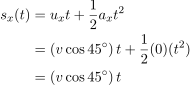
\begin{aligned} s_x(t) & = u_x t+\frac{1}{2}a_xt^2 \\ & = (v\cos 45^\circ )\, t + \frac{1}{2}(0)(t^2) \\ & = (v\cos 45^\circ )\, t \\ \end{aligned}

and

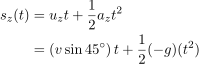
\begin{aligned} s_z(t) & = u_zt + \frac{1}{2}a_zt^2 \\ & = (v\sin 45^\circ )\, t + \frac{1}{2}(-g)(t^2) \\ \end{aligned}

202010022249 Problem 2.1.10

In C[0,1], determine the values of d_{\infty}(x,y) and d_{1}(x,y), when

(a) x(t)=t^3+t+1 and y(t)=t^3+t^2+\frac{1}{2}t+1;

(b) x(t)=\sin t and y(t)=t;
(c) x(t)=\sin t and y(t)=t-\displaystyle{\frac{t^3}{6}};
(d) x(t)=\mathrm{exp}(t) and y(t)=\displaystyle{\sum_{m=0}^n}\frac{t^m}{m!}.


Recall.

Definition. (uniform metric) Let C[a,b] be the set of all real-valued continuous functions defined on [a,b]. For any x,y\in C[a,b], define the uniform metric d_{\infty}:

d_{\infty}(x,y)=\displaystyle{\max_{t\in [a,b]}}|x(t)-y(t)|.

N.b. If we let B[a,b] be the set of all real-valued functions defined and bounded on [a,b], the uniform metric is then defined

d_{\infty}(x,y)=\displaystyle{\sup_{t\in [a,b]}}|x(t)-y(t)|.

(cited from Examples 14 and 15, pg. 13, Pawan K. Jain and Khalil Ahmad’s Metric Spaces (2e) on Introductory Concepts)

Definition. For any x, y\in C[a,b], define

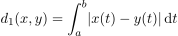
d_1(x,y)=\displaystyle{\int_a^b}|x(t)-y(t)|\,\mathrm{d}t

N.b. d_1(x,y) represents the absolute area between the functions x and y as a measure of the distance between these two functions.

(cited from Example 16, pg. 14, Pawan K. Jain and Khalil Ahmad’s Metric Spaces (2e) on Introductory Concepts)


Solution.

(a)

\begin{aligned} & \quad\, d_{\infty} (x,y) \\ &= \max_{t\in [0,1]} |x(t)-y(t)| \\ \end{aligned}


Roughwork.

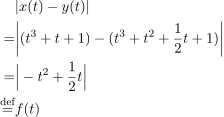
\begin{aligned} & |x(t)-y(t)| \\ = & \bigg| (t^3+t+1)-(t^3+t^2+\frac{1}{2}t+1)\bigg| \\ = & \Big|-t^2+\frac{1}{2}t\Big| \\ \stackrel{\textrm{def}}{=} & f(t) \\ \end{aligned}


Approach.

To know the maximum value of |x(t)-y(t)|, apply differentiation to

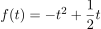
f(t)=-t^2+\displaystyle{\frac{1}{2}}t

and attain

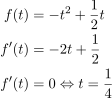
\begin{aligned} f(t) & = -t^2 + \frac{1}{2}t \\ f'(t) & = -2t+\frac{1}{2} \\ f'(t) & = 0 \Leftrightarrow t=\frac{1}{4} \\ \end{aligned}

If the quadratic function f(t) is plotted in a graph, a parabola admits of no inflexion points, needless to check on f''(x)=0. So,

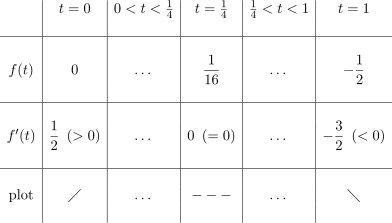
\begin{array}{c|c|c|c|c|c} & t=0 & 0<t<\frac{1}{4} & t=\frac{1}{4} & \frac{1}{4}<t<1 & t=1 \\ &&&&&\\ \hline &&&&&\\ f(t) & 0 & \dots & \displaystyle{\frac{1}{16}} & \dots & -\displaystyle{\frac{1}{2}} \\ &&&&&\\ \hline &&&&&\\ f'(t) & \displaystyle{\frac{1}{2}}\enspace (>0) & \dots & 0\enspace (=0) & \dots & -\displaystyle{\frac{3}{2}}\enspace (<0) \\ &&&&&\\ \hline &&&&&\\ \textrm{plot} & \diagup & \dots & --- & \dots & \diagdown \\ &&&&&\\ \end{array}

The continuous function f(t) in the closed interval [0,1] attains its maximum value f(\frac{1}{4})=\frac{1}{16} when t=\frac{1}{4}.

\begin{aligned} & d_{\infty} (x,y) \\ = & \max_{t\in [0,1]} |x(t)-y(t)| \\ = & \max_{t\in [0,1]} |f(t)| \\ = & \frac{1}{16} \qquad\qquad\qquad \checkmark\\ \end{aligned}

and should you think of what follows as quite right

\begin{aligned} d_1(x,y) & = \int_0^1 |x(t)-y(t)| \,\mathrm{d}t \\ & = \int_0^1 f(t)\,\mathrm{d}t \\ & = \int_0^1 \bigg| -t^2 + \frac{1}{2}t  \bigg| \, \mathrm{d}t \\ & = \bigg[ -\frac{t^3}{3} + \frac{t^2}{4} \bigg] \bigg|_0^1 \\ & = -\frac{1}{12}\qquad\qquad\qquad \times \\ \end{aligned}

you might have rather mistaken calculus.


Correction.

Get back to the basics,

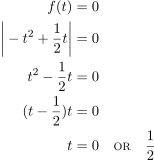
\begin{aligned} f(t) & = 0 \\ \bigg| -t^2+\frac{1}{2}t \bigg| & = 0 \\ t^2-\frac{1}{2}t &= 0 \\ (t-\frac{1}{2})t & = 0 \\ t & = 0\quad \textrm{\scriptsize{OR}}\quad \frac{1}{2} \\ \end{aligned}

From the previous graph of C[0,1], f(t) is found to be positive when t\in (0,0.5), zero when t\in \{ 0\} \cup\{ 0.5\}, and negative when t\in (0.5,1].

Doing it step-by-step,

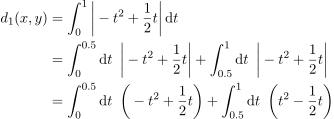
\begin{aligned} d_1(x,y) & = \int_0^1 \bigg| -t^2+\frac{1}{2}t \bigg| \,\mathrm{d}t \\ & = \int_{0}^{0.5}\mathrm{d}t\enspace \bigg| -t^2+\frac{1}{2}t \bigg| + \int_{0.5}^{1}\mathrm{d}t \enspace \bigg| -t^2+\frac{1}{2}t \bigg| \\ & = \int_{0}^{0.5}\mathrm{d}t\enspace \bigg( - t^2 + \frac{1}{2}t \bigg) + \int_{0.5}^{1}\mathrm{d}t \enspace \bigg( t^2-\frac{1}{2}t\bigg) \\ \end{aligned}

Evaluating term-by-term, the first term being

\begin{aligned} & \int_{0}^{0.5} \bigg( -t^2 + \frac{1}{2}t \bigg) \,\mathrm{d}t \\ = & \bigg[ -\frac{t^3}{3} + \frac{t^2}{4} \bigg] \bigg|_{0}^{0.5} \\ = & \bigg[ -\frac{(0.5)^3}{3} + \frac{(0.5)^2}{4} \bigg] - \bigg[ -\frac{(0)^3}{3} + \frac{(0)^2}{4} \bigg] \\ \dots & \enspace \textrm{by arithmetic}\enspace \dots \\ = & \frac{1}{48} \\ \end{aligned}

and the second term being

\begin{aligned} & \int_{0.5}^{1}\bigg( t^2-\frac{1}{2}t\bigg) \,\mathrm{d}t \\ = & \bigg[ \frac{t^3}{3} - \frac{t^2}{4} \bigg]\bigg|_{0.5}^{1} \\ = & \bigg[ \frac{(1)^3}{3} - \frac{(1)^2}{4} \bigg] - \bigg[ \frac{(0.5)^3}{3} - \frac{(0.5)^2}{4} \bigg] \\ \dots & \enspace \textrm{by arithmetic}\enspace \dots \\ = & \bigg( \frac{1}{12} \bigg) - \bigg( -\frac{1}{48} \bigg) \\ = & \frac{5}{48} \\ \end{aligned}

In sum,

d_{1}(x,y)=\displaystyle{\frac{1}{48}+\frac{5}{48}=\frac{6}{48}=\frac{1}{8}}=0.125.


Part (b), (c), and (d) are not chosen.

202010020718 Problem 2.1.2

Let (X,d) be a metric space and let k be a fixed positive real number. For x,\, y\in X, define

d^{*}=kd(x,y).

Prove that d^{*} is a metric on X.


Recall.

Definition. (metric) Let X be a non-empty set. A metric on X is a real-valued function d:\enspace X\times X\rightarrow \mathbb{R} satisfying the following conditions iiv:

i. d(x,y)\ge 0;
ii. d(x,y)=0\Leftrightarrow x=y;
iii. (Symmetry) d(x,y)=d(y,x);
iv. (Triangle Inequality) d(x,y)\le d(x,z)+d(z,y)for any x,\, y,\, z\in X.

N.b. Given x,\,y\in X, d(x,y) is sometimes called the distance between x and y with respect to d.


Proof.

i.

WTS (wish to show)

d^{*}(x,y)\ge 0

By definition d^{*}(x,y)=kd(x,y) and in that the metric d is let clear (\therefore d(x,y)\ge 0) and k a fixed positive real number (\therefore k>0),

one can see

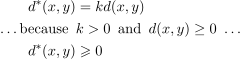
\begin{aligned} d^{*}(x,y) & = kd(x,y) \\ \textrm{\dots because\enspace} & k>0 \enspace \textrm{and}\enspace d(x,y)\ge 0\textrm{\enspace \dots}\\ d^{*}(x,y) & \geqslant 0 \\ \end{aligned}

\therefore Condition i. is made.

ii.

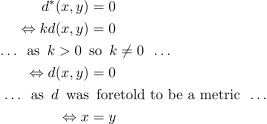
\begin{aligned} d^{*}(x,y) & = 0 \\ \Leftrightarrow kd(x,y) & = 0 \\ \dots\enspace \textrm{as}\enspace k>0 \enspace & \textrm{so}\enspace k\neq 0\enspace \dots \\ \Leftrightarrow d(x,y) & = 0 \\ \dots\enspace \textrm{as}\enspace d \enspace \textrm{was} &\enspace\textrm{foretold to be a metric}\enspace \dots \\ \Leftrightarrow x & = y \\ \end{aligned}

\therefore Condition ii. is made.

iii.

NTS (need to show)

d^{*}(x,y)=d^{*}(y,x)

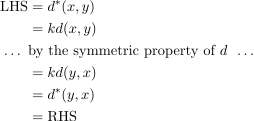
\begin{aligned} \textrm{LHS} & = d^{*}(x,y) \\ & = kd(x,y) \\ \dots \enspace & \textrm{by the symmetric property of }d\enspace \dots \\ & =kd(y,x) \\ & = d^{*}(y,x) \\ & = \textrm{RHS} \\ \end{aligned}

\therefore Condition iii. is made.

iv.

RTP (required to prove)

d^{*}(x,y)\leqslant d^{*}(x,z)+d^{*}(z,y)

One starts with the left hand side,

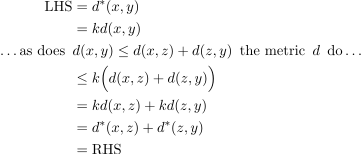
\begin{aligned} \textrm{LHS} & = d^{*}(x,y) \\ & = kd(x,y) \\ \dots \textrm{as does}\enspace & d(x,y)\le d(x,z)+d(z,y)\enspace\textrm{the metric}\enspace d\enspace \textrm{do} \dots \\ & \le k\Big( d(x,z) + d(z,y) \Big) \\ & = kd(x,z) + kd(z,y) \\ & = d^{*}(x,z) + d^{*}(z,y) \\ & = \textrm{RHS} \\ \end{aligned}

Condition iv. is made.


In conclusion, (X,d^{*}) is a metric space metered by a well-defined metric d^{*}. This metric space shall simply be called X hence.

202009290227 Exercise 2.3.5

Prove that 10^{n+1}+10^n+1 is divisible by 3 for n\in\mathbb{N}.

Extracted from T. W. Judson. (2021). Abstract Algebra Theory and Applications.


Proof.

Let P(n) be the statement:

P(n):\qquad 3\,\Big| (10^{n+1}+10^n+1) for any n\in\mathbb{N}

Determine whether or not P(n) is true when n=1:

P(1): \qquad 3\,\Big| (10^{(1)+1}+10^{(1)}+1)

As 10^{(1)+1}+10^{(1)}+1 = 111 = 37\cdot 3 is divisible by 3, P(1) is true.

Suppose P(n) is true for some n\, (\geqslant 1) \in\mathbb{N}, try and prove the statement P(n+1):

P(n+1): \qquad 3\,\Big| (10^{(n+1)+1}+10^{(n+1)}+1)

\begin{aligned} &\quad 10^{(n+1)+1}+10^{(n+1)}+1 \\ = &\quad 10^{n+1}\cdot 10 + 10^n\cdot 10 +1 \\ = &\quad 10^{n+1}\cdot 10 + 10^n\cdot 10 +10 - 9  \\ = &\quad 10\cdot (10^{n+1}+10^n+1) - 9 \\ \end{aligned}

As P(n) is true and by the fact that three divides nine, 10\cdot (10^{n+1}+10^n+1) - 9 is therefore divisible by 3. That is,

P(n)\textrm{\enspace is true\enspace}\Rightarrow P(n+1)\textrm{\enspace is true\enspace}

That P(n) is true for n=1, by the principle of mathematical induction, I have thus proven 10^{n+1}+10^n+1 is divisible by 3 for n\in\mathbb{N}.

202009290114 Exercise 2.3.1

Prove that

1^2+2^2+\cdots +n^2=\displaystyle{\frac{n(n+1)(2n+1)}{6}}

for n\in\mathbb{N}.


Proof.

Let P(n) be the statement

1^2+2^2+\cdots +n^2=\displaystyle{\frac{n(n+1)(2n+1)}{6}} for n\in\mathbb{N}.

When n=1, check for the validity of P(1):

\begin{aligned} \textrm{LHS} & = 1^2 = 1 \\ \textrm{RHS} & = \frac{(1)\big( (1)+1\big) \big( 2(1)+1\big) }{6} = 1 \\ \end{aligned}

\because \textrm{LHS}=\textrm{RHS}

\therefore P(n) is true for n=1.

Suppose P(n) holds true, let’s see if P(n+1) holds too:

P(n+1):\qquad 1^2+2^2+\cdots + n^2 + (n+1)^2 \stackrel{?}{=} \displaystyle{\frac{(n+1)\big( (n+1) +1 \big) \big( 2(n+1) +1 \big) }{6}}

Beginning with the left hand side,

\begin{aligned} \textrm{LHS} & = 1^2+2^2+\cdots + n^2 + (n+1)^2 \\ & = P(n) + (n+1)^2 \\ & = \frac{n(n+1)(2n+1)}{6} + (n+1)^2 \\ & = \frac{n(n+1)(2n+1)+6(n+1)^2}{6} \\ & = \frac{(n+1)\big[ (n)(2n+1) + 6(n+1) \big]}{6} \\ & = \frac{(n+1)(2n^2+n+6n+6)}{6} \\ & = \frac{(n+1)(2n^2+7n+6)}{6} \\ & = \frac{(n+1)(2n+3)(n+2)}{6} \\ \end{aligned}

Then turn to the right hand side,

\begin{aligned} \textrm{RHS} & = \frac{(n+1)\big( (n+1) +1 \big) \big( 2(n+1) +1 \big) }{6} \\ & = \frac{(n+1)(n+2)(2n+3)}{6} \\ \end{aligned}

\because \textrm{LHS} = \textrm{RHS}

\therefore P(n+1) holds when P(n) holds.

As is proven P(1) is true, by the principle of mathematical induction, P(n) is also true for n\geqslant 1, i.e.,

\forall\, n\in\mathbb{N},\qquad 1^2+2^2+\cdots +n^2=\displaystyle{\frac{n(n+1)(2n+1)}{6}}

202009281158 Logic the Basics

Notation and notion

\begin{array}{ccc}  \hline  \textrm{\textbf{Statement connective}} & \qquad \qquad & \textrm{\textbf{Abbreviation}} \\  \hline \\  \textrm{\small{AND}} & & \wedge \\  \textrm{\small{OR}} & & \vee \\  \textrm{\small{IMPLIES}} & & \Rightarrow \\  \textrm{\small{IF AND ONLY IF}} & & \Leftrightarrow \\  \textrm{\small{IT IS NOT THE CASE}} & & \neg \\  \end{array}

\begin{array}{ccc}  \hline  & \qquad\qquad & \textrm{\textbf{Parenthesized expressions}} \\  \hline \\  (\textrm{\textbf{highest precedence}}) & & \textrm{\small{NOT}}\enspace (\neg ) \\  & & \textrm{\small{AND}}\enspace (\wedge )\textrm{,\,} \textrm{\small{OR}}\enspace (\vee ) \\  & & \textrm{\small{IMPLIES}}\enspace (\Rightarrow ) \\  (\textrm{\textbf{lowest precedence}}) & &\textrm{\small{IF AND ONLY IF}} \enspace (\Leftrightarrow ) \\  \end{array}


Truth tables

\begin{array}{c|c|c|c|c|c}  \hline  & & \textrm{\textbf{\scriptsize{AND}}} & & & \textrm{\textbf{\scriptsize{OR}}}  \\  \hline  P & Q & P\wedge Q & P & Q & P\vee Q \\  \hline  \textrm{T} & \textrm{T} & \textrm{T} & \textrm{T} & \textrm{T} & \textrm{T} \\  \textrm{T} & \textrm{F} & \textrm{F} & \textrm{T} & \textrm{F} & \textrm{T} \\  \textrm{F} & \textrm{T} & \textrm{F} & \textrm{F} & \textrm{T} & \textrm{T} \\  \textrm{F} & \textrm{F} & \textrm{F} & \textrm{F} & \textrm{F} & \textrm{F} \\  \end{array}

\begin{array}{c|c|c|c|c}  \hline  & \textrm{\textbf{\scriptsize{NOT}}} & & & \textrm{\textbf{\scriptsize{IMPLIES}}}  \\  \hline  P & \neg P & P & Q & P\Rightarrow Q \\  \hline  \textrm{T} &  \textrm{F} & \textrm{T} & \textrm{T} & \textrm{T} \\  \textrm{F} &  \textrm{T} & \textrm{T} & \textrm{F} & \textrm{F} \\  &  & \textrm{F} & \textrm{T} & \textrm{T} \\  &   & \textrm{F} & \textrm{F} & \textrm{T} \\  \end{array}

\begin{array}{c|c|c|c|c|c}  \hline  & & \textrm{\textbf{\scriptsize{IF AND ONLY IF}}} & & & \textrm{\textbf{\scriptsize{EXCLUSIVE-OR}}}  \\  \hline  P & Q & P\Leftrightarrow Q & P & Q & P\veebar Q \\  \hline  \textrm{T} & \textrm{T} & \textrm{T} & \textrm{T} & \textrm{T} & \textrm{F} \\  \textrm{T} & \textrm{F} & \textrm{F} & \textrm{T} & \textrm{F} & \textrm{T} \\  \textrm{F} & \textrm{T} & \textrm{F} & \textrm{F} & \textrm{T} & \textrm{T} \\  \textrm{F} & \textrm{F} & \textrm{T} & \textrm{F} & \textrm{F} & \textrm{F} \\  \end{array}

\begin{array}{c|c|c|c|c|c}  \hline  & & \textrm{\textbf{\scriptsize{NOR}}} & & & \textrm{\textbf{\scriptsize{NAND}}}  \\  \hline  P & Q & P\downarrow Q & P & Q & P\uparrow Q \\  \hline  \textrm{T} & \textrm{T} & \textrm{F} & \textrm{T} & \textrm{T} & \textrm{F} \\  \textrm{T} & \textrm{F} & \textrm{F} & \textrm{T} & \textrm{F} & \textrm{T} \\  \textrm{F} & \textrm{T} & \textrm{F} & \textrm{F} & \textrm{T} & \textrm{T} \\  \textrm{F} & \textrm{F} & \textrm{T} & \textrm{F} & \textrm{F} & \textrm{T} \\  \end{array}


Logical equivalence

a. (rule of double negation)

\neg\neg\, P\equiv P

b. (or-form of an implication)

P\Rightarrow Q\equiv \neg\, P\vee Q

c. (contrapositive of an implication)

P\Rightarrow Q\equiv \neg\, Q\Rightarrow \neg\, P

d. (de Morgan’s laws)

\neg\, (P\vee Q) \equiv \neg\, P\wedge \neg\, Q;

\neg\, (P\wedge Q)\equiv \neg\, P\vee \neg\, Q

e. (rule for direct proof)

(P\wedge R\Rightarrow Q)\equiv (R\Rightarrow (P\Rightarrow Q))

f. (rule for proof by contradiction)

(P\wedge \neg\, Q\Rightarrow O) \equiv (P\Rightarrow Q)

g. (rule for proof by cases)

(P\vee R\Rightarrow Q) \equiv \big[ (P\Rightarrow Q)\wedge (R\Rightarrow Q)\big]


Boolean laws of logic

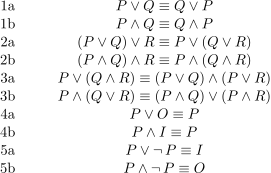
\begin{array}{cc}  \textrm{1a} \qquad & P\vee Q \equiv Q\vee P \\  \textrm{1b} \qquad & P\wedge Q\equiv Q\wedge P\\  \textrm{2a} \qquad & (P\vee Q)\vee R \equiv P\vee (Q\vee R)\\  \textrm{2b} \qquad & (P\wedge Q) \wedge R \equiv P\wedge (Q\wedge R) \\  \textrm{3a} \qquad & P\vee (Q\wedge R) \equiv (P\vee Q)\wedge (P\vee R) \\  \textrm{3b} \qquad & P\wedge (Q\vee R) \equiv (P\wedge Q)\vee(P\wedge R) \\  \textrm{4a} \qquad & P\vee O \equiv P \\  \textrm{4b} \qquad & P\wedge I\equiv P \\  \textrm{5a} \qquad & P\vee \neg\, P \equiv I\\  \textrm{5b} \qquad & P\wedge \neg\, P \equiv O \\  \end{array}

(1a) and (1b) are known as communicative laws, (2a) and (2b) as associate laws, and (3a) and (3b) as distributive laws.

Predicate validity

\begin{array}{cc}  \textrm{Q1} \qquad & \exists\, y\,\forall\, x\enspace P(x,y) \Leftrightarrow \forall\, x\,\exists\, y\enspace P(x,y)   \\  \textrm{Q2} \qquad & \neg\,\forall\, x\enspace P(x) \Leftrightarrow \exists\, x\enspace \neg\, P(x) \\  \textrm{Q3} \qquad &\neg\,\exists\, x\enspace P(x) \Leftrightarrow \forall\, x\enspace \neg\, P(x) \\  \end{array}


Boolean laws for set theory

\begin{array}{cccc}  & \textrm{Union} & & \textrm{Intersection} \\  \textrm{S1a} & \quad A\cup B = B\cup A & \textrm{S1b} &\quad A\cap B=B\cap A \\  \textrm{S2a} & \quad (A\cup B)\cup C = A\cup (B\cup C) & \textrm{S2b} & \quad (A\cap B)\cap C=A\cap (B\cap C) \\  \textrm{S3a} & \quad A\cup (B\cap C) = (A\cup B)\cap (A\cup C) & \textrm{S3b} & \quad A\cap(B\cup C) = (A\cap B) \cup (A\cap C)\\  \textrm{S4a} & \quad A\cup \emptyset =A & \textrm{S4b} & \quad A\cap \mathrm{U}=A \\  \textrm{S5a} & \quad A\cup A' = \mathrm{U} & \textrm{S5b} & \quad A\cap A' = \emptyset \\  \textrm{S6a} & \quad A\cup \mathrm{U} = \mathrm{U} & \textrm{S6b} & \quad A\cap \emptyset = \emptyset \\  \textrm{S7a} & \quad A\cup A = A & \textrm{S7b} & \quad A\cap A =A \\  \textrm{S8a} & \quad \mathrm{U}' = \emptyset & \textrm{S8b} & \quad \emptyset' = \mathrm{U} \\  \textrm{S9a} & \quad (A')' = A & & \\  \textrm{S10a} & \quad (A\cup B)' = A' \cap B' & \textrm{S10b} &\quad  (A\cap B)' = A' \cup B' \\  \textrm{S11a} & \quad A\cap (A\cup B) = A & \textrm{S11b} &\quad A\cup (A\cap B) = A \\  \textrm{S12a} & \quad A\subseteq A\cup B  & \textrm{S12b} & \quad A\cap B\subseteq B \\  \textrm{S13} & \quad A\subseteq B\Leftrightarrow B'\subseteq A' & & \\  \textrm{S14} & \quad A\subseteq B \Leftrightarrow A'\cup B = \mathrm{U} & & \\  \textrm{S15} & \quad A\subseteq B \Leftrightarrow A\cap B' = \emptyset & & \\  \textrm{S16} & \quad A\subseteq B\Leftrightarrow A\cup B & & \\  \textrm{S17} & \quad A\subseteq B\Leftrightarrow A\cap B = A & & \\  \textrm{S18} & \quad A\subseteq B\,\wedge\, B\subseteq D \Rightarrow A\subseteq D & & \\  \end{array}

Remarks. Statements (S1a) and (S1b) are called the commutative laws; (S2a) and (S2b) the associative laws; (S3a) and (S3b) the distributive laws; (S4a) and (S4b) the identity laws; (S5a) and (S5b) the complement laws; (S7a) and (S7b) the idempotent laws; (S8a) and (S8b) the universal/empty set complement law; (S10a) and (S10b) the De Morgan's laws; (S11a) and (S11b) the absorption laws; and (S18) the transitive law.

202009272336 Homework 1 (Q3)

Verify the following statements by definition of limit.

[Hint: Use the (\epsilon ,\,\delta )-language.]

i. \displaystyle{\lim_{n\to \infty}\frac{2n^2-1}{4n^2+2}=\frac{1}{2}};

ii. \displaystyle{\lim_{n\to \infty}\frac{\sqrt{n^2+n}}{n}=1};

iii. \displaystyle{\lim_{n\to \infty}\sqrt[n]{n+2}=1}.


Verification.

i. Given

\displaystyle{\lim_{n\to \infty}\frac{2n^2-1}{4n^2+2}=\frac{1}{2}},

or,

\displaystyle{\lim_{n\to \infty}f(n)=\frac{1}{2}},

in which

\displaystyle{f(n)=\frac{2n^2-1}{4n^2+2}}.

Informally speaking of it, the function f(n) shall go to the limit 1/2 if its variable n goes to the (+\textrm{ve}) infinity.

Remark.

In other words, if a function f tends to its limit L, by that it is to say, there exists some output value(s) f(x) sufficiently close to the number L.

Make-up arguments.

\begin{aligned} & \quad\enspace \bigg| \frac{2n^2-1}{4n^2+2} - \frac{1}{2} \bigg| \\ & = \bigg| \frac{(2n^2-1)-(2n^2+1)}{4n^2+2} \bigg| \\ & = \bigg| \frac{-2}{4n^2+2}\bigg| \\ & = \frac{1}{2n^2+1} \qquad\qquad \big( < \frac{1}{2n^2} \big) \\ \end{aligned}

As needs

\big| f(n)-L\big| = \displaystyle{\frac{1}{2n^2+1}} < \epsilon,

so let

\begin{aligned} \epsilon & = \frac{1}{2n^2} \\ n & = \frac{\sqrt{2}}{2\sqrt{\epsilon}} \\ \end{aligned}

Roughwork. (Instructive)

\forall\, \epsilon >0,

\exists\, n>N(\epsilon )=\displaystyle{\frac{\sqrt{2}}{2\sqrt{\epsilon}}} s.t.

\begin{aligned} & \quad\enspace \bigg| \frac{2n^2-1}{4n^2+2} - \frac{1}{2} \bigg| \\ & = \frac{1}{2n^2+1} \\ & < \frac{1}{2n^2} \\ & < \frac{1}{2(\frac{\sqrt{2}}{2\sqrt{\epsilon}})^2} \\ & = \epsilon \\ \end{aligned}

(to be continued)


Definition. (Limit) Let f be a real-valued function defined on a subset D of the real numbers \mathbb{R}. Let c be a limit point of D and let L be a real number. Symbolically:

\begin{aligned} & \qquad\enspace \lim_{x\to c} f(x) = L \\ & \Longleftrightarrow \bigg( \forall\, \epsilon >0,\, \exists\, \delta >0,\, \forall\, x\in D, 0<|x-c|<\delta \Rightarrow \big| f(x)-L \big| < \epsilon \bigg) \\ \end{aligned}

Wikipedia on (\epsilon ,\,\delta )-definition of limit


(continue)

The presentation below is based on the Suggested Solution:

First,

\bigg| \displaystyle{\frac{2n^2-1}{4n^2+2}-\frac{1}{2}}\bigg| = \bigg| \frac{1}{2n^2+1}\bigg| <\bigg| \frac{1}{n^2} \bigg|.

Then, just do let

N=N(\epsilon )=\bigg[ \displaystyle{\frac{1}{\sqrt{\epsilon}}} \bigg] +1.

Lastly, \forall\, \epsilon >0, it stands that

\bigg| \displaystyle{\frac{2n^2-1}{4n^2+2}-\frac{1}{2}}\bigg| <\epsilon

whenever n\ge N.

QED


Part ii. and part iii. are noteworthy exercises that have yet to be done.

202009270104 Homework 1 (Q1)

i. Prove that \sqrt{6} is irrational; and

ii. Determine whether \sqrt{2}+\sqrt{3} is rational or not.


Solution.

i. Assume on the contrary that \sqrt{6} be rational, may I rewrite it in terms of a quotient (or a fraction) where the numerator and the nonzero denominator are a pair of coprime integers.

I.e., \sqrt{6}=\displaystyle{\frac{p}{q}} where p,q \in\mathbb{Z} and (p,q)=1.


Roughwork.

\begin{aligned} \sqrt{6} & = \frac{p}{q} \\ 6 & = \frac{p^2}{q^2} \\ p^2 & = 6q^2 \\ & = 2(3q^2) \\ \therefore \qquad 2\big| p^2 & \Rightarrow 2\big| p \textrm{\qquad(why?)} \\ \end{aligned}


From p^2=6q^2 we have 2\big| p.

So let p=2r for some integer r.


Roughwork.

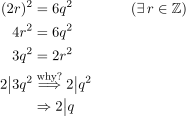
\begin{aligned} (2r)^2 & = 6q^2 \qquad\qquad (\exists\, r\in\mathbb{Z}) \\ 4r^2 & = 6q ^2 \\ 3q^2 & = 2r^2 \\ 2\big| 3q^2 & \stackrel{\textrm{why?}}{\Longrightarrow} 2\big| q^2 \\ & \Rightarrow 2\big| q \\ \end{aligned}


We have also seen 2\big| q.

If and when both statements 2\big| p and 2\big| q meet, it implies p and q are no more coprime, and thus a contradiction.

Definition. (Coprime) Two integers a and b are said to be coprime if the only positive integer that divides them both is one. Equivalently speaking, the greatest common divisor (gcd) of a and b is 1,i.e., \textrm{gcd}(a,b)=1, or written simply, (a,b)=1. Synonymous with coprime' are relatively prime’, `mutually prime’, and the like.

ii.

To prove or disprove from scratch, assume that \sqrt{2}+\sqrt{3} be rational, and see what happens. Let

\sqrt{2}+\sqrt{3}=\displaystyle{\frac{p}{q}}

for some coprimes p,\, q\in\mathbb{Z} s.t. (p,q)=1.

\begin{aligned} \sqrt{3} & = \frac{p}{q} - \sqrt{2} \\ 3 & = \frac{p^2}{q^2} - 2\bigg(\frac{p}{q}\bigg)(\sqrt{2}) +2 \\ 2(\sqrt{2})\bigg(\frac{p}{q}\bigg) & = \frac{p^2}{q^2} - 1 = \frac{p^2-q^2}{q^2} \\ \sqrt{2} & = \frac{p^2-q^2}{2pq} \\ \sqrt{2} & = \frac{p}{2q} - \frac{q}{2p} \in \mathbb{Q} \\ \textrm{As is proven,\enspace} & \sqrt{2}\in \mathbb{R}\backslash\mathbb{Q} \\ \end{aligned}

Contradiction arises ( \Rightarrow \Leftarrow ).

\therefore \sqrt{2}+\sqrt{3} is irrational.

(to be continued)


(doing another way around)

To make use of part i., one might find the Lemma below useful:


Lemma. The product of any two rational numbers is again one rational number.

Proof. Let \displaystyle{\frac{a}{b}} and \displaystyle{\frac{c}{d}}
be rational numbers in their simplest forms reducible.
\begin{aligned} \bigg( \frac{a}{b}\bigg) \bigg( \frac{c}{d}\bigg) & = \bigg( \frac{ac}{bd}\bigg) \\ \because \quad a,b,c,d\in\mathbb{Z} & \Rightarrow ac,\, bd\in\mathbb{Z}\\ \therefore \bigg( \frac{a}{b}\bigg) , \bigg( \frac{c}{d}\bigg) \in \mathbb{Q} & \Rightarrow \bigg( \frac{ac}{bd}\bigg) \in \mathbb{Q} \\ \end{aligned}


If \sqrt{2}+\sqrt{3} were rational, again were its square rational in view of the aforementioned Lemma. Just make an experiment in so doing:

\begin{aligned} (\sqrt{2}+\sqrt{3})^2 & = (\sqrt{2})^2 + 2(\sqrt{2})(\sqrt{3}) + (\sqrt{3})^2 \\ & = 5 + 2\sqrt{6} \\ \end{aligned}

On logic,

\begin{aligned} & \quad (\sqrt{2}+\sqrt{3})^2 \textrm{\quad is rational} \\ & \Rightarrow 5+2\sqrt{6} \textrm{\quad is rational} \\ & \stackrel{\textrm{why?}}{\Longrightarrow} \sqrt{6} \textrm{\quad is rational} \\ \end{aligned}

However, as shown in part i., \sqrt{6} is irrational. The assumption that \sqrt{2}+\sqrt{3} be rational has been contradicted.

The contrary is true that \sqrt{2}+\sqrt{3} is \textrm{\scriptsize{NOT}} rational.

202009260344 Exercise 2.5.1

Show that x=e^{2\theta}\sin\theta satisfies the equation x''-4x'+5x=0.


Solution.

(bottom-up)

Let x' denote \displaystyle{\frac{\mathrm{d}x}{\mathrm{d}\theta}}, x'' denote \displaystyle{\frac{\mathrm{d}^2x}{\mathrm{d}\theta^2}}.

\begin{aligned} x' & = \frac{\mathrm{d}}{\mathrm{d}\theta} \big( e^{2\theta} \sin\theta  \big) \\ & = e^{2\theta} \cdot \frac{\mathrm{d}}{\mathrm{d}\theta} \big( \sin\theta  \big) + \sin\theta \cdot \frac{\mathrm{d}}{\mathrm{d}\theta} \big( e^{2\theta} \big) \\ & = e^{2\theta} \cos\theta + 2e^{2\theta}\sin\theta \\ & = e^{2\theta}(\cos\theta + 2\sin\theta ) \\ \end{aligned}

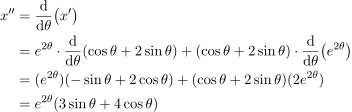
\begin{aligned} x'' & = \frac{\mathrm{d}}{\mathrm{d}\theta} \big( x'  \big) \\ & = e^{2\theta} \cdot \frac{\mathrm{d}}{\mathrm{d}\theta} (\cos\theta +2\sin\theta ) + (\cos\theta + 2\sin\theta )\cdot \frac{\mathrm{d}}{\mathrm{d}\theta} \big( e^{2\theta} \big) \\ & = (e^{2\theta})(-\sin\theta + 2\cos\theta ) + (\cos\theta + 2\sin\theta )(2e^{2\theta }) \\ & = e^{2\theta}(3\sin\theta + 4 \cos\theta ) \\ \end{aligned}

To know whether or not x=e^{2\theta}\sin\theta is a solution, I simply do substitution in the equation x''-4x'+5x=0.

\begin{aligned} \textrm{LHS} & = x''-4x'+5x \\ & = e^{2\theta}(3\sin\theta +4\cos\theta )-4\big[ e^{2\theta}(\cos\theta +2\sin\theta )\big] + 5\big(e^{2\theta}\sin\theta \big) \\ & = \dots \\ & = 0 \\ & = \textrm{RHS} \\ \end{aligned}


Revision.

(top-down)

We are given a second-order linear homogeneous ordinary differential equation (ODE):

x''-4x'+5x = 0

with some independent variable \theta and some dependent variable x(\theta )=e^{2\theta }\sin\theta, the coefficients of x'', x', and x being constants 1, -4, and 5.

Let the primed [ *]' be the function derived wrt. to \theta. Following the routine procedures,

\begin{aligned} x & = e^{r\theta} \\ x' & = re^{r\theta }\\ x'' & = r\cdot ( e^{r\theta })' + r' \cdot ( e^{r\theta }) \\ & = r^2e^{r\theta} \end{aligned}

rewrite it,

\begin{aligned} x''-4x'+5x & = 0 \\ r^2e^{r\theta} - 4re^{r\theta} + 5e^{r\theta} & = 0 \\ \dots  \textrm{\quad excepting\quad} & x=e^{r\theta}=0\textrm{\quad \dots} \\ r^2 -4r+5 & = 0 \\ \end{aligned}

and we shall obtain the auxiliary equation (aka. the characteristic equation) on the very last line.

r=\displaystyle{\frac{-(-4)\pm\sqrt{(-4)^2-4(1)(5)}}{2(1)}}=2\pm \textrm{i}.


Note.

If the roots of the auxiliary equation ar^2+br+c=0 are the complex numbers r_1=\alpha +\textrm{i}\beta and r_2=\alpha -\textrm{i}\beta, the general solution of ay''+by'+cy=0 is

y=e^{\alpha x}(c_1\cos\beta x+c_2\sin\beta x)

(please refer to J. Stewart’s Calculus, Second-Order Linear Differential Equations)


Now that r_1=2+\textrm{i} and r_2=2-\textrm{i} and c_1, c_2 are arbitrary constants, to this 2^{\textrm{nd}}-order ODE, the general solution is

x=e^{2\theta}(c_1\cos\theta +c_2\sin\theta ).


Examination.

It is a good practice, no matter how much time one would allow oneself, to countercheck one’s solution…

Here it goes,

\begin{aligned} x & =e^{2\theta}(c_1\cos\theta +c_2\sin\theta )  \\ & = (c_2e^{2\theta })(\sin\theta ) + (c_1e^{2\theta })(\cos\theta ) \\ \end{aligned}.

\begin{aligned} x' & = e^{2\theta}(-c_1\sin\theta +c_2\cos\theta ) + 2e^{2\theta}(c_1\cos\theta +c_2\sin\theta ) \\ & = (2c_2e^{2\theta }-c_1e^{2\theta})(\sin\theta ) + (2c_1e^{2\theta} + c_2e^{2\theta} )(\cos\theta ) \\ \end{aligned}

\begin{aligned} x''& = \big[ (2c_2e^{2\theta }-c_1e^{2\theta})(\sin\theta ) \big]' + \big[ (2c_1e^{2\theta} + c_2e^{2\theta} )(\cos\theta ) \big]' \\ & = \big[ (2c_2e^{2\theta}-c_1e^{2\theta })(\cos\theta )+(4c_2e^{2\theta }-2c_1e^{2\theta })(\sin\theta ) \big] \\ & \qquad\quad + \big[ (2c_1e^{2\theta }+c_2e^{2\theta })(-\sin\theta )+(4c_1e^{2\theta }+2c_2e^{2\theta })(\cos\theta ) \big] \\ & = (-4c_1e^{2\theta }+3c_2e^{2\theta })(\sin\theta ) + (3c_1e^{2\theta }+4c_2e^{2\theta })(\cos\theta ) \\ \end{aligned}

Then,

\begin{aligned} \textrm{LHS} & =  x'' - 4x' + 5x \\ & = \big( (-4c_1e^{2\theta }+3c_2e^{2\theta })-4(2c_2e^{2\theta}-c_1e^{2\theta})+5c_2e^{2\theta}\big)(\sin\theta ) \\ & \qquad\quad + \big( (3c_1e^{2\theta}+4c_2e^{2\theta}) - 4(2c_1e^{2\theta}+c_2e^{2\theta})+5c_1e^{2\theta} \big)(\cos\theta ) \\ & = 0 \\ & = \textrm{RHS} \end{aligned}


In conclusion, x=e^{2\theta}\sin\theta is a particular solution, the general solution being x=e^{2\theta}(c_1\cos\theta +c_2\sin\theta ).

202009251201 Homework 1 (Q1)

Solve the system \mathbf{A}\mathbf{x} = \mathbf{0} for each matrix \mathbf{A} below.

(a)

\mathbf{A}= \begin{bmatrix}  1 & 3 & 5 & 7 \\ 3 & 5 & 7 & 9 \\ 5 & 7 & 9 & 1 \\  \end{bmatrix}

(b)

\mathbf{A}= \begin{bmatrix}  1 & 0 & 1 & 1 \\ 1 & 1 & 0 & 1 \\ 1 & 1 & -2 & 0 \\  \end{bmatrix}

(c)

\mathbf{A}= \begin{bmatrix}  4 & 6 & 0 & 1 & -9 \\ 1 & 2 & -4 & 5 & 7 \\ 2 & 3 & 6 & 4 & 2 \\ 1 & 0 & 3 & 2 & -5 \\  \end{bmatrix}

(d)

\mathbf{A}= \begin{bmatrix}  1 & 2 & 3 & 1 & 1 \\ 1 & 4 & 0 & 1 & 2 \\ 0 & 2 & -3 & 0 & 1 \\ 1 & 0 & 0 & 0 & 0 \\  \end{bmatrix}


Recall

Observe that \mathbf{A}‘s in (a) and (b) are 3-by-4 matrices, and in (c) and (d) are 4-by-5 matrices. Multiplication of two matrices \mathbf{A} and \mathbf{B} results in a matrix product \mathbf{A}\mathbf{B}. By convention, should an m-by-n matrix \mathbf{A} be written on the left, \mathbf{A} is meant the multiplicand, and should an n-by-p matrix \mathbf{B} be written on the right, \mathbf{B} is meant the multiplier. The matrix product \mathbf{AB} will become an m-by-p matrix.


Solution.

(a)

Let a 4-by-1 column vector \mathbf{x} be

\mathbf{x} = \begin{bmatrix} x_1 \\ x_2 \\ x_3 \\ x_4 \end{bmatrix}.

Then,

\begin{aligned} \mathbf{A}\mathbf{x} & = \mathbf{0} \\ \begin{bmatrix} 1 & 3 & 5 & 7 \\ 3 & 5 & 7 & 9 \\ 5 & 7 & 9 & 1 \\ \end{bmatrix} \begin{bmatrix} x_1 \\ x_2 \\ x_3 \\ x_4 \\ \end{bmatrix} & = \mathbf{0} \\ \begin{bmatrix} (1)(x_1)+(3)(x_2)+(5)(x_3)+(7)(x_4) \\ (3)(x_1)+(5)(x_2)+(7)(x_3)+(9)(x_4) \\ (5)(x_1)+(7)(x_2)+(9)(x_3)+(1)(x_4) \\ \end{bmatrix} & = \begin{bmatrix} 0 \\ 0 \\ 0 \\ \end{bmatrix} \end{aligned}

Here we have four unknowns but three equations.

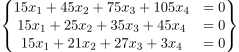
\begin{Bmatrix} 15x_1+ 45x_2+75x_3+105x_4 & = 0 \\ 15x_1+25x_2+35x_3+45x_4 & = 0 \\ 15x_1+21x_2+27x_3+3x_4 & = 0 \\ \end{Bmatrix}

It is feasible to carry through all the calculations, but do let us not work in so awkward a manner.

Performing row operations of matrices and using shorthand notations (e.g., R_1 stands for Row 1; 5R_2 stands for 5 times each entry in Row 2; R_1-R_3 means every entry in Row 3 is to be subtracted from the corresponding entry in Row 1.)

(1) R_3-5R_1

\begin{bmatrix}  1 & 3 & 5 & 7 \\ 3 & 5 & 7 & 9 \\ 0 & -8 & -16 & -34 \\  \end{bmatrix}

(2) R_2 - 3R_1

\begin{bmatrix}  1 & 3 & 5 & 7 \\ 0 & -4 & -8 & 12 \\ 0 & -8 & -16 & -34 \\  \end{bmatrix}

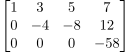
(3) R_3 - 2R_2

\begin{bmatrix}  1 & 3 & 5 & 7 \\ 0 & -4 & -8 & 12 \\ 0 & 0 & 0 & -58 \\  \end{bmatrix}

(4) R_3 \div (-58)

\begin{bmatrix}  1 & 3 & 5 & 7 \\ 0 & -4 & -8 & 12 \\ 0 & 0 & 0 & 1 \\  \end{bmatrix}

(5) R_2-12R_3

\begin{bmatrix}  1 & 3 & 5 & 7 \\ 0 & -4 & -8 & 0 \\ 0 & 0 & 0 & 1 \\  \end{bmatrix}

(6) R_1-7R_3

\begin{bmatrix}  1 & 3 & 5 & 0 \\ 0 & -4 & -8 & 0 \\ 0 & 0 & 0 & 1 \\  \end{bmatrix}

(7) R_2 \div (-4)

\begin{bmatrix}  1 & 3 & 5 & 0 \\ 0 & 1 & 2 & 0 \\ 0 & 0 & 0 & 1 \\  \end{bmatrix}

(8) R_1-3R_2

\begin{bmatrix}  1 & 0 & -1 & 0 \\ 0 & 1 & 2 & 0 \\ 0 & 0 & 0 & 1 \\  \end{bmatrix}

The matrix above is called the reduced row-echelon form of \mathbf{A}.

Now that the simplification has come handy:

\begin{aligned} x_1 -x_3 &=0 \\ x_2 +2x_3 & = 0 \\ x_4 & = 0 \\ \end{aligned}

and the answer is \mathbf{x}=\begin{bmatrix} x \\ -2x \\ x \\ 0 \end{bmatrix}.


Questions (b), (c), and (d) are left the readers.