
For Exercises 1-8, determine if the given sequence is convergent. If so then find its limit.
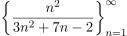
2. 
Solution.
By L’Hôpital’s Rule, treating an integer  as a real-valued variable
  ,
,
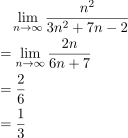
Thus the sequence is convergent and its limit is  .
.
For Exercises 1-8, determine if the given sequence is convergent. If so then find its limit.
2.
Solution.
By L’Hôpital’s Rule, treating an integer as a real-valued variable ,
Thus the sequence is convergent and its limit is .
For Exercises 1-8, determine if the given sequence is convergent. If so then find its limit.

Solution.
By L’Hôpital’s Rule, treating an integer  as a real-valued variable ,

Thus the sequence is convergent and its limit is  .
.
When the functions  and
and  are divided by
  , the remainders are 1 and 4 respectively. Find
  and
and  .
.
Solution.
Translating mathematically, we have
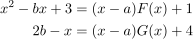
Plugging in  , we have

After simplifying it, we have

Solving two equations with two unknowns,

is the solution.
Given that  . By using the remainder theorem, prove that
  is a factor of
  . Find also the remaining factor of .
Solution.

 is a factor of .
By trial-and-error,
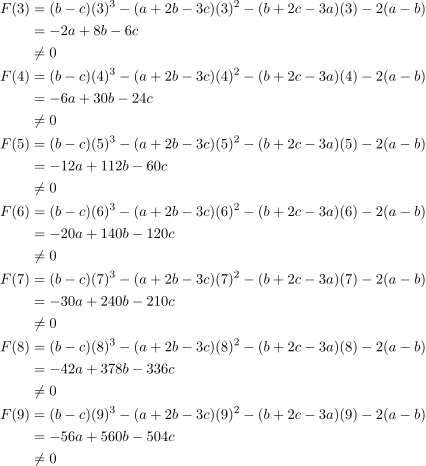
It may be feasible to work in this manner, however endlessly, to find a zero. But it is high time for me to work in another way round.
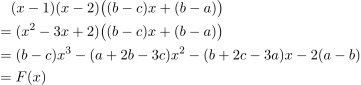
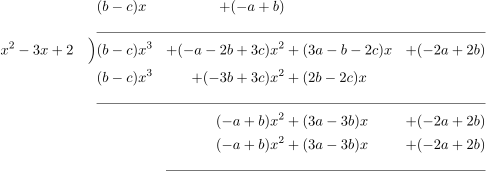
By long division, the remaining factor is
 .
.
One should check that
Remark.
This remaining zero, i.e.,  , is hard to find by trial-and-error, so long division is necessary.
Roughwork.
When  is divided by
  the remainder is
  . What is the value of ?
Solution.
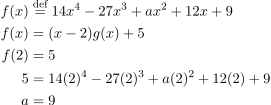
The value of is  .
.
For Exercises 1-6, find the area of the region bounded by the given curves.
 and
and 

Roughwork.
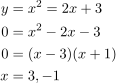
 are the points of intersection.
The area  of the shaded region is
![\begin{aligned} A & = \int_{-1}^{3}|(2x+3)-(x^2)|\,\mathrm{d}x \\ & = \bigg[ x^2+3x-\frac{x^3}{3}\bigg]\bigg|_{-1}^{3} \\ & = \bigg( (3)^2+3(3)-\frac{(3)^3}{3}\bigg) - \bigg( (-1)^2+3(-1)-\frac{(-1)^3}{3}\bigg) \\ & = (9) - \bigg(-\frac{5}{3}\bigg) \\ & = \frac{32}{3}\quad \textrm{(squared units)} \\ \end{aligned}](https://physicspupil.com/wp-content/ql-cache/quicklatex.com-5f993d3e91bd421fd15165ddee343693_l3.svg "Rendered by QuickLaTeX.com")
(alternatively)
![\begin{array}{cl} {A & = \displaystyle\int_{1}^{9}\bigg( \sqrt{y} - \frac{y-3}{2}\bigg)\,\mathrm{d}y + \int_{0}^{1}\Big( (\sqrt{y})-(-\sqrt{y})\Big)\,\mathrm{d}y }\\ & = \displaystyle\bigg( \frac{2y^{3/2}}{3}-\frac{y^2}{4}+\frac{3y}{2}\bigg)\bigg|_{1}^{9} + \bigg( \frac{4y^{3/2}}{3}\bigg)\bigg|_{0}^{1}} \\ & = \displaystyle\Bigg\{ \bigg[ \frac{2(9)^{3/2}}{3}-\frac{(9)^2}{4}+\frac{3(9)}{2}\bigg] -\bigg[\frac{2(1)^{3/2}}{3}-\frac{(1)}{4}+\frac{3(1)}{2}\bigg]\Bigg\} }\\ &\displaystyle\qquad \quad + \Bigg\{\bigg[\frac{4(1)^{3/2}}{3}\bigg] - \bigg[ \frac{4(0)^{3/2}}{3} \bigg]\Bigg\} }\\ & =\displaystyle \bigg( 18-\frac{81}{4}+\frac{27}{2}\bigg) - \bigg( \frac{2}{3}-\frac{1}{4}+\frac{3}{2} \bigg) + \bigg(\frac{4}{3}\bigg) - (0)} \\ & = \displaystyle\frac{32}{3}\quad \textrm{(squared units)}} \end{array}](https://physicspupil.com/wp-content/ql-cache/quicklatex.com-29c78f65521eca21cb00bbea7ceb330b_l3.svg "Rendered by QuickLaTeX.com")
This exercise is related to Einstein’s famous law  . The relativistic momentum
  of a particle of mass
  moving at a speed
  along a straight line (say, the -axis) is
 ,
,
where  is the speed of light. The relativistic force on the particle along that line is
 ,
,
which is the same formula as Newton’s Second Law of motion in classical mechanics. Assume that the particle starts at rest at position  and ends at position
  along the -axis. The work done by the force
  on the particle is:

(a) Show that
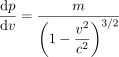 .
.
(b) Use the Chain Rule formula

to show that
 .
.
(c) Use parts (a) and (b) to show that
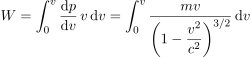 .
.
(d) Use part (c) to show that
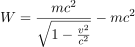 .
.
(e) Define the relativistic kinetic energy  of the particle to be
  , and define the total energy
  to be
to be
 .
.
So by part (d),  . Show that
 .
.
(Hint: Expand the right side of that equation.)
(f) What is when the particle is at rest?
Solution.
(a)
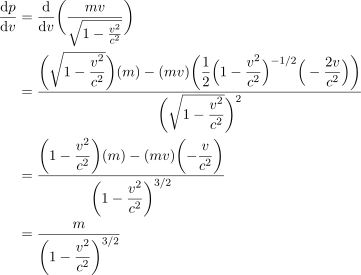
(b)
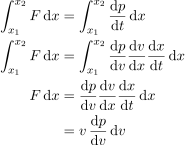
(c)
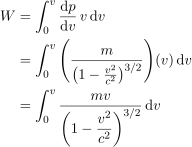 .
.
(d)
![\begin{aligned} W & = \int_{0}^{v}\frac{mv}{\bigg(\displaystyle{1-\frac{v^2}{c^2}}\bigg)^{3/2}}\,\mathrm{d}v \\ \dots\enspace & \textrm{let }u=\frac{v}{c}\enspace\dots \\ \dots\enspace & \textrm{then }\mathrm{d}v=c\,\mathrm{d}u\enspace\dots \\ & = \int_{0}^{\frac{v}{c}}\frac{mc^2u}{(1-u^2)^{\frac{3}{2}}}\,\mathrm{d}u \\ \dots\enspace & \textrm{let }u=\sin\theta\enspace\dots \\ \dots\enspace & \textrm{then }\mathrm{d}u=\cos\theta\,\mathrm{d}\theta\enspace\dots \\ & = \int\frac{mc^2\sin\theta}{\cos^3\theta}\cdot\cos\theta\,\mathrm{d}\theta \\ & = \int\frac{mc^2\sin\theta}{\cos^2\theta}\,\mathrm{d}\theta \\ \dots\enspace & \textrm{let }w=\cos\theta\enspace\dots \\ \dots\enspace & \textrm{then }\mathrm{d}w=-\sin\theta\,\mathrm{d}\theta\enspace\dots \\ & \quad -\int \frac{mc^2}{w^2}\,\mathrm{d}w \\ & = \frac{mc^2}{w} \\ & = \frac{mc^2}{\cos\theta} \\ & = mc^2\sec\theta \\ & = \frac{mc^2}{\sqrt{1-u^2}} \\ & = \enspace\dots \\ & = \bigg[\frac{mc^2}{\sqrt{1-u^2}}\bigg]\bigg|^{\frac{v}{c}}_{0} \\ & = \frac{mc^2}{\sqrt{1-\displaystyle{\frac{v^2}{c^2}}}}-mc^2 \\ \end{aligned}](https://physicspupil.com/wp-content/ql-cache/quicklatex.com-2227d7c994b723ce7bc00a0cb45545d2_l3.svg "Rendered by QuickLaTeX.com")
Parts (e) and (f) are left to the readers.
(a) Show that  in
in ![k[x,y]](https://physicspupil.com/wp-content/ql-cache/quicklatex.com-584acc935973e616ea2c851bc464e2d7_l3.svg "Rendered by QuickLaTeX.com") (
( any field).
(b) Show that  .
.
(c) Is  ? Why or why not?
Definition.
Let ![f_1,\dots ,f_s\in k[x_1,\dots ,x_n]](https://physicspupil.com/wp-content/ql-cache/quicklatex.com-5f08e62a15ff4e03854490db864f1aba_l3.svg "Rendered by QuickLaTeX.com") . We let
. We let  denote the collection
 ![\langle f_1,\dots ,f_s\rangle = \{ p_1f_1+\cdots +p_sf_s:p_i\in k[x_1,\dots ,x_n]\}](https://physicspupil.com/wp-content/ql-cache/quicklatex.com-f334ab4b3301b6106a075356020d5bc8_l3.svg "Rendered by QuickLaTeX.com") for
for  .
.
(a)
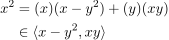
(b)
First, we want to show
 .
.
For any ![p_1,p_2,p_3\in k[x,y]](https://physicspupil.com/wp-content/ql-cache/quicklatex.com-12dccf91798ff1604735efc161b91edc_l3.svg "Rendered by QuickLaTeX.com") ,
,
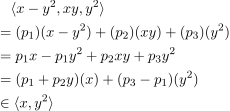
Next, we want to show
 .
.
For any ![p_1,p_2\in k[x,y]](https://physicspupil.com/wp-content/ql-cache/quicklatex.com-0f988f74e666d0747607e1462e98d6e8_l3.svg "Rendered by QuickLaTeX.com") ,
,
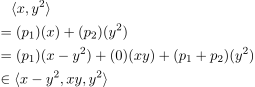
All in all,
.
(c) I guess  .
.
Graph each function by algebraically determining its key features. Then state the domain and range of the function.

Solution.
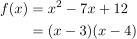
We see that  when
when  .
.
i. The -intercepts of  are thus
  and
and  .
.
Plugging in  will give the
  -intercept:
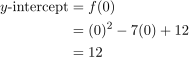
ii. The -intercept is thus  .
.
Differentiating  with respect to ,
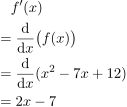
When  and
and  , the slope of is zero, i.e.,
  .
.
iii.  is a turning point (/extreme point/vertex).
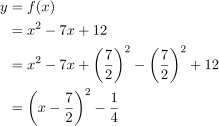
iv. The axis of symmetry of the graph is  .
.
Differentiating twice with respect to ,
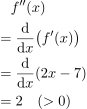
We see that the slope is increasing with .
v. The graph of is concave upward (/convex downward).
vi. The domain is  and the range
  .
.

There are two forces  and
and  , of constant magnitudes (i.e.,
  ;
;  ), acting at the same point. The angle
  between and increases from
  to
to  .Apparently from the figure,
  .
.
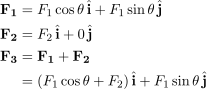
Let the direction of be fixed due east.
Then,
If  , then
  and
and  ;
;
if  , then
  and
and  ;
;
if  , then
  and
and  .
.
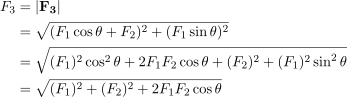
By the triangle inequality,
 .
.
So the magnitude  of the resultant force
  decreases throughout.
(Countercheck)
Differentiating w.r.t. ,
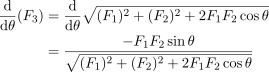
As  for
for  , and
, and ![\sqrt{[\cdots ]}\ge 0](https://physicspupil.com/wp-content/ql-cache/quicklatex.com-a9a35d9114b29758db23150be645ace5_l3.svg "Rendered by QuickLaTeX.com") , we have
, we have
 .
.
And the answer is A.