202112021444 Solution to 1979-CE-AMATH-I-1

Let \displaystyle{y=x+\frac{1}{x^2}}. Find \displaystyle{\frac{\mathrm{d}y}{\mathrm{d}x}} from first principles.


Solution.

From first principles,
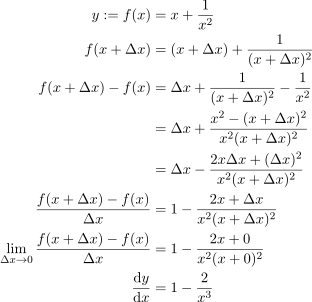
\begin{aligned} y:=f(x) & =x+\frac{1}{x^2} \\ f(x+\Delta x) & =(x+\Delta x) + \frac{1}{(x+\Delta x)^2} \\ f(x+\Delta x)-f(x) & = \Delta x + \frac{1}{(x+\Delta x)^2} - \frac{1}{x^2} \\ & = \Delta x + \frac{x^2-(x+\Delta x)^2}{x^2(x+\Delta x)^2} \\ & = \Delta x - \frac{2x\Delta x+(\Delta x)^2}{x^2(x+\Delta x)^2} \\ \frac{f(x+\Delta x)-f(x)}{\Delta x} & = 1 - \frac{2x + \Delta x}{x^2(x+\Delta x)^2} \\ \lim_{\Delta x\to 0}\frac{f(x+\Delta x)-f(x)}{\Delta x} & = 1 - \frac{2x + 0}{x^2(x+0)^2} \\ \frac{\mathrm{d}y}{\mathrm{d}x} & = 1 - \frac{2}{x^3} \\ \end{aligned}


Playground.

To make fun of calculus, do let
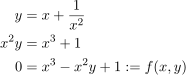
\begin{aligned} y & =x+\frac{1}{x^2} \\ x^2y & =x^3+1 \\ 0 & = x^3-x^2y+1 := f(x,y) \\ \end{aligned}

where f(x,y) is a degree 3 polynomial in two variables x and y.

The set of solutions to f(x,y)=0 is

\begin{cases} \enspace x \neq 0 \\ \enspace  y = \frac{x^3+1}{x^2} \end{cases}

Computing \partial_xf and \partial_yf as follow:

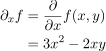
\begin{aligned} \partial_xf & = \frac{\partial}{\partial x}f(x,y) \\ & = 3x^2-2xy \\ \end{aligned}

and

\begin{aligned} \partial_yf & = \frac{\partial}{\partial y}f(x,y) \\ & = -x^2 \\ \end{aligned},

we oversee the relation

\mathrm{d}f = (\partial_xf)(\Delta x)+(\partial_yf)(\Delta y).


Definition. (Singularity and Smoothness)

A point p=(a,b) on a curve \mathcal{C}=\{ (x,y)\in\mathbb{C}^2:f(x,y)=0\} is said to be singular if

\begin{aligned} \frac{\partial f}{\partial x}(a,b) & = 0 \\ \frac{\partial f}{\partial y}(a,b) & = 0 \\ \end{aligned}.

A point that is not singular is called smooth. If there is at least one singular point on \mathcal{C}, then curve \mathcal{C} is called a singular curve. If there are no singular points on \mathcal{C}, the curve \mathcal{C} is called a smooth curve.

C.f. Definition 1.9.1, T. Carrity, et al., Algebraic Geometry: A Problem Solving Approach


That said, in our scenario

f(x,y)=x^3-x^2y+1,

the set of candidates for singularity

\{ (a,b)\in\mathbb{C}^2\enspace \mathrm{s.t.}\enspace f(a,b)=0\textrm{ and }\partial_xf(a,b)=\partial_yf(a,b)=0\}.

is empty.

\therefore The curve \mathcal{C}=\{ (x,y)\in\mathbb{C}^2:x^3-x^2y+1=0\} is smooth, thus everywhere differentiable.


Wait, the function in question should be the curve

F(x)=\displaystyle{x+\frac{1}{x^2}};

still, for better or worse, F(x) is \textrm{\scriptsize{NOT}} a differentiable function because the derivative does \textrm{\scriptsize{NOT}} exist at x=0, for that point is a discontinuity.

202112021138 SQL Table 004

Background. (Equilibrium)

Equilibrium is established by the exchange of energy, volume, or particle number between different systems or subsystems.

Section 2.2. Arovas. (2019). Thermodynamics and Statistical Mechanics


202112021037 Exercise 1.4 Lagrangian actions

For a free particle an appropriate Lagrangian is

Eq. (1.8):

\mathcal{L}(t,x,v)=\displaystyle{\frac{1}{2}mv^2}.

Suppose that x is the constant-velocity straight-line path of a free particle, such that x_a=x(t_a) and x_b=x(t_b). Show that the action on the solution path is

Eq. (1.9):

\displaystyle{\frac{m}{2}\frac{(x_b-x_a)^2}{t_b-t_a}}.

Extracted from Structure and Interpretation of Classical Mechanics, SICP, 2e


Background. (Lagrangians and Lagrangian actions)

The function \mathcal{L} is called a Lagrangian for the system, and the resulting action,

Eq. (1.4):

S[q](t_1,t_2)=\displaystyle{\int_{t_1}^{t_2}\mathcal{L}\circ\Gamma [q]},

is called the Lagrangian action. For Lagrangians that depend only on time, positions, and velocities the action can also be written

Eq. (1.5):

S[q](t_1,t_2)=\displaystyle{\int_{t_1}^{t_2}\mathcal{L}(t,q(t),\mathrm{D}q(t))\,\mathrm{d}t}.

(Section 1.3 The Principle of Stationary Action)


Working. (roughly)

\begin{aligned} S & = \int_{t_a}^{t_b}\frac{1}{2}mv^2\,\mathrm{d}t \\ & = \frac{m}{2}\int_{t_a}^{t_b}(\mathbf{v}\cdot\mathbf{v})\,\mathrm{d}t \\ & = \frac{m}{2}\int_{t_a}^{t_b}\bigg( \frac{\mathrm{d}\mathbf{x}}{\mathrm{d}t}\cdot\frac{\mathrm{d}\mathbf{x}}{\mathrm{d}t}\bigg) \,\mathrm{d}t \\ & = \frac{m}{2}\int_{x_a,t_a}^{x_b,t_b}\frac{(\mathrm{d}x)^2}{(\mathrm{d}t)} \\ & = \frac{m}{2}\frac{(x_b-x_a)^2}{t_b-t_a} \\ \end{aligned}

202111251402 Exercise 2.59 in Lisp

Implement the union-set operation for the unordered-list representation of sets.

Extracted from Structure and Interpretation of Computer Programs, SICP


Attempts.

Define a function element-of-set?by

to determine whether an object xis an element of a set set.

Define a function intersection-set by

to draw the intersection intersection-set of two sets set1 and set2.

Define a function union-set by

to draw the union  union-set of two sets set1 and set2.

202111250910 Solution to 2020-DSE-PHY-1A-10

The diameter of Neptune is about 4 times that of the Earth and its mass is about 17 times that of the Earth. Estimate the acceleration due to gravity on Neptune’s surface.

Given: acceleration due to gravity on Earth’s surface g=9.81\,\mathrm{m\, s^{-2}}


Background.

From Newton’s law of gravitation, Eq. (B7):

F=\displaystyle{\frac{Gm_{1}m_{2}}{r^2}}

(pg. 15, List of data, formulae and relationship)


Solution.

On the Earth, for some object of mass m, we see that:

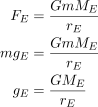
\begin{aligned} F_{E} & = \frac{GmM_{E}}{r_{E}} \\ mg_{E} & = \frac{GmM_{E}}{r_{E}} \\ g_{E} & = \frac{GM_{E}}{r_{E}} \\ \end{aligned}

Similarly, for some object of mass m on Neptune, we have

\begin{aligned} F_{N} & = \frac{GmM_{N}}{r_{N}} \\ mg_{N} & = \frac{GmM_{N}}{r_{N}} \\ g_{N} & = \frac{GM_{N}}{r_{N}} \\ \end{aligned}

We compare g_{N} to g_{E} by the assumption:

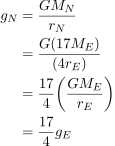
\begin{aligned} g_{N} & = \frac{GM_{N}}{r_{N}} \\ & = \frac{G(17M_E)}{(4r_{E})} \\ & = \frac{17}{4}\bigg(\frac{GM_{E}}{r_{E}}\bigg) \\ & = \frac{17}{4}g_{E} \\ \end{aligned}

And the answer is D.

202111241152 Solution to 1971-CE-AMATH-3

Prove by mathematical induction that n(n^2+2) is divisible by 3 for all positive integral values of n.


Solution.

Let P(n) be the statement that

P(n):\enspace n(n^2+2)\textrm{ is divisible by }3\textrm{ for }n\in\mathbb{Z}^{+}

First, we wish to show P(1) holds true.

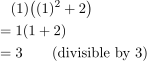
\begin{aligned} &\quad (1)\big( (1)^2 + 2\big) \\ & = 1(1+2) \\ & = 3\qquad (\textrm{divisible by }3)\\ \end{aligned}

\therefore P(1) is true.

Once we assume that P(n) is true for some positive integral values, we wish to show P(n+1) is true.

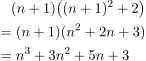
\begin{aligned} &\quad (n+1)\big( (n+1)^2 + 2\big) \\ & = (n+1)(n^2+2n+3) \\ & = n^3 + 3n^2 + 5n +3 \\ \end{aligned}

Let f(x)=x^3+3x^2+5x+3.

Suppose we can divide f(x) by 3, i.e.,

f(x)=3\cdot g(x)

for some g(x)=Ax^3+Bx^2+Cx+D where A,B,C,D\in\mathbb{R}.

Then, let’s see

\begin{aligned} \frac{f(x)}{g(x)} & = 3 \\ \frac{\mathrm{d}}{\mathrm{d}x}\bigg( \frac{f(x)}{g(x)}\bigg) & = \frac{\mathrm{d}}{\mathrm{d}x}(3) \\ \frac{g(x)f'(x)-f(x)g'(x)}{[g(x)]^2} & = 0 \\ g(x)f'(x)-f(x)g'(x) & = 0 \\ \end{aligned}

Plugging in f(x), f'(x), g(x), and g'(x), we have

\begin{aligned} &\quad (Ax^3+Bx^2+Cx+D)(3x^2+6x+5) \\ & = (x^3+3x^2+5x+3)(3Ax^2+2Bx+C) \\ \end{aligned}

\begin{aligned} &\quad \enspace \textrm{LHS} \\ & = (3A)x^5 + (6A+3B)x^4 + (5A+6B+3C)x^3 \\ &\qquad\quad + (5B+6C+3D)x^2 + (5C+6D)x + (5D) \\ \end{aligned}

\begin{aligned} &\quad \enspace \textrm{RHS} \\ & = (3A)x^5 + (9A+2B)x^4 + (15A+6B+C)x^3 \\ &\qquad\quad + (9A+10B+3C)x^2 + (6B+5C)x + (3C) \\ \end{aligned}

We have a set of five equations below:

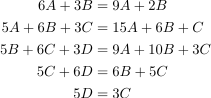
\begin{aligned} 6A + 3B & = 9A + 2B \\ 5A+6B+3C & = 15A+6B+C \\ 5B+6C+3D & = 9A+10B+3C \\ 5C +6D & = 6B+5C \\ 5D & = 3C \\ \end{aligned}

which can be summarized to

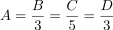
\displaystyle{A=\frac{B}{3}=\frac{C}{5}=\frac{D}{3}},

that is equivalent to saying

g(x)=\displaystyle{\frac{f(x)}{3}=\frac{x^3}{3}+x^2+\frac{5x}{3}+1},

viz. I have been wasting time over a circular reasoning of no use.

I should have tried to attest otherwise that g(x) is of some positive integral values, even though this is \textrm{\scriptsize{NOT}} proving the statement P(n) by mathematical induction firsthand.


Reformulation.

To show that the following statement Q(x) holds true:

Q(x):\quad \displaystyle{\frac{x^3}{3}+x^2+\frac{5x}{3}+1}\textrm{ is an integer for any }x\in\mathbb{Z}^{+}.

Q(1) is true because

\displaystyle{\frac{(1)^3}{3}+(1)^2+\frac{5(1)}{3}+1}=4

is an integer.

Assume Q(x) is true for some x\in\mathbb{Z}^{+}.

Then,

\begin{aligned} &\qquad \frac{(x+1)^3}{3}+(x+1)^2+\frac{5(x+1)}{3}+1 \\ & = \frac{(x^3+3x^2+3x+1)}{3} + (x^2+2x+1)+\frac{(5x+5)}{3} + 1 \\ & = \bigg( \frac{x^3}{3}+x^2+\frac{5x}{3}+1\bigg) + \bigg( \frac{3x^2+3x+1}{3}+2x+1+\frac{5}{3}+1 \bigg) \\ \end{aligned}

The first term is an integer for Q(x) is assumed to be true. We then need to check whether the second term is of integral value(s).

The second term, after simplification, is

x^2+3x+4,

obviously an integer.

\therefore Q(x+1) thus holds.

Because Q(1) is true, by mathematical induction, Q(x) is true for all positive integers x.


Escape to the original statement.

3|n^3+3n^2+5n+3\Longleftrightarrow P(n+1)\textrm{ holds true.}

Because P(1) is true, by mathematical induction, P(n) is true for any positive integers n.

202111241104 Solution to 1969-CE-AMATH-3

Prove by mathematical induction that if n is a positive integer, f(n)\equiv 3^{2n}-1 is divisible by 8.


Solution.

We wish to show that the statement is true for n=1, and also true for n+1.

When n=1, f(1)=3^{2(1)}-1=8 is divisible by 8.

Assume f(n) is true for some positive integer n, i.e.,

\{f(n):3^{2n}-1=8m\, |\, \exists \, m, n\in\mathbb{Z}^{+}\}.

For f(n+1)=3^{2(n+1)}-1, we have

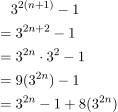
\begin{aligned} & \quad 3^{2(n+1)}-1 \\ & = 3^{2n+2} - 1 \\ & = 3^{2n}\cdot 3^2 - 1 \\ & = 9(3^{2n})-1 \\ & = 3^{2n} -1 + 8(3^{2n}) \\ \end{aligned}

As is assumed 3^{2n}-1 divisible by 8, the statement is thus also true for n+1.

We have proven by mathematical induction that for any positive integer n\enspace (\in\mathbb{Z}^+), f(n) is divisible by 8.


Afterword.

Try to prove \textrm{\scriptsize{NOT}} by mathematical induction \textrm{\scriptsize{BUT}} by direct proof.

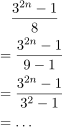
\begin{aligned} &\quad \frac{3^{2n}-1}{8} \\ & = \frac{3^{2n}-1}{9-1} \\ & = \frac{3^{2n}-1}{3^2-1} \\ & = \dots \end{aligned}

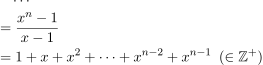
Let x=3^2, then

\begin{aligned} &\quad \dots \\ & = \frac{x^n-1}{x-1} \\ & = 1+x+x^2+\cdots + x^{n-2} + x^{n-1} \enspace (\in\mathbb{Z}^{+}) \\ \end{aligned}

\therefore f(n)\equiv 3^{2n}-1 is divisible by 8.