202204021539 Example 3, Chapter 1.3, Methods in Physics II (2015-2016 Lectures)

If \mathbf{f}(t)=t\,\hat{\mathbf{i}}+t^3\,\hat{\mathbf{j}}, \mathbf{g}(t)=\cos t\,\hat{\mathbf{i}}+\sin t\,\hat{\mathbf{j}}, and \mathbf{v}=2\,\hat{\mathbf{i}}-3\,\hat{\mathbf{j}}. Calculate

(a) (\mathbf{f}+\mathbf{g})';

(b) (\mathbf{v}\cdot\mathbf{f})';

(c) (\mathbf{f}\cdot\mathbf{g})'.


Settings. (Some properties of vector differentiation)

i. If \mathbf{f} and \mathbf{g} are differentiable vector functions,

\displaystyle{\frac{\mathrm{d}}{\mathrm{d}t}(\mathbf{f}+\mathbf{g})=\frac{\mathrm{d}\mathbf{f}}{\mathrm{d}t}+\frac{\mathrm{d}\mathbf{g}}{\mathrm{d}t}}

ii. If \mathbf{f} is a differentiable vector function and \alpha a constant scalar,

\displaystyle{\frac{\mathrm{d}}{\mathrm{d}t}(\alpha\mathbf{f})=\alpha\frac{\mathrm{d}\mathbf{f}}{\mathrm{d}t}}

iii. If \mathbf{f}(t) is a vector function, \mathbf{v} a constant vector, and \mathbf{v}\cdot\mathbf{f} differentiable,

\displaystyle{\frac{\mathrm{d}}{\mathrm{d}t}(\mathbf{v}\cdot\mathbf{f})=\mathbf{v}\cdot\frac{\mathrm{d}\mathbf{f}}{\mathrm{d}t}}

iv. If h(t) is a scalar function, \mathbf{f}(t) a vector function and h\mathbf{f} differentiable,

\displaystyle{\frac{\mathrm{d}}{\mathrm{d}t}(h\mathbf{f})=h\frac{\mathrm{d}\mathbf{f}}{\mathrm{d}t}+\mathbf{f}\frac{\mathrm{d}h}{\mathrm{d}t}}

v. If \mathbf{f} and \mathbf{g} are vector functions and \mathbf{f}\cdot\mathbf{g} differentiable,

\displaystyle{\frac{\mathrm{d}}{\mathrm{d}t}(\mathbf{f}\cdot\mathbf{g})=\mathbf{f}\cdot\frac{\mathrm{d}\mathbf{g}}{\mathrm{d}t}+\mathbf{g}\cdot\frac{\mathrm{d}\mathbf{f}}{\mathrm{d}t}}

vi. If \mathbf{f} and \mathbf{g} are vector functions and \mathbf{f}\times\mathbf{g} differentiable,

\displaystyle{\frac{\mathrm{d}}{\mathrm{d}t}}(\mathbf{f}\times\mathbf{g})=\displaystyle{\bigg( \frac{\mathrm{d}\mathbf{f}}{\mathrm{d}t}\times\mathbf{g}\bigg) + \bigg( \mathbf{f}\times \frac{\mathrm{d}\mathbf{g}}{\mathrm{d}t}\bigg)}.


Solution.

(a)

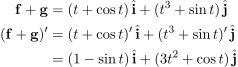
\begin{aligned} \mathbf{f}+\mathbf{g} & = (t+\cos t)\,\hat{\mathbf{i}}+(t^3+\sin t)\,\hat{\mathbf{j}} \\ (\mathbf{f}+\mathbf{g})' & = (t+\cos t)'\,\hat{\mathbf{i}}+(t^3+\sin t)'\,\hat{\mathbf{j}} \\ & = (1-\sin t)\,\hat{\mathbf{i}}+(3t^2+\cos t)\,\hat{\mathbf{j}} \\ \end{aligned}

(b)

\begin{aligned} \mathbf{v}\cdot\mathbf{f} & = (2,-3)\cdot (t,t^3) \\ & = 2t-3t^3 \\ (\mathbf{v}\cdot\mathbf{f})' & = (2t-3t^3)' \\ & = 2-9t^2 \\ \end{aligned}

(c)

\begin{aligned} \mathbf{f}\cdot\mathbf{g} & = (t,t^3) \cdot (\cos t,\sin t) \\ & = t\cos t+t^3\sin t \\ (\mathbf{f}\cdot\mathbf{g})' & = \cos t-t\sin t+t^3\cos t + 3t^2\sin t\\ \end{aligned}

202201260719 Problem 1.57

Let A=\{ x:x^2-3x+2=0\}, B=\{ x:x^2\le 16\}. Determine whether or not A\subset B.

Extracted from M. R. Spiegel. (1969). Schaum’s Outline of Theory and Problems of Real Variables


Set A and set B are described according to property method; if described by the roster method:

\begin{aligned} A & =\{ 1,2\} \\ B & = \{ -4,-3,-2,-1,0,1,2,3,4\} \\ \end{aligned}

Obviously set A is a subset of set B.


Roughwork.

(set A)

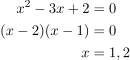
\begin{aligned} x^2-3x+2 & = 0 \\ (x-2)(x-1) & = 0 \\ x & = 1,2 \\ \end{aligned}

(set B)

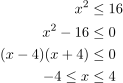
\begin{aligned} x^2 & \le 16 \\ x^2 - 16 & \le 0 \\ (x-4)(x+4) & \le 0 \\ -4\le x & \le 4 \\ \end{aligned}

202201251933 Circumference 001

Draw a circle of radius R around the center (R,0).

As the center of a circle is equidistant from all points on the circumference, using Pythagorean theorem, we have

\begin{aligned} (x-R)^2+(y-0)^2 & = R^2 \\ y^2 & = R^2 - (x-R)^2 \\ y & = \pm\sqrt{2xR-x^2} \\ |y| & = \sqrt{2xR-x^2}\\ \end{aligned}


Attempts. (reinventing the wheel)

Considering the differentials \mathrm{d}x and \mathrm{d}y, we have

\mathrm{d}y =\displaystyle{\frac{R-x}{\sqrt{2xR-x^2}}\,\mathrm{d}x}

Suppose I do not know the circumference is 2\pi R long. Let its unknown length be s, and let it be partitioned into infinitesimal \mathrm{d}s, such that

s=\displaystyle{\int\mathrm{d}s}

Assume we may write

(\mathrm{d}s)^2=(\mathrm{d}x)^2+(\mathrm{d}y)^2.

Expand the right hand side as follows

\begin{aligned} &\quad \textrm{RHS} \\ & = (\mathrm{d}x)^2+(\mathrm{d}y)^2 \\ & = (\mathrm{d}x)^2 + \bigg( \frac{R-x}{\sqrt{2xR-x^2}}\,\mathrm{d}x\bigg)^2 \\ & = \bigg(\frac{R^2}{2xR-x^2}\bigg)(\mathrm{d}x)^2 \\ \end{aligned}

Then

\begin{aligned} \mathrm{d}s & = \sqrt{\bigg( \frac{R^2}{2xR-x^2}\bigg)(\mathrm{d}x)^2} \\ s = \int\mathrm{d}s & = \int_{x=0}^{2R} \frac{R}{\sqrt{2xR-x^2}}\,\mathrm{d}x \\ \end{aligned}

Suppose I evaluate the integral above \textrm{\scriptsize{NOT}} by direct substitution \textrm{\scriptsize{BUT}} by Riemann sum, so the definite integral due to Riemann is given by

\displaystyle{\int_{a}^{b}f(x)\,\mathrm{d}x}=\lim_{n\to\infty}\sum_{i=1}^{n}f(x_{i}^{*})\, x.

For i=0,1,2,\dots ,n, let P=\{ x_i\} be a regular partition of [0,2R]. Then

x=\displaystyle{\frac{b-a}{n}=\frac{2R}{n}}.

By right-endpoint approximation for Riemann sums, for each interval [x_{i-1},x_i], we have

\displaystyle{x_i=x_0+ix=0+i\bigg[\frac{2R}{n}\bigg]=\frac{2Ri}{n}}.

Let f(x)\stackrel{\textrm{def}}{=}\displaystyle{\frac{R}{\sqrt{2xR-x^2}}}. Thus,

\begin{aligned} f(x_i) & = \frac{R}{\sqrt{(2)\displaystyle{\bigg(\frac{2Ri}{n}\bigg)}(R)-\displaystyle{\bigg(\frac{2Ri}{n}\bigg)^2}}} \\ & = \dots \\ & = \frac{n}{2\sqrt{in-i^2}} \\ \end{aligned}

Writing the Riemann sum in the form

\begin{aligned} \sum_{i=1}^{n}f(x_i)\, x & = \sum_{i=1}^{n}\frac{n}{2\sqrt{in-i^2}}\bigg(\frac{2Ri}{n}\bigg) \\ & = R\cdot \sum_{i=1}^{n}\frac{1}{\sqrt{\frac{n}{i}-1}} \\ & = R\cdot g(n) \\ \end{aligned}

Inspecting R\cdot g(n) where

g(n) = \displaystyle{ \sum_{i=1}^{n}\frac{1}{\sqrt{\frac{n}{i}-1}}}

I guess, under correction, that g(n)=2\pi.

(to be continued)


Solution. (arc-length parametrization)

Referring to the equation of locus on the very first line:

(x-R)^2+(y-0)^2=R^2,

then parameterizing x(\theta ), y(\theta ) by \theta,

\begin{aligned} x & = R+R\cos\theta \\ y & = R\sin\theta \\ \end{aligned}

and computing the derivatives wrt \theta:

\begin{aligned} \frac{\mathrm{d}x}{\mathrm{d}\theta} & = -R\sin\theta \\ \frac{\mathrm{d}y}{\mathrm{d}\theta} & = R\cos\theta \\ \end{aligned}

Note that

\displaystyle{s=\int\mathrm{d}s}

where

\mathrm{d}s=\sqrt{\displaystyle{\bigg(\frac{\mathrm{d}x}{\mathrm{d}\theta}\bigg)^2+\bigg(\frac{\mathrm{d}y}{\mathrm{d}\theta}\bigg)^2}}\,\mathrm{d}\theta.

Then,

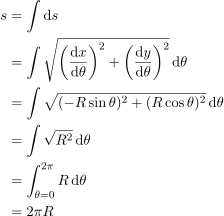
\begin{aligned} s & = \int \mathrm{d}s \\ & = \int \sqrt{\bigg( \frac{\mathrm{d}x}{\mathrm{d}\theta}\bigg)^2+\bigg( \frac{\mathrm{d}y}{\mathrm{d}\theta}\bigg)^2}\,\mathrm{d}\theta \\ & = \int \sqrt{(-R\sin\theta )^2+(R\cos\theta )^2}\,\mathrm{d}\theta \\ & = \int \sqrt{R^2}\,\mathrm{d}\theta \\ & = \int_{\theta =0}^{2\pi} R\,\mathrm{d}\theta \\ & = 2\pi R \\ \end{aligned}


(to be continued)

202201211321 Problem 1.1

Two particles move along the x-axis uniformly with speeds v_1=8\,\mathrm{m/s} and v_2=4\,\mathrm{m/s}. At the initial moment the first point was 21\,\mathrm{m} to the left of the origin and the second 7\,\mathrm{m} to the right of the origin. When will the first point catch up with the second? Where will this take place? Plot the graph of the motion.

Extracted from A. A. Pinsky. (1980). Problems in Physics.


Set-up.

Rename the two particles by a and b. The velocity of particle a is \mathbf{v}_a=+8\,\mathrm{(m\, s^{-1})}\enspace\hat{\mathbf{i}} and that of particle b is \mathbf{v}_b=+4\,\mathrm{(m\, s^{-1})}\enspace\hat{\mathbf{i}}. The particles at time t=0 are located on the x-axis with x-coordinates x_a=-21 and x_b=+7 respectively.


Roughwork.

When t=0:

when t=1:

when t=2:

when t=3:

when t=4:

when t=5:

when t=6:

when t=7:


Solution.

The positions x_a(t), x_b(t) of particle a, b can be expressed in a function of discrete time interval

t=\{ t_i\in\mathbb{Z^{+}}\textrm{ s.t. } t_{i+1}-t_{i}=t_{i}-t_{i-1}=1\},

i.e.,

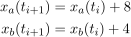
\begin{aligned} x_a(t_{i+1}) & =x_a(t_{i})+8 \\ x_b(t_{i+1}) & =x_b(t_{i})+4 \\ \end{aligned}

or simply, in continuous time intervals,

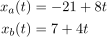
\begin{aligned} x_a(t) & =-21+8t \\ x_b(t) & = 7+4t \\ \end{aligned}

Particle a will meet particle b when x_a(t)=x_b(t) at some time t', as

\begin{aligned} x_a(t') & = x_b(t') \\ -21+8t' & = 7+4t' \\ 4t' & = 28 \\ t' & = 7 \\ \end{aligned}

so the place of meeting is

x_a(7)=-21+8(7)=\boxed{35}=7+4(7)=x_b(7).

202112100933 Kinematics graphs (Elementary) Q2

This post is depreciated as it is misleading the reader about the speed of train.

The number 038 should be the “mission order” of the train which indicates to stationed staff of its running railway, service time, and need of assistance if any (MTR Academy, 2017).


An MTR train enters the station at a speed of 38 kilometres an hour, i.e., 38\,\mathrm{km/h}.

Retrieved image from http://mtr.hk365day.com/

If the subway is 100\,\mathrm{m} long and the train terminates at the stop with constant deceleration, i.e., \mathbf{a}=-a\,\hat{\mathbf{i}}\quad (a=\textrm{Const.}>0),

Modified figures retrieved from https://www.shutterstock.com/

what is the time required for the train to come to a full stop?


Background. (Equations of linear motion in uniform acceleration)

\begin{cases} \enspace & v = u + at \\ \enspace & s = \displaystyle{\frac{(u+v)}{2}t} \\ \enspace & s = \displaystyle{ut+\frac{1}{2}at^2} \\ \enspace & v^2 = u^2 + 2as \\ \end{cases}


Solution.

Take the rightward to be positive direction.

Provided that the initial velocity \mathbf{u} is

\begin{aligned} \mathbf{u} & =+38\,(\mathrm{km\, h^{-1}})\,\hat{\mathbf{i}} \\ & = +38\times\frac{1000}{60\times 60}\,(\mathrm{m\, s^{-1}})\,\hat{\mathbf{i}} \\ & = +10.5556\,(\mathrm{m\, s^{-1}})\,\hat{\mathbf{i}}\quad (4\,\mathrm{d.p.}) \\ \end{aligned}

the final velocity \mathbf{v} is

\mathbf{0}, or simply put, 0;

and the displacement \mathbf{s} for the duration is

\begin{aligned} \mathbf{s} & =s\,\hat{\mathbf{i}} \\ & =+100\,\hat{\mathbf{i}}\\ \end{aligned},

so, out of five variables:

a, s, t, u, and v,

we already know three exactly:

\mathbf{s} (of magnitude s);
\mathbf{u} (of magnitude u);
\mathbf{v} (of magnitude v).

If the first step were to solve for only one unknown in the equations of motion i iv below,

i. v=u+at is \textrm{\scriptsize{NOT}} solvable for there are two unknowns a and t;

ii. s=\frac{(u+v)}{2}t solvable for there is \textrm{\scriptsize{ONLY}} one unknown t;

iii. s=ut+\frac{1}{2}at^2 \textrm{\scriptsize{NOT}} solvable for there are two unknowns a and t;

iv. v^2=u^2+2as solvable for there is \textrm{\scriptsize{ONLY}} one unknown a.

thus, we should pick equation ii. to calculate the unknown t.

That said, solving for time t,

\begin{aligned} s & = \frac{(u+v)}{2}t \\ 100 & = \frac{(10.5556+0)}{2}t \\ t & = 18.9\,\mathrm{s}\quad \textrm{(3 s.f.)} \\ \end{aligned}


Afterword.

\dagger If you wish to know about the rate of deceleration -a, you can use equation iv., yet this is left the reader.

\ddagger The time t might seem longer than expected, because normally the deceleration of train is non-constant.

202112041209 Homework 1 (Q5)

Suppose that light of intensity 10^{-9}\,\mathrm{W/m^2} normally shines on a metal surface. The metal is made up of a simple cubic lattice of atoms with lattice spacing 0.3\,\mathrm{nm}. Each atom has one free electron. The binding energy at the metal surface is 8\,\mathrm{eV}. Suppose further that the light is uniformly distributed over the surface and all its energy is absorbed by the surface electrons.

(a) If the incident radiation were well described by classical physics, how long would one have to wait after switching on the light source until an electron gains enough energy to be released as a photoelectron?

(b) In reality, how long is this time duration? Explain briefly.


Reading Comprehension.

Highlighting some keyword(s) will help doing the question:

(S1) [] light […] normally shines on a […] surface […] ;

(S2) […] metal is made up of a simple cubic lattice of atoms […] ;

(S3) […] Each atom has one free electron […] .


Solution.

(The solution below is based on the manuscript of 2015-2016 PHYS2265 Modern Physics Homework 1 Solution.)

(a)

There are eight atoms each lattice and one electron each atom. Hence,

\begin{aligned} t & = \frac{8 \times (1.602\times 10^{-19})}{10^{-9} \times (0.3\times 10^{-9})^2} \\ & = 1.424\times 10^{10}\,\mathrm{s} \\ \end{aligned}

(b)

No electron can be released as a photoelectron, for no photon has energy greater than 8\,\mathrm{eV}. (Why?)

202112031054 Kinematics graphs (Elementary) Q1

The graph below illustrates three paths in Red (R), Green (G), and Blue (B).

For a person walking along paths R, G, and B at a constant speed 2\,\mathrm{m\, s^{-1}}, find, in each path,

(a) the distance travelled;
(b) the time needed from start to finish; and
(c) the displacement and velocity on the journey.


Solution.

(a)

Along path R, the walking distance d is

\begin{aligned} \textrm{Distance }d & = \bigg(\frac{1}{2}\bigg) \big(\pi (90-50)\big) + \bigg(\frac{1}{2}\bigg) \big( \pi (50-30)\big) \\ & = \bigg(\frac{1}{2}\bigg) (40\pi ) + \bigg(\frac{1}{2}\bigg) (20\pi ) \\ & = 20\pi + 10\pi \\ & = 30\pi\,\mathrm{m} \\ \end{aligned}

Along path G, the walking distance d is

\begin{aligned} \textrm{Distance }d & = \sqrt{(30-0)^2+(60-20)^2} + \sqrt{(30-0)^2+(100-60)^2} \\ & = \sqrt{900+1600} + \sqrt{900+1600} \\ & = \sqrt{2500} + \sqrt{2500} \\ & = 50+50 \\ & = 100\,\mathrm{m} \end{aligned}

Along path B, the walking distance d is

\begin{aligned} \textrm{Distance }d & = (20-0) + (20-0) + (50-20) + (50-20) \\ & \qquad\quad + (100-50) + (100-50) \\ & = 20+20+30+30+50+50 \\ & = 200\,\mathrm{m} \\ \end{aligned}

(b)

Along path R, the time t needed is

\begin{aligned} \textrm{Time }t & = \frac{30\pi\,\mathrm{m}}{2\,\mathrm{m\, s^{-1}}} \\ & = 47.1\,\mathrm{s}\\ \end{aligned}

Along path G, the time t needed is

\begin{aligned} \textrm{Time }t & = \frac{100\,\mathrm{m}}{2\,\mathrm{m\, s^{-1}}} \\ & = 50\,\mathrm{s}\\ \end{aligned}

Along path B, the time t needed is

\begin{aligned} \textrm{Time }t & = \frac{200\,\mathrm{m}}{2\,\mathrm{m\, s^{-1}}} \\ & = 100\,\mathrm{s}\\ \end{aligned}

(c)

Read the following graph, and you shall see each and every displacement in dashed lines.

For path R, the displacement \mathbf{s} travelled is

\begin{aligned} \textrm{Displacement }\mathbf{s} & = - s\,\hat{\mathbf{i}} \\ & = - (90-30)\,\hat{\mathbf{i}} \\ & = - 60\,\mathrm{m}\,\hat{\mathbf{i}} \\ \end{aligned}

and the velocity \mathbf{v} is

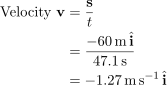
\begin{aligned} \textrm{Velocity }\mathbf{v} & = \frac{\mathbf{s}}{t} \\ & = \frac{- 60\,\mathrm{m}\,\hat{\mathbf{i}}}{47.1\,\mathrm{s}} \\ & = -1.27\,\mathrm{m\, s^{-1}}\,\hat{\mathbf{i}} \\ \end{aligned}

For path G, the displacement \mathbf{s} travelled is

\begin{aligned} \textrm{Displacement }\mathbf{s} & = s\,\hat{\mathbf{j}} \\ & = (100-20)\,\hat{\mathbf{j}} \\ & = 80\,\mathrm{m}\,\hat{\mathbf{j}} \\ \end{aligned}

and the velocity \mathbf{v} is

\begin{aligned} \textrm{Velocity }\mathbf{v} & = \frac{\mathbf{s}}{t} \\ & = \frac{80\,\mathrm{m}\,\hat{\mathbf{j}}}{50\,\mathrm{s}} \\ & = +1.6\,\mathrm{m\, s^{-1}}\,\hat{\mathbf{j}} \\ \end{aligned}

For path B, the displacement \mathbf{s} travelled is

\begin{aligned} \textrm{Displacement }\mathbf{s} & = 100\,\mathrm{m}\,\hat{\mathbf{i}} + 100\,\mathrm{m}\,\hat{\mathbf{j}} \\ \end{aligned}

or, the magnitude s of displacement \mathbf{s} is

\begin{aligned} s & = \sqrt{(100)^2+(100)^2} \\ & = 100\sqrt{2}\,\mathrm{m} \\ \end{aligned}

such that

\mathbf{s} = s\cos 45^\circ\,\hat{\mathbf{i}} + s\sin 45^\circ\,\hat{\mathbf{j}}

the velocity \mathbf{v} is

\begin{aligned} \textrm{Velocity }\mathbf{v} & = \frac{\mathbf{s}}{t} \\ & = \frac{100\,\mathrm{m}\,\hat{\mathbf{i}} + 100\,\mathrm{m}\,\hat{\mathbf{j}}}{100\,\mathrm{s}} \\ & = +1\,\mathrm{m\, s^{-1}}\,\hat{\mathbf{i}} + 1\,\mathrm{m\, s^{-1}}\,\hat{\mathbf{j}}\\ \end{aligned}