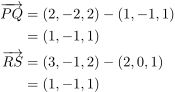
Given that the binomial coefficient is so defined as
 .
.
Prove the identities (3.49), (3.50), and (3.51) in Section 3.8.2 Useful Identities for the Binomial Coefficients. Namely,
Eq. (3.49):

Eq. (3.50):

Eq. (3.51):

R. H. Swendsen. (2012). An Introduction to Statistical Mechanics and Thermodynamics
Proof of Eq. (3.49).


Proof of Eq. (3.50).

Proof of Eq. (3.51).

QED
 inside the paraboloid
  for
for  .
. where the mapping
  ,
,  ,
,  maps the solid
  in
in  -space onto the solid
  in
in  -space in a one-to-one manner.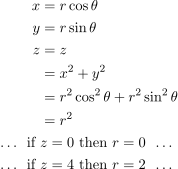

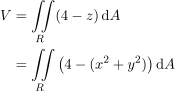
 is the disc in
  . In polar coordinates
  we know that
  and that
  .
.![\begin{aligned} V & = \int_{0}^{2\pi}\int_{0}^{2} (4-r^2)\, r\,\mathrm{d}r\,\mathrm{d}\theta \\ & = \int_{0}^{2\pi}\int_{0}^{2} (4r-r^3)\,\mathrm{d}r\,\mathrm{d}\theta \\ & = \int_{0}^{2\pi} \bigg[ 2r^2-\frac{r^4}{4}\bigg]\bigg|_{0}^{2}\,\mathrm{d}\theta \\ & = 4\int_{0}^{2\pi} \mathrm{d}\theta \\ & = 4(2\pi )\\ & = 8\pi\quad \textrm{(cubic units)} \end{aligned}](https://physicspupil.com/wp-content/ql-cache/quicklatex.com-a70165187c9359906eb264d8ceb14cba_l3.svg "Rendered by QuickLaTeX.com")
 be a constant. Show that
 .
.![\begin{aligned} & \qquad \int_{z_1}^{z_2}\int_{y_1}^{y_2}\int_{x_1}^{x_2}M\,\mathrm{d}x\,\mathrm{d}y\,\mathrm{d}z \\ & = M\int_{z_1}^{z_2}\int_{y_1}^{y_2}\big[ x\big]\big|_{x_1}^{x_2} \,\mathrm{d}y\,\mathrm{d}z \\ & = M(x_2-x_1)\int_{z_1}^{z_2}\int_{y_1}^{y_2} \,\mathrm{d}y\,\mathrm{d}z \\ & = M(x_2-x_1)\int_{z_1}^{z_2}\big[ y\big] \big|_{y_1}^{y_2}\,\mathrm{d}z \\ & = M(y_2-y_1)(x_2-x_1)\int_{z_1}^{z_2}\,\mathrm{d}z \\ & = M(y_2-y_1)(x_2-x_1)\big[ z\big] \big|_{z_1}^{z_2} \\ & = M(z_2-z_1)(y_2-y_1)(x_2-x_1) \\ \end{aligned}](https://physicspupil.com/wp-content/ql-cache/quicklatex.com-15a31f4bcf7f39b3312471e1403c5a08_l3.svg "Rendered by QuickLaTeX.com")

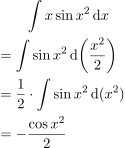
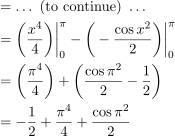
![\begin{aligned} &\qquad \int_{0}^{\pi}\int_{0}^{x}\int_{0}^{xy}x^2\sin z\,\mathrm{d}z\,\mathrm{d}y\,\mathrm{d}x \\ & = \int_{0}^{\pi}\int_{0}^{x}\big( -x^2\cos z\big)\big|_{z=0}^{z=xy}\,\mathrm{d}y\,\mathrm{d}x \\ & = \int_{0}^{\pi}\int_{0}^{x}(-x^2)(\cos xy-1)\,\mathrm{d}y\,\mathrm{d}x \\ & = \int_{0}^{\pi} (-x^2)\bigg(\frac{\sin xy}{x}-y\bigg)\bigg|_{y=0}^{y=x}\,\mathrm{d}x \\ & = \int_{0}^{\pi} (-x^2)\bigg( \frac{\sin x^2}{x}-x \bigg)\,\mathrm{d}x \\ & = \int_{0}^{\pi} (x^3 - x\sin x^2)\,\mathrm{d}x \\ & = \int_{0}^{\pi}x^3\,\mathrm{d}x - \int_{0}^{\pi} x\sin x^2\,\mathrm{d}x \\ & = \bigg( \frac{x^4}{4} \bigg)\bigg|_{0}^{\pi} - \bigg[ \cdots \bigg] \\ & = \enspace \dots \textrm{ (to be continued) }\dots \end{aligned}](https://physicspupil.com/wp-content/ql-cache/quicklatex.com-705c529a32c98933b62b3916d36478e2_l3.svg "Rendered by QuickLaTeX.com")
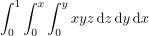
![\begin{aligned} &\qquad \int_{0}^{1}\int_{0}^{x}\int_{0}^{y}xyz\,\mathrm{d}z\,\mathrm{d}y\,\mathrm{d}x \\ & = \int_{0}^{1}\int_{0}^{x} \bigg( \frac{xyz^2}{2}\bigg|_{z=0}^{z=y} \bigg)\,\mathrm{d}y\,\mathrm{d}x \\ & = \int_{0}^{1}\int_{0}^{x} \frac{xy^3}{2}\,\mathrm{d}y\,\mathrm{d}x \\ & = \int_{0}^{1} \bigg( \frac{xy^4}{8}\bigg|_{y=0}^{y=x} \bigg) \,\mathrm{d}x \\ & = \int_{0}^{1} \frac{x^5}{8}\,\mathrm{d}x \\ & = \bigg[ \frac{x^6}{48} \bigg]_{0}^{1} \\ & = \frac{1}{48} \\ \end{aligned}](https://physicspupil.com/wp-content/ql-cache/quicklatex.com-494694de5af1769156ad6675597d4f03_l3.svg "Rendered by QuickLaTeX.com")
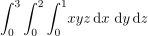
![\begin{aligned} & \qquad \int_{0}^{3}\int_{0}^{2}\int_{0}^{1}xyz\,\mathrm{d}x\,\mathrm{d}y\,\mathrm{d}z \\ & = \int_{0}^{3}\int_{0}^{2} \bigg(\frac{x^2yz}{2}\bigg|_{x=0}^{x=1}\bigg)\,\mathrm{d}y\,\mathrm{d}z \\ & = \int_{0}^{3}\int_{0}^{2}\bigg(\frac{yz}{2}\bigg)\,\mathrm{d}y\,\mathrm{d}z \\ & = \int_{0}^{3}\bigg( \frac{y^2z}{4}\bigg|_{y=0}^{y=2} \bigg) \,\mathrm{d}z \\ & = \int_{0}^{3} z\,\mathrm{d}z \\ & = \bigg[\frac{z^2}{2}\bigg]_{0}^{3} \\ & = 4\frac{1}{2} \\ \end{aligned}](https://physicspupil.com/wp-content/ql-cache/quicklatex.com-73a9a99dffed3134dd8c75fb87dea5aa_l3.svg "Rendered by QuickLaTeX.com")
 ,
,  ,
,  ,
,  , does
  ?
?