(A001) Scalar ().A quantity with magnitude only. Read More
The seven fundamental physical quantities in SI base units are length in metre , mass in kilogram , time in second , temperature in Kelvin , electric current in Ampere , amount of substance in mole , and light intensity in candela , of dimensions , , , , , , and .
(A002) Vector (, ).A quantity with magnitude (size) and direction. Read More
Say, i. position vector of magnitude ; ii. displacement (change in position) ; iii. average velocity during time interval ; iv. instantaneous velocity of magnitude the speed; v. average acceleration ; and vi. instantaneous acceleration .
(A003) Distance.How far something travels, a scalar. Read More
Path-dependent. Its SI unit is metre , in dimension of length .
(A004) Displacement (, ).How far something travels in a given direction, a vector. Read More
As a vector, its magnitude being a scalar. Path-independent. Its SI unit is metre, , in dimension of length .
(A005) Speed.How fast something is moving, a scalar. Read More
. Its SI unit is , in dimensions .
(A006) Velocity (, ).How fast something is moving in a given direction, a vector. Read More
Velocity is the change of displacement with respect to time rate of change of displacement rate of change of distance moved in a given direction, a vector denoted by . Its unit being , in dimensions , and its magnitude a scalar.
(A007) Acceleration (, ).The rate at which the velocity changes during a given amount of time, a vector denoted by . Read More
Its unit being in dimensions and its magnitude a scalar,
(A008) Free Fall.The movement of an object in response to a gravitational attraction.
(A009) Projectile.An object that moves through space acted upon only by the Earth’s gravity.
(A010) Rectilinear Motion. ( straight-line, one-dimensional, axial) Read More
For uniformly accelerated motion, i.e., , the equations of rectilinear motion are
(A011) Curvilinear Motion. ( parabolic, projectile, planar) Read More
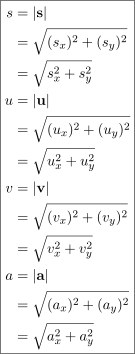
For uniformly accelerated motion, i.e., , the equations of curvilinear motion are
where
such that
(A012) Rotational Motion. ( uniform circular, orbital, planetary)Read More
The equations of circular motion in constant angular acceleration are , , and , herein the variables being angular displacement , angular velocity , and time .
Circular motion examples. Aircraft turning a flight, vehicles rounding bends with or without banking, loop motion, satellite orbits, centrifuge, etc.
(A013) Periodic Motion. ( simple harmonic, pendulum, oscillating)Read More
Periodic motion is motion repeated in equal time interval, period. Oscillation is the back-and-forth motion about a fixed point called the equilibrium position, e.g., simple, compound, or torsion pendulum, spring-mass, and alternating current. If there is no damping force disturbing the body, it oscillates forever at the natural frequency that is characteristic of the system. If a system whose acceleration is in magnitude proportional to displacement , and yet in opposite direction to it, i.e., and , it is said to be in a simple harmonic motion.
Hooke’s law states that the restoring force is proportional to the displacement from its equilibrium position:
(A014) Force ().A push or a pull, vector denoted by . Read More
Its magnitude being a scalar, the unit being Newton , or , in dimensions . E.g., gravitational force, electromagnetic force, frictional force, viscous force, upthrust, etc. The properties of force are implicitly stated in Newton’s Laws of Motion:
Newton’s 1st Law. A body remains at rest, or in motion at a constant speed in a straight line, unless acted upon by a force.
Also called “Law of Inertia” as discovered by Galileo.
Inertia, aka vis insita or innate force of matter, is the reluctance of a body to change its state of rest or motion.
Inertia is quantified by mass.
Newton’s 2nd Law. When a body is acted upon by a force, the time rate of change of its momentum equals the force.
Newton’s 3rd Law. If two bodies exert forces on each other, these forces have the same magnitude but opposite directions.
For every action, there is an equal but opposite reaction.
(A015) Friction ().The force that acts to oppose the motion between two materials moving past each other. Read More
Static (resp. kinetic) friction is given by (resp. ). By definition, friction is dependent on the material properties () of contact surfaces and the normal reaction (), independent of the speed () of motion and the area () of contact.
(A016) Static Friction (). The resistance force that must be overcome to start an object in motion, a vector.Read More
The magnitude being with where is the coefficient of static friction and the normal force. The direction being which that is parallel to surface of contact, and opposes relative motion.
When net force the object will not move. But if net force it will be moved.
(A017) Kinetic Friction ().The resistance force between two surfaces already in motion, a vector.Read More
The magnitude being where is the coefficient of kinetic friction and the normal force. The direction being which that is parallel to the surface of contact, and opposes relative motion.
(A018) Statics.The study of forces in equilibrium, i.e., rotation acceleration.Read More
For static equilibrium, i. the net force acting on the object must be zero, i.e., , , and ; and ii. the net torque acting on the object must be zero .
A couple, torque, or moment of force satisfies ii.i.
(A019) Dynamics. The study of cause and effect of motions, namely, of the agent force (contact) and the field force (non-contact).
(A020) Kinematics. The study of motions proper to the movements, being concerned with displacement , velocity , acceleration and time only, without reference to force or mass .
(A021) Pressure.The force per unit area. Read More
Cf. Archimedes’s principle, Pascal’s principle, Bernoulli’s principle, and Stokes’s law.
(A022) Momentum (, ).A measure of how difficult it is to stop a moving object, aka “quantity of motion” by Newton, a vector.Read More
The product of mass (aka quantity of matter) and velocity.
(A023) Impulse (, , , , ).The product of the force exerted on an object and the time interval during which it acts, or, in essence, the change in momentum. Impulse is a vector.Read More
I.e., . Its unit being or .
(A024) Elastic Collision.A collision in which objects collide and bounce apart with no energy loss.Read More
Momentum kinetic energy are conserved.
;
You might wish to further know of Newton’s law of restitution:
For two bodies impinging directly or obliquely, their relative velocity (wrt to one) after impact is equal to times that before impact in the opposite direction, the constant being the coefficient of restitution ranging from (perfectly inelastic) to (perfectly elastic).
(A025) Inelastic Collision.A collision in which objects collide and some mechanical energy is transformed into thermal energy.Read More
momentum, kinetic energy, is conserved.
Perfectly inelastic collision in addition is such that the colliding objects stick together after they hit each other.
Super inelastic collision as an aside is such that one object explodes into granules gaining kinetic energy by losing potential energy.
Nevertheless, in the absence of external force, energy of a closed system is conserved, as stated by the law of conservation of energy.
(A026) Work ().The product of the component of the force exerted on an object in the direction of displacement and the magnitude of the displacement, a scalar.Read More
(A027) Power ().The rate at which work is done.Read More
Generally, ; for mechanical power, ; and for power in a circuit,
(A028) Energy ().The ability to do work.
(A029) Potential Energy (, , , ).Energy of position, or stored energy. Read More
(A030) Kinetic Energy (, , ).Energy of motion. Read More
(A031) Machine.A device that helps to do work by changing the magnitude or direction of the applied force. E.g., lever, pulley, and incline.
(A032) Efficiency.The ratio of the work output to the work input.
(A033) Period ().The time it takes for one full rotation or revolution of an object, and also the time it takes for a vibrating object to repeat its motion. Read More
(A034) Frequency ().The number of rotations or revolutions per unit time, and also the number of vibrations made per unit time. Read More
(A035) Torque (, ).A measurement of the tendency of a force to produce a rotation about an axis.Read More
Torque is the moment of force, e.g., where is the perpendicular distance of a point, say , from .
(A036) Center of Gravity ().The point on any object that acts like the place at which all the weight is concentrated.
(A037) Moment of Inertia ().The resistance of an object to changes in its rotational motion.
(A038) Angular Momentum ().The measure of how difficult it is to stop a rotating object, a (pseudo-)vector.Read More
Angular momentum is defined the moment of momentum, e.g., , where is the perpendicular distance of a point, say , from .
(A039) Law of Universal Gravitation.Every particle attracts every other particle with a force that is proportional to the mass of the particles and inversely proportional to the square of the distance between them.Read More
I.e., where is the universal gravitational constant.
(A040) Escape Speed.The minimum speed an object must possess in order to escape from the gravitational pull of a body.Read More
(A041) Density ().A measure of how much mass occupies a given space.Read More
(A042) Stress.The force exerted on an area divided by the area.Read More
Its unit is either or .
(A043) Strain.The ratio of change in dimension to original dimension.Read More
It has no unit.
(A044) Temperature.A quantity that you can measure with a thermometer. Read More
Cf. average kinetic energy, .
(A045) Heat ().The transfer of energy between two objects that differ in temperature. Read More
For energy transfer by conduction, the rate is given by
(A046) Specific Heat.A measure of the amount of heat needed to raise the temperature of of a substance by .Read More
(A047) Latent Heat of Fusion.The quantity of heat needed per kilogram to melt a solid (or solidify a liquid) at a constant temperature and atmospheric pressure.Read More
(A048) Latent Heat of Vaporization.The quantity of heat needed per kilogram to vaporize a liquid (or liquidize a gas) at a constant temperature and atmospheric pressure.Read More
(A049) Doppler Effect.A change in the apparent frequency of sound due to the motion of the source () or the observer ().Read More
(A050) Reflection.The bouncing of light. Read More
where is the angular wave number, the frequency, and the phase angle.
(A053) Refraction.The change in direction of light due to a change in speed as it passes from one medium to another. Read More
(A054) Diffraction.The spreading of a wave as it passes around an obstacle or through an opening. Read More
The diffraction grating equation is
.
(A055) Interference.When two waves overlap to produce one new wave. Read More
Cf. constructive (/superposition) as light fringes and increased intensity of sound; destructive (/neutralization) as dark fringes and silence.
Fringe separation in double-slit interference is given by
.
(A056) Electrostatics.The study of electric charges at rest, electric forces in equilibrium, and electric field under invariance.
(A057) Coulomb’s Law.Two charged objects attract each other with a force that is proportional to the charge on the objects and inversely proportional to the square of the distance between them. Read More
(A058) Electric Field.An area of influence around a charged object. The magnitude of the field is proportional to the amount of electrical force exerted on a positive test charge placed at a given point in the field.Read More
Electric field strength due to a point charge:
Electric field between parallel plates:
(A059) Potential Difference.The work done to move a test charge (resp. mass) from one location to another, denoted by (resp. ).
(A060) Current ().The amount of charge that passes through an area in a given amount of time.Read More
Current flows from point to point iff .
(A061) Resistance ().An opposition to the flow of charge.Read More
(A062) Capacitor.A device that stores charge on conductors that are separated by an insulator.Read More
The capacitance of a capacitor is defined the amount of electric charges stored per unit volt .
Its unit being or Farad ().
(A063) Inductor. A device that stores energy to oppose the current flowing through it. Read More
Voltage (/loop) rule: The algebraic sum of the changes in potential encountered in a complete traversal of any loop of a circuit must be zero. I.e., Current (/junction) rule: The sum of the currents entering any junction must be equal to the sum of the currents leaving that junction. I.e., (Note: sign convention applies.) In sum, .
(A065) Magnetic Field.An area of influence around a moving charge. The size of the field is related to the amount of magnetic force experienced by the moving charge when it is at a given location in the field.Read More
Magnetic field due to a long straight wire:
Magnetic field inside a long solenoid:
Magnetic field at the centre of a toroid:
(A066) Flux.The number of field lines passing through a given area.
(A067) Faraday’s Law.If the flux through a given area changes over time, a voltage will be induced in the wire and a current will momentarily flow. If the number of turns is increased, the voltage will increase proportionally.Read More
(A068) Lenz’s Law.An induced voltage always produces a magnetic field that opposes the field that originally produced it.Read More
By , write where , , and might some or other be constant(s).
E.g. As translational motion in a -field might be horizontal, i.e., or at an angle , in either case constant, so a current-carrying rod of length sweeping at a speed an area will induce an electromotive force (emf) . Similarly, a current-carrying rod rotating horizontally () at angular speed about its centre will sweep an area , and thus .
(A069) Transformer.A device that produces a change in voltage in an alternating current circuit.Read More
The ratio of secondary voltage to primary voltage in a transformer is given by
(A070) Quantum.A packet of energy that exhibits both particle and wave properties.Read More
The macrostate of a particle (say, electron, photon, neutron) is a physically measurable phenomenon theorized by a wavefunction , the probability density of which satisfies i. microstate superposition in that ; ii. probablistic normalization such that ; and iii. boundary conditions by that and . To find some particle somewhere in the universe, we do space-and-time integration over the probability density, i.e., , however easier said than done. We hope it thus much time-independent and evolves in the simplest one dimension, say . The probability of finding a particle in some observable state (e.g. position, momentum, energy) is so called the probability amplitude . The measurement order does matter, viz., being non-commutative. As for the dynamics of quantum system, one should read Schrödinger equation.
(A071) De Broglie Wavelength ().The effective wavelength of a moving particle.Read More
(A072) Radioactivity.E.g., alpha (-) decay, beta (-) decay, and gamma (-) decay.Read More
Alpha decay. ,
Beta decay. ,
Gamma decay. ,
(A073) Activity.The rate at which a radioactive sample decays. Read More
Activity and the number of undecayed nuclei are related by
(A074) Decay Constant, Lambda (λ). The probability of disintegration per unit time. Read More
The law of radioactive decay is given by
(A075) Half-life ().The time it takes for half of a radioactive sample to decay. Read More
E.g., conservative force as the negative gradient of potential: ; outward flux as the positive divergence of field; the curls of -field and -field as in Faraday’s law and Ampère’s law; and the Laplacian as in Schrödinger equation.
Wave manifests itself in reflection, refraction, interference, diffraction, and polarisation whereas particle exhibits reflection, refraction, and photoelectric effect. Both wave-like and particle-like properties of a quantum, e.g., photon, were demonstrated by experiments with photoelectric effect and electron diffraction.
On a slope of inclination angle , a block of mass is kept at rest by static friction . At time applied to the block is a force of magnitude starting it in motion with the minimally possible velocity of magnitude . The block meets with kinetic friction along the displacement. After some time , it has travelled a distance of long to the slope bottom, its velocity being then of magnitude . The block moves further for a duration of on the ground level until it stops.
Assume that the collision between two billiard balls of identical mass conserve momentum and energy, and that the connecting strings be inextensible and massless. At , ball hanging at an angle is released from rest to the lowest level. It then bombards with ball , such that at time , they bounce off each other with linear speed and and angular speed . At time , they make with the vertical angles and and stop motion there temporarily.
One artificial satellite-to-be of mass is launched from the ground into an ideally empty space at a height of some in a geostationary low Earth orbit (LEO) where . In order to stay in orbit perpetually, the orbital period of this satellite needs to be , the orbital speed , and the launch velocity in magnitude and perpendicular to the Earth’s surface. If the satellite can reach an altitude of , i.e., , the launch succeeds and the satellite revolves around the Earth in uniform circular motion; else, i.e., , the launch fails and the satellite falls down on the Earth in projectile motion, its range being .
(C002) Correction.
Dimensional analysis. Dimensional analysis is a procedure to check the validity of any equation by dimensional consistency. Read More
All equations in physics consist in dimension, i.e., .
E.g. The SUVAT equations comprise the sum, the difference, the product, and the power law in functions of variables displacement, initial velocity, final velocity, acceleration, and time, namely, , , , , and where the corresponding dimensions for both sides, , , , , and are equivalent.
(C003) Deduction.
Deduce the law of conservation of linear momentum subsequent to all 1st, 2nd, and 3rd of Newton’s laws of motion.Read More
By Newton’s 1st law, if there is no force (from without) acting externally on the system, the objects within will remain at rest or in uniform motion, i.e., when .
By Newton’s 3rd law, an action-reaction pair of forces is opposite in direction and equal in magnitude .
By Newton’s 2nd law, from , we have .
Derive Snell’s Law from Fermat’s principle of least time.Read More
Setting zero () the derivative of time wrt to path , you shall have for reflection and for refraction .
E.g. Let the origin be , the start point be , and the end point be , where and such that light travels from in quadrant III via the origin to in quadrant I. Paths and are thus and long. Let the speed of light in the initial and the final medium be and . The time needed is thus . Since , we have .
Derive the laws of reflection and refraction by Huygen’s principle. Read More
This file is licensed under the Creative Commons Attribution-Share Alike 2.5 Generic license. Author: Arne Nordmann from Renningen, Germany
Deduce that electromagnetic waves are sinusoidal by observing induction of the magnetomotive and the electromotive in time-varying -field and -field. Read More
Let electromagnetic (EM) waves in a time-varying field be described by a linear superposition of electric field component and magnetic field component , i.e.,
.
By experimentation on electromagnetic induction, we see that
Hence
Derive Kepler’s Third Law by Newton’s law of universal gravitation.Read More
Let the mass of the Sun be and the mass of a planet .
Deduce the existence of a net force (unnamed centripetal still) in uniform circular motion by Newton’s first law.Read More
Uniform circular motion is at uniform speed , its direction changing in a circle. By Newton’s first law,
Deduce the nature of acceleration in uniform circular motion by vector analysis.Read More
In uniform circular motion there is centripetal acceleration; if there be tangential acceleration, it is non-uniform.
Deduce the use of a rheostat by definition of path of least resistance.
Derive Bernoulli’s equation from Work-Energy Theorem for fluids.Read More
Deduce Newton’s second law from Euler-Lagrange equation.Read More
is -independent s.t. is -independent s.t.
Deduce the speed of light from Maxwell’s equations.
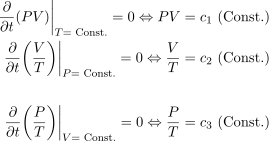
Deduce the ideal gas law, and hence the equation of state, from Boyle’s law, Charles’s law, and Gay-Lussac’s law. Read More
By assumption
multiplying together,
.
hence .
One can countercheck as follows
s.t.
agrees with
Deduce the kinetic gas equation from conservation of momentum by assumption of elastic collision.Read More
For a cubic container of volume , the average squared speed of one particle of mass in random motion along any -, -, -directions is identical . For impulse during , write . With particles of rms speed , rewrite , the pressure being , thus the kinetic gas equation, .
Deduce the magnetic field strength , due to a long straight wire and to a long tightly-packed solenoid both with current carrying, from Biot–Savart law and also from Ampere’s law.Read More
Ampere’s law states that the magnetic flux summed over a closed surface is proportional to the current enclosed by the closed path, i.e.,
By the use of Gaussian pillbox, the magnetic field at a distance from a long straight wire is given by
By the use of amperian loop of length with turns of coils, the coil density being ,
Biot–Savart law of magnetic field states that
At a distance away from a point , let there be a (infinitely) long vertical line for . The locus, joining point and any a point on line , is given by s.t. and where is the angle of elevation or depression. So, , , and .
Derive Fleming’s left hand rule and right hand rule by vector analysis.Read More
(C004) Observation.
Similarities in formulae for finding the equivalent.Read More
Current in series:
Current in parallel:
Voltage in series:
Voltage in parallel:
Resistance in series:
Resistance in parallel:
Capacitance in series:
Capacitance in parallel:
Inductance in series:
Inductance in parallel:
Similarities in terms of inverse square law.Read More
Newton’s law of gravitational force :
Gravitational field strength:
Coulomb’s law of electrostatic force:
Electric field strength:
Biot–Savart law of magnetic field:
Intensity:
Correspondence between intensive (/intrinsic) and extensive (/extrinsic) properties.Read More
Assumed that the Earth is a perfect sphere of mass , radius , and volume having uniform mass density The weight of a test particle at some height above sea level is provided by the Earth’s gravitational force with gravitational constant and -dependent gravity , i.e.,
For , please explain the physical meanings of , , and .
Ex. 2, Projectile in parabolic equation. Read More
Let an object be projected from an angle with the level, at an initial speed , and subjected to gravity . Begin with
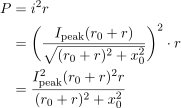
In an electric circuit with a supplied voltage (emf) , a resistor with resistance , and an inductor with reactance , suppose you want to add a second resistor. If represents the resistance of this second resistor then the power delivered to that resistor is given by
with , , and treated as constants. For which value of is the power maximized?
extracted from Michael Corral. (2020). Elementary Calculus
Lemma. (quotient rule)
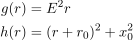
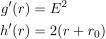
Let , where both and are differentiable and . The quotient rule states that the derivative of is
Wikipedia on Quotient Rule
Roughwork.
Defining
and
then
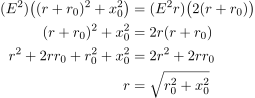
Computing as follows
The mathematically formal way is to show that
But from a physical point of view, assume that the electric currents passing through every components in series are the same, and the potential difference across each total up to the supplied voltage, namely,
The power delivered to resistor is given by the formula
and the only way to maximize , is to maximize either or both and .
Solving for a first-order ordinary differential equation:
deriving current wrt , we have
Thus
(to be continued)
Recall the relation between root mean square (rms) values and peak values:
Recall also that the resistance of an ideal inductor is zero (), and that after the circuit has shortly reached steady state (i.e., constant current anywhere/anytime), the potential difference () or voltage drop () across the inductor will become zero () before long.
Try again,
The derivative test seems inevitable. Maybe you could show that resistance maximizes power , simply by drawing a phasor diagram?

 and
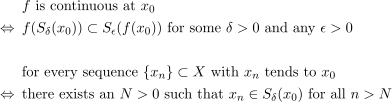
and  be metric spaces and
  be a function. Then,
  is continuous at a point
  if and only if
  , for every sequence
  with
with  .
.

 ,
, .
.

![|z_1+z_2|^2+|z_1-z_2|^2=2[|z_1|^2+|z_2|^2]](https://physicspupil.com/wp-content/ql-cache/quicklatex.com-1396ff10adcc1ecad6bae92cbdcfa5b5_l3.svg "Rendered by QuickLaTeX.com")


 , where
  is a constant. Find the potential as a function of position, taking
  at
at  .
.


 .
.
 is
is  – and
– and  -independent.

 is the water depth and
  the gravitational acceleration. Give an expression for the wave speed.
 being such as
 .
.
 The wave speed
  .
. in metre
  , mass
  in kilogram
  , time
  in second
  , temperature
  in Kelvin
  , electric current
  in Ampere
  , amount of substance
  in mole
  , and light intensity
  in candela
  , of dimensions
 ![[L]](https://physicspupil.com/wp-content/ql-cache/quicklatex.com-283f010575e7faea78d89561d3b25462_l3.svg "Rendered by QuickLaTeX.com") ,
, ![[M]](https://physicspupil.com/wp-content/ql-cache/quicklatex.com-41efb3cdc699b51e117b827dd2b2532a_l3.svg "Rendered by QuickLaTeX.com") ,
, ![[T]](https://physicspupil.com/wp-content/ql-cache/quicklatex.com-b046b88ef5231f9f99b3921141fb931a_l3.svg "Rendered by QuickLaTeX.com") ,
, ![[\Theta]](https://physicspupil.com/wp-content/ql-cache/quicklatex.com-f436b30f65df4d1ff66c13c795242a6b_l3.svg "Rendered by QuickLaTeX.com") ,
, ![[I]](https://physicspupil.com/wp-content/ql-cache/quicklatex.com-e620fa48094760bf56e357e8b427a43e_l3.svg "Rendered by QuickLaTeX.com") ,
, ![[N]](https://physicspupil.com/wp-content/ql-cache/quicklatex.com-29a0c2bc4a1dac7e822a44dbb7354ec4_l3.svg "Rendered by QuickLaTeX.com") , and
, and ![[J]](https://physicspupil.com/wp-content/ql-cache/quicklatex.com-6010a8c42b968acaf68f251160a6b246_l3.svg "Rendered by QuickLaTeX.com") .
.  ,
,  ).
).  of magnitude
  ; ii. displacement
  (change in position)
  ; iii. average velocity
  during time interval
  ; iv. instantaneous velocity
  of magnitude
  the speed; v. average acceleration
  ; and vi. instantaneous acceleration
  .
.  , in dimension of length
  ).
).  being a scalar. Path-independent. Its SI unit is metre,
  . Its SI unit is
  , in dimensions
 ![\displaystyle{\frac{[L]}{[T]}}](https://physicspupil.com/wp-content/ql-cache/quicklatex.com-324985ff2512d537ce90930a056ea051_l3.svg "Rendered by QuickLaTeX.com") .
. rate of change of displacement
  , in dimensions
 ,
,  ).
).  in dimensions
 ![\displaystyle{\frac{[L]}{[T]^2}}](https://physicspupil.com/wp-content/ql-cache/quicklatex.com-b901eca055255bb1632c377d49bf7e04_l3.svg "Rendered by QuickLaTeX.com") and its magnitude
and its magnitude  a scalar,
 straight-line, one-dimensional, axial)
  , the equations of rectilinear motion are


 are
are  ,
,  , and
, and  , herein the variables being angular displacement
  , angular velocity
  , and time


 and
and  , it is said to be in a simple harmonic motion.
 is proportional to the displacement from its equilibrium position:
 .
.  , the unit being Newton
  , or
, or  , in dimensions
 ![\displaystyle{\frac{[M][L]}{[T]^2}}](https://physicspupil.com/wp-content/ql-cache/quicklatex.com-62c3dc5c0b846df6e0728b8ea1d50fdb_l3.svg "Rendered by QuickLaTeX.com") . E.g., gravitational force, electromagnetic force, frictional force, viscous force, upthrust, etc. The properties of force are implicitly stated in Newton’s Laws of Motion:
. E.g., gravitational force, electromagnetic force, frictional force, viscous force, upthrust, etc. The properties of force are implicitly stated in Newton’s Laws of Motion:

 is given by
  (resp.
  ). By definition, friction
  is
is  dependent on the material properties (
 ) of contact surfaces and the normal reaction (
 independent of the speed (
 ) of contact.
  ).
).  with
with  is the coefficient of static friction and
  the object will not move. But if net force
  it will be moved.
  ).
).  where
where  is the coefficient of kinetic friction and
  rotation
  ,
,  , and
, and  ; and ii. the net torque acting on the object must be zero
  .
. ii.
ii.  , velocity
  , acceleration
  and time
  ,
,  ).
).  ,
,  ,
,  ,
,  ,
,  ).
).  . Its unit being
  or
or  .
. kinetic energy are conserved.
 ;
; 

 times that before impact in the opposite direction, the constant
 ![e\in [0,1]](https://physicspupil.com/wp-content/ql-cache/quicklatex.com-87579a900046e13094ea325496e31673_l3.svg "Rendered by QuickLaTeX.com") being the coefficient of restitution ranging from
being the coefficient of restitution ranging from  (perfectly inelastic) to
  (perfectly elastic).
  momentum,


 energy of a closed system is conserved, as stated by the law of conservation of energy.
  ).
). 
 ).
). ; for mechanical power,
  ; and for power in a circuit,
 ).
).  ,
,  ,
,  ,
, 
 ,
,  ,
, 


 ,
,  ).
).  , where
  is the perpendicular distance of a point, say
  , from
  ).
).  ).
).  , where
  where
where  is the universal gravitational constant.


 ).
). 

 or
or  .
.
 .
. ).
). 
 of a substance by
  .
.


 ).
).


 is the angular wave number,
  the frequency, and
  the phase angle.
 .
. .
.


 (resp.
  ).
).
 iff
iff  .
. ).
). 
 of a capacitor is defined the amount of electric charges
 or Farad (
 ).
).


![\Sigma [\textrm{emf}]=\Sigma [IR]](https://physicspupil.com/wp-content/ql-cache/quicklatex.com-e8c5cad7403257208c6a6cd7275f99ca_l3.svg "Rendered by QuickLaTeX.com") .
.


 , write
  where
where  ,
,  , and
, and  might some or other be constant(s).
 -field might be horizontal, i.e.,
  or at an angle
  will induce an electromotive force (emf)
  . Similarly, a current-carrying rod rotating horizontally (


 , and thus
  .
.
 , the probability density
  of which satisfies i. microstate superposition in that
  ; ii. probablistic normalization such that
  ; and iii. boundary conditions by that
  and
and  . To find some particle somewhere in the universe, we do space-and-time integration over the probability density, i.e.,
  , however easier said than done. We hope it thus much time-independent and evolves in the simplest one dimension, say
  . The probability of finding a particle in some observable state
  (e.g. position, momentum, energy) is so called the probability amplitude
  . The measurement order does matter, viz.,
 ![[\hat{x},\hat{p}]\neq [\hat{p},\hat{x}]](https://physicspupil.com/wp-content/ql-cache/quicklatex.com-1301160d6f966c1fd76ffd7c53733c45_l3.svg "Rendered by QuickLaTeX.com") being non-commutative. As for the dynamics of quantum system, one should read Schrödinger equation.
being non-commutative. As for the dynamics of quantum system, one should read Schrödinger equation. ).
). 
 -) decay, and gamma (
 -) decay.
 ,
, ,
,
 ,
,

 ).
). 
 -gate: The bulb emits light if and only if switches
 -gate: The bulb emits light if either switch
 -gate: The bulb emits light if neither switch
 -gate: The bulb emits light if switch
 -gate: The bulb does not emit light if both switch

![\boxed{\begin{aligned}\textrm{grad}\, f & = \nabla f \\\textrm{div}\, \mathbf{F} & = \nabla \cdot \mathbf{F}\\\textrm{curl}\, \mathbf{F} & = \nabla \times \mathbf{F} \\\boldsymbol{\Delta} [\cdots ] & = \nabla^2 [\cdots ] \\\end{aligned}}](https://physicspupil.com/wp-content/ql-cache/quicklatex.com-6b349611df044e17970ed0ef9d3e6f61_l3.svg "Rendered by QuickLaTeX.com")
 ; outward flux as the positive divergence of field; the curls of
  -field and


 , its absolute error is
  , its fractional error
  , and its percentage error
  .
.
![[a,x]](https://physicspupil.com/wp-content/ql-cache/quicklatex.com-3cbca4e86957c904794e22a2877feb97_l3.svg "Rendered by QuickLaTeX.com") if
if  (or
(or ![[x,a]](https://physicspupil.com/wp-content/ql-cache/quicklatex.com-713aa02897bbe5df9b8e30453c65df32_l3.svg "Rendered by QuickLaTeX.com") if
if  ). The function
  is a primitive function of
  , i.e.,
 .
. of
of  ,
,![\displaystyle{\int_a^xf(t)\,\mathrm{d}t=[F(t)]_{a}^{x}=F(x)-F(a)}](https://physicspupil.com/wp-content/ql-cache/quicklatex.com-d8b642f3699fc8b6291486e1d53ed31d_l3.svg "Rendered by QuickLaTeX.com")

 , a block of mass
  . At time
  applied to the block is a force of magnitude
  starting it in motion with the minimally possible velocity of magnitude
  . The block meets with kinetic friction
  along the displacement. After some time
  , it has travelled a distance of
  long to the slope bottom, its velocity being then of magnitude
  . The block moves further
  for a duration of
  on the ground level until it stops.
 conserve momentum and energy, and that the connecting strings be inextensible and massless. At
  , ball
  hanging at an angle
  , such that at time
  , they bounce off each other with linear speed
  and
and  and angular speed
  . At time
  , they make with the vertical angles
  and
and  and stop motion there temporarily.

 into an ideally empty space at a height of some
  in a geostationary low Earth orbit (LEO) where
 ![\exists\, !\, h\in [180, 2000]](https://physicspupil.com/wp-content/ql-cache/quicklatex.com-b4e4bee7089fbfe445cdfc5c40c5ffca_l3.svg "Rendered by QuickLaTeX.com") . In order to stay in orbit perpetually, the orbital period of this satellite needs to be
. In order to stay in orbit perpetually, the orbital period of this satellite needs to be  , the orbital speed
  , and the launch velocity
  in magnitude and perpendicular
  to the Earth’s surface. If the satellite can reach an altitude of
  , i.e.,
  , the launch succeeds and the satellite revolves around the Earth in uniform circular motion; else, i.e.,
  , the launch fails and the satellite falls down on the Earth in projectile motion, its range being
  .
. .
.
 displacement,
  initial velocity,
  acceleration, and
  ,
,  ,
,  ,
,  , and
, and  where the corresponding dimensions for both sides,
  ,
,  ,
,  ,
,  , and
, and  are equivalent.
 force (from without) acting externally on the system, the objects within will remain at rest or in uniform motion, i.e.,
  when
when  .
. and equal in magnitude
  .
.


 , we have
  .
. ) the derivative
  of time
  and for refraction
  .
. , the start point
  , and the end point
  , where
  and
and  such that light travels from
  and
and  are thus
  and
and  long. Let the speed of light in the initial and the final medium be
  . Since
  , we have
 .
.
 a linear superposition of electric field component
  and magnetic field component
  , i.e.,
 .
.


 and the mass of a planet


 is
is  -independent s.t.

 is
is 
![\displaystyle{F=\frac{\mathrm{d}}{\mathrm{d}t}\bigg[ \frac{\partial}{\partial \dot{x}} \bigg( \frac{1}{2}m\dot{x}^2\bigg) \bigg] =\frac{\mathrm{d}}{\mathrm{d}t}(m\dot{x})=m\ddot{x}=ma}](https://physicspupil.com/wp-content/ql-cache/quicklatex.com-82258c0c725a722d7b00bafa725ad7ea_l3.svg "Rendered by QuickLaTeX.com")
 .
. .
. s.t.
s.t.

 , the average squared speed
  of one particle of mass
  -,
-, 

 . For impulse
  during
  , write
  . With
  , rewrite
  , the pressure
  , thus the kinetic gas equation,
  .
.

 ,
,


 away from a point
  , let there be a (infinitely) long vertical line
  for
for  . The locus, joining point
  s.t.
s.t.  and
and  where
where  ,
,  , and
, and  .
.





 vs
vs  .
. vs
vs 


 on gravity variation.
 is a variable of gravity
  having uniform mass density
  The weight
  of a test particle
  with gravitational constant
  , i.e.,
 , please explain the physical meanings of
  ,
,  , and
, and  .
.

 in terms of


 .
. in terms of
 in terms of

 , find
  ,
,  ,
,  ,
,  ,
,  , and
, and  and hence find whether the image is real or virtual.


 , instantaneous velocity
  , and instantaneous acceleration
  into four parts such that the second part is
  more than the first.
 ,
,  , and
, and  be positive real numbers (
 ) such that
  .
.




 , the second
  , the third
  , and the fourth and last
  .
.
 , and an inductor with reactance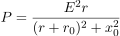
 , where both
  . The quotient rule states that the derivative of

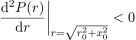
 passing through every components in series are the same, and the potential difference across each total up to the supplied voltage, namely,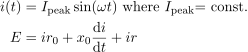
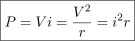

 , we have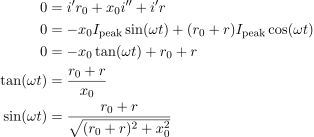


 of an ideal inductor is zero (
 ) or voltage drop (
 ) across the inductor will become zero (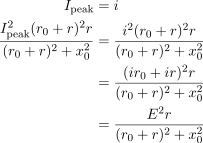
 maximizes power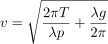
 s.t.
s.t.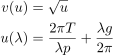
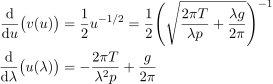
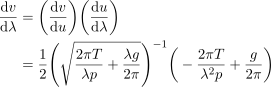
 requires: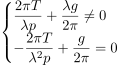
 .
. ,
, ,
, ,
, ,
, .
. .
.
 such that
 .
. .
. .
. ,
, .
. and
and  , so
, so .
. ,
,  ,
,  ,
,  , and
, and  , give the value of


