202207071209 Exercise 45W (Q1)

Separate 46 into four parts such that the second part is 1 more than twice the first, the third is twice the fourth, and the fourth is 3 more than the first.

J. R. Lux & R. S. Pieters. (1969). Exercises in Elementary Algebra


Roughwork.

Let a, b, c, and d be positive real numbers (\in\mathbb{R}^{+}) such that 0<a,b,c,d<46.

Given that

\begin{aligned} 46 & = a+b+c+d \\ 1 & = b - 2a \\ 2d & = c \\ 3 & = d-a \\ \end{aligned}

or,

\begin{aligned} \begin{bmatrix} 1 & 1 & 1 & 1 \\ -2 & 1 & 0 & 0 \\ 0 & 0 & 1 & -2 \\ -1 & 0 & 0 & 1\end{bmatrix} \begin{bmatrix} a \\ b \\ c\\ d \end{bmatrix} & = \begin{bmatrix} 46 \\ 1 \\ 0 \\ 3 \end{bmatrix} \\ \end{aligned}

or,

\begin{aligned} \begin{bmatrix} a \\ b \\ c\\ d \end{bmatrix} & = \begin{bmatrix} 1 & 1 & 1 & 1 \\ -2 & 1 & 0 & 0 \\ 0 & 0 & 1 & -2 \\ -1 & 0 & 0 & 1\end{bmatrix}^{-1}\begin{bmatrix} 46 \\ 1 \\ 0 \\ 3 \end{bmatrix} \\ \end{aligned}

To find the inverse, begin with

\begin{aligned} & \boxed{\begin{array}{cccc|cccc} 1 & 1& 1 & 1 & 1 & 0 & 0 & 0 \\ -2 & 1 & 0 & 0 & 0 & 1 & 0 & 0 \\ 0 & 0 & 1 & -2 & 0 & 0 & 1 & 0 \\ -1 & 0 & 0 & 1 & 0 & 0 & 0 & 1 \\ \end{array} }\\ R1' & \Longleftarrow R1-R2-R3-3R4 \\ \begin{bmatrix} 6 \\ 0 \\ 0 \\ 0\\ \end{bmatrix}^{\mathrm{T}} & = \begin{bmatrix} 1 \\ 1 \\ 1 \\ 1 \end{bmatrix}^{\mathrm{T}} - \begin{bmatrix} -2 \\ 1 \\ 0 \\ 0 \end{bmatrix}^{\mathrm{T}} - \begin{bmatrix} 0 \\ 0 \\ 1 \\ -2 \end{bmatrix}^{\mathrm{T}} - 3\begin{bmatrix} -1 \\ 0 \\ 0 \\ 1 \end{bmatrix}^{\mathrm{T}} \\ \begin{bmatrix} 1 \\ -1 \\ -1 \\ -3 \\ \end{bmatrix}^{\mathrm{T}} & = \begin{bmatrix} 1 \\ 0 \\ 0 \\ 0 \end{bmatrix}^{\mathrm{T}} - \begin{bmatrix} 0 \\ 1 \\ 0 \\ 0 \end{bmatrix}^{\mathrm{T}} - \begin{bmatrix} 0 \\ 0 \\ 1 \\ 0 \end{bmatrix}^{\mathrm{T}} - 3\begin{bmatrix} 0 \\ 0 \\ 0 \\ 1 \end{bmatrix}^{\mathrm{T}} \\ \end{aligned}

proceed with

\begin{aligned} & \boxed{\begin{array}{cccc|cccc} 6 & 0& 0 & 0 & 1 & -1 & -1 & -3 \\ -2 & 1 & 0 & 0 & 0 & 1 & 0 & 0 \\ 0 & 0 & 1 & -2 & 0 & 0 & 1 & 0 \\ -1 & 0 & 0 & 1 & 0 & 0 & 0 & 1 \\ \end{array} }\\ R2' & \Longleftarrow R2+\frac{R1}{3} \\ \begin{bmatrix} 0 \\ 1 \\ 0 \\ 0 \\ \end{bmatrix}^{\mathrm{T}} & = \begin{bmatrix} -2 \\ 1 \\ 0 \\ 0\end{bmatrix}^{\mathrm{T}} + \frac{1}{3}\begin{bmatrix} 6 \\ 0 \\ 0 \\ 0 \end{bmatrix}^{\mathrm{T}}\\ \begin{bmatrix} 1/3 \\ 2/3 \\ -1/3 \\ -1 \end{bmatrix}^{\mathrm{T}} & = \begin{bmatrix} 0 \\ 1 \\ 0 \\ 0 \end{bmatrix}^{\mathrm{T}} +\frac{1}{3}\begin{bmatrix} 1 \\ -1 \\ -1 \\ -3 \end{bmatrix}^{\mathrm{T}} \\ \end{aligned}

proceed with

\begin{aligned} & \boxed{\begin{array}{cccc|cccc} 6 & 0& 0 & 0 & 1 & -1 & -1 & -3 \\ 0 & 1 & 0 & 0 & 1/3 & 2/3 & -1/3 & -1 \\ 0 & 0 & 1 & -2 & 0 & 0 & 1 & 0 \\ -1 & 0 & 0 & 1 & 0 & 0 & 0 & 1 \\ \end{array} }\\ R4' & \Longleftarrow 6R4+R1 \\ \begin{bmatrix} 0 \\ 0 \\ 0 \\ 6 \\ \end{bmatrix}^{\mathrm{T}} & = 6\begin{bmatrix} -1 \\ 0 \\ 0 \\ 1\end{bmatrix}^{\mathrm{T}} + \begin{bmatrix} 6 \\ 0 \\ 0 \\ 0 \end{bmatrix}^{\mathrm{T}}\\ \begin{bmatrix} 1 \\ -1 \\ -1 \\ 3 \end{bmatrix}^{\mathrm{T}} & =6\begin{bmatrix} 0 \\ 0 \\ 0 \\ 1 \end{bmatrix}^{\mathrm{T}}+\begin{bmatrix} 1 \\ -1 \\ -1 \\ -3 \end{bmatrix}^{\mathrm{T}} \\ \end{aligned}

proceed with

\begin{aligned} & \boxed{\begin{array}{cccc|cccc} 6 & 0& 0 & 0 & 1 & -1 & -1 & -3 \\ 0 & 1 & 0 & 0 & 1/3& 2/3 & -1/3 & 0 \\ 0 & 0 & 1 & -2 & 0 & 0 & 1 & 0 \\ 0 & 0 & 0 & 6 & 1 & -1 & -1 & 3 \\ \end{array} }\\ R3' & \Longleftarrow R3+\frac{1}{3}R4 \\ \begin{bmatrix} 0\\0 \\1 \\0 \\ \end{bmatrix}^{\mathrm{T}} & = \begin{bmatrix} 0 \\ 0 \\ 1 \\ -2\end{bmatrix}^{\mathrm{T}} + \frac{1}{3}\begin{bmatrix} 0 \\ 0 \\ 0 \\ 6 \end{bmatrix}^{\mathrm{T}}\\ \begin{bmatrix} 1/3\\ -1/3 \\2/3 \\ 1 \end{bmatrix}^{\mathrm{T}} & =\begin{bmatrix} 0 \\ 0 \\ 1 \\ 0 \end{bmatrix}^{\mathrm{T}}+\frac{1}{3}\begin{bmatrix} 1 \\ -1 \\ -1 \\ 3 \end{bmatrix}^{\mathrm{T}} \\ \end{aligned}

proceed with

\begin{aligned} & \boxed{\begin{array}{cccc|cccc} 6 & 0& 0 & 0 & 1 & -1 & -1 & -3 \\ 0 & 1 & 0 & 0 & 1/3& 2/3 & -1/3 & 0 \\ 0 & 0 & 1 & 0 & 1/3 & -1/3 & 2/3 & 1 \\ 0 & 0 & 0 & 6 & 1 & -1 & -1 & 3 \\ \end{array} }\\ R1',R4' & \Longleftarrow \frac{1}{6}\cdot R1, R4 \\ & \boxed{\begin{array}{cccc|cccc} 1 & 0& 0 & 0 & 1/6 & -1/6 & -1/6 & -1/2 \\ 0 & 1 & 0 & 0 & 1/3& 2/3 & -1/3 & 0 \\ 0 & 0 & 1 & 0 & 1/3 & -1/3 & 2/3 & 1 \\ 0 & 0 & 0 & 1 & 1/6 & -1/6 & -1/6 & 1/2 \\ \end{array} }\\ \end{aligned}

Hence

\begin{aligned} \begin{bmatrix} 1 & 1 & 1 & 1 \\ -2 & 1 & 0 & 0 \\ 0 & 0 & 1 & -2 \\ -1 & 0 & 0 & 1\end{bmatrix}^{-1} & = \begin{bmatrix} 1/6 & -1/6 & -1/6 & -1/2 \\ 1/3 & 2/3 & -1/3 & 0 \\ 1/3 & -1/3 & 2/3 & 1 \\ 1/6 & -1/6 & -1/6 & 1/2 \end{bmatrix} \\ \end{aligned}

and thus

\begin{aligned} \begin{bmatrix} a \\ b \\ c\\ d \end{bmatrix} & = \begin{bmatrix} 1/6 & -1/6 & -1/6 & -1/2 \\ 1/3 & 2/3 & -1/3 & 0 \\ 1/3 & -1/3 & 2/3 & 1 \\ 1/6 & -1/6 & -1/6 & 1/2 \end{bmatrix}\begin{bmatrix} 46 \\ 1 \\ 0 \\ 3 \end{bmatrix} \\ \end{aligned}

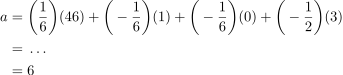
\begin{aligned} a & = \bigg( \frac{1}{6} \bigg) (46) + \bigg(-\frac{1}{6} \bigg) (1) + \bigg(-\frac{1}{6} \bigg) (0) + \bigg(-\frac{1}{2} \bigg) (3) \\ & =\,\dots \\ & = 6 \\ \end{aligned}

\begin{aligned} \because & \enspace 3 = d-a\\ \therefore & \enspace 3=d-(6) \\ \therefore & \enspace d=9 \\ \end{aligned}

\begin{aligned} \because &\enspace 2d = c\\ \therefore &\enspace 2(9) = c\\ \therefore &\enspace c=18 \\ \end{aligned}

\begin{aligned} \because &\enspace 1=b-2a\\ \therefore &\enspace 1=b-2(6)\\ \therefore &\enspace b=13 \\ \end{aligned}

\boxed{\begin{pmatrix} a & b & c & d  \end{pmatrix} = \begin{pmatrix} 6 & 13 & 18 & 9\\ \end{pmatrix}}

\therefore The first number is 6, the second 13, the third 18, and the fourth and last 9.