(a) Prove that the following are open sets:
i.  ;
;
ii. ![\mathbb{C}\backslash [0,1]](https://physicspupil.com/wp-content/ql-cache/quicklatex.com-3c3f8cb78fee59df59019937122773e1_l3.svg "Rendered by QuickLaTeX.com") .
.
(b) Prove that the following are not open:
i.  ;
;
ii.  .
.
Extracted from H. A. Priestley. (2003). Introduction to Complex Analysis.
Background.
Definition. (open set)
A set  is open if, given
  , there exists
  (depending on
  ) such that
  .
.
Definition. (open disc)
The open disc centre  and radius is defined to be
 .
.
(a) i.
Warm-up.

No, just let  is done.
(a) ii.
Set-up.
In set notation a complex interval number may be represented in the form
![\mathcal{A}=[a,b]+[c,d]\mathrm{i}=\{ x+\mathrm{i}y\, |\, a\leqslant x\leqslant b,c\leqslant y \leqslant d\}](https://physicspupil.com/wp-content/ql-cache/quicklatex.com-7317978d8b61f93f45fd1cf9401e89f3_l3.svg "Rendered by QuickLaTeX.com") .
.
Extracted from R. Boche. (1966). Complex Interval Arithmetic with Some Applications.
Thus is equivalent to
![\{z=a+\mathrm{i}b\textrm{ where }a,b\notin [0,1]\}](https://physicspupil.com/wp-content/ql-cache/quicklatex.com-0107dc39dce70fb864a02e1f5354b588_l3.svg "Rendered by QuickLaTeX.com") ,
,
as shown in the figure below:

Abortive attempt.
Lemma.
Let  be a non-empty subset and
  . Then
  is open in
  if and only if
  for some
  which is open in
  .
.
Proof. Necessity.  s.t.
s.t.  . Let
. Let  . Then . Note that
  is open in . Sufficiency.
  s.t.
s.t.  . Thus
  .
. 
Now that ![U=\mathbb{C}\backslash [0,1]](https://physicspupil.com/wp-content/ql-cache/quicklatex.com-fce0b22b9067c654ef384144b7d73a4c_l3.svg "Rendered by QuickLaTeX.com") ,
,  , and
, and  … quit this circular reasoning of no use.
Make use of the following
Lemma.
The union of any collection of open sets is open.
Proof.
Let  where
where  is open in
  and
and  any index set. Then
  ,
,  for some
  and so
  s.t.
s.t.  .
.
Thereby
![\mathbb{C}\backslash [0,1]=\mathbb{C}(-\infty ,0)\cup\mathbb{C}(1,\infty)](https://physicspupil.com/wp-content/ql-cache/quicklatex.com-74dbab052bb4eeed9b9277638c0a45de_l3.svg "Rendered by QuickLaTeX.com")
is open.
QED
(b)
A set is not open whenever  (/
(/ ), the interior of , falls short of its whole, i.e.,
For i. and ii. the unbelonging boundaries  ‘s to either are
  and
and  .
.

 to the parabola
  .
.
 and
and  be two points at which the two tangents touches the parabola. Then,


 .
.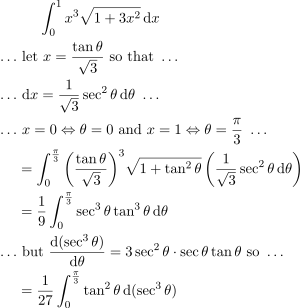
![\begin{aligned} & \quad\enspace \int_{0}^{1}x^3\sqrt{1+3x^2}\,\mathrm{d}x \\ \dots &\textrm{ let }u=1+3x^2\textrm{ then }\mathrm{d}x=\frac{\mathrm{d}u}{6x}\textrm{ }\dots \\ \dots &\textrm{ then }x=0\Leftrightarrow u=1\textrm{ and }x=1\Leftrightarrow u=4\textrm{ }\dots \\ & = \int_{1}^{4}x^3\sqrt{u}\,\bigg(\frac{\mathrm{d}u}{6x}\bigg) \\ & = \frac{1}{6}\int_{1}^{4}\bigg(\frac{u-1}{3}\bigg)\sqrt{u}\,\mathrm{d}u \\ & = \frac{1}{18}\int_{1}^{4}\big( u^{\frac{3}{2}}-u^{\frac{1}{2}}\big)\,\mathrm{d}u \\ & = \frac{1}{18}\bigg[ \frac{2u^{\frac{5}{2}}}{5}-\frac{2u^{\frac{3}{2}}}{3}\bigg]\bigg|_{1}^{4} \\ & = \cdots \\ \end{aligned}](https://physicspupil.com/wp-content/ql-cache/quicklatex.com-2de73630bc9aa34328c9f2a302349c59_l3.svg "Rendered by QuickLaTeX.com")
 is in the form of the parabola given by the equation

 is
is  . Find the coordinate of
 .
. on the curve
 .
.


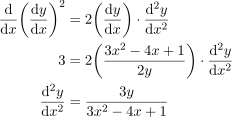

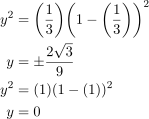


 for the author.
 if
if .
.
 . By what approximate amount does the volume increases, if the diameter is increased by a very small amount
  ?
?
 million in
  and it increases by
  each year, what will be the estimated population in
  ? Give your answer correct to
 in Fourier series.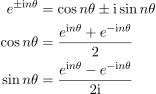
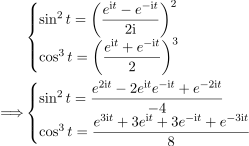
 .
.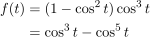
 is as expanded
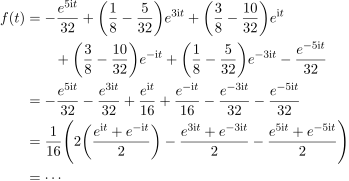
 .
. satisfying
  is called a periodic function, and the smallest
  its period. A periodic function

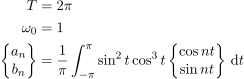
 . The coefficients of the Fourier series are found by using the orthogonality properties of sine and cosine functions over a period: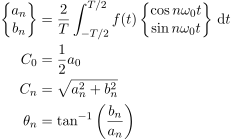
 :
:![\begin{aligned} a_0 & = \frac{1}{\pi}\int_{-\pi}^{\pi}\sin^2t\cos^3t\,\mathrm{d}t \\ \cdots\enspace\textrm{Let }& u=\sin t\textrm{ s.t. }\mathrm{d}t=\frac{\mathrm{d}u}{\cos t}\enspace\cdots \\ & = \frac{1}{\pi}\int_{t=-\pi}^{t=\pi}u^2\cos^2t\,\mathrm{d}u \\ & = \frac{1}{\pi}\int_{t=-\pi}^{t=\pi}u^2(1-u^2)\,\mathrm{d}u \\ & = \frac{1}{\pi}\int_{t=-\pi}^{t=\pi}(u^2-u^4)\,\mathrm{d}u \\ & = \frac{1}{\pi}\bigg[ \frac{u^3}{3}-\frac{u^5}{5} \bigg]\bigg|_{t=-\pi}^{t=\pi} \\ & = \frac{1}{\pi}\bigg[ \frac{\sin^3t}{3}-\frac{\sin^5t}{5} \bigg]\bigg|_{t=-\pi}^{t=\pi} \\ & = 0 \\ \end{aligned}](https://physicspupil.com/wp-content/ql-cache/quicklatex.com-d583ae6f5ca5004737bd61c8c302a97c_l3.svg "Rendered by QuickLaTeX.com")
 :
:![\begin{aligned} a_1 & = \frac{1}{\pi}\int_{-\pi}^{\pi}\sin^2t\cos^4t\,\mathrm{d}t \\ \dots\enspace &\textrm{By WolframAlpha}\enspace\dots \\ & = \frac{1}{\pi}\bigg[\frac{1}{192}(12t+3\sin (2t)-3\sin (4t)-\sin (6t))\bigg]\bigg|_{-\pi}^{\pi} \\ & = \frac{1}{\pi}\bigg(\frac{24\pi}{192}\bigg) \\ & = \frac{1}{8} \\ \end{aligned}](https://physicspupil.com/wp-content/ql-cache/quicklatex.com-1e3322729803545339064a82f75780e7_l3.svg "Rendered by QuickLaTeX.com")
 converges, and give its limit, when
  is given by
 ,
, ,
, .
. ,
, ,
, .
. is called a geometric series if
 .
. is divergent whenever
  .
. . Define
  for
for  . Assume that
  exists,
  . The series is absolutely convergent if
  , divergent if
  , and undetermined if
  .
. define
  . Assume that
  exists,
  . The series is absolutely convergent if
  , divergent if
  , and undetermined if
  .
. observe that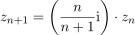
 :
: .
.

 .
.
 .
.
