202210101009 Exercise 3.9

(a) Prove that the sequence \{ z_n\} converges, and give its limit, when z_n is given by
i. \displaystyle{\frac{1}{n}\mathrm{i}^n},
ii. (1+\mathrm{i})^{-n},
iii. \displaystyle{\frac{n^2+\mathrm{i}n}{n^2+\mathrm{i}}}.
(b) Prove that the sequence \{ z_n\} does not converge when z_n is given by
i. \mathrm{i}^n,
ii. (1+\mathrm{i})^n,
iii. \displaystyle{(-1)^n\frac{n}{n+\mathrm{i}}}.

Extracted from H. A. Priestley. (2003). Introduction to Complex Analysis.


Background.

Definition. (geometric series)
A series of complex number \displaystyle{\sum_{n=0}^{\infty}z_n} is called a geometric series if

\exists\, t\in\mathbb{C}\textrm{ s.t. }z_{n+1}=tz_n\enspace\forall\, n\in\mathbb{N}.

N.b. Such geometric series as z_0\neq 0 is divergent whenever |t|\geqslant 1.

Proposition. (ratio test)
Let \displaystyle{\sum_{n=0}^{\infty}z_n} be a series of complex numbers, z_n\neq 0\enspace\forall\, n\in\mathbb{N}. Define \displaystyle{r_n:=\bigg|\frac{z_{n+1}}{z_n}\bigg|} for n\in\mathbb{N}. Assume that \displaystyle{\lim_{n\to\infty}r_n=r} exists, r\in [0,\infty)\cup \{\infty\}. The series is absolutely convergent if r<1, divergent if r>1, and undetermined if r=1.

Proposition. (root test)
Let \displaystyle{\sum_{n=0}^{\infty}z_n} be a series of complex numbers. For n\geqslant 1 define \rho_n =|z_n|^{\frac{1}{n}}. Assume that \displaystyle{\lim_{n\to\infty} \rho_n :=A} exists, A\in [0,\infty )\cup \{\infty\}. The series is absolutely convergent if A<1, divergent if A>1, and undetermined if A=1.


(a) i.

From \displaystyle{z_n=\frac{1}{n}\mathrm{i}^n} observe that

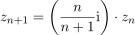
\displaystyle{z_{n+1}=\bigg(\frac{n}{n+1}\mathrm{i}}\bigg)\cdot z_n

is a geometric series of common ratio t:

\displaystyle{t:=\frac{n}{n+1}\mathrm{i}}}.

\begin{aligned} |t| & =\bigg| \frac{n}{n+1} \mathrm{i}\bigg| \\ & = \sqrt{(0)^2+\bigg(\frac{n}{n+1}\bigg)^2} \\ & = \frac{n}{n+1} < 1\enspace \forall\, n\in\mathbb{N} \\ \end{aligned}

\therefore \{ z_n\} converges to the limit 1.


(a) ii.

\begin{aligned} z_n & = (1+\mathrm{i})^{-n} \\ z_{n+1} & = (1+\mathrm{i})^{-(n+1)} \\ & = (1+\mathrm{i})^{-1}(1+\mathrm{i})^{-n} \\ & = \bigg(\frac{1}{1+\mathrm{i}}\bigg) \cdot z_n \\ t & := \frac{1}{1+\mathrm{i}} \\ & = \frac{1}{1+\mathrm{i}} \cdot \frac{1-\mathrm{i}}{1-\mathrm{i}} \\\ & = \frac{1-\mathrm{i}}{1-\mathrm{i}^2} \\ & = \frac{1-\mathrm{i}}{1-(-1)} \\ & = \frac{1}{2} - \frac{1}{2}\mathrm{i} \\ |t| & = \sqrt{\bigg(\frac{1}{2}\bigg)^2 + \bigg( -\frac{1}{2}\bigg)^2} \\ & = \cdots \\ & = \frac{\sqrt{2}}{2}<1 \\ \end{aligned}

\therefore \{ z_n\} converges to the limit 0.


(a) iii.

\begin{aligned} z_n & = \frac{n^2+\mathrm{i}n}{n^2+\mathrm{i}} \\ z_{n+1} & = \frac{(n+1)^2+\mathrm{i}(n+1)}{(n+1)^2+\mathrm{i}} \\ \frac{z_{n+1}}{z_n} & = \frac{(n+1)^2+\mathrm{i}(n+1)}{(n+1)^2+\mathrm{i}}\bigg/ \frac{n^2+\mathrm{i}n}{n^2+\mathrm{i}} \\ & = \frac{(n+1)^2+\mathrm{i}(n+1)}{(n+1)^2+\mathrm{i}}\cdot \frac{n^2+\mathrm{i}}{n^2+\mathrm{i}n} \\ & =: r_n \\ \end{aligned}

By ratio test or root test for convergence the series being undetermined, we had rather adopt another approach.

\begin{aligned} \frac{n^2+\mathrm{i}n}{n^2+\mathrm{i}} & = \frac{(n^2+\mathrm{i}n)(n^2-\mathrm{i})}{(n^2+\mathrm{i})(n^2-\mathrm{i})} \\ z_n & = \frac{(n^4+n)+\mathrm{i}(n^3-n^2)}{n^4+1} \\ \textrm{Re}\, z_n & = \frac{n^4+n}{n^4+1} \\ \textrm{Im}\, z_n & = \frac{n^3-n^2}{n^4+1} \\ \lim_{n\to\infty} \textrm{Re}\, z_n & = \cdots = 1 \\ \lim_{n\to\infty} \textrm{Im}\, z_n & = \cdots = 0 \\ \end{aligned}

\therefore \{ z_n\} converges to the limit 1.


(b) i., ii., and iii. are left the reader as an exercise.