
The blogger claims no originality of his question below.
The circuit below is not a short circuit if switches  and
and  are:
are:

-
- : open; : open
- : open; : closed
- : closed; : open
- : closed; : closed
Answer. A
The blogger claims no originality of his question below.
The circuit below is not a short circuit if switches and are:
: open; : open: open; : closed: closed; : open: closed; : closedAnswer. A
The blogger claims no originality of his question below.
Find the equivalent resistance between nodes  and
and  .
.

Solution:
We notice that the leftmost resistor is short-circuited, and we have the following diagram:

Or, more neatly drawn, we have

The equivalent resistance is  .
.
The blogger claims no originality of his question below.
Find the equivalent resistance between nodes  and
and  .
.

Solution.
The equivalent resistance of two  ‘s in series is
  :
:

The equivalent resistance of and in parallel is  :
:

For and  in series,
  :
:

Finally, the equivalent resistance between nodes and is  .
.
The blogger claims no originality of his problem below.
Find the equivalent resistance between nodes  and
and  .
.

Solution.
We draw the following diagram:

Then the equivalent resistance is  .
.
The blogger claims no originality of his problem below.

Find the equivalent resistance of the circuit above.
Solution.
We draw the diagram below:

For two resistors in parallel:
 .
.
For three resistors in parallel:
 .
.
Summing over them in series:
 .
.
The blogger claims no originality of his question below.

In the figure above, the resistors are identical. Find the equivalent resistance between nodes:
and ; and
and  ; and .
Solution.
 ,
,  ,
,  , etc. Different nodes with the same electric potential will be labelled with the same label, as shown below:
 ‘s. Hence we draw the diagram below:
 .(Alternatively one can use the
  –
– transformation.)
 and is given by
  . Thus .– transformation.
The blogger claims no originality of his problem below.

Find the equivalent resistance of the circuit above.
Solution.
In series,  .
.

In parallel, 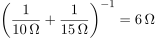 .
.

In series,  .
.

In parallel, 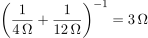 .
.

Finally, the equivalent resistance of the resistors above in series is  .
.
The blogger claims no originality of his question below.

Find the equivalent resistance, in terms of  ,
,  ,
,  , and
, and  , when the switch is
i. open;
ii. closed.
Solution.
i. When the switch is open, we draw the following diagram: The equivalent resistance of and in series is their sum
  . Similarly, that of and in series is
  . The equivalent resistance
  of and in parallel is given by
  . Thus
  .
.
ii. When the switch is closed, we draw the following diagram: The equivalent resistance of and in parallel is
  . Similarly, that of and in parallel is
  . Thus the equivalent resistance of them in series is
  .
.
The blogger claims no originality of his question below.

In the figure above, when the key is closed, which of the following descriptions about the circuit is true?
is an ammeter and is a voltmeter, then resistors and are in parallel. is an ammeter and is a voltmeter, then resistors and are in series. is a voltmeter and is an ammeter, then resistors and are in parallel. is a voltmeter and is an ammeter, then resistors and are in series.Answer. A
The blogger claims no originality of his question below.

In the figure above, the same current pass through the same cuboid resistor with sides , and where  . The resistor has a uniform composition. The current direction is indicated by the arrow. In which direction (A, B or C) does the current have the least resistance?
Answer. A