


are two four-vectors.


Scalar product of any two four-vectors is frame-independent.
are two four-vectors.
Scalar product of any two four-vectors is frame-independent.
It sometimes occurs that the generalized coordinates appear separately in the kinetic energy and the potential energy in such a manner that  and
and  may be written in the form
 and
and  .
.
Show that Lagrange’s equations then separate, and that the problem can always be reduced to quadratures.
Solution.
This solution is not mine. It was found on the Internet some years ago, to whose author(s) I lost references.
From the fact that
 ,
,
the Lagrange’s equation can be separated into  Lagrange’s equations.
Remark.
The solution is incomplete. It remains to be shown how the problem can always be reduced to quadratures.
When two billiard balls collide, the instantaneous forces between them are very large but act only in an infinitesimal time  , in such a manner that the quantity

remains finite. Such forces are described as impulsive forces, and the integral over is known as the impulse of the force. Show that if impulsive forces are present Lagrange’s equations may be transformed into
 ,
,
where the subscripts and  refer to the state of the system before and after the impulse,
  is the impulse of the generalized impulsive force corresponding to
  , and
, and  is the Lagrangian including all the non-impulsive forces.
Solution.
This solution is not mine. It was found on the Internet some years ago, to whose author(s) I lost references.
For billiard-balls collision, the Euler-Lagrange (E-L) equation is
 ,
,
where  is the generalised impulsive force corresponding to and not derivable from the potential.
Taking integral over on both sides,
LHS becomes
 .
.
The second term upon integration is zero,
because  for infinitesimal time
  .
.
The first term is
![\displaystyle{\int_{\Delta t}\mathrm{d}\bigg( \frac{\partial L}{\partial \dot{q_j}} \bigg)}=\bigg[ \frac{\partial L}{\partial \dot{q_j}}\bigg]^{t+\Delta t}_{t}](https://physicspupil.com/wp-content/ql-cache/quicklatex.com-1e3b7bf3cc0fa5186d619199e4bbfa33_l3.svg "Rendered by QuickLaTeX.com") .
.
Rename  the (final) state of system after the impulse and
  the (initial) state of system before the impulse.
LHS reads

whereas RHS reads
 ,
,
i.e., the impulse of generalised impulsive force.
The transformed E-L equation in the presence of impulsive forces is
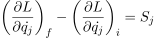 ,
,
as desired.
A particle is subjected to the potential  , where
  is a constant. The particle travels from
  to
to  in a time interval
  . Assume the motion of the particle can be expressed in the form
  . Find the values of
  ,
,  , and
, and  such that the action is a minimum.
Solution.
The solution is not mine. It was found on the Internet some years ago, to whose author(s) I lost references.
1D-case:
 .
.
Euler-Lagrange (E-L) equation:

gives the path over which the action is stationary.
That is,
 .
.
On taking derivative twice,
 .
.
Equate them,
 .
.
The event  gives
gives
 .
.
And the event  gives
gives
 .
.
Express it as
 .
.
Thus,

is recovered.
Prove that the shortest distance between two points in space is a straight line.
Solution.
This solution is not mine. It was found on the Internet some years ago, to whose author(s) I lost references.
Assume the path (of any curve ) connecting two points  and
and  is given by a function
  , with
  being the first derivative of the curve.
To minimise the path distance
 ,
,
define now
 ,
,
having  and
and  .
.
From Euler-Lagrange (E-L) equation it follows that
 ,
,
i.e., 
In conclusion, the shortest distance between two points in space is a straight line.
Lemma. (Fundamental lemma of the calculus of variations)
If  for any
  continuous through second derivative, then
  must identically vanish in the interval
  .
.
Text on pg.38, Goldstein
Prove that the magnitude  of the position vector for the center of mass from an arbitrary origin is given by the equation
 .
.
Solution.
This solution is not mine. It was found on the Internet some years ago, to whose author(s) I lost references.
 .
.
Taking squares on both sides,
 .
.
Notice  , squaring it,
 ,
,
arranging,
 .
.
Plugging this,

Show that for a single particle with constant mass the equation of motion implies the following differential equation for the kinetic energy:
 ,
,
while if the mass varies with time the corresponding equation is
 .
.
Solution.
This solution is not mine. It was found on the Internet some years ago, to whose author(s) I lost references.
Single particle with constant mass:

if mass varies with time:

Remark.

The blogger claims no originality of his question posted here.
Think of a field in some representation other than a diagram of field lines. For instance, suppose any point in a field is assigned a number to its field strength magnitude, but the direction of field strength of each point is not indicated. Now, could we deduce a rough picture of the (vector) E-field from these (scalar) numbers, provided that we know the distribution of these numbers and the position of charges?

In the figure, , and are charges of unknown charge quantities and sign. Each single-digit number at a point represents the magnitude of E-field strength at that point. For example,  stands for
  ,
,  stands for zero E-field, i.e., a neutral point. By deducing from the figure, determine which of the following statements is/are correct.
(1) Charge quantity of is larger than that of either or .
(2) Charge quantity of equals charge quantity of .
(3) Charge is positive. Charge and charge are both negative.
A. (1) only
B. (2) only
C. (1) and (2) only
D. (1), (2), and (3)
Answer. D
The blogger claims no originality of his idea here.
We are given the following diagram:

We would like to classify the nodes by the electric potential there. We label the nodes with  ,
,  ,
,  , etc. where the potential at is larger than that at , the potential at is larger than that at , etc. Therefore we have the following diagram:

Aligning , , and from left to right would give the main current direction. And we put each resistor back in between two consecutive nodes, (e.g., and , and , etc.) according to the two labels nearest to its two ends:

And then the simplification is done.
The blogger claims no originality of his problem below.
Find the equivalent resistance between nodes and .

Solution.
We notice that some resistors will be short-circuited, as shown below:

Then, the circuit will have equivalent resistance
 .
.