202405091824 Pastime Exercise 011

About the graph below, tell some stories as probable as probable can be.


Roughwork.

Assuming linear (/rectilinear) motion in a single direction.

Assuming uniform acceleration, there are two cases: i. zero acceleration and ii. non-zero (constant) acceleration; in the former velocity being (a) constant and the latter (b) non-constant.

Assuming a flat spacetime metric of which the spatial part does not expands with the temporal part.

Imagine a man walking along a straight line from point (x_1,y_1) to point (x_2,y_2). From

\displaystyle{\textrm{Speed }(v)=\frac{\textrm{Distance }(s)}{\textrm{Time }(t)}}

as the path is fixed, i.e., \Delta s=\textrm{Const.}, we see speed v and time t

\begin{aligned} v\uparrow\enspace \Leftrightarrow \enspace& t\downarrow \\ v\downarrow\enspace\Leftrightarrow\enspace& t\uparrow \\ \end{aligned}

in an inverse relationship. As the man keeps his own fair pace and makes himself a good timekeeper, we can treat speed v as an independent variable, and time t a dependent variable.

\textrm{\scriptsize{CASE} \textbf{\texttt{(a)}}}: velocity being constant

Parameterize the Cartesian equation y=mx+c by the parameter t' (*as distinguished from the natural/unit-speed/arc-length parameter time t) so as to write a set of parametric equations:

\begin{aligned} & \begin{cases} s_x(t')=t' \\ s_y(t')=mt'+c \\ \end{cases} \\ & \\ & \begin{cases} v_x(t') =s_x'(t') = 1 \\ v_y(t') = s_y'(t') = m \\ \end{cases} \\ \end{aligned}

\begin{aligned} v^2(t') & = v_x^2(t')+v_y^2(t') \\ v(t') & = \displaystyle{\sqrt{\bigg(\frac{\mathrm{d}s_x(t')}{\mathrm{d}t'}\bigg)^2 +\bigg(\frac{\mathrm{d}s_y(t')}{\mathrm{d}t'}\bigg)^2}} \\ |\mathbf{v}(t')| & = \sqrt{1+m^2} \\ t & = \int_{0}^{t'}|\mathbf{v}(t)|\,\mathrm{d}t \\ & = (\sqrt{1+m^2})t'\\ \end{aligned}

\textrm{\scriptsize{CASE} \textbf{\texttt{(b)}}}: velocity being non-constant

The man begins with initial speed v_1 at start point (x_1,y_1) and ends with final speed v_2 at finish point (x_2,y_2). We have

\displaystyle{\textrm{Acceleration }(a)=\frac{\textrm{Change in speed }(v-u)}{\textrm{Time }(t)}}

Write by SUVAT equations of motion:

\begin{aligned} \mathbf{u} & = (u_x,u_y) \\ \mathbf{v} & = (v_x,v_y) \\ \mathbf{a} & = (a_x,a_y) \\ & = \bigg( \frac{v_x-u_x}{t}, \frac{v_y-u_y}{t}\bigg) \\ \mathbf{s} & = (s_x,s_y) \\ & = \bigg( u_xt+\frac{1}{2}a_xt^2, u_yt+\frac{1}{2}a_yt^2\bigg) \\ & = \bigg(\frac{1}{2}(u_x+v_x)t, \frac{1}{2}(u_y+v_y)t\bigg) \\ & = (x_2-x_1,y_2-y_1) \\ \end{aligned}

Is this time t also a natural parameter?

For a given parametric curve, the natural parametrization is unique up to a shift of parameter.

Wikipedia on Differentiable curve


(to be continued)

202405081402 Pastime Exercise 010

About the graph below, tell some stories as probable as probable can be.


Roughwork.

We naturally assume there are no forms of negative energy. That is, kinetic energy \textrm{KE: } K\geqslant 0, potential energy \textrm{PE: }U\geqslant 0, and (total) mechanical energy K+U=E=\textrm{Const.}\geqslant 0.

The graph is divided into Zone ①, Zone ②, and Zone ③.

\begin{aligned} V(x) & = \begin{cases} +\infty & \textrm{for }x\leqslant 1 \\ 2 & \textrm{for }1<x\leqslant 2 \\ -2|x-3|+4& \textrm{for }2\leqslant x\leqslant 5 \\ \frac{1}{2}(x^2-10x+25) & \textrm{for }5\leqslant x\\ \end{cases} \\ \end{aligned}

For any conservative system, total energy E takes the form of a horizontal line y=\textrm{Const.} as in a graph. Take E=2 as an example:

\begin{aligned} & \qquad E: y=2 \\ & \Longrightarrow \begin{cases} (E-U=)K> 0\Rightarrow x\in (4,7) \\ (E-U=)K = 0\Rightarrow x \in (1,2]\cup\{ 4\}\cup\{ 7\} \\ (E-U=)K< 0\Rightarrow x\in (-\infty ,1]\cup (2,4)\cup (7,\infty) \\ \end{cases} \\ \end{aligned}

\begin{aligned} & \qquad K=\frac{1}{2}mv^2 = \frac{p^2}{2m} \\ & \Longrightarrow \begin{cases} K(x)>0\Rightarrow \textrm{a particle moves at }x \\ K(x)=0\Rightarrow\textrm{a particle stays at }x \\ K(x)<0\Rightarrow \textrm{no particle exists at }x \\ \end{cases} \\ \end{aligned}


(to be continued)

202405071349 Exercise 13.2.1

A right pyramid, 12\,\mathrm{cm} high, stands on a rectangular base 6\,\mathrm{cm} by 10\,\mathrm{cm}. Calculate (a) the length of an edge of the pyramid; (b) the angles the triangular faces made with the base; (c) the volume of the pyramid.

Extracted from A. Godman & J. F. Talbert. (1973). Additional Mathematics Pure and Applied in SI Units.


Roughwork.

Commit my visualization to drawing.

right pyramid is a pyramid where the base is circumscribed about the circle and the altitude of the pyramid meets at the circle’s center.

Wikipedia on Pyramid (geometry)

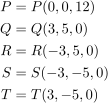
The pyramid above has a polygonal base, here the rectangle QRST, and an apex P, here the common vertex of triangles \triangle PTQ, \triangle PQR, \triangle PRS, and \triangle PST. The altitude is based on the origin O. To suit our coordinates to this problem, we write

\begin{aligned} P & =P(0,0,12) \\ Q & =Q(3,5,0) \\ R & =R(-3,5,0) \\ S & =S(-3,-5,0) \\ T & =T(3,-5,0) \\ \end{aligned}

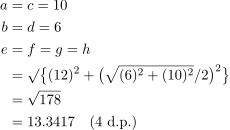
such that

\begin{aligned} a & = c = 10 \\ b & = d = 6 \\ e & = f = g = h \\ & = \surd \big\{ (12)^2 + \big( \sqrt{(6)^2+(10)^2}/2\big)^2 \big\} \\ & = \sqrt{178} \\ & = 13.3417\quad\textrm{(4 d.p.)} \\ \end{aligned}

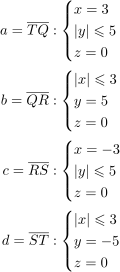
For the edges of its base, write

\begin{aligned} a=\overline{TQ} & :\begin{cases} x=3 \\ |y|\leqslant 5 \\ z=0 \\ \end{cases} \\ b=\overline{QR} & :\begin{cases} |x|\leqslant 3 \\ y=5 \\ z=0 \\ \end{cases} \\ c=\overline{RS} & :\begin{cases} x=-3 \\ |y|\leqslant 5 \\ z=0 \\ \end{cases} \\ d=\overline{ST}& :\begin{cases} |x|\leqslant 3 \\ y=-5 \\ z=0 \\ \end{cases} \\ \end{aligned}

and for, the lateral, edge e=\overline{PQ}:

\begin{aligned} \frac{x-3}{0-3} & = \frac{y-5}{0-5} = \frac{z-0}{12-0} \\ \end{aligned}

edge f=\overline{PR}:

\begin{aligned} \frac{x-(-3)}{0-(-3)} & = \frac{y-5}{0-5} = \frac{z-0}{12-0} \\ \end{aligned}

edge g=\overline{PS}:

\begin{aligned} \frac{x-(-3)}{0-(-3)} & = \frac{y-(-5)}{0-(-5)} = \frac{z-0}{12-0} \\ \end{aligned}

and edge h=\overline{PT}:

\begin{aligned} \frac{x-3}{0-3} & = \frac{y-(-5)}{0-(-5)} = \frac{z-0}{12-0} \\ \end{aligned}

For lateral surface A enclosed by edges a, h, and e, write

A(x,y,z):\begin{cases} (x,y,z)\in [0,3]\times [-5,5]\times [0,12] \\ \textrm{s.t. }\displaystyle{\frac{|y|}{5}\leqslant \frac{x}{3}=1-\frac{z}{12}} \\ \end{cases}

for lateral surface B by edges b, e, and f, write:

B(x,y,z):\begin{cases} (x,y,z)\in [-3,3]\times [0,5]\times [0,12] \\ \textrm{s.t. }\displaystyle{\frac{|x|}{3}\leqslant \frac{y}{5}=1-\frac{z}{12}} \\ \end{cases}

for lateral surface C by edges c, f, and g, write:

C(x,y,z):\begin{cases} (x,y,z)\in [-3,0]\times [-5,5]\times [0,12] \\ \textrm{s.t. }\displaystyle{\frac{|y|}{5}\leqslant -\frac{x}{3}=1-\frac{z}{12}} \\ \end{cases}

for lateral surface D by edges d, g, and h, write:

D(x,y,z):\begin{cases} (x,y,z)\in [-3,3]\times [-5,0]\times [0,12] \\ \textrm{s.t. }\displaystyle{\frac{|x|}{3}\leqslant -\frac{y}{5}=1-\frac{z}{12}} \\ \end{cases}

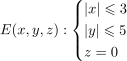
and for base E by edges a, b, c, and d:

write

E(x,y,z):\begin{cases} |x|\leqslant 3 \\ |y|\leqslant 5 \\ z=0 \\ \end{cases}


This problem is not to be attempted.

202405061531 不求甚解

埃及人:符號造形,意由物事。獨體曰文,合體曰字。華語以外,率歸拼音。

中國人:請以「相看兩不厭」的「相看」承言。相者,左木右目,曲直長短,為之匠察良材;看者,上手下目,日頭掁眼,即便掌搭涼篷。

日本人:「是藥三分毒」尚有通理;敝國「今度(こんど)」是「以後、下一次」、「留守(るす)」是「外出、不在家」,則相去霄壤,殊為難解。

中國人:《大學》的「止於至善」、《易經》的「既濟」然後「未濟」,也只可意會,非以言象。

202404111733 潛移默化

泰國人:凡泰文字母皆以一物命名,熟誦可詳:ก ไก่ ko kai、ข ไข่ kho khai、ฃ ขวด kho khuat、ค ควาย kho khwai、ฅ คน kho khon、ฆ ระฆัง kho rakhang、ง งู ngo ngu、จ จาน cho chan、ฉ ฉิ่ง cho ching、ช ช้าง cho chang、ซ โซ่ so so、ฌ เฌอ cho choe、ญ หญิง yo ying、ฎ ชฎา do chada、ฏ ปฏัก to patak、ฐ ฐาน tho than、ฑ มณโฑ tho montho、ฒ ผู้เฒ่า tho phu thao、ณ เณร no nen、ด เด็ก do dek、ต เต่า to tao、ถ ถุง tho thung、ท ทหาร tho thahan、ธ ธง tho thong、น หนู no nu、บ ใบไม้ bo baimai、ป ปลา po pla、ผ ผึ้ง pho phueng、ฝ ฝา fo fa、พ พาน pho phan、ฟ ฟัน fo fan、ภ สำเภา pho samphao、ม ม้า mo ma、ย ยักษ์ yo yak、ร เรือ ro ruea、ล ลิง lo ling、ว แหวน wo waen、ศ ศาลา so sala、ษ ฤๅษี so ruesi、ส เสือ so suea、ห หีบ ho hip、ฬ จุฬา lo chula、อ อ่าง o ang、ฮ นกฮูก ho nok huk

中國人:1 – 鉛筆一(壹);2 – 鴨子二(貳);3 – 耳仔三(參);4 – 旗子四(肆);5 – 魚鈎五(伍);6 – 煙斗六(陸);7 – 高腳七(柒);8 – 葫蘆八(捌);9 – 蝌蚪九(玖);10 – 腸蛋十(拾)。然而,「道生一、一生二、二生三、三生萬物」,自然或數由 0 – 〇(零)開始。

202403191813 饔飧

中國人:日出而作,朝飯嘗飽,過中不食,日入而息,是上古先民的生活寫照。

英國人:Breakfast (to break one’s fast) 者,一吞一嚥;lunch (= noon + shench) 者,一啖一啜;supper (to sup/soup) 者,一咀一嚼。水穀精微,以固體難消化、流質易吸收。

法國人:Le déjeuner (= dé- +‎ jeûner) 本與 to break fast 同義;不過我輩晏起,又忌空腹食大餐,故襲以早餐為 le petit déjeuner,午餐為 le déjeuner。(注:petit = little)

202403051417 Revision Paper XIII Q10

To a man walking along a horizontal road at 1.5\,\mathrm{m/s} the rain is coming towards him and appears to be falling at 3.5\,\mathrm{m/s} at an angle of 30^\circ to the vertical. Find, by calculation or drawing, the true speed of the rain and the angle this makes with the vertical.

Extracted from A. Godman & J. F. Talbert. (1973). Additional Mathematics Pure and Applied in SI Units.


Setup.

As always, visualise the scene.

Two observers in different reference frames S and S' can give different descriptions of the same physical event (x,y,z,t). Where something is depends on when you check on it and on the movement of your own reference frame. Time and space are not independent quantities; they are related by relative velocity.

If S' is moving with speed v in the positive x-direction relative to S, then its coordinates in S' are

\begin{aligned} x' & = x-vt \\ y' & = y \\ z' & = z \\ t' & = t \\ \end{aligned}

and if an object has velocity \mathbf{u} in frame S, then velocity \mathbf{u}' of the object in frame S' is

\begin{aligned} u' & = \frac{\mathrm{d}x'(t)}{\mathrm{d}t} \\ & = \frac{\mathrm{d}}{\mathrm{d}t}(x(t)-vt) \\ & = \frac{\mathrm{d}x(t)}{\mathrm{d}t}-v \\ & = u-v \\ \end{aligned}

in magnitude.

Cf. Ming-chang Chen. (2017). NTHU EE211000 Modern Physics.


Roughwork.

Recall that a triangle is uniquely determined by not all but some of its three sides and three angles:

\begin{aligned} \textrm{SSS} & \quad \textrm{(Side-Side-Side)} \\ \textrm{SAS} & \quad \textrm{(Side-Angle-Side)} \\ \textrm{ASA} & \quad \textrm{(Angle-Side-Angle)} \\ \textrm{AAS} & \quad \textrm{(Angle-Angle-Side)} \\ \textrm{RHS} & \quad \textrm{(Right angle-Hypotenus-Side)} \\ \end{aligned}

Hence, provided in part

\begin{aligned} u' & = 3.5 \\ v & = 1.5 \\ \measuredangle (u',v) & = 60^\circ \\ \end{aligned}

we can supply in whole

\begin{aligned} u & = \cdots \\ \measuredangle (v,u) & = \cdots \\ \measuredangle (u,u') & = \cdots \\ \end{aligned}


This problem is not to be attempted.

202403041703 Revision Paper II Q10

A body travels in a straight line but its speed at any time does not exceed 5\,\mathrm{m\,s^{-1}}. If it accelerates and decelerates at 2\,\mathrm{m\,s^{-2}}, find the shortest time needed to cover a distance of 30\,\mathrm{m} from rest to rest.

Extracted from A. Godman & J. F. Talbert. (1973). Additional Mathematics Pure and Applied in SI Units.


Roughwork.

For avoidance of physics is one by mathematical formulation.


\begin{aligned} v & = u+at \\ 5 & = 0 + 2t_1 \\ \textrm{Eq. (1):}\qquad\qquad t_1 & = 2.5\,\mathrm{s} \\ & \\ v & = u+at \\ 0 & = 5-2(t_3-t_2) \\ \textrm{Eq. (2):}\qquad t_3-t_2 & = 2.5\,\mathrm{s} \\ & \\ s & = \frac{((t_2-t_1)+(t_3-0))(v_{\textrm{max}})}{2} \\ 30 & = \frac{(t_2-2.5+t_3)(5)}{2} \\ \textrm{Eq. (3):}\qquad t_2+t_3 & = 14.5\,\mathrm{s} \\ \end{aligned}

What is t_3 then, in unit \textrm{sec}?


This problem is not to be attempted.

202403011713 Revision Paper IV Q8

Ball A (mass 3\,\mathrm{kg}) is travelling due east in a straight line with speed 5\,\mathrm{m\,s^{-1}} when it collides with ball B (mass 4\,\mathrm{kg}) which was at rest. After the collision both balls move east with relative speed 2.5\,\mathrm{m\,s^{-1}}. Find their separate speeds.

Extracted from A. Godman & J. F. Talbert. (1973). Additional Mathematics Pure and Applied in SI Units.


Roughwork.

Take eastward positive.

\begin{aligned} \textrm{CoM:}\qquad p_{\textrm{initial}} & = p_{\textrm{final}} \\ \sum_{i=A}^{B}m_iu_i & = \sum_{i=A}^{B}m_iv_i \\ m_Au_A+m_Bu_B & = m_Av_A+m_Bv_B \\ (3)(5)+(4)(0) & = (3)(v_A)+(4)(v_B) \\ \textrm{Eq. (1):}\qquad\quad 15 & = 3v_A+4v_B \\ \textrm{Eq. (1)':}\qquad\quad v_A & = 5-\frac{4}{3}v_B \\ \end{aligned}

\begin{aligned} \textrm{CoE:}\qquad\textrm{KE}_{\textrm{initial}} & = \textrm{KE}_{\textrm{final}} \\ \sum_{i=A}^{B}\frac{1}{2}m_iu_i^2 & = \sum_{i=A}^{B}\frac{1}{2}m_iv_i^2 \\ m_Au_A^2+m_Bu_B^2 & = m_Av_A^2+m_Bv_B^2 \\ (3)(5)^2 + (4)(0)^2 & = (3)(v_A)^2 + (4)(v_B)^2 \\ \textrm{Eq. (2):}\qquad\qquad 75 & = 3v_A^2 + 4v_B^2 \\ \end{aligned}

\begin{aligned} 75 & = 3\bigg( 5-\frac{4}{3}v_B\bigg)^2 + 4v_B^2 \\ 25 & = \bigg( 25 - \frac{40}{3}v_B + \frac{16}{9}v_B^2\bigg) + \frac{4}{3}v_B^2 \\ 0 & = v_B\bigg( -\frac{40}{3} + \frac{28}{9}v_B \bigg) \\ v_B & = 0\textrm{ \scriptsize{OR} }\frac{30}{7} \\ v_A & = \bigg[ 5-\frac{4}{3}(0)\bigg] \textrm{ \scriptsize{OR} }\bigg[ 5-\frac{4}{3}\bigg(\frac{30}{7}\bigg)\bigg] \\ & = 5\textrm{ \scriptsize{OR} }-\frac{5}{7} \\ \end{aligned}

(v_A,v_B) = \bigg( \displaystyle{-\frac{5}{7} , \frac{30}{7}}\bigg) \qquad \text{}^*\textrm{(5,0) is rejected.}

This contradicts with v_B-2.5=v_A>0. As the law of conservation of momentum is always observed, herein has energy \textrm{\scriptsize{NOT}} been conserved.


This problem is not to be attempted.

202204051215 Dot grammar one

Linguistics can be summarized in one line:

\textrm{\scriptsize{MOOD}}\triangleright\textrm{\scriptsize{METRE}}\triangleright\textrm{\scriptsize{TONE}}\triangleright\textrm{\scriptsize{VOWEL}}\triangleright\textrm{\scriptsize{CONSONANT}}

and the rest is literature.


In order to listen carefully to whatever tongue someone else is speaking, one must lend an ear first to his mood, comes next to his metre, then to his tone, and lastly to the vowels, followed by the consonants.

\textrm{\scriptsize{MOOD}}\simeq\textrm{\scriptsize{MODE}}\simeq\textrm{\scriptsize{SOUND}}\simeq\textrm{\scriptsize{AFFECT}}\simeq\textrm{\scriptsize{FEEL}}

Any equivalence relation between human beings, e.g., equality, must be reflexive, symmetric, and transitive. Without even knowing perfectly what somebody else is trying to convey, any Tom, Dick, or Harry can conceive whether the speaker feels happy, angry, glad, or sad. As follow are grammatical moods, for instance, the indicative mood, the imperative mood, the infinitive mood, and the subjunctive mood, as in English.

\textrm{\scriptsize{METRE}}\simeq\textrm{\scriptsize{SYLLABLE}}\simeq\textrm{\scriptsize{BEAT}}\simeq\textrm{\scriptsize{RHYTHM}}\simeq\textrm{\scriptsize{SPEECH}}

For anything said, you can count the syllables, tap the beat, hear the rhythm, or imitate the speech. You can make sense of the bites of word, the sets of phrase, and the parts of speech; you may also parse a sentence and analyse the syntax; furthermore, you will differentiate between an agglutinative and an inflectional language.

\textrm{\scriptsize{TONE}}\simeq\textrm{\scriptsize{PITCH}}\simeq\textrm{\scriptsize{VOICE}}\simeq\textrm{\scriptsize{ACCENT}}\simeq\textrm{\scriptsize{TUNE}}

There are high, middle, and low pitches, as in Thai; stressed and unstressed syllables, as in German; primary or secondary accents, as in Italian; penult or antepenult, as in Latin; the acute, the grave, or the circumflex, as in French; the upper, the lower, the even, and the oblique tones, as in Mandarin; the rise and fall, the sharp or flat, of tunes, for the affirmative, the negative, the interrogative, or the exclamatory tones, as in Russian; and a deep, a loud, a soft, a shrill, or a thick voice, as annotated by diacritics.

\textrm{\scriptsize{VOWEL}}\simeq\textrm{\scriptsize{UTTER}}\simeq\textrm{\scriptsize{ENUNCIATE}}\simeq\textrm{\scriptsize{RHYME}}\simeq\textrm{\scriptsize{BREATH}}

All are based on a, e, i, o, u. There are open vowels and close vowels; short or long vowels; front, central, or back vowels; written or spoken vowels; monophthong, diphthong, and triphthong; masculine, feminine, or neuter vowels, as in vowel harmony, etc.

\textrm{\scriptsize{CONSONANTS}}\simeq\textrm{\scriptsize{UNITS}}\simeq\textrm{\scriptsize{CVC}}\simeq\textrm{\scriptsize{ORGAN}}\simeq\textrm{\scriptsize{FLOW}}

Consonants classified by units are phoneme, allophone, and morpheme; by positions initial, medial, and final; by organs fricatives, nasals, uvular, glottal, labial, alveolar, and velar; and by the flow of air aspirated and unaspirated, i.e., soft and hard.

Only after you have learnt to get your priorities straight (I repeat: first mood, second metre, third tone, fourth vowels, and fifth consonants), then you will manage to attend my every word. That said, you shall have a gift for tongues.

In no time, you will be caught up with such grammatical terms as aspect, tense, voice, mood, case, class, gender, number, agreement, Sandhi, mutation, liaison, etymology, lexicology, orthography, alphabet, script, character, and what not, so much so that you are divided between literature and linguistics, out of which I prefer the former, anyway.

The every essence of literature is the war between emotion and intellect.

—Isaac Bashevis Singer

Qua grammarian, his sentiments of art and science in grammar lay to rest the struggle, thanks to i. nomenclature (e.g. synonym, antonym, metonym, and homonym); ii. rhetoric (e.g. diction, euphemism, idioms, phraseology, and proverbs); iii. figures of speech (e.g. alliteration, anastrophe, assonance, ellipsis, inversion, metaphor, and simile); iv. composition (e.g. discourse, narration, orchestration, plot, and style); and v. translation and interpretation (e.g. figurative, free, literal, and verbatim).