202402051319 Pastime Exercise 009

The blogger claims no originality of his problem below.


On a rollover road,

a vehicle performs circular motion:

Discuss how the driver could prevent a traffic accident.


Roughwork.

Take positive both, the angle \theta in an anti-clockwise direction, and the displacement \mathbf{s} in a rightward and an upward direction.
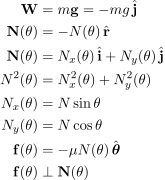
\begin{aligned} \mathbf{W} & = m\mathbf{g} = -mg\,\hat{\mathbf{j}} \\ \mathbf{N}(\theta ) & = -N(\theta )\,\hat{\mathbf{r}} \\ \mathbf{N}(\theta ) & = N_x(\theta )\,\hat{\mathbf{i}} + N_y(\theta )\,\hat{\mathbf{j}} \\ N^2(\theta ) & = N_x^2(\theta )+N_y^2(\theta ) \\ N_x(\theta ) & = N\sin\theta \\ N_y(\theta ) & = N\cos\theta \\ \mathbf{f}(\theta ) & = -\mu N(\theta )\,\hat{\boldsymbol{\theta}} \\ \mathbf{f}(\theta ) & \perp \mathbf{N}(\theta ) \\ \end{aligned}

In order for the vehicle not to leave the track, the radius of curvature r \textrm{\scriptsize{MUST}} be kept constant, i.e., r=R(=\textrm{Const.}).

Recall, in uniform circular motion there isn’t any (angular) acceleration in angular velocity, i.e.,
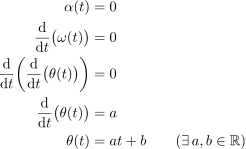
\begin{aligned} \alpha (t) & = 0 \\ \frac{\mathrm{d}}{\mathrm{d}t}\big(\omega (t)\big) & = 0 \\ \frac{\mathrm{d}}{\mathrm{d}t}\bigg( \frac{\mathrm{d}}{\mathrm{d}t}\big(\theta (t)\big)\bigg) & = 0 \\ \frac{\mathrm{d}}{\mathrm{d}t}\big(\theta (t)\big) & = a \\ \theta (t) & = at+b\qquad (\exists\, a,b\in\mathbb{R}) \\ \end{aligned}

If uniform circular motion is \textrm{\scriptsize{NOT}} assumed,

i.e., \alpha \neq 0\textrm{ \scriptsize{OR} }r\neq\textrm{Const.},

then angular displacement \theta (t) wrt time t will be a polynomial in an indeterminate t of degree 2 or higher,

i.e., O(t)=O(t^c)\qquad\exists\, c\, (\in\mathbb{Z}^+)\geqslant 2.

Angular acceleration \boldsymbol{\alpha} is less often mentioned than is its parallel tangential acceleration \mathbf{a}_{\parallel}\, (=r\boldsymbol{\alpha}) as the pair to centripetal (/centrifugal) acceleration \mathbf{a}_{\perp}.

By Newton 2nd Law, write

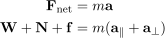
\begin{aligned} \mathbf{F}_{\textrm{net}} & = m\mathbf{a} \\ \mathbf{W}+\mathbf{N}+\mathbf{f} & = m(\mathbf{a}_{\parallel}+\mathbf{a}_{\perp}) \\ \end{aligned}

The presence of a centripetal acceleration, i.e., \exists\,\mathbf{a}_{\perp}\neq\mathbf{0}, is necessary for any circular motion, be it uniform or not; but not sufficient for the absence of a tangential acceleration \forall\,\mathbf{a}_{\parallel}= 0 (why?). One knows instinctively, that the vehicle should possess a minimum angular speed \min (\omega ) to do this dangerous stunt. And so much the better if beyond this bound \min (\omega )\leqslant \omega \leqslant \max (\omega ) \ll c one has all degrees of freedom.

By definition,
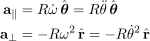
\begin{aligned} \mathbf{a}_{\parallel} & = R\dot{\omega}\,\hat{\boldsymbol{\theta}} = R\ddot{\theta}\,\hat{\boldsymbol{\theta}} \\ \mathbf{a}_{\perp} & = -R\omega^2\,\hat{\mathbf{r}} = -R\dot{\theta}^2\,\hat{\mathbf{r}} \\ \end{aligned}

Stepping on and off the accelerator (/gas pedal), however delicately, is \textrm{\scriptsize{NOT}} designed to keep a constant acceleration for the gear.


This problem is not to be attempted.

202311061327 Exercise 36.11

Two plane mirrors are parallel to each other and spaced 20\,\mathrm{cm} apart. A luminous point is placed between them and 5\,\mathrm{cm} from one mirror. Determine the distance from each mirror of the three nearest images in each.

Extracted from Daniel Schaum. (1961). Schaum’s Ouline of Theory and Problems of College Physics. (6e)


Roughwork.

Ans. 5,\, 35,\, 45\,\mathrm{cm}; 15,\, 25,\, 55\,\mathrm{cm}


This problem is not to be attempted.

202210141016 Solution to 1975-CE-AMATH-II-XX

In the Figure below, OABC is a square. D and E are the mid-points of AB and BC respectively. Let the vector \overrightarrow{OA} be represented by \mathbf{i} and \overrightarrow{OC} by \mathbf{j}.

(a) Express \overrightarrow{OD} in terms of \mathbf{i} and \mathbf{j}.
(b) Express \overrightarrow{OE} in terms of \mathbf{i} and \mathbf{j}.
(c) Evaluate \displaystyle{\frac{\overrightarrow{OD}\cdot\overrightarrow{OE}}{\left|\overrightarrow{OD}\right|\left|\overrightarrow{OE}\right|}}, where \left|\overrightarrow{OD}\right| and \left|\overrightarrow{OE}\right| are the magnitudes of \overrightarrow{OD} and \overrightarrow{OE} respectively.
(d) Hence calculate \angle DOE.


Notation.

In what follow vectors will be typographically boldfaced, i.e.,

\begin{aligned} \mathbf{OA} & := \overrightarrow{OA} \\ \mathbf{OC} & := \overrightarrow{OC} \\ \mathbf{OD} & := \overrightarrow{OD} \\ \mathbf{OE} & := \overrightarrow{OE} \\ \end{aligned}

etc., in place of an overhead arrow \overrightarrow{[\cdot ]} more than usually handwritten, the direction of which (e.g. \overrightarrow{AB}) is intended an initial point (e.g. A) make to a terminal point (e.g. B).


(a)

\begin{aligned} \mathbf{OD} & = \mathbf{OA} + \mathbf{AD} \\ & = \mathbf{OA} + \frac{1}{2}\mathbf{AB} \\ \dots\enspace\because\enspace & \mathbf{AB}=\mathbf{OC}\enspace\dots \\ & = \mathbf{OA} + \frac{1}{2}\mathbf{OC} \\ & = \mathbf{i} + \frac{1}{2}\mathbf{j} \\ \end{aligned}

(b)

\begin{aligned} \mathbf{OE} & = \mathbf{OC} + \mathbf{CE} \\ & = \mathbf{OC} + \frac{1}{2}\mathbf{CB} \\ \dots\enspace\because\enspace & \mathbf{CB}=\mathbf{OA}\enspace\dots \\ & = \mathbf{OC} + \frac{1}{2}\mathbf{OA} \\ & = \mathbf{j} + \frac{1}{2}\mathbf{i} \\ \end{aligned}

(c) and (d) are not chosen.

202008181129 Homework 1 (Q1)

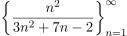
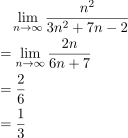
Solve for z\in \mathbb{C} in the following equations:

(a) z^4+z^3+z^2+z+1=0,

(b) 3z^3+29z^2+497z-169=0.


 Attempts.

(a) Take notice that z\neq 1. Try and see having both sides of the equation multiplied by (1-z),

\begin{aligned} 0 & = (1-z)(z^4+z^3+z^2+z+1)  \\ 0 & = 1-z^5  \\ z^5 & = 1 = 1(1+0\,\mathrm{i}) \\ z^5 & = e^{\mathrm{i}(2n\pi)}\qquad \qquad \textrm{where }n=0,1,2,3,4. \\ \end{aligned}

\therefore z=e^{\mathrm{i}(\frac{2n\pi}{5})}.

(n=0 is rejected for z\neq 1=e^{\mathrm{i}(\frac{2(0)\pi}{5})}.)

In polar expression z=e^{\mathrm{i\frac{2\pi}{5}}},\, e^{\mathrm{i\frac{4\pi}{5}}},\, e^{\mathrm{i\frac{6\pi}{5}}},\, e^{\mathrm{i\frac{8\pi}{5}}}.

In trigonometric expression

z=\mathrm{cis}(\frac{2n\pi}{5})=\mathrm{cis}(\frac{2\pi}{5}),\, \mathrm{cis}(\frac{4\pi}{5}),\, \mathrm{cis}(\frac{6\pi}{5}),\, \mathrm{cis}(\frac{8\pi}{5})

I.e.,

\begin{aligned} z^1 & = \cos 72^\circ +\mathrm{i}\sin 72^\circ = \mathrm{cis\,} 72^\circ \\ z^2 & = \cos 144^\circ +\mathrm{i}\sin 144^\circ = \mathrm{cis\,} 144^\circ \\ z^3 & = \cos 216^\circ +\mathrm{i}\sin 216^\circ = \mathrm{cis\,} 216^\circ \\ z^4 & = \cos 288^\circ +\mathrm{i}\sin 288^\circ = \mathrm{cis\,} 288^\circ \\ \end{aligned}

(b)Let f(z)=3z^3+29z^2+497z-169=0. Then (3z-1) is a factor, because \frac{1}{3} is a zero (i.e., f(\frac{1}{3}) = \frac{1}{9}+\frac{29}{9}+\frac{497}{3}-169=0).

\begin{aligned} f(z) & =(3z-1)(z^2+10z+169) \\ & = (3z-1)g(z) \\ \end{aligned}

When g(z)=0, z=\displaystyle{\frac{-10\pm \sqrt{100-4(169)}}{2}}=-5\pm 12\,\mathrm{i}.

The solution to f(z)=0 gives z_1=\frac{1}{3}, z_2=-5+12\,\mathrm{i}, and z_3=-5-12\,\mathrm{i}.

202004240521 Homework 1 (Q5)

Estimate the apparent magnitude of Mercury and Venus when the Earth-planet-Sun forms a right angle. (Assuming the planet reflects 50% of solar light.)


Setup.

Recall the apparent magnitude m_b, the Sun’s luminosity being the reference, is given by the formula

m_b=-0.23+5\log D-2.5\log (L/L_{\odot}),

where D is the distance (in parsec) from the source to the Earth, L the luminosity of the source, and L_\odot =3.8\times 10^{33}\,\mathrm{erg\, s^{-1}} the solar luminosity.


CASE I of Mercury

According to http://coolcosmos.ipac.caltech.edu/ask/25-How-far-is-Mercury-from-Earth-, the average distance between Mercury and Earth is 0.0000024954 pc. From Wikipedia on Mercury (planet), the mean radius of Mercury R_{\textrm{Mercury}} is 2439.7\pm 1\,\mathrm{km}.

The luminosity of Mercury L_{\textrm{Mercury}} due to reflection of sunlight, is related to the solar luminosity L_\odot =3.8\times 10^{33}\,\mathrm{erg\, s^{-1}} by
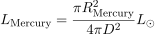
L_{\textrm{Mercury}}=\displaystyle{\frac{\pi R^2_{\textrm{Mercury}}}{4\pi D^2}}L_\odot,

where the Sun-Earth distance D is one astronomical unit 1\,\mathrm{AU}=1.5\times 10^{13}\,\mathrm{cm}.

Thence one computes

\begin{aligned} L_{\textrm{Mercury}} & = \displaystyle{\frac{\pi (2.4397\times 10^8)^2}{4\pi (1.5\times 10^{13})^2}}\times 3.8\times 10^{33} \\ & = 2.513124127\times 10^{23}\enspace \mathrm{erg\, s^{-1}} \end{aligned}

Thus, the apparent magnitude m_{b,\textrm{mercury}} of Mercury is

\begin{aligned} m_{b,\textrm{mercury}} & =-0.23+5\log (0.0000024954)-2.5\log (6.613484544\times 10^{-11})\\ & = -2.795375004 \end{aligned}


CASE II of Venus

According to http://coolcosmos.ipac.caltech.edu/ask/52-How-far-away-is-Venus-from-Earth-, the average distance between Venus and Earth is 0.0000012963 pc. From Wikipedia on Venus, the mean radius of Venus R_{\textrm{Venus}} is 6051.8\pm 1\,\mathrm{km}.

The luminosity of Venus L_{\textrm{Venus}} due to reflection of sunlight, is related to the solar luminosity L_\odot =3.8\times 10^{33}\,\mathrm{erg\, s^{-1}} by
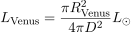
L_{\textrm{Venus}}=\displaystyle{\frac{\pi R^2_{\textrm{Venus}}}{4\pi D^2}}L_\odot,

where the Sun-Earth distance D is one astronomical unit 1\,\mathrm{AU}=1.5\times 10^{13}\,\mathrm{cm}.

Thence one computes

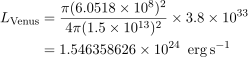
\begin{aligned} L_{\textrm{Venus}} & = \displaystyle{\frac{\pi (6.0518\times 10^8)^2}{4\pi (1.5\times 10^{13})^2}}\times 3.8\times 10^{33} \\ & = 1.546358626\times 10^{24}\enspace \mathrm{erg\, s^{-1}} \end{aligned}

Thus, the apparent magnitude m_{b,\textrm{venus}} of Venus is

\begin{aligned} m_{b,\textrm{venus}} & =-0.23+5\log (0.0000012963)-2.5\log (4.069364804\times 10^{-10})\\ & = -6.190288956 \end{aligned}


Correction.

Without heed to the 50% reduction of solar light reflection,
this problem need be redone.

201902190842 Electric field representation

The blogger claims no originality of his question posted here.

Think of a field in some representation other than a diagram of field lines. For instance, suppose any point in a field is assigned a number to its field strength magnitude, but the direction of field strength of each point is not indicated. Now, could we deduce a rough picture of the (vector) E-field from these (scalar) numbers, provided that we know the distribution of these numbers and the position of charges?

Visualizing_the_Efield_by_numbers_distribution

In the figure, A, B and C are charges of unknown charge quantities and sign. Each single-digit number at a point represents the magnitude of E-field strength at that point. For example, 6 stands for 6\,\mathrm{N/C}, 0 stands for zero E-field, i.e., a neutral point. By deducing from the figure, determine which of the following statements is/are correct.

(1) Charge quantity of A is larger than that of either B or C.
(2) Charge quantity of B equals charge quantity of C.
(3) Charge A is positive. Charge B and charge C are both negative.

A. (1) only
B. (2) only
C. (1) and (2) only
D. (1), (2), and (3)


Answer. D