
Estimate the apparent magnitude of Mercury and Venus when the Earth-planet-Sun forms a right angle. (Assuming the planet reflects 50% of solar light.)
Setup.
Recall the apparent magnitude  , the Sun’s luminosity being the reference, is given by the formula
 ,
,
where  is the distance (in parsec) from the source to the Earth,
  the luminosity of the source, and
  the solar luminosity.
CASE I of Mercury
According to http://coolcosmos.ipac.caltech.edu/ask/25-How-far-is-Mercury-from-Earth-, the average distance between Mercury and Earth is 0.0000024954 pc. From Wikipedia on Mercury (planet), the mean radius of Mercury  is
is  .
.
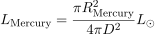
The luminosity of Mercury  due to reflection of sunlight, is related to the solar luminosity by
 ,
,
where the Sun-Earth distance is one astronomical unit  .
.
Thence one computes

Thus, the apparent magnitude  of Mercury is

CASE II of Venus
According to http://coolcosmos.ipac.caltech.edu/ask/52-How-far-away-is-Venus-from-Earth-, the average distance between Venus and Earth is 0.0000012963 pc. From Wikipedia on Venus, the mean radius of Venus  is
is  .
.
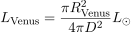
The luminosity of Venus  due to reflection of sunlight, is related to the solar luminosity by
 ,
,
where the Sun-Earth distance is one astronomical unit .
Thence one computes
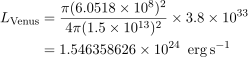
Thus, the apparent magnitude  of Venus is

Correction.
Without heed to the 50% reduction of solar light reflection,

this problem need be redone.