202301041207 Solution to 1969-HL-PHY-2

Derive the relation between Young’s modulus Y and Hooke’s constant k for a uniform steel wire of cross-section A and length L.

Two uniform wires of equal cross-section have the same Young’s modulus Y but different Hooke’s constants k_1 and k_2. If the two wires are connected in series to form a new wire, compare Young’s modulus of the connected wire with that of the original wires, and find Hooke’s constant of the connected wire in terms of k_1 and k_2.


Roughwork.

\displaystyle{\textrm{Young's modulus (}Y\textrm{)}=\frac{\textrm{Stress (}\sigma\textrm{)}}{\textrm{Strain (}\varepsilon\textrm{)}}}

Y \equiv \displaystyle{\frac{\sigma}{\varepsilon} = \frac{F/A}{\Delta l/L} = \frac{FL}{A\Delta l}\quad \textrm{\scriptsize{OR}}\quad \displaystyle{F = \frac{YA\Delta l}{L}}

Lemma.

Hooke’s law for a stretched wire:

\displaystyle{F=\bigg(\frac{YA}{L}\bigg)\Delta l=kx}

such that

\displaystyle{k\equiv \frac{YA}{L}}\qquad\because\enspace x\equiv \Delta l.

Wikipedia on Young’s modulus

\begin{aligned} \Delta l' & = \Delta l_1+\Delta l_2 \\ \frac{F}{A'}\frac{L'}{Y'} & = \frac{F}{A}\bigg(\frac{L_1}{Y_1}+\frac{L_2}{Y_2}\bigg) \\ \because &\enspace \begin{cases} A' = A \\ Y_1 =Y_2 =Y\\ L' =L_1+L_2 \\ \end{cases} \\ \therefore& \quad Y'=Y \\ \end{aligned}

Hence

\begin{aligned} k' & = \frac{Y'A'}{L'} \\ & = \frac{YA}{L_1+L_2} \\ & = \bigg(\frac{L_1}{YA}+\frac{L_2}{YA}\bigg)^{-1} \\ & = \bigg(\frac{1}{k_1}+\frac{1}{k_2}\bigg)^{-1} \\ & = \bigg(\frac{k_1+k_2}{k_1k_2}\bigg)^{-1} \\ & = \frac{k_1k_2}{k_1+k_2} \\ \end{aligned}

This problem is not to be attempted.

202212091158 Solution to 1965-HL-PHY-3

(a) State the three different types of heat transfer, and give a simple example for each type of heat transfer.
(b) Calculate the amount of heat required to change 10\,\mathrm{g} of ice in a sealed container of volume 1\,\mathrm{L} and pressure at 1\,\mathrm{atm} at -20\,^\circ\mathrm{C} to steam at 120\,^\circ\mathrm{C}. (Neglect the heat absorbed by the air and the container. The specific heat of ice and steam is 0.5\,\mathrm{cal\,g^{-1}\,^\circ C^{-1}}). What is the pressure inside the container expressed in atmospheric pressure, when the 10\,\mathrm{g} of ice is completely changed to steam at 120\,^\circ\mathrm{C}?


Roughwork.

(a) Skip it.

(b) Stuck. Any equation of state f(P,V,T)=0 as may well be applicable to solids and liquids as the ideal gas law PV=nRT to gases, lacking the enthalpies of fusion and vaporisation unknown?

(to be continued)

202212071217 Solution to 1971-HL-PHY-I-7

The figure below shows a three-dimensional network in the form of a pyramid, in which A is the apex, and BCDE the square base.

Each of the eight edges of the pyramid is a wire of resistance 1\,\mathrm{\Omega}. A 12\,\mathrm{V} battery with internal resistance of 0.1\,\mathrm{\Omega} is connected across B and D. Calculate

(a) the power input of the network,
(b) the terminal voltage across the battery when current flows through the network, and
(c) the potential at the points B, C, D, and E if the apex A is earthed.


Roughwork.

Draw the circuit.

Label the potential.

Straighten the main.

Calculate the equivalent.

\begin{aligned} R_{\textrm{eq}} & = \big( R\parallel R\parallel R\big) + \big( R\parallel R\parallel R\big) \\ & = \frac{1}{\frac{1}{R}+\frac{1}{R}+\frac{1}{R}}\times 2 \\ & = \frac{2R}{3} \\ & = \frac{2(1)}{3} \\ & = \frac{2}{3}\,\mathrm{\Omega} \\ \end{aligned}

This problem is not to be attempted.

202212061213 Solution to 1976-HL-PHY-I-4

(a) A kettle of negligible heat capacity, full of liquid, was placed over a burner. It was found that the liquid, initially at a temperature of 297\,\mathrm{K}, reached the boiling point of 378\,\mathrm{K} in 9 minutes, and after another 60 minutes all the liquid in the kettle boiled away. Neglecting heat loss, calculate the latent heat of vaporisation of the liquid. Specific heat capacity of the liquid =\textrm{4,000}\,\mathrm{J\,kg^{-1}\,K^{-1}}.

(b) Describe another method to determine the latent heat of vaporisation of a liquid.


Roughwork.

(a)

Let P be the power of the burner, and m the mass of the liquid. Assume no heat loss to the surroundings, then

\begin{aligned} Pt = E & = Q = mc\Delta T \\ P\times 9(60) & = m\times 4000\times (378-297) \\ \frac{P}{m} & = 600 \\ \end{aligned}

Suppose for the liquid the latent heat of vaporisation is l_v, then

\begin{aligned} Pt = E & = Q = ml_v \\ P\times 60(60) & = ml_v \\ l_v & = 3600\times\bigg(\frac{P}{m}\bigg) \\ & = 3600\times (600) \\ & = 2.16\times 10^6\,\mathrm{J\,kg^{-1}} \\ \end{aligned}

(b) Left as an exercise to the reader.

202212021339 Solution to 1972-HL-PHY-I-2

A frictionless circular track of radius 15.3\,\mathrm{cm} is fixed vertically on the floor. A particle at the top of the track glides down from rest.

Find the height at which the particle will begin to leave the circular track. Calculate the horizontal and vertical components of the velocity with which the particle strikes the floor.


Roughwork.

Set up a coordinate system:

with an interface:

Write resolved x-, y-components of normal reaction N

\begin{aligned} N_x & = N\cos\theta = mg\sin 2\theta \\ N_y & = N\sin\theta =mg\sin^2\theta \\ \end{aligned}

For the particle to lose contact with the surface, necessarily there exists some largest possible angle \theta\in [0,90^\circ ) s.t.

N_x(\theta )\textrm{ \scriptsize{OR} }N_y(\theta )=0;

and sufficiently some smallest possible period t\in \Big[0, \sqrt{\frac{2R}{g}}\Big) s.t.

s_x^2(t)+s_y^2(t)>R^2

hereby SUVAT equations of motion do \textrm{\scriptsize{NOT}} apply because of non-uniform acceleration a(\theta ) depending on \theta, e.g.,

\begin{aligned} \textrm{Net }F_x = ma_x & = N_x \\ a_x(\theta ) & = g\sin 2\theta \\ \textrm{Net }F_y = ma_y & = W-N_y \\ a_y & = g-g\sin^2\theta \\ a_y(\theta ) & = g\cos^2\theta \\ \end{aligned}

By quotient rule,

\begin{aligned} \frac{\mathrm{d}}{\mathrm{d}\theta}\bigg(\frac{s_y(\theta)}{s_x(\theta )}\bigg) & = \frac{\mathrm{d}}{\mathrm{d}\theta} (\tan\theta )\\ \frac{s_x(\theta)v_y(\theta)-s_y(\theta)v_x(\theta)}{s_x^2(\theta)} & = \sec^2\theta \\ \end{aligned}

Try considering the Lagrangian \mathcal{L}=T-V by

\begin{aligned} T & = \frac{1}{2}m(\dot{s_x}^2+\dot{s_y}^2) \\ V & = mgs_y \\ \end{aligned}

will not work. Try instead mathematically, first by noting s=\sqrt{s_x^2+s_y^2} and \theta = s/R. On one hand, along s we have one equation of motion with initial boundary conditions:

\begin{aligned} 0 & =\frac{\mathrm{d}^2s}{\mathrm{d}t^2}-g\cos\bigg(\frac{s}{R}\bigg) \\ 0 & = \bigg[\frac{\mathrm{d}s}{\mathrm{d}t}\bigg]\bigg|_{t=0} \\ \frac{\pi R}{2} & = s(0) \\ \end{aligned}

on the other hand, along line of action of the centripetal force,

\begin{aligned} & F_\textrm{C} = \frac{m\dot{s}^2}{R} = mg\sin \bigg( \frac{s}{R} \bigg) \\ & \bigg(\frac{\mathrm{d}s}{\mathrm{d}t}\bigg)^2 - gR\sin\bigg(\frac{s}{R}\bigg) = 0 \\ \end{aligned}

we have one another. Then,

\begin{aligned} \frac{\mathrm{d}s}{\mathrm{d}t}\frac{\mathrm{d}^2s}{\mathrm{d}t^2}-g\frac{\mathrm{d}s}{\mathrm{d}t}\cos\bigg(\frac{s}{R}\bigg) & = 0 \\ \frac{\mathrm{d}s}{\mathrm{d}t}\frac{\mathrm{d}}{\mathrm{d}t}\bigg( \frac{\mathrm{d}s}{\mathrm{d}t}\bigg) -\frac{\mathrm{d}}{\mathrm{d}t}\bigg[ gR\sin\bigg(\frac{s}{R}\bigg)\bigg] & = 0 \\ \frac{\mathrm{d}}{\mathrm{d}t}\bigg[ \frac{1}{2}\bigg(\frac{\mathrm{d}s}{\mathrm{d}t}\bigg)^2 - gR\sin \bigg(\frac{s}{R}\bigg) \bigg] & = 0 \\ \end{aligned}

This problem is not to be attempted.

(discontinued)

202212020955 Solution to 1978-HL-PHY-II-4

A rectangular loop of length 0.2\,\mathrm{m} and width 0.1\,\mathrm{m}, carrying a steady current I of 2\,\mathrm{A} is hinged along the y-axis, and is situated in a uniform magnetic field \mathbf{B} of 0.5\,\mathrm{T} parallel to the x-axis.

If the plane of the loop makes an angle of 60^\circ with the xy plane,

(a) calculate the force exerted by the magnetic field on each side of the loop, and
(b) calculate the torque required to hold the loop in this position.


Roughwork.

Force on a current-carrying conductor in a magnetic field is in magnitude

\boxed{F=BIl\sin\theta}

its direction to be determined by Fleming’s left hand rule.

(a) Have in mind a picture as viewing cross-sectionally:

and as down the top:

where

\begin{aligned} F_1 = F_3 & = (0.5)(2)(0.2)\sin 90^\circ \\ F_2 = F_4 & = (0.5)(2)(0.1)\sin 60^\circ \\ \end{aligned}

(b) This part is not to be attempted.

202212011713 Solution to 1974-HL-PHY-I-2

A uniform ladder 6\,\mathrm{m} long and weighing 390\,\mathrm{N} rests with one end on the rough ground and the other end against a smooth wall. The ladder makes an angle of 60^\circ with the ground, and the coefficient of friction between the ladder and ground is 0.8.

(a) Draw a diagram to indicate the forces acting on the ladder.
(b) How far can a man weighing 980\,\mathrm{N} go up the ladder before the ladder begins to slip?


Roughwork.

(a)

Taking moment about the lower end of the ladder:

\begin{aligned} \textrm{Torque}_\textrm{clockwise}\,(\tau_{\circlearrowright}) & = \textrm{Torque}_\textrm{anticlockwise}\,(\tau_{\circlearrowleft}) \\ (W\cos\theta )(d/2) & = (N_2\sin\theta )(d) \\ \end{aligned}

whereas about its upper tip:

\begin{aligned} (N_1\cos\theta )(d)  & =(W\cos\theta )(d/2) + (f\sin\theta )(d) \\ \end{aligned}

we have two equations.

(b)

This part is not to be attempted.

202211241139 Solution to 1970-HL-PHY-I-4

Two spherical copper bulbs A and B are interconnected through a fine tube. The bulbs are filled with one mole of an ideal gas at temperature 27\,^\circ\mathrm{C}. The gas pressure is found to be one atmosphere, and the volume of bulb B is four times that of bulb A. Now bulb B is immersed in a bath at constant temperature 327\,^\circ\mathrm{C}, while bulb A is maintained at its original temperature. Find the final pressure inside the bulbs, assuming that the volume of the fine tube can be neglected. The coefficient of linear expansion of copper is given as 2\times 10^{-5} per degree Celsius.


Roughwork.

For isotropic materials the volumetric thermal expansion coefficient is three times the linear coefficient:

\alpha_V=3\alpha_L

Wikipedia on Thermal Expansion

Initially,

\begin{aligned} P(V_A+V_B) & = nRT \\ (1.01\times 10^5)(5V_A) & = (1)(8.31)(300) \\ V_A & = 4940\,\mathrm{cm^3} \\ V_B & = 19760\,\mathrm{cm^3}\\ \end{aligned}

finally,

\begin{aligned} P_AV_A & =n_ART_A \\ P_BV_V & =n_BRT_B \\ \end{aligned}

where

\begin{aligned} n_A+n_B & =1 \\ V_A & = 0.00494 \\ V_B & = 0.01976 (1+(3)(2\times 10^{-5})(300))\\ T_A & = 300 \\ T_B & = 600 \\ \end{aligned}

The remaining are left as an exercise to the reader.

202211241033 Solution to 1970-HL-PHY-I-1

Show that, when an object of mass m is weighed by a spring-balance suspended from the ceiling of a lift moving upwards with acceleration a, the reading W' in the spring-balance is given by m(g+a), where g is the acceleration due to gravity. W' is called the apparent weight of the object, and mg the true weight.

It is known that a passenger in a lift will experience discomfort if his appparent weight exceeds his true weight by more than one sixth, or falls short of his true weight by more than one eighth. A lift in a hotel is designed to transport passengers from the ground floor direct to the top floor in the shortest possible time without causing discomfort. Find this time if the distance between the ground floor and the top floor is 100 metres.


Roughwork.

By Newton’s 2nd law,

\begin{aligned} F_{\textrm{net}}& = ma \\ W'-mg & = ma \\ W' & = m(g+a) \\ \end{aligned}

By boundary conditions,

\begin{aligned} & \quad \enspace \begin{cases} \displaystyle{\frac{W'-W}{W}\leqslant \frac{1}{6} }\\ \displaystyle{\frac{W-W'}{W}\leqslant \frac{1}{8} }\\ \end{cases} \\ & \Rightarrow \frac{8W}{9} \leqslant W' \leqslant \frac{7W}{6} \\ & \Rightarrow \frac{8}{9}mg\leqslant m(g+a)\leqslant \frac{7}{6}mg \\ & \Rightarrow -\frac{g}{9} \leqslant a\leqslant \frac{g}{6} \\ & \Rightarrow |a|\leqslant \frac{g}{9} \\ \end{aligned}

Take upward positive and let g=10\,\mathrm{m\,s^{-2}},

\begin{aligned} s & = ut+\frac{1}{2}at^2 \\ (100) & = (0)t + \frac{1}{2}\bigg(\frac{10}{9}\bigg) t^2 \\ t & = 6\sqrt{5}\,\mathrm{s} \\ \end{aligned}

This problem is not to be attempted.

202211240932 Solution to 1965-HL-PHY-I-2

A 1.0\,\mathrm{kg} object rests on a table 1.0\,\mathrm{m} above the floor, and the floor is 4.0\,\mathrm{m} above the street.

(a) What is the potential energy of the object with reference to i. the table top, ii. the floor, and iii. the street?
(b) Now the object is put on the floor. Find the change in potential energy for this decrease of 1.0\,\mathrm{m} in the height of the object when the reference level is i. the table top, ii. the floor, and iii. the street?
(c) Let the object fall freely from the original position on the table. Find its speed and kinetic energy when it reaches the floor.


Roughwork.

(a) Take g=10\,\mathrm{m\,s^{-2}},

i. \textrm{PE}=mgh=(1)(10)(0)=0
ii. \textrm{PE}=mgh=(1)(10)(1)=10\,\mathrm{J}
iii. \textrm{PE}=mgh=(1)(10)(1+4)=50\,\mathrm{J}

(b)

i. h_{\textrm{table}}=0:

\begin{aligned} \Delta\textrm{PE} & = \textrm{PE}_{\textrm{final}} - \textrm{PE}_{\textrm{initial}} \\ & = mgh_f - mgh_i \\ & = (1)(10)(-1) - (1)(10)(0) \\ & = -10\,\mathrm{J} \\ \end{aligned}

ii. h_{\textrm{floor}}=0:

\begin{aligned} \Delta\textrm{PE} & = \textrm{PE}_{\textrm{final}} - \textrm{PE}_{\textrm{initial}} \\ & = mgh_f - mgh_i \\ & = (1)(10)(0) - (1)(10)(1) \\ & = -10\,\mathrm{J} \\ \end{aligned}

iii. h_{\textrm{street}}=0:

\begin{aligned} \Delta\textrm{PE} & = \textrm{PE}_{\textrm{final}} - \textrm{PE}_{\textrm{initial}} \\ & = mgh_f - mgh_i \\ & = (1)(10)(4) - (1)(10)(1+4) \\ & = -10\,\mathrm{J} \\ \end{aligned}

(c) Take downward positive,

\begin{aligned} s & = ut+\frac{1}{2}at^2 \\ (1) & = (0)t + \frac{1}{2}(10)t^2 \\ t & = \frac{\sqrt{5}}{5}\,\mathrm{s} \\ \end{aligned}

\begin{aligned} v & = u + at \\ & = (0) + (10)\bigg(\frac{\sqrt{5}}{5}\bigg) \\ & = 2\sqrt{5}\,\mathrm{m\,s^{-1}} \\ \end{aligned}

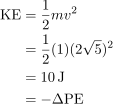
\begin{aligned} \textrm{KE} & =\frac{1}{2}mv^2} \\ & = \frac{1}{2}(1)(2\sqrt{5})^2 \\ & = 10\,\mathrm{J} \\ & = -\Delta\textrm{PE} \\ \end{aligned}

This problem is not to be attempted.