202211240932 Solution to 1965-HL-PHY-I-2

A 1.0\,\mathrm{kg} object rests on a table 1.0\,\mathrm{m} above the floor, and the floor is 4.0\,\mathrm{m} above the street.

(a) What is the potential energy of the object with reference to i. the table top, ii. the floor, and iii. the street?
(b) Now the object is put on the floor. Find the change in potential energy for this decrease of 1.0\,\mathrm{m} in the height of the object when the reference level is i. the table top, ii. the floor, and iii. the street?
(c) Let the object fall freely from the original position on the table. Find its speed and kinetic energy when it reaches the floor.


Roughwork.

(a) Take g=10\,\mathrm{m\,s^{-2}},

i. \textrm{PE}=mgh=(1)(10)(0)=0
ii. \textrm{PE}=mgh=(1)(10)(1)=10\,\mathrm{J}
iii. \textrm{PE}=mgh=(1)(10)(1+4)=50\,\mathrm{J}

(b)

i. h_{\textrm{table}}=0:

\begin{aligned} \Delta\textrm{PE} & = \textrm{PE}_{\textrm{final}} - \textrm{PE}_{\textrm{initial}} \\ & = mgh_f - mgh_i \\ & = (1)(10)(-1) - (1)(10)(0) \\ & = -10\,\mathrm{J} \\ \end{aligned}

ii. h_{\textrm{floor}}=0:

\begin{aligned} \Delta\textrm{PE} & = \textrm{PE}_{\textrm{final}} - \textrm{PE}_{\textrm{initial}} \\ & = mgh_f - mgh_i \\ & = (1)(10)(0) - (1)(10)(1) \\ & = -10\,\mathrm{J} \\ \end{aligned}

iii. h_{\textrm{street}}=0:

\begin{aligned} \Delta\textrm{PE} & = \textrm{PE}_{\textrm{final}} - \textrm{PE}_{\textrm{initial}} \\ & = mgh_f - mgh_i \\ & = (1)(10)(4) - (1)(10)(1+4) \\ & = -10\,\mathrm{J} \\ \end{aligned}

(c) Take downward positive,

\begin{aligned} s & = ut+\frac{1}{2}at^2 \\ (1) & = (0)t + \frac{1}{2}(10)t^2 \\ t & = \frac{\sqrt{5}}{5}\,\mathrm{s} \\ \end{aligned}

\begin{aligned} v & = u + at \\ & = (0) + (10)\bigg(\frac{\sqrt{5}}{5}\bigg) \\ & = 2\sqrt{5}\,\mathrm{m\,s^{-1}} \\ \end{aligned}

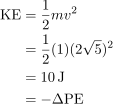
\begin{aligned} \textrm{KE} & =\frac{1}{2}mv^2} \\ & = \frac{1}{2}(1)(2\sqrt{5})^2 \\ & = 10\,\mathrm{J} \\ & = -\Delta\textrm{PE} \\ \end{aligned}

This problem is not to be attempted.