Find the  -coordinate of the point on the curve
  where the tangent is horizontal.
Roughwork.
The gradient  of the curve
  is
is
 .
.
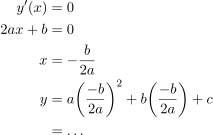
When the tangent is horizontal,

物理子衿
Find the -coordinate of the point on the curve where the tangent is horizontal.
Roughwork.
The gradient of the curve is
.
When the tangent is horizontal,
Calculate the gradient of the curve  at the point
  .
.
Roughwork.
Let the function  of variables and
  be
be

Then,
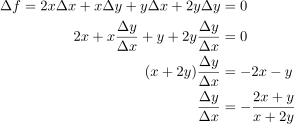
The gradient  at point
  is
is
 .
.
Calculate the gradient of the curve  at the point
  .
.
Roughwork.
Differentiating  wrt to and taking reciprocal,

the gradient  at point
  is
is
 .
.
Find the area bounded by the curve  and the straight line
  .
.
Roughwork.
Rewriting,

Solving,


Now that the points of intersection are  and
and  , plot a graph below.

By either definite integral,

The upper integral is easier solvable than the lower one. Exercise.
Prove that
 .
.
Hence solve the equation

for  .
.
Roughwork.

The missing steps are left the reader.
Show that the straight line  touches the curve
  .
.
Roughwork.
If there exists some point  of intersection of the straight line and the curve, we have

Substituting  for
for  in the second equation, we have


Such point as  exists.
 The intersection of
  is non-empty.
 The straight line touches the curve.
By using

or otherwise, evaluate
 .
.
Warm-up.

 is an even function such that
 .
.
Assume  is a periodic function for some
 ![T\in (0,2\pi ]](https://physicspupil.com/wp-content/ql-cache/quicklatex.com-6fa3a274097e96e3c0b1eb1cafdfa916_l3.svg "Rendered by QuickLaTeX.com") .
.

where  ,
,  , and
, and  .
.
![g:[0,\pi ]\to [-1,1]](https://physicspupil.com/wp-content/ql-cache/quicklatex.com-28f41495bcab02694c1f6cde16faa83c_l3.svg "Rendered by QuickLaTeX.com") by
by  is one-to-one and onto.
![h:[-1,1]\to [-1,1]](https://physicspupil.com/wp-content/ql-cache/quicklatex.com-9fcdc55bce03e1b86a74522c0f5e6234_l3.svg "Rendered by QuickLaTeX.com") by
by  is injective and surjective as well.
Hence , the composition  of bijections
  and
and  , is also bijective. Besides
 ![f:[0,\pi ]\to [-1,1]](https://physicspupil.com/wp-content/ql-cache/quicklatex.com-ff4a0990b92d2c60284151cb0ab26d1a_l3.svg "Rendered by QuickLaTeX.com") is a continuously differentiable function that
is a continuously differentiable function that  ,
,  , and
, and  .
.
How do you evaluate the integral below:

where  is an odd function such that

The curve of function is flat at point(s) whose slope  is zero, i.e.,

Roughwork. Show
Integrating by parts,
![\begin{aligned} \int_{0}^{\pi}\cos^7x\,\mathrm{d}x & = \int_{0}^{\pi}\cos^6x\,\mathrm{d}(\sin x) \\ & = \big[\cos^6x\sin x\big]\big|_{0}^{\pi} - \int_{0}^{\pi}\sin x\,\mathrm{d}(\cos^6x)\\ & = 0 + \int_{0}^{\pi}6\sin^2x\cos^5x\,\mathrm{d}x \\ & = \int_{0}^{\pi}6(1-\cos^2x)\cos^5x\,\mathrm{d}x \\ & = \int_{0}^{\pi}6\cos^5x\,\mathrm{d}x - \int_{0}^{\pi}6\cos^7x\,\mathrm{d}x \\ \int_{0}^{\pi}7\cos^7x\,\mathrm{d}x & = \int_{0}^{\pi}6\cos^5x\,\mathrm{d}x \\ \int_{0}^{\pi}\cos^7x\,\mathrm{d}x & = \frac{6}{7}\int_{0}^{\pi}\cos^5x\,\mathrm{d}x \\ & = \frac{6}{7}\int_{0}^{\pi}\cos^4x\,\mathrm{d}(\sin x) \\ &= \frac{6}{7}\bigg\{ \big[\cos^4x\sin x\big]\big|_{0}^{\pi} - \int_{0}^{\pi}\sin x\,\mathrm{d}(\cos^4x)\bigg\} \\ &= \frac{6}{7}\bigg\{ 0 + \int_{0}^{\pi}4\sin^2 x\cos^3x\,\mathrm{d}x\bigg\} \\ & = \frac{24}{7}\int_{0}^{\pi} (1-\cos^2x)\cos^3x\,\mathrm{d}x \\ \frac{30}{7}\int_{0}^{\pi}\cos^5x\,\mathrm{d}x & = \frac{24}{7} \int_{0}^{\pi}\cos^3x\,\mathrm{d}x \\ \int_{0}^{\pi}\cos^5x\,\mathrm{d}x & = \frac{4}{5}\int_{0}^{\pi}\cos^3x\,\mathrm{d}x \\ \end{aligned}](https://physicspupil.com/wp-content/ql-cache/quicklatex.com-31445326a7b1124dd634df8fc94df9bf_l3.svg "Rendered by QuickLaTeX.com")
![\begin{aligned} \int_{0}^{\pi}\cos^7x\,\mathrm{d}x & = \frac{6}{7}\bigg\{ \frac{4}{5}\int_{0}^{\pi}\cos^3x\,\mathrm{d}x \bigg\} \\ & = \frac{24}{35} \int_{0}^{\pi} \cos^2x\,\mathrm{d}(\sin x) \\ & = \frac{24}{35}\bigg\{ \big[ \cos^2x\sin x\big]\big|_{0}^{\pi} - \int_{0}^{\pi}\sin x\,\mathrm{d}(\cos^2x) \bigg\} \\ & = \frac{24}{35} \bigg\{ 0 + \int_{0}^{\pi}2\sin^2x\cos x\,\mathrm{d}x \bigg\} \\ & = \frac{48}{35} \int_{0}^{\pi}(1-\cos^2x)\cos x\,\mathrm{d}x \\ \bigg(\frac{24}{35}+\frac{48}{35}\bigg) \int_{0}^{\pi} \cos^3x\,\mathrm{d}x & = \frac{48}{35}\int_{0}^{\pi}\cos x\,\mathrm{d}x \\ \int_{0}^{\pi} \cos^3x\,\mathrm{d}x & = \frac{2}{3}\int_{0}^{\pi}\cos x\,\mathrm{d}x \\ \int_{0}^{\pi}\cos^7x\,\mathrm{d}x & = \frac{24}{35}\bigg\{ \frac{2}{3}\int_{0}^{\pi}\cos x\,\mathrm{d}x \bigg\} \\ & = \frac{16}{35}\big[ \sin x\big]\big|_{0}^{\pi} \\ & = 0 \\ \end{aligned}](https://physicspupil.com/wp-content/ql-cache/quicklatex.com-ce61d6e9537eacef7b16e34667bae82b_l3.svg "Rendered by QuickLaTeX.com")
Solution.
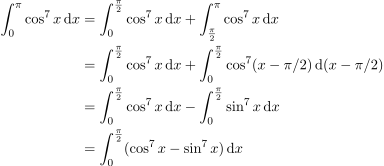
The rest is left as an exercise to the reader.
Find in terms of , if  and
and  when
when  .
.
Roughwork.
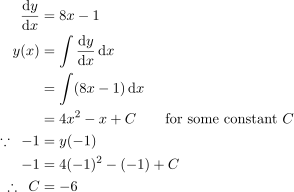
In conclusion,  .
.
If  is an integer, simplify
![\displaystyle{\cos\bigg[ \frac{1}{2}(4k+1)\pi +\theta \bigg]\tan\bigg[\frac{1}{2}(4k+3)\pi -\theta \bigg]}](https://physicspupil.com/wp-content/ql-cache/quicklatex.com-ec89597481e0fd1af0eba569df3c54b1_l3.svg "Rendered by QuickLaTeX.com") .
.
Roughwork.
First,
![\begin{aligned} & \quad \cos\bigg[ \frac{1}{2}(4k+1)\pi +\theta \bigg]\tan\bigg[\frac{1}{2}(4k+3)\pi -\theta \bigg] \\ & = \cos\bigg( 2k\pi+\frac{\pi}{2}+\theta \bigg) \tan \bigg( 2k\pi+\frac{3\pi}{2}-\theta \bigg) \\ \dots\textrm{as } &\textrm{are}\cos (\angle ),\tan (\angle )\textrm{ shifted by full periods, \textit{i.e.}, }k\cdot 2\pi\,\dots \\ & = \cos\bigg(\frac{\pi}{2}+\theta\bigg) \tan \bigg(\frac{3\pi}{2}-\theta \bigg) \\ \end{aligned}](https://physicspupil.com/wp-content/ql-cache/quicklatex.com-d16918bc852fe27ea5afc4656f251530_l3.svg "Rendered by QuickLaTeX.com")
Second,
recall that

Hence,
![\begin{aligned} & \quad \cos\bigg(\frac{\pi}{2}+\theta\bigg) \tan \bigg(\frac{3\pi}{2}-\theta \bigg) \\ & = \cos\bigg(\frac{\pi}{2}+\theta\bigg) \tan \bigg(-\frac{\pi}{2}-\theta \bigg) \\ & = \cos\bigg(\frac{\pi}{2}+\theta\bigg) \tan \bigg[ -\bigg(\frac{\pi}{2}+\theta \bigg)\bigg] \\ \dots &\textrm{ as }\tan(-\theta )=-\tan\theta \enspace\dots \\ & = -\cos\bigg(\frac{\pi}{2}+\theta\bigg) \tan \bigg(\frac{\pi}{2}+\theta\bigg) \\ \end{aligned}](https://physicspupil.com/wp-content/ql-cache/quicklatex.com-344a343e107f7c226c6ba732eded8ae6_l3.svg "Rendered by QuickLaTeX.com") .
.
Recall that
 .
.
Hence,

Third,
recall that
 .
.
so
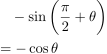
Answer.
![\displaystyle{\cos\bigg[ \frac{1}{2}(4k+1)\pi +\theta \bigg]\tan\bigg[\frac{1}{2}(4k+3)\pi -\theta \bigg]}=-\cos\theta](https://physicspupil.com/wp-content/ql-cache/quicklatex.com-00909e88a1dee4d80f6fcf1c856898be_l3.svg "Rendered by QuickLaTeX.com") .
.