202310130920 Exercise 14.1.3

If \cos A=\frac{4}{5} and \cos B=\frac{12}{13} where A and B are both acute angles, find, without using tables or a calculator,

(a) \sin (A+B),
(b) \cos (A-B),
(c) \tan (A+B).

Extracted from J. F. Talbert & H. H. Heng. (1995). Additional Mathematics Pure and Applied (6e).


Roughwork.

(a)

Not yet to approach a solution, I wish to get a feel of the problem from three perspectives— i. algebraic, ii. geometric, and iii. differential:

(i. algebraic)

\begin{aligned} \cos A & =\frac{4}{5} \\ \cos B & = \frac{12}{13} \\ & \\ \cos^2A & = \frac{16}{25} \\ \cos^2B & = \frac{144}{169} \\ & \\ \sin^2A & = 1-\cos^2A\\ & = \frac{9}{25} \\ \sin^2B & = 1-\cos^2B\\ & = \frac{25}{169} \\ & \\ \sin A & = \sqrt{\frac{9}{25}} \\ & = \frac{3}{5} \\ \sin B & = \sqrt{\frac{25}{169}} \\ & = \frac{5}{13} \\ \end{aligned}

(ii. geometric)


(iii. differential)

Let f(x)=\sin x. Then, recall that

\displaystyle{f(x)\approx x-\frac{x^3}{3!}+\frac{x^5}{5!}-\frac{x^7}{7!}+\cdots }

because of Taylor series/expansion of a function f(x) at some point a:

\displaystyle{f(x)\big|_{x=a} = \sum_{n=0}^{\infty}\frac{f^{(n)}(a)}{n!}(x-a)^n\bigg|_{x=a}}

such that in our situation, you know, we have a=0 (the Maclaurin series):

\displaystyle{f(x)=\sum_{n=0}^{\infty}\frac{f^{(n)}(0)}{n!}x^n}


Now that we have enough, here begins the

Solution.

(i. algebraic)

\begin{aligned} \sin (A+B) & = \sin A\cos B + \cos A\sin B \\ & = \bigg(\frac{3}{5}{\bigg)\bigg(\frac{12}{13}\bigg) + \bigg(\frac{4}{5}\bigg)\bigg(\frac{5}{13}\bigg) \\ & = \frac{56}{65} \\ \end{aligned}

(ii. geometric)

\begin{aligned} \frac{h}{14} & = \sin (90^\circ -B) \\ h & = 14\cos B \\ & \\ \sin (A+B) & = \frac{h}{15} \\ & = \frac{14\cos B}{15} \\ & = \frac{14}{15}\bigg( \frac{12}{13} \bigg) \\ & = \frac{56}{65} \\ \end{aligned}

(iii. differential)

That angles A and B are acute angles, i.e.,

0<B<A<90^\circ

does not imply A+B is also an acute angle, but that

0<A+B<180^\circ.

© 2010 Geek3 / GNU-FDL, https://commons.wikimedia.org/wiki/File:Sine_cosine_one_period.svg

such that

\begin{aligned} 0 & <\sin (A+B)<1 \\ -1 & <\cos (A+B)<1 \\ 0 & <\sin B<\sin A<\cos A<\cos B < 1\\ \end{aligned}

Letting f(x)=\sin x,

\begin{aligned} &\quad \textrm{Area under curve }f(x)\textrm{ in }x\in [0,A+B] \\ & = \int_{0}^{A+B}f(x)\,\mathrm{d}x \\ & = \int_{0}^{A+B}\sin (x)\,\mathrm{d}x \\ & = \big[-\cos x\big]_{0}^{A+B} \\ & = 1-\cos (A+B) \\ \end{aligned}

\begin{aligned} &\quad \textrm{Area under curve }f(x)\textrm{ in }x\in [0,A] \\ & = \int_{0}^{A}f(x)\,\mathrm{d}x \\ & = \int_{0}^{A}\sin (x)\,\mathrm{d}x \\ & = \big[-\cos x\big]_{0}^{A} \\ & = 1-\cos A \\ & = 1-\frac{4}{5} \\ & = \frac{1}{5} \\ \end{aligned}

\begin{aligned} &\quad \textrm{Area under curve }f(x)\textrm{ in }x\in [0,B] \\ & = \int_{0}^{B}f(x)\,\mathrm{d}x \\ & = \int_{0}^{B}\sin (x)\,\mathrm{d}x \\ & = \big[-\cos x\big]_{0}^{B} \\ & = 1-\cos B \\ & = 1-\frac{12}{13} \\ & = \frac{1}{13} \\ \end{aligned}

\begin{aligned} &\quad \textrm{Area under curve }f(x)\textrm{ in }x\in [B,A] \\ & = \frac{1}{5}-\frac{1}{13} \\ & = \frac{8}{65} \\ \end{aligned}

\begin{aligned} &\quad \textrm{Area under curve }f(x)\textrm{ in }x\in [A,A+B] \\ & = 1-\cos (A+B) - \frac{1}{5} \\ & = \frac{4}{5}-\cos (A+B) \\ \end{aligned}

then letting g(x)=\cos x, and noting in a right-angled triangle the cosine of an angle admits of no negative values, so can it further be said

\begin{aligned} & \quad\enspace 0<g(x)<1 \\ &\Rightarrow 0<g(A+B)<1 \\ &\Rightarrow 0<A+B<90^\circ \\ \end{aligned}


I lost my way…


Let w(u(t),v(t))=u(t)-v(t) be the difference in degrees between time-varying angles u and v where assumed is u(t)>v(t) without loss of generality.

\begin{aligned} f(u,v,w) & \stackrel{\textrm{def}}{=} \sin (u+v) \\ & = \sin (2v+w ) \\ & = \sin (2u-w ) \\ & \\ g(u,v,w) &\stackrel{\textrm{def}}{=} \cos (u+v) \\ & = \cos (2v+w ) \\ & = \cos (2u-w ) \\ \end{aligned}

Taking partial derivatives wrt u, v, w, and t:

\begin{aligned} \partial_uf(u,v,w) & = 2\cos (2u-w) \\ \partial_vf(u,v,w) & = 2\cos (2v+w) \\ \partial_wf(u,v,w) & = 0 \\ \partial_tf(u,v,w) & = (u'+v')\cos (u+v)\\ \end{aligned}

\begin{aligned} \mathrm{d}f(u,v,w) & = \partial_uf\,\mathrm{d}u + \partial_vf\,\mathrm{d}v + \partial_wf\,\mathrm{d}w \\ & = 2\cos (2u-w )\,\mathrm{d}u + 2\cos (2v+w )\,\mathrm{d}v + 0 \\ \dots\,\mathrm{d}u & =  \mathrm{d}v+\mathrm{d}w\,\dots \\ & = 4\cos (u+v)\,\mathrm{d}v + 2\cos (u+v)\,\mathrm{d}w \\ & = 2\big(\cos (u+v)\big)(2\,\mathrm{d}v+\mathrm{d}w) \\ \end{aligned}


I lost my faith…


If

f(x,y)\stackrel{\textrm{(1)}}{=}\sin (x+y)

then

f(x'=x+y,0)\stackrel{\textrm{(2)}}{=} f(x,y)\stackrel{\textrm{(3)}}{=} f(0,x+y=y').

By equality \textrm{(1)} it states that the output value f(x,y) of f(\texttt{var1},\texttt{var2}) is determined by input values of two arguments (\texttt{var1},\texttt{var2})=(x,y);

by equality \textrm{(2)} that the output value f(x,y) of f(\texttt{var1},\texttt{var2}) is determined by input values (\texttt{var1},\texttt{var2})=(x+y,0), i.e., by one significant argument \texttt{var1}=x+y, and another trivial argument \texttt{var2}=0; and

by equality \textrm{(3)} that the output value f(x,y) of f(\texttt{var1},\texttt{var2}) is determined by input values (\texttt{var1},\texttt{var2})=(0,x+y), i.e., by one trivial argument \texttt{var1}=0, and another significant argument \texttt{var2}=x+y.

Hence, assuming a partial variation

\begin{aligned} &\quad\enspace \sin (\texttt{var1}+\texttt{var2}) \\ & = k_1(\texttt{var1},\texttt{var2})\sin (\texttt{var1}) + k_2(\texttt{var1},\texttt{var2})\sin (\texttt{var2}) \\ \end{aligned}

we WTS the following

\begin{aligned} k_1(\texttt{var1},\texttt{var2}) & = \cos (\texttt{var2}) \\ k_2(\texttt{var1},\texttt{var2}) & = \cos (\texttt{var1}) \\ \end{aligned}

LHS:

\begin{aligned} &\quad\enspace \frac{\mathrm{d}}{\mathrm{d}t}\sin (\texttt{var1}+\texttt{var2}) \\ & = \big[\cos (\texttt{var1}+\texttt{var2})\big] (\texttt{var1}'+\texttt{var2}') \\ \end{aligned}

RHS:

\begin{aligned} &\quad\enspace \frac{\mathrm{d}}{\mathrm{d}t}(k_1\sin (\texttt{var1})+k_2\sin (\texttt{var2})) \\ & = \big(k_1'\cos (\texttt{var1})\big) \texttt{var1}' + \big(k_2'\cos (\texttt{var2})\big) \texttt{var2}' \\ \end{aligned}

and LHS=RHS implies:

\begin{aligned} \frac{\mathrm{d}}{\mathrm{d}t}k_1 & = \frac{\cos (\texttt{var1}+\texttt{var2})}{\cos (\texttt{var1})} \\ \frac{\mathrm{d}}{\mathrm{d}t}k_2 & = \frac{\cos (\texttt{var1}+\texttt{var2})}{\cos (\texttt{var2})} \\ \dots & \dots \dots \dots \\ k_1' & = \bigg( \frac{\cos (\texttt{var2})}{\cos (\texttt{var1})}\bigg) k_2' \\ \end{aligned}


(to be continued)

202310121132 Pastime Exercise 005

The blogger claims no originality of his problem below.

Below is a \textrm{3-D} graph of the customary quadratic equation on the flat xy-plane at some level of z=d:

where the discriminant is \Delta =b^2-4ac.


Setup.

Let ten operators \hat{Q}_1, \hat{Q}_2, \hat{Q}_3, \hat{Q}_4, \hat{Q}_5, \hat{Q}_6, \hat{Q}_7, \hat{Q}_8, \hat{Q}_9, and \hat{Q}_{10} be defined as such that follow:

Of the curve f(x,y,z)\big|_{z=d}=0,

\hat{Q}_1: a horizontal translation along (\pm\textrm{ve})\, x-direction;
\hat{Q}_2: a vertical translation along (\pm\textrm{ve})\, y-direction.
\hat{Q}_3: a horizontal scaling by a (\pm\textrm{ve}) factor;
\hat{Q}_4: a vertical scaling by a (\pm\textrm{ve}) factor;
\hat{Q}_5: a(n) anti-/clockwise rotation about a normal on the xy-plane;
\hat{Q}_6: a horizontal reflection over a vertical line parallel to the y-axis;
\hat{Q}_7: a vertical reflection over a horizontal line parallel to the x-axis;
\hat{Q}_8: an oblique reflection over a slanted line on the xy-plane;
\hat{Q}_9: a tilting about the (\pm\textrm{ve})\,y-axis;
\hat{Q}_{10}: a tilting about the (\pm\textrm{ve})\,z-axis.


Problem.

(a) Describe the ten operators explicitly in the form of some linear functions.

(b) Does it matter to have one operator performed with some priority over another in order to give a curve and the only curve after multiple transformations? If you think so, list them in order; if not, give a counterexample that any two sequences of execution are able to reach the same result.


This problem is not to be attempted.

202309191729 Pastime Exercise 004

The blogger claims no originality of his problem below.

Let there be a rubber band of constant mass m (an invariable) but of non-constant length l (a variable), whose relaxed length (when unstretched) is l=L. May it sustain longitudinal elongation \Delta l to any degree,

i.e., \min (l)=L\leqslant l< \infty =\max (l);

and withstand uni-directional tension T to any extent,

i.e., \min (T)=0\leqslant T< \infty =\max (T);

as and when its cross-sectional area approaches the limit \displaystyle{\lim_{l\to\infty}A=0}.

Let there also be some pencil(s) of rigid body and in diameter comparable to the thickness of a slack rubber band.

Let the rubber band obey Hooke’s law.

\mathbf{F}=-k\,\mathbf{x}

where F is the magnitude of restoring force, k the spring constant, and x the magnitude of displacement from the equilibrium position.

Let the pencils be held firmly in any positions as desired, to each of which applies whenever necessary some force |\mathbf{F}|\propto T in direction pointing away from the centre of rubber band.


For your information.

The process of parallel layers sliding past each other is known as shearing.

A pile of papers, a pack of cards with rectangular cross-section can be pushed to obtain a parallelogram cross-section. In such cases, the angle between the sides has changed, but all that has actually happened is some parallel sliding.

Byju’s on Shearing stress


Setup.

Figures \text{\scriptsize{NOT}} drawn to scale.

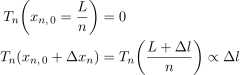
\begin{aligned} T_{n}\bigg( x_{n,\, 0}=\frac{L}{n}\bigg) & = 0 \\ T_{n}(x_{n,\, 0} +\Delta x_n) & = T_{n}\bigg( \frac{L+\Delta l}{n}\bigg) \propto \Delta l\\ \end{aligned}


Problem.

Discuss what resistive (/restrictive) force \mathbf{F} the rubber band exerts on itself when it is in a circle, i.e., n\to\infty, expanding (radially), i.e., l\to\infty; such that in any infinitesimal sections, the direction of \mathbf{F} is orthogonal to that of tension \mathbf{T}, i.e.,

- F\,\hat{\mathbf{r}}=\mathbf{F}\perp \mathbf{T}=\pm T\,\hat{\boldsymbol{\theta}}.


This problem is not to be attempted.

202308301657 Pastime Exercise 002

The blogger claims no originality of the problem below.

The image files are licensed under the Creative Commons Attribution-Share Alike 2.5 Generic license in the public domain.


Xiangqi, commonly known as Chinese chess or elephant chess, is a strategy board game for two players.

Wikipedia on Xiangqi

Setup.

Let “帥/將” be referred to as a; “仕/士” as b, “相/象” as c; “傌/馬” as d; “俥/車” as e; and “兵/卒” as f.

Any intersection of the ten horizontal and the nine vertical lines is called a point on the board; there are ninety points.

Let t\in \{1,2,3,\dots ,\{+\infty\}\} be the number of time(s) of movement of pieces from the start (t=0). Each player moves in turn such that for one army t\in\{1,3,5,\dots ,1+2n\, |\, n\in\mathbb{N}\} and for its enemy t\in\{2,4,6,\dots ,2n\, |\, n\in\mathbb{N}\}.

And \mathbf{l}(x_{[*]}(t),y_{[*]}(t))\in\{1,2,3,\dots ,9\}\times \{1,2,3,\dots ,10\} be the location of a piece [*]\in\{a,b,c,d,e,f\} at time(s) t of movement.

And \mathbf{s}(t)=\mathbf{l}(t)-\mathbf{l}(t-2) be the displacement of the piece after one succession \Delta t=(t+2)-(t)=2, and by the inverse \mathbf{s}^{-1}(t)=\mathbf{l}(t-4)-\mathbf{l}(t-2)=-\mathbf{s}(t-2) a retreat to the original location is such that displacements for an advance and a retreat s^{-1}(t)=|\mathbf{s}^{-1}(t)|=|-\mathbf{s}(t-2)|=s(t-2) are equal in magnitudes.


And v(t)=|\mathbf{v}(t)|=\displaystyle{\bigg|\frac{\Delta\mathbf{s}(t)}{\Delta t}\bigg|=\bigg|\frac{\mathbf{s}(t)-\mathbf{s}(t-2)}{(t)-(t-2)}\bigg|} be the instantaneous speed at some point t_i in a series of movements i\in \mathbb{N}.

And \mathrm{ord}[*] called the order of a set [*] be the number of elements in that collection. For instance, in a peaceful match \mathrm{ord}(t)=+\infty the number of times t of movements could be in such countably and indefinitely infinite.


In the case of a (“帥/將”):

\mathbf{l}_a(t)=\{4,5,6\}\,\hat{\mathbf{i}}+\{1,2,3\}\,\hat{\mathbf{j}};

\mathrm{ord}(\mathbf{l}_a)=9;

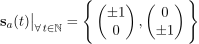
\mathbf{s}_a(t)\big|_{\forall\, t\in\mathbb{N}}=\Bigg\{\begin{pmatrix}\pm 1\\0\end{pmatrix},\begin{pmatrix}0\\ \pm 1\end{pmatrix}\Bigg\}

such that \mathbf{l}_a\to \mathbf{l}_a:\mathbf{l}_a(t-2)\stackrel{\mathbf{s}_a}{\mapsto}\mathbf{l}_a(t);

\mathrm{ord}(\mathbf{s}_a)=4;

v_a(t)=\displaystyle{\frac{\sqrt{(\pm 1)^2+(0)^2}}{\Delta t}=\frac{1}{2}\,\mathrm{unit/time}};

\mathrm{ord}_a(v)=1.


In the case of b (“仕/士”):

\mathbf{l}_b(t)=\{(4,1),(4,3),(5,2),(6,1),(6,3)\};

\mathrm{ord}(\mathbf{l}_b)=5;

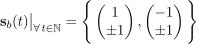
\mathbf{s}_b(t)\big|_{\forall\, t\in\mathbb{N}}=\Bigg\{\begin{pmatrix}1\\\pm 1\end{pmatrix},\begin{pmatrix}-1\\ \pm 1\end{pmatrix}\Bigg\}

such that \mathbf{l}_b\to \mathbf{l}_b:\mathbf{l}_b(t-2)\stackrel{\mathbf{s}_b}{\mapsto}\mathbf{l}_b(t);

\mathrm{ord}(\mathbf{s}_b)=4

v_b(t)=\displaystyle{\frac{\sqrt{(\pm 1)^2+(\pm 1)^2}}{\Delta t}=\frac{\sqrt{2}}{2}\,\mathrm{unit/time}};

\mathrm{ord}(v_b)=1.


In the case of c (“相/象”):

\mathbf{l}_c(t)=\{(3,1),(7,1),(1,3),(5,3),(9,3),(3,5),(7,5)\};

\mathrm{ord}(\mathbf{l}_c)=7;

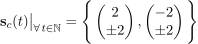
\mathbf{s}_c(t)\big|_{\forall\, t\in\mathbb{N}}=\Bigg\{\begin{pmatrix}2\\\pm 2\end{pmatrix},\begin{pmatrix}-2\\ \pm 2\end{pmatrix}\Bigg\}

such that \mathbf{l}_c\to \mathbf{l}_c:\mathbf{l}_c(t-2)\stackrel{\mathbf{s}_c}{\mapsto}\mathbf{l}_c(t);

\mathrm{ord}(\mathbf{s}_c)=4

v_c(t)=\displaystyle{\frac{\sqrt{(\pm 2)^2+(\pm 2)^2}}{\Delta t}=\frac{2\sqrt{2}}{2}=\sqrt{2}\,\mathrm{unit/time}};

\mathrm{ord}(v_c)=1.


In the case of d (“傌/馬”):

\mathbf{l}_d(t)=\{ 1,2,3,\dots ,9\}\,\hat{\mathbf{i}}+\{1,2,3,\dots ,10\}\,\hat{\mathbf{j}};

\mathrm{ord}(\mathbf{l}_d)=9\times 10=90;

\mathbf{s}_d(t)\big|_{\forall\, t\in\mathbb{N}}=\Bigg\{\begin{pmatrix}-1\\\pm 2\end{pmatrix},\begin{pmatrix}2\\ \pm 1\end{pmatrix},\begin{pmatrix}1\\ \pm 2\end{pmatrix},\begin{pmatrix}-2\\ \pm 1\end{pmatrix}\Bigg\}

such that \mathbf{l}_d\to \mathbf{l}_d:\mathbf{l}_d(t-2)\stackrel{\mathbf{s}_d}{\mapsto}\mathbf{l}_d(t);

\mathrm{ord}(\mathbf{s}_d)=8

v_d(t)=\displaystyle{\frac{\sqrt{(\pm 1)^2+(\pm 2)^2}}{\Delta t}=\frac{\sqrt{5}}{2}\,\mathrm{unit/time}};

\mathrm{ord}(v_d)=1.


In the case of e (“俥/車”):

\mathbf{l}_e(t)=\{ 1,2,3,\dots ,9\}\,\hat{\mathbf{i}}+\{1,2,3,\dots ,10\}\,\hat{\mathbf{j}};

\mathrm{ord}(\mathbf{l}_e)=9\times 10=90;

\mathbf{s}_e(t)\big|_{\forall\, t\in\mathbb{N}}=\Bigg\{\pm\begin{pmatrix}\{1,2,3,\dots ,8\}\\0\end{pmatrix},\pm\begin{pmatrix}0\\ \{1,2,3,\dots , 9\}\end{pmatrix}\Bigg\}

such that \mathbf{l}_e\to \mathbf{l}_e:\mathbf{l}_e(t-2)\stackrel{\mathbf{s}_e}{\mapsto}\mathbf{l}_e(t);

\mathrm{ord}(\mathbf{s}_e)=8\times 2+9\times 2=34

\begin{aligned} v_e(t) & =[\min v_e(t),\max v_e(t)]\big|_{\in n/2\textrm{ for } n\in\mathbb{N}\backslash\{ 0 \} } \\ & = \bigg[ \frac{\sqrt{(1)^2+(0)^2}}{2},\frac{\sqrt{(0)^2+(9)^2}}{2}\bigg] \\ &= \{ 1/2,1,3/2,\dots , \, 9/2\}\,\mathrm{unit/time} \\ \end{aligned};

\mathrm{ord}(v_e)=9.


In the case of f (“兵/卒”):

Exercise.

202306091242 Pastime Exercise 001

The act of throwing a dart is made up of three movements: “take back”, “release”, and “follow through”.

Retrieved from www.dartslive(DOT)com on How to throw


A math student and a physics pupil are debating the probability of scoring by the outer and the inner region of a dartboard.

The math student calculates this way:

but the physics pupil deliberates this way:

Please follow suit by making assumptions: i. the darts land safe on the board if the incident angle is no more than 45^\circ; ii. air resistance is negligible; and iii. the possible throwing speed(s) and angle(s) are evenly distributed.


This problem is not to be attempted.

202306021010 Pastime Exercise 000

To tell time on an analog clock, you look at where the hands are pointing.

The short/small hand tells you the hour, the long/big hand tells you the minute of the current hour, and the thinnest hand indicates the seconds of the current minute.

Extracted from Malcolm McKinsey. (2023). How To Tell Time; Read An Analog Clock


Roughwork.

Define two periodic functions by

\begin{aligned} \theta_\textrm{h}(t) &:[0,12)\in [T\textrm{ (in hours)}]\rightarrow [0,2\pi )\in [\Theta\textrm{ (in radians)}] \\ \theta_\textrm{m}(t) & :[0,1)\in [T\textrm{ (in hours)}]\rightarrow [0,2\pi )\in [\Theta\textrm{ (in radians)}] \\ \end{aligned}

for angular displacement \theta of the hour hand \textrm{h} and the minute hand \textrm{m} as of time t, with

\begin{aligned} \theta_\textrm{h}(t+T_\textrm{h}) & =\theta_\textrm{h}(t)\textrm{ where }T_\textrm{h}=12\,\mathrm{hr} \\ \theta_\textrm{m}(t+T_\textrm{m}) & =\theta_\textrm{m}(t)\textrm{ where }T_\textrm{m}=1\,\mathrm{hr} \\ \end{aligned}

such that

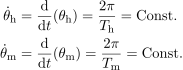
\begin{aligned} \dot{\theta}_\textrm{h} & = \frac{\mathrm{d}}{\mathrm{d}t}(\theta_\textrm{h}) = \frac{2\pi}{T_\textrm{h}} =\textrm{Const.}\\ \dot{\theta}_\textrm{m} & =\frac{\mathrm{d}}{\mathrm{d}t}(\theta_\textrm{m}) = \frac{2\pi}{T_\textrm{m}}=\textrm{Const.} \\ \end{aligned}

observing an isomorphism \varphi between \theta_\textrm{m}(t) and the restriction \theta_\textrm{h}\big|_{[0,1)}(t) of \theta_\textrm{h} to [0,1) at one-hour time intervals:

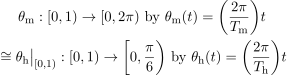
\begin{aligned} & \quad\enspace  \theta_\textrm{m} :[0,1)\rightarrow [0,2\pi ) \textrm{ by }\theta_\textrm{m}(t)=\bigg(\frac{2\pi}{T_\textrm{m}}\bigg) t \\ & \cong \theta_\textrm{h}\big|_{[0,1)} :[0,1)\rightarrow\bigg[ 0,\frac{\pi}{6}\bigg) \textrm{ by }\theta_\textrm{h}(t)=\bigg(\frac{2\pi}{T_\textrm{h}}\bigg) t \\ \end{aligned}

Then, let

\begin{aligned} \textrm{HH12} & =\{00,01,02,\dots ,09,10,11\} \\ \textrm{MI} & = \{00,01,02,\dots ,57,58,59\} \\ \end{aligned}

so that digital format of clocks is given as the Cartesian product:

\textrm{hh:mm}=\textrm{HH12}\times \textrm{MI}.

Synchronised at the start time:

\theta_\textrm{h}(\textrm{00:00})=\theta_\textrm{m}(\textrm{00:00})=0.

(a) Find the time(s) exact to minutes when the hour hand and the minute hand are perpendicular to each other, i.e.,

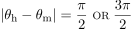
\displaystyle{|\theta_\textrm{h}-\theta_\textrm{m}|=\frac{\pi}{2}\textrm{ \scriptsize{OR} }}\frac{3\pi}{2}

(b) Find also the time(s) exact to minutes when the hour hand and the minute hand are parallel to each other, i.e.,

|\theta_\textrm{h}-\theta_\textrm{m}|=0\textrm{ \scriptsize{OR} }\pi

(c) Is the aforementioned isomorphism \theta_\textrm{h}\stackrel{\varphi}{\cong}\theta_\textrm{m} perturbed when the clock is losing or gaining time \delta t?


This problem is not to be attempted.

202305241325 Problem 16.2.7

A person 6\,\mathrm{ft} tall stands 4\,\mathrm{ft} in front of a plane mirror.

(a) Where is his image?
(b) How tall is his image?
(c) What is the shortest mirror in which this person can see his whole image?
(d) Does the answer to (c) depend upon how far the person is from the mirror?

Extracted from C. E. Bennett. (1973). Physics Problems and How to Solve Them.


Roughwork.

(a), (b)

His image is 6\,\mathrm{ft} tall and 4\,\mathrm{ft} behind the plane mirror.

(c), (d)

Visualise the scene:

assuming the eye level is 5\,\mathrm{in} below the top of the head, and by conversion from feet to inches: 1\,\mathrm{ft}=12\,\mathrm{in}.


This problem is not to be attempted.

202305171045 Problem 23.11

In the figure below, AC is a diameter of the circle.

If AC=1, which of the following gives the area of triangle ABC in terms of \theta?

A. \displaystyle{\frac{\theta}{2}}
B. \displaystyle{\frac{\tan\theta}{2}}
C. 2\sin\theta
D. \displaystyle{\frac{\sin\theta\cos\theta}{2}}

Extracted from Phu Nielson. (2015). SAT Math Advanced Guide and Workbook.


Remark.

The quantity angle \theta is dimensionless as it is the ratio of arc length to radius, i.e.,

\frac{[L]}{[L]}=[L]^0;

the sine, the cosine, and the tangent of which, as in a right-angled triangle, are

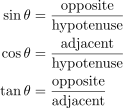
\begin{aligned} \sin\theta & = \frac{\textrm{opposite}}{\textrm{hypotenuse}} \\ \cos\theta & = \frac{\textrm{adjacent}}{\textrm{hypotenuse}} \\ \tan\theta & = \frac{\textrm{opposite}}{\textrm{adjacent}} \\ \end{aligned}

also dimensionless, i.e., [L]^0. Note that the quantity area is [L]^2 in dimension. Hence, choices A. to D. are being understood as:

A. \displaystyle{\frac{\theta}{2}}\enspace\textrm{(sq unit)}
B. \displaystyle{\frac{\tan\theta}{2}}\enspace\textrm{(sq unit)}
C. 2\sin\theta\enspace\textrm{(sq unit)}
D. \displaystyle{\frac{\sin\theta\cos\theta}{2}}\enspace\textrm{(sq unit)}


Warm-up.

Set-up.

where

\begin{aligned} \mathbf{OA} & = (-1/2,0) \\ \mathbf{OB} & = (x,y) \\ \mathbf{OC} & = (1/2,0) \\ \mathbf{AB} & = \mathbf{OB}-\mathbf{OA} \\ & = (x+1/2,y) \\ AB &= |\mathbf{AB}| \\ & = \sqrt{\bigg( x+\frac{1}{2}\bigg)^2+y^2} \\ \mathbf{BC} & = \mathbf{OC}-\mathbf{OB} \\ & = (1/2-x,-y) \\ BC &= |\mathbf{BC}| \\ & = \sqrt{\bigg(\frac{1}{2}-x\bigg)^2+(-y)^2} \\ \mathbf{AC} & = \mathbf{OC}-\mathbf{OA} \\ & = (1,0) \\ AC & = |\mathbf{AC}| \\ & = \sqrt{(1)^2+(0)^2} =1\\ \sin\theta & = \frac{y}{BC} \\ \cos\theta & = \frac{1/2-x}{BC} \\ \tan\theta & = \frac{y}{1/2-x} \\ \end{aligned}

Observe that

\displaystyle{\textrm{Area of }\triangle ABC=\frac{|\mathbf{AB}||\mathbf{BC}|}{2}}

proceed with

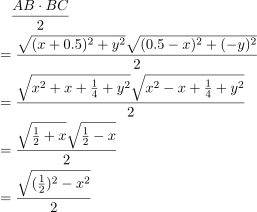
\begin{aligned} &\quad \frac{AB\cdot BC}{2} \\ & = \frac{\sqrt{(x+0.5)^2+y^2}\sqrt{(0.5-x)^2+(-y)^2}}{2} \\ & = \frac{\sqrt{x^2+x+\frac{1}{4}+y^2}\sqrt{x^2-x+\frac{1}{4}+y^2}}{2} \\ & = \frac{\sqrt{\frac{1}{2}+x}\sqrt{\frac{1}{2}-x}}{2} \\ & = \frac{\sqrt{(\frac{1}{2})^2-x^2}}{2}\\ \end{aligned}

by noting OB=|\mathbf{OB}| the radius being \frac{1}{2}:

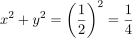
\displaystyle{x^2+y^2=\bigg(\frac{1}{2}\bigg)^2=\frac{1}{4}}.

The function

\displaystyle{f(x)=\sqrt{\frac{1}{16}-\frac{x^2}{4}}}

will output the area by inputting x under constraint on x, y:

g(x,y)=x^2+y^2-\frac{1}{4}=0.

(to be refreshed)


Now ready for problem-solving, write simply

\begin{aligned} \sin\theta & = \frac{AB}{AC}=AB\\ \cos\theta & = \frac{BC}{AC}=BC\\ \tan\theta & = \frac{AB}{BC}\\ \end{aligned}

and the answer is D.

202305151128 Exercise 1.1

Evaluate \textrm{\scriptsize{WITHOUT}} a calculator.

1. (-1)^4 2. (-1)^5 3. (-1)^{10} 4. (-1)^{15} 5. (-1)^8 6. -1^8 7. -(-1)^8 8. (-3)^3 9. -3^3 10. -(-3)^3 11. -(-6)^2 12. -(-4)^3 13. 2^3\times 3^2\times (-1)^5 14. (-1)^4\times 3^3\times 2^2 15. (-2)^3\times (-3)^4 16. 3^0 17. 6^{-1} 18. 4^{-1} 19. 5^0 20. 3^2 21. 3^{-2} 22. 5^3 23. 5^{-3} 24. 7^2 25. 7^{-2} 26. 10^3 27. 10^{-3}

Extracted from Phu Nielson. (2015). SAT Math Advanced Guide and Workbook.


Roughwork.

1.

Since (x^m)^n=x^{mn},

\begin{aligned} (-1)^4 & = ((-1)^2)^2 \\ & = (1)^2\\ & = 1 \\ \end{aligned}

2.

Since x^m\cdot x^n=x^{m+n},

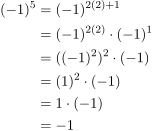
\begin{aligned} (-1)^5 & = (-1)^{2(2)+1} \\ & = (-1)^{2(2)}\cdot (-1)^1 \\ & = ((-1)^{2})^2\cdot (-1)\\ & = (1)^2\cdot (-1) \\ & = 1\cdot (-1) \\ & = -1 \\ \end{aligned}

3.

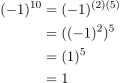
\begin{aligned} (-1)^{10} & = (-1)^{(2)(5)}\\ & = ((-1)^2)^5 \\ & = (1)^5 \\ & = 1\\ \end{aligned}

4.

\begin{aligned} (-1)^{15} & = (-1)^{2(7)+1} \\ & = (-1)^{2(7)}\cdot (-1)^1 \\ & = ((-1)^2)^7\cdot (-1) \\ & = (1)^7\cdot (-1) \\ & = 1\cdot (-1) \\ & = -1 \\ \end{aligned}

5.

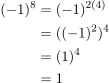
\begin{aligned} (-1)^8 & = (-1)^{2(4)} \\ & = ((-1)^2)^4 \\ & = (1)^4 \\ & = 1 \\ \end{aligned}

6.

\begin{aligned} -1^8 & = -(1^8) \\ & = -(1) \\ & = -1 \\ \end{aligned}

7.

\begin{aligned} -(-1)^8 & = -((-1)^8) \\ & = -((-1)^{2(4)}) \\ & = -(((-1)^2)^4) \\ & = -(1^4) \\ & = -(1) \\ & = -1 \\ \end{aligned}

8.

Since (xy)^m=x^my^m,

\begin{aligned} (-3)^3 & = ((-1)(3))^3 \\ & = (-1)^3(3)^3 \\ & = (-1)^{2+1}(3\cdot 3\cdot 3) \\ & = ((-1)^2\cdot (-1))(9\cdot 3) \\ & = (1\cdot (-1))(27) \\ & = (-1)(27) \\ & = -27 \\ \end{aligned}

9.

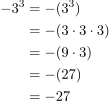
\begin{aligned} -3^3 & = -(3^3) \\ & = -(3\cdot 3\cdot 3) \\ & = -(9\cdot 3) \\ & = -(27) \\ & = -27 \\ \end{aligned}

10.

\begin{aligned} -(-3)^3 & = -((-3)^3) \\ & = -(((-1)(3))^3) \\ & = -((-1)^3(3)^3) \\ & = -((-1)^{2+1}(3\cdot 3\cdot 3)) \\ & = -((-1)^2(-1)(9\cdot 3)) \\ & = -((1)(-1)(27)) \\ & = -((-1)(27)) \\ & = -(-27) \\ & = 27 \\ \end{aligned}

Expressions 11. to 27. are not to be attempted.