202302200931 Review Problem 6.5.7

Let z\in\mathbb{C}. Recall that z=x+iy for some x,y\in\mathbb{R}, and we can form the complex conjugate of z by taking \overline{z}=x-iy. The function c:\mathbb{R}^2\to\mathbb{R}^2 which sends (x,y)\mapsto (x,-y) agrees with complex conjugation.

(a) Show that c is a linear map over \mathbb{R} (i.e., scalars in \mathbb{R}).
(b) Show that \overline{z} is not linear over \mathbb{C}.

Extracted from D. Cherney, et al. (2013). Linear Algebra.


Roughwork.

A function L:V\to W is linear if V and W are vector spaces and

L(ru+sv)=rL(u)+sL(v)

for all u,v\in V and r,s\in\mathbb{R}.

(a)

\begin{aligned} c(az_1+bz_2) & = c(a(x_1+iy_1)+b(x_2+iy_2)) \\ & = c((ax_1+bx_2)+i(ay_1+by_2)) \\ & = (ax_1+bx_2)+i(-(ay_1+by_2)) \\ & = (ax_1+bx_2)-i(ay_1+by_2) \\ & = a(x_1-iy_1) + b(x_2-iy_2) \\ & = a(x_1+i(-y_1)) + b(x_2+i(-y_2)) \\ & = a(c(x_1+iy_1)) + b(c(x_2+iy_2)) \\ & = ac(z_1) + bc(z_2) \\ \end{aligned}

(b)

Not to be attempted.

202302140910 Exercises 2.1

What do the following equations represent geometrically? Give sketches.

i. |z+2|=6,
ii. |z-3\,\mathrm{i}|=|z+\mathrm{i}|,
iii. |\mathrm{i}z-1|=|\mathrm{i}z+1|,
iv. |z-\omega |=|z-1| (\omega=e^{2\pi\,\mathrm{i}/3}).

Extracted from H. A. Priestley. (2003). Introduction to Complex Analysis.


Roughwork.

i.

\begin{aligned} |z+2|&=6 \\ |(x+\mathrm{i}y)+2| & = 6 \\ |(x+2)+\mathrm{i}y| & = 6 \\ \sqrt{(x+2)^2+y^2} & = 6 \\ (x+2)^2 + y^2 & = 6^2 \\ \end{aligned}

i.e., a circle centred at (-2,0) with 6 units in radius.

ii.

\begin{aligned} |z-3\,\mathrm{i}| & = |z+\mathrm{i}| \\ |(x+\mathrm{i}y)-3\,\mathrm{i}| & = |(x+\mathrm{i}y)+\mathrm{i}| \\ |x+\mathrm{i}(y-3)| & = |x+\mathrm{i}(y+1)| \\ \sqrt{x^2+(y-3)^2} & = \sqrt{x^2+(y+1)^2} \\ x^2+(y-3)^2 & = x^2 + (y+1)^2 \\ y^2-6y+9 & = y^2+2y+1 \\ y & = 1 \\ \end{aligned}

i.e., a horizontal line with y-intercept 1 unit.

iii.

\begin{aligned} |\mathrm{i}z-1| & = |\mathrm{i}z+1| \\ |\mathrm{i}(x+\mathrm{i}y)-1| & = |\mathrm{i}(x+\mathrm{i}y)+1| \\ |(-y+\mathrm{i}x)-1| & = |(-y+\mathrm{i}x+1|\\ |(-y-1)+\mathrm{i}x| & = |(-y+1)+\mathrm{i}x| \\ \sqrt{(-y-1)^2+x^2} & = \sqrt{(-y+1)^2+x^2} \\ y^2+2y+1 & = y^2-2y+1 \\ y & = 0 \\ \end{aligned}

i.e., the x-axis.

iv.

\begin{aligned} |z-\omega | & = |z-1| \\ |(x+\mathrm{i}y)-\mathrm{cis}(2\pi/3)|& = |(x+\mathrm{i}y)-1| \\ \bigg|\bigg(x+\frac{1}{2}\bigg)+\mathrm{i}\bigg(y-\frac{\sqrt{3}}{2}\bigg)\bigg| & = |(x-1)+\mathrm{i}y| \\ \end{aligned}

Not to be completed.

202301170910 Exercise 3.2

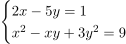
Solve these simultaneous equations:

1. \begin{cases} x+y=5 \\ xy=6 \\ \end{cases}

Roughwork. Read More

    Substituting x=5-y for x:

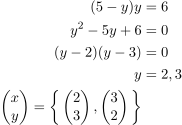
    \begin{aligned} (5-y)y & = 6 \\ y^2-5y+6 & = 0 \\ (y-2)(y-3) & = 0 \\ y & = 2,3 \\ \begin{pmatrix}x \\ y \end{pmatrix} = \bigg\{ \begin{pmatrix} 2 \\ 3 \end{pmatrix},\begin{pmatrix} 3 \\ 2 \end{pmatrix} \bigg\} & \\ \end{aligned}

    Substituting x=1+2y for x:

    \begin{aligned} (1+2y)^2 + y^2 & =29 \\ (1+4y+4y^2)+y^2 & = 29 \\ 5y^2 +4y -28 & = 0 \\ (5y+14)(y-2) & = 0 \\ y & = -\frac{14}{5},2 \\ \begin{pmatrix}x\\y\end{pmatrix} = \bigg\{ \begin{pmatrix}5\\2\end{pmatrix}, \begin{pmatrix}-23/5\\-14/5\end{pmatrix} \bigg\} & \\ \end{aligned}

    Substituting y=5-2x for y:

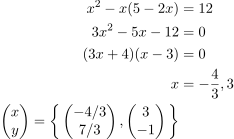
    \begin{aligned} x^2-x(5-2x) & = 12 \\ 3x^2 -5x -12 & = 0 \\ (3x+4)(x-3) & = 0 \\ x & = -\frac{4}{3},3 \\ \begin{pmatrix}x\\y\end{pmatrix} = \bigg\{ \begin{pmatrix}-4/3\\7/3\end{pmatrix},\begin{pmatrix}3\\-1\end{pmatrix}\bigg\} &\\ \end{aligned}

    Substituting y=3x-7 for y:

    \begin{aligned} x^2-x(3x-7)+(3x-7)^2 & = 7 \\ 7x^2 -35x +42 & = 0 \\ (7x+7)(x-6) & = 0 \\ x & = -1,6 \\ \begin{pmatrix}x\\y\end{pmatrix} = \bigg\{ \begin{pmatrix}-1\\-10\end{pmatrix} , \begin{pmatrix}6\\11\end{pmatrix}\bigg\} & \\ \end{aligned}

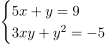
    Substituting y=9-5x for y:

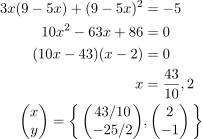
    \begin{aligned} 3x(9-5x)+(9-5x)^2 & = -5 \\ 10x^2-63x +86 & = 0 \\ (10x-43)(x-2) & = 0 \\ x & = \frac{43}{10},2 \\ \begin{pmatrix}x\\y\end{pmatrix} = \bigg\{ \begin{pmatrix}43/10\\-25/2\end{pmatrix} & , \begin{pmatrix}2\\-1\end{pmatrix}\bigg\}  \\ \end{aligned}

    Substituting \displaystyle{y = \frac{13-3x}{2}} for y:

    \begin{aligned} 3x^2 + \bigg(\frac{13-3x}{2}\bigg)^2 = 31 \\ 7x^2 - 26x+15 & = 0 \\ (7x-5)(x-3) & = 0 \\ x & = \frac{7}{5},3 \\ \begin{pmatrix}x\\y\end{pmatrix} = \bigg\{ \begin{pmatrix}7/5\\22/5\end{pmatrix},\begin{pmatrix}3\\-13\end{pmatrix} \bigg\} & \\ \end{aligned}

    Substituting \displaystyle{y=\frac{2x+11}{3}} for y:

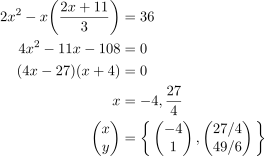
    \begin{aligned} 2x^2-x\bigg( \frac{2x+11}{3}\bigg) & =36 \\ 4x^2-11x-108 &= 0 \\ (4x-27)(x+4) & = 0 \\ x & = -4,\frac{27}{4} \\ \begin{pmatrix}x\\y\end{pmatrix} & = \bigg\{ \begin{pmatrix}-4\\1\end{pmatrix},\begin{pmatrix}27/4\\49/6\end{pmatrix}\bigg\} \\ \end{aligned}

    Substituting \displaystyle{y=\frac{2x-1}{5}} for y:

    \begin{aligned} x^2-x\bigg(\frac{2x-1}{5}\bigg)+3\bigg(\frac{2x-1}{5}\bigg)^2 & = 9 \\ 27x^2 -7x -222 & = 0 \\ (27x+74)(x-3) & = 0 \\ x & = -\frac{74}{27},3 \\ \begin{pmatrix}x\\y\end{pmatrix} = \bigg\{ \begin{pmatrix}-74/27\\-35/27\end{pmatrix} , \begin{pmatrix}3\\1\end{pmatrix} \bigg\} & \\ \end{aligned}

    Substituting \displaystyle{x=\frac{7-3y}{2}} for x:

    \begin{aligned} y^2 & = 26-\bigg(\frac{7-3y}{2}\bigg)^2 \\ 0 & = 13y^2 -42y -55 \\ 0 & = (13y-55)(y+1) \\ y & = -1,\frac{55}{13} \\ \begin{pmatrix}x\\y\end{pmatrix} & = \bigg\{ \begin{pmatrix}5\\-1\end{pmatrix} , \begin{pmatrix}74/26\\55/13\end{pmatrix}\bigg\} \\ \end{aligned}

    Substituting \displaystyle{x=\frac{-7-3y}{5}} for x:

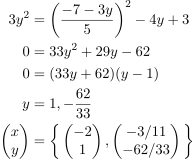
    \begin{aligned} 3y^2 & = \bigg(\frac{-7-3y}{5}\bigg)^2-4y+3 \\ 0 & = 33y^2+29y-62 \\ 0 & = (33y+62)(y-1) \\ y & = 1,-\frac{62}{33}\\ \begin{pmatrix}x\\y\end{pmatrix} & = \bigg\{\begin{pmatrix} -2 \\1\end{pmatrix},\begin{pmatrix} -3/11\\-62/33\end{pmatrix}\bigg\} \\ \end{aligned}

    Extracted from A. Godman & J. F. Talbert. (1975). Additional Mathematics Pure and Applied in SI Units.


    This problem is not to be attempted.

202301160933 Exercise 3.4.B (Q29)

A ball is thrown vertically upward from the ground. Its displacement at time t is given by 20t-5t^2. Find the maximum distance of the ball from the ground and the time this occurs.

Extracted from Y. F. So & M. S. Wong. (1988). New Way Additional Mathematics.


Roughwork.

By differentiation wrt time

\begin{aligned} s(t) & = 20t-5t^2 \\ v(t) & = 20 - 10t \\ a(t) & = -10 \\ \end{aligned}

Its velocity is zero at some time t', i.e.,

\begin{aligned} 0=v(t') & =20-10t' \\ t' & = 2\,\mathrm{s} \\ \end{aligned}

once it reaches the maximum height

\begin{aligned} s(t') & = 20(2)-5(2)^2 \\ & = 20\,\mathrm{m} \\ \end{aligned}

This problem is not to be attempted.

202212311431 Problem 1.4

Let g:\Omega\to\mathbb{R} be such that \displaystyle{\frac{\partial g}{\partial x}} and \displaystyle{\frac{\partial g}{\partial y}} exist at (x_0,y_0)\in\Omega, and suppose that one of these partials exists in a neighbourhood of (x_0,y_0) and is continuous at (x_0,y_0). Show that g is real-differentiable at (x_0,y_0).

Extracted from R. B. Ash & W. P. Novinger. (2004). Complex Variables.


Roughwork.

Granted that

\begin{aligned} w=f(z)&=u(x,y)+iv(x,y) \\ \textrm{s.t. }A & =u_0+iv_0 \\ z_0 & =x_0+iy_0 \\ \end{aligned}

the concepts of existence of limit

\begin{aligned} &\qquad\enspace \lim_{z\to z_0}f(z) = A \\ & \Longleftrightarrow \begin{cases} \lim_{(x,y)\to (x_0,y_0)}u(x,y)=u_0 \\ \lim_{(x,y)\to (x_0,y_0)}v(x,y)=v_0 \\ \end{cases} \textrm{exist} \end{aligned}

and continuity at a point

\begin{aligned} &\qquad\enspace w=f(z)\textrm{ continuous at }z_0 \\ &\Longleftrightarrow \textrm{ both }u(x,y)\textrm{ and }v(x,y)\textrm{ continuous at }z_0 \\ \end{aligned}

are held by definition.

This problem is not to be attempted.

202212311359 Problem 1.3

Let z_1 and z_2 be nonzero complex numbers, and let \theta (0\leqslant \theta\leqslant \pi) be the angle between them. Show that

(a) \mathrm{Re}z_1\overline{z}_2=|z_1||z_2|\cos\theta, \mathrm{Im}z_1\overline{z}_2=\pm |z_1||z_2|\sin\theta, and consequently
(b) The area of the triangle formed by z_1, z_2, and z_2-z_1 is |\mathrm{Im}z_1\overline{z}_2|/2.

Extracted from R. B. Ash & W. P. Novinger. (2004). Complex Variables.


Roughwork.

The area of a triangle \triangle ABC, constructed by any two sides \mathbf{AB} and \mathbf{AC} with an included angle \theta, is

\begin{aligned} \textrm{Area} & = \frac{1}{2}\mathbf{AB}\times \mathbf{AC} \\ \bigg( & =\frac{1}{2}(AB)(AC)\sin\theta\bigg) \\ \end{aligned}

i.e., half the area of the parallelogram spanned by these two vectors.

Hence, \mathtt{(a)} \Longrightarrow \mathtt{(b)}.

This problem is not to be attempted.

202212311329 Problem 1.2

Show that |z_1+z_2|=|z_1|+|z_2| iff z_1 and z_2 lie on a common ray from 0 iff one of z_1 or z_2 is a nonnegative multiple of the other.

Extracted from R. B. Ash & W. P. Novinger. (2004). Complex Variables.


Roughwork.

Let z_1=r_1e^{i\theta_{1}} and z_2=r_2e^{i\theta_{2}}, rewrite

\begin{aligned} |r_1e^{i\theta_{1}}+r_2e^{i\theta_{2}}| & = |r_1e^{i\theta_{1}}|+|r_2e^{i\theta_{2}}| \\ ? = r_3 & = r_1 + r_2 \\ \end{aligned}

by Lemma.

\begin{aligned} r_3e^{i\theta_{3}} & = r_1e^{i\theta_{1}}+r_2e^{i\theta_{2}} \\ & = r_1(\cos\theta_1+i\sin\theta_1) + r_2(\cos\theta_2+i\sin\theta_2) \\ & = (r_1\cos\theta_1+r_2\cos\theta_2) + i(r_1\sin\theta_1+r_2\sin\theta_2) \\ r_3^2 & = r_1^2+r_2^2+2r_1r_2\cos (\theta_1-\theta_2) \\ r_3 & = \sqrt{r_1^2+r_2^2+2r_1r_2\cos (\theta_1-\theta_2)} \\ \end{aligned}

we have

\begin{aligned} \cos (\theta_1-\theta_2) & = 1 \\ \theta_1 - \theta_2 & = 0 \\ \theta_1 & = \theta_2 \\ \end{aligned}

The rest is left an exercise for the reader.

202212301726 Solution to 1987-CE-AMATH-I-3

For any complex number z, let \overline{z}, |z|, and \mathrm{Re}(z) be its conjugate, modulus, and real part respectively. Show that

z+\overline{z}=2\mathrm{Re}(z) and |z|\geqslant \mathrm{Re}(z).

Hence, or otherwise, show that for any complex numbers z_1 and z_2,

z_1z_2+\overline{z_1z_2}\leqslant 2|z_1||z_2|.


Roughwork.

In the field \mathbb{C}=\{ x+iy:x,y\in\mathbb{R}\} of complex numbers, x is called the real part of z and y the imaginary part, i.e.,

z=x+iy=\mathrm{Re}(z)+i\,\mathrm{Im}(z),

its trigonometric form being z=r(\cos\theta +i\sin\theta ) with r the modulus and \theta the argument, and its exponential form, z=re^{i\theta}.

This problem is not to be attempted.