202305171045 Problem 23.11

In the figure below, AC is a diameter of the circle.

If AC=1, which of the following gives the area of triangle ABC in terms of \theta?

A. \displaystyle{\frac{\theta}{2}}
B. \displaystyle{\frac{\tan\theta}{2}}
C. 2\sin\theta
D. \displaystyle{\frac{\sin\theta\cos\theta}{2}}

Extracted from Phu Nielson. (2015). SAT Math Advanced Guide and Workbook.


Remark.

The quantity angle \theta is dimensionless as it is the ratio of arc length to radius, i.e.,

\frac{[L]}{[L]}=[L]^0;

the sine, the cosine, and the tangent of which, as in a right-angled triangle, are
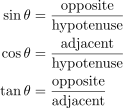
\begin{aligned} \sin\theta & = \frac{\textrm{opposite}}{\textrm{hypotenuse}} \\ \cos\theta & = \frac{\textrm{adjacent}}{\textrm{hypotenuse}} \\ \tan\theta & = \frac{\textrm{opposite}}{\textrm{adjacent}} \\ \end{aligned}

also dimensionless, i.e., [L]^0. Note that the quantity area is [L]^2 in dimension. Hence, choices A. to D. are being understood as:

A. \displaystyle{\frac{\theta}{2}}\enspace\textrm{(sq unit)}
B. \displaystyle{\frac{\tan\theta}{2}}\enspace\textrm{(sq unit)}
C. 2\sin\theta\enspace\textrm{(sq unit)}
D. \displaystyle{\frac{\sin\theta\cos\theta}{2}}\enspace\textrm{(sq unit)}


Warm-up.

Set-up.

where

\begin{aligned} \mathbf{OA} & = (-1/2,0) \\ \mathbf{OB} & = (x,y) \\ \mathbf{OC} & = (1/2,0) \\ \mathbf{AB} & = \mathbf{OB}-\mathbf{OA} \\ & = (x+1/2,y) \\ AB &= |\mathbf{AB}| \\ & = \sqrt{\bigg( x+\frac{1}{2}\bigg)^2+y^2} \\ \mathbf{BC} & = \mathbf{OC}-\mathbf{OB} \\ & = (1/2-x,-y) \\ BC &= |\mathbf{BC}| \\ & = \sqrt{\bigg(\frac{1}{2}-x\bigg)^2+(-y)^2} \\ \mathbf{AC} & = \mathbf{OC}-\mathbf{OA} \\ & = (1,0) \\ AC & = |\mathbf{AC}| \\ & = \sqrt{(1)^2+(0)^2} =1\\ \sin\theta & = \frac{y}{BC} \\ \cos\theta & = \frac{1/2-x}{BC} \\ \tan\theta & = \frac{y}{1/2-x} \\ \end{aligned}

Observe that

\displaystyle{\textrm{Area of }\triangle ABC=\frac{|\mathbf{AB}||\mathbf{BC}|}{2}}

proceed with

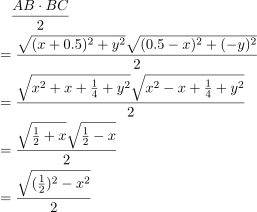
\begin{aligned} &\quad \frac{AB\cdot BC}{2} \\ & = \frac{\sqrt{(x+0.5)^2+y^2}\sqrt{(0.5-x)^2+(-y)^2}}{2} \\ & = \frac{\sqrt{x^2+x+\frac{1}{4}+y^2}\sqrt{x^2-x+\frac{1}{4}+y^2}}{2} \\ & = \frac{\sqrt{\frac{1}{2}+x}\sqrt{\frac{1}{2}-x}}{2} \\ & = \frac{\sqrt{(\frac{1}{2})^2-x^2}}{2}\\ \end{aligned}

by noting OB=|\mathbf{OB}| the radius being \frac{1}{2}:

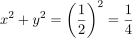
\displaystyle{x^2+y^2=\bigg(\frac{1}{2}\bigg)^2=\frac{1}{4}}.

The function

\displaystyle{f(x)=\sqrt{\frac{1}{16}-\frac{x^2}{4}}}

will output the area by inputting x under constraint on x, y:

g(x,y)=x^2+y^2-\frac{1}{4}=0.

(to be refreshed)


Now ready for problem-solving, write simply

\begin{aligned} \sin\theta & = \frac{AB}{AC}=AB\\ \cos\theta & = \frac{BC}{AC}=BC\\ \tan\theta & = \frac{AB}{BC}\\ \end{aligned}

and the answer is D.

202305151128 Exercise 1.1

Evaluate \textrm{\scriptsize{WITHOUT}} a calculator.

1. (-1)^4 2. (-1)^5 3. (-1)^{10} 4. (-1)^{15} 5. (-1)^8 6. -1^8 7. -(-1)^8 8. (-3)^3 9. -3^3 10. -(-3)^3 11. -(-6)^2 12. -(-4)^3 13. 2^3\times 3^2\times (-1)^5 14. (-1)^4\times 3^3\times 2^2 15. (-2)^3\times (-3)^4 16. 3^0 17. 6^{-1} 18. 4^{-1} 19. 5^0 20. 3^2 21. 3^{-2} 22. 5^3 23. 5^{-3} 24. 7^2 25. 7^{-2} 26. 10^3 27. 10^{-3}

Extracted from Phu Nielson. (2015). SAT Math Advanced Guide and Workbook.


Roughwork.

1.

Since (x^m)^n=x^{mn},

\begin{aligned} (-1)^4 & = ((-1)^2)^2 \\ & = (1)^2\\ & = 1 \\ \end{aligned}

2.

Since x^m\cdot x^n=x^{m+n},

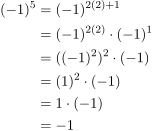
\begin{aligned} (-1)^5 & = (-1)^{2(2)+1} \\ & = (-1)^{2(2)}\cdot (-1)^1 \\ & = ((-1)^{2})^2\cdot (-1)\\ & = (1)^2\cdot (-1) \\ & = 1\cdot (-1) \\ & = -1 \\ \end{aligned}

3.

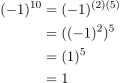
\begin{aligned} (-1)^{10} & = (-1)^{(2)(5)}\\ & = ((-1)^2)^5 \\ & = (1)^5 \\ & = 1\\ \end{aligned}

4.

\begin{aligned} (-1)^{15} & = (-1)^{2(7)+1} \\ & = (-1)^{2(7)}\cdot (-1)^1 \\ & = ((-1)^2)^7\cdot (-1) \\ & = (1)^7\cdot (-1) \\ & = 1\cdot (-1) \\ & = -1 \\ \end{aligned}

5.

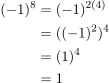
\begin{aligned} (-1)^8 & = (-1)^{2(4)} \\ & = ((-1)^2)^4 \\ & = (1)^4 \\ & = 1 \\ \end{aligned}

6.

\begin{aligned} -1^8 & = -(1^8) \\ & = -(1) \\ & = -1 \\ \end{aligned}

7.

\begin{aligned} -(-1)^8 & = -((-1)^8) \\ & = -((-1)^{2(4)}) \\ & = -(((-1)^2)^4) \\ & = -(1^4) \\ & = -(1) \\ & = -1 \\ \end{aligned}

8.

Since (xy)^m=x^my^m,

\begin{aligned} (-3)^3 & = ((-1)(3))^3 \\ & = (-1)^3(3)^3 \\ & = (-1)^{2+1}(3\cdot 3\cdot 3) \\ & = ((-1)^2\cdot (-1))(9\cdot 3) \\ & = (1\cdot (-1))(27) \\ & = (-1)(27) \\ & = -27 \\ \end{aligned}

9.

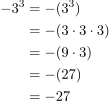
\begin{aligned} -3^3 & = -(3^3) \\ & = -(3\cdot 3\cdot 3) \\ & = -(9\cdot 3) \\ & = -(27) \\ & = -27 \\ \end{aligned}

10.

\begin{aligned} -(-3)^3 & = -((-3)^3) \\ & = -(((-1)(3))^3) \\ & = -((-1)^3(3)^3) \\ & = -((-1)^{2+1}(3\cdot 3\cdot 3)) \\ & = -((-1)^2(-1)(9\cdot 3)) \\ & = -((1)(-1)(27)) \\ & = -((-1)(27)) \\ & = -(-27) \\ & = 27 \\ \end{aligned}

Expressions 11. to 27. are not to be attempted.

202305111603 Exercise 3.1

Solve the following equations:

(a) 13x-4=3x+16.

(b) \displaystyle{\frac{3x-9}{18}+\frac{x}{27}-\frac{2x-5}{4}=\frac{4}{3}-x}.

(c) \displaystyle{\frac{3}{x-1}-\frac{2}{x+4}=\frac{4}{2-2x}}.

(d) \displaystyle{\frac{2x}{x-3}-\frac{4x+1}{2x-1}=\frac{21}{2x^2-7x+3}}.

(e) \displaystyle{\frac{1}{4}(3y-2)-\bigg[ y-\frac{1}{y}(7-3y)\bigg] =-\frac{1}{4}y-7}.

Extracted from K. L. Nielsen. (1958). College Mathematics.


Roughwork.

(a)

\begin{aligned} 13x-4 & = 3x+16 \\ 13x-3x & = 16+4 \\ 10x & = 20 \\ x & = 2 \\ \end{aligned}

(b)

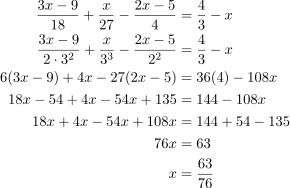
\begin{aligned} \frac{3x-9}{18} + \frac{x}{27} - \frac{2x-5}{4} & = \frac{4}{3}-x \\ \frac{3x-9}{2\cdot 3^2} + \frac{x}{3^3} - \frac{2x-5}{2^2} & = \frac{4}{3}-x \\ 6(3x-9) + 4x-27(2x-5) & =36(4)-108x \\ 18x-54+4x-54x+135 & =144-108x \\ 18x+4x-54x+108x & = 144+54-135 \\ 76x & = 63 \\ x & = \frac{63}{76} \\ \end{aligned}

(c)

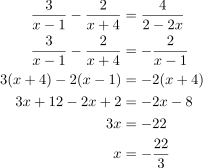
\begin{aligned} \frac{3}{x-1}-\frac{2}{x+4} & = \frac{4}{2-2x} \\ \frac{3}{x-1}-\frac{2}{x+4} & = -\frac{2}{x-1} \\ 3(x+4) - 2(x-1) & = -2(x+4) \\ 3x+12-2x+2 & = -2x-8 \\ 3x & = -22 \\ x & = -\frac{22}{3} \\ \end{aligned}

(d) Not to be attempted.

(e) Not to be attempted.

202305101606 Problem 3.16.1

Let G=\{ \mathbf{e},a,a^2,a^3\} be a cyclic group of order 4 and G' be the multiplicative group \{1,-1,\mathbf{i},-\mathbf{i}\} of 4 complex numbers.

i. Tabulate two isomorphisms from G to G'.
ii. Explain why there are no other isomorphisms from G to G'.

Extracted from A. P. Hillman. (1999). Abstract Algebra A First Undergraduate Course.


Background.

The group G is cyclic if and only if every element of G can be expressed as the power of one element of G:

\exists\, g\in G,\,\forall\, h\in G:\enspace h=g^n\textrm{ for some }n\in\mathbb{Z}.

if and only if it is generated by one element g\in G called a generator of G:

G=\langle g\rangle.

ProofWiki on Cyclic Group

Let (F,+,\times ) be a field and let F^*:=F\backslash\{ 0\} be the set F less its zero. The group (F^*,\times ) is known as the multiplicative group of F.

ProofWiki on Multiplicative Group

A bijective homomorphism is called an isomorphism; that is, a group isomorphism \theta from G to G' is a bijection \theta such that \theta (ab)=\theta (a)\theta (b) for all a and b in G.

Text on 3.2 Group Isomorphism, pg.141

Let \theta be a group isomorphism from G to G'. Then:

(a) \mathbf{e}\stackrel{\theta}{\mapsto}\mathbf{e}', where \mathbf{e} and \mathbf{e}' are the identities of G and G'.
(b) If a\stackrel{\theta}{\mapsto}a', then a^n\stackrel{\theta}{\mapsto}(a')^n for all integers n. In particular,

a^{-1}\stackrel{\theta}{\mapsto}(a')^{-1}.

(c) If a\stackrel{\theta}{\mapsto}a', then a and a' have equal orders.

Text on 3.2 Group Isomorphism, pg.143


Roughwork.

\begin{array}{c|cccc} (G,*) & \mathbf{e} & a & a^2 & a^3 \\\hline \mathbf{e} & \mathbf{e} & a & a^2 & a^3 \\ a & a & a^2 & a^3 & \mathbf{e} \\ a^2 & a^2 & a^3 & \mathbf{e} & a \\ a^3 & a^3 & \mathbf{e} & a & a^2 \\ \end{array}

\begin{array}{c|cccc} (G',\times ) & 1 & -1 & \mathbf{i} & -\mathbf{i} \\\hline 1 & 1 & -1 & \mathbf{i} & -\mathbf{i} \\ -1 & -1 & 1 & -\mathbf{i} & \mathbf{i} \\ \mathbf{i} & \mathbf{i} & -\mathbf{i} & -1 & 1 \\ -\mathbf{i} &-\mathbf{i} & \mathbf{i}} & 1 & -1 \\ \end{array}

Observe that

G=\langle a\rangle; G'=\langle \mathbf{i}\rangle=\langle -\mathbf{i}\rangle.


This problem is not to be attempted.

202304131118 Problem 2.1.1

For each of the following parts, tell whether it specifies \theta as a permutation on \mathbf{X_5}=\{ 1,2,3,4,5\}. If not, explain how Definition 1 is not satisfied.

(a) \theta:1\mapsto 1,2\mapsto 3,3\mapsto 4,4\mapsto 5,5\mapsto 1.
(b) \theta:1\mapsto 5,2\mapsto 1,3\mapsto 2,4\mapsto 3,5\mapsto 4.
(c) \theta:1\mapsto 1,2\mapsto 2,3\mapsto 3,4\mapsto 4,5\mapsto 5.

Extracted from A. P. Hillman. (1999). Abstract Algebra A First Undergraduate Course.


Roughwork.

(a)

The arrow form

\theta:1\mapsto 1,2\mapsto 3,3\mapsto 4,4\mapsto 5,5\mapsto 1

may also be expressed as in function form

\begin{aligned} \theta (1) & = 1\\ \theta (2) & = 3\\ \theta (3) & = 4\\ \theta (4) & = 5\\ \theta (5) & = 1\\ \end{aligned}

For any finite non-empty set S, A(S) the set of all \textrm{1--1} transformations (mappings) of S onto S forms a group called permutation group and any element of A(S), i.e., a mapping from S onto itself, is called permutation.

From Wikibooks on Permutation groups

As is seen, function \theta here is \textrm{\scriptsize{NOT}} injective (i.e., \textrm{\scriptsize{NOT}} \textrm{1--1}), for \theta sends both 1 and 5 to 1. Hence it cannot specify a permutation.

(b)

The arrow form

\theta:1\mapsto 5,2\mapsto 1,3\mapsto 2,4\mapsto 3,5\mapsto 4

or two-line form

\begin{pmatrix} 1 & 2 & 3 & 4 & 5 \\ 5 & 1 & 2 & 3 & 4 \end{pmatrix}

or cyclic form

(15432)

also in diagram

is obviously a one-to-one function (/an injection). Thus function \theta here specifies a permutation.

(c)

In arrow form

\theta:1\mapsto 1,2\mapsto 2,3\mapsto 3,4\mapsto 4,5\mapsto 5

or matrix form

\begin{pmatrix} 1 & 2 & 3 & 4 & 5 \\ 1 & 2 & 3 & 4 & 5 \end{pmatrix}

or cyclic form

()

is the identity permutation.


This problem is not to be attempted.

202304131021 Problem 1.2.1

Which of the following integers are in the set 6\mathbb{Z} of integral multiples of 6?

(a) 10;
(b) -10;
(c) 12;
(d) -12;
(e) 4002;
(f) -4002;
(g) 4003;
(h) -4003.

Extracted from A. P. Hillman. (1999). Abstract Algebra A First Undergraduate Course.


Roughwork.

(a), (b)

\begin{aligned} \pm 10\div 6 & = \frac{\pm 10}{6} \\ & = \pm 1\frac{2}{3}\enspace\notin \mathbb{Z} \\ \end{aligned}

\begin{aligned} \because \quad & 6\nmid \pm 10 \\ \therefore \quad & \mathrm{\pm 10}\notin 6\mathbb{Z} \\ \end{aligned}

Because 6 is not a divisor (/factor) of \pm 10 in \mathbb{Z}, integers 10 and -10 are \textrm{\scriptsize{NOT}} in the set 6\mathbb{Z} of integral multiples of 6.

(c), (d)

\begin{aligned} \pm 12\div 6 & = \frac{\pm 12}{6} \\ & = \pm 2\enspace\in \mathbb{Z} \end{aligned}

\begin{aligned} \because\quad & 6\mid \pm12 \\ \therefore\quad & \mathrm{\pm 12}\in 6\mathbb{Z} \\ \end{aligned}

Since 6 is an integral divisor of \pm 12, integers 12 and -12 are in the set 6\mathbb{Z} of integral multiples of 6.

(e), (f)

\begin{aligned} \pm 4002\div 6 & = \frac{\pm 4002}{6} \\ & = \pm 667\enspace \in\mathbb{Z} \\ \end{aligned}

\begin{aligned} \because\quad & 6\mid \pm 4002 \\ \therefore\quad & \mathrm{\pm 4002}\in 6\mathbb{Z} \\ \end{aligned}

As \pm 4002 is a multiple of 6 in \mathbb{Z}, integers 4002 and -4002 are in the set 6\mathbb{Z} of integral multiples of 6.

(g), (h)

\begin{aligned} \pm 4003\div 6 & = \frac{\pm 4003}{6} \\ & = \pm 667\frac{1}{6}\enspace \notin\mathbb{Z} \\ \end{aligned}

\begin{aligned} \because\quad & 6\nmid \pm 4003 \\ \therefore\quad & \mathrm{\pm 4003} \notin 6\mathbb{Z} \\ \end{aligned}

Now that \pm 4003 is not an integral multiple of 6, integers 4003 and -4003 are \textrm{\scriptsize{NOT}} in the set 6\mathbb{Z} of integral multiples of 6.


This problem is not to be attempted.

202303270928 Problem 1.1.1

Let F_1, F_2, F_3, … be the Fibonacci sequence. Prove that

F_{n+1}F_{n+2}-F_{n}F_{n+3}=(-1)^n

for all positive integers n.

Extracted from A. P. Hillman. (1999). Abstract Algebra A First Undergraduate Course.


Roughwork.

Let P(n) be the statement to prove. When n=1,

P(1):\quad F_{2}F_{3}-F_{1}F_{4}\stackrel{\textrm{?}}{=}-1

is to check.

\begin{aligned} F_1 & = 1\\ F_2 & = 1\\ F_3 & = 2\\ F_4 & = 3\\ \dots & \dots \\ F_{n} & = F_{n-1} + F_{n-2}\quad\textrm{for integers }n\geqslant 3 \\ \end{aligned}

First, P(1) is true.

Next, be P(n) true. WTS P(n+1) true whenever P(n) true:

\begin{aligned} P(n+1): & \quad F_{(n+1)+1}F_{(n+1)+2}-F_{n+1}F_{(n+1)+3}\stackrel{\textrm{?}}{=}(-1)^{n+1} \\ \textrm{LHS} & = F_{n+2}F_{n+3}-F_{n+1}F_{n+4} \\ & = (F_{n+1}+F_n)F_{n+3}-F_{n+1}(F_{n+3}+F_{n+2})\\ & = F_{n}F_{n+3}-F_{n+1}F_{n+2} \\ & = -(F_{n+1}F_{n+2}-F_{n}F_{n+3}) \\ & \stackrel{.}{=} -((-1)^n) \\ & = (-1)^{n+1} \\ & = \textrm{RHS} \\ \end{aligned}

Lastly, as P(1) true and P(n)\Rightarrow P(n+1), by principle of mathematical induction, the statement is proven for all n\in\mathbb{Z}^+.

202303150916 Exercise 4.6.4

Let f:\mathbb{R}^2\to\mathbb{R}^2 be defined by

f(x,y)=(x^3+y^3,x^3-y^3) for (x,y)\in\mathbb{R}^2.

Prove that the Jacobian matrix J_{f,(0,0)} is the zero matrix. Show that nevertheless f is globally invertible on \mathbb{R}^2. [Hint: prove that f is \textrm{1--1} on \mathbb{R}^2.] Show also that the inverse function is not differentiable at f(0,0)=(0,0).

Extracted from P. R. Baxandall. (1986). Vector Calculus.


Roughwork.

\begin{aligned} f\bigg(\begin{bmatrix}x\\y\end{bmatrix}\bigg) & = \begin{bmatrix} x^3+y^3 \\ x^3-y^3 \end{bmatrix} \\ J_{f,(x,y)} & = \begin{bmatrix} \partial_x (x^3+y^3) & \partial_y(x^3+y^3) \\ \partial_x(x^3-y^3) & \partial_y(x^3-y^3) \\ \end{bmatrix} \\ & = \begin{bmatrix} 3x^2 & 3y^2 \\ 3x^2 & -3y^2 \\ \end{bmatrix} \\ J_{f,(0,0)} & = \begin{bmatrix} 3(0)^2 & 3(0)^2 \\ 3(0)^2 & -3(0)^2 \end{bmatrix} \\ & = \begin{bmatrix} 0 & 0 \\ 0 & 0 \\ \end{bmatrix} \\ \end{aligned}

The function f:\mathbb{R}^n\to\mathbb{R}^n is locally invertible at \mathbf{x}_0 if there is an \epsilon >0 and a function g:B_{\epsilon}(f(\mathbf{x}_0))\to\mathbb{R}^n such that

\begin{cases} f\circ g(\mathbf{y}) \equiv \mathbf{y}\quad\textrm{for }\mathbf{y}\in B_{\epsilon}(f(\mathbf{x}_0)) \\ g\circ f(\mathbf{x}) \equiv \mathbf{x}\quad \textrm{for }\mathbf{x}\in B_{\epsilon}(\mathbf{x}_0) \\ \end{cases}

Luca Rigotti. (2015). University of Pittsburgh, ECON2001 Lecture 12

I should have felt no hesitation in applying the inverse function theorem but for some difficulties when interpreting

\begin{aligned} &\quad\enspace\textrm{ locally invertible everywhere} \\ & \nLeftrightarrow \textrm{ globally invertible} \\ \end{aligned}

(to be continued)

202303141200 Exercise 7.7.1

Consider the coordinate transformation (x,y)=G(u,v) given by

G(u,v)=(au,bv) for (u,v)\in\mathbb{R}^2

where a and b are positive constants.

(a) Prove that G is \textrm{1--1} on \mathbb{R}^2.
(b) Show that G maps the circular disc

K=\{(u,v)\in\mathbb{R}^2 : u^2+v^2\leqslant 1\}

in the u, v plane onto the elliptical disc

G(K)=\{(x,y)\in\mathbb{R}^2 : x^2/a^2+y^2/b^2\leqslant 1\}

in the x, y plane.
(c) Calculate \mathrm{det}\,J_{G,(u,v)}.
(d) Calculate, using Theorem 7.7.5, the area of the elliptical disc G(K). (Assume known that the area of K is \pi.)

Extracted from P. R. Baxandall. (1986). Vector Calculus.


Roughwork.

Symbolically,

\forall\, a,b\in X,\quad f(a)=f(b)\Rightarrow a=b,

or the contrapositive

\forall\, a,b\in X,\quad a\neq b\Rightarrow f(a)\neq f(b).

Wikipedia on Injective function

(a)

From G:\mathbb{R}^2\to\mathbb{R}^2:(u,v)\mapsto (x=au,y=bv),

\begin{aligned} & \enspace & (x_1,y_1)=G(u_1,v_1) & = G(u_2,v_2)=(x_2,y_2) \\ \Rightarrow & \enspace & (au_1,bv_1) & = (au_2,bv_2) \\ \Rightarrow & \enspace & (u_1,v_1) & = (u_2,v_2) \\ \end{aligned}

(b) Obvious.

(c)

\begin{aligned} J_{G}(u,v) & = \begin{bmatrix} \partial_u(au)&\partial_v(au) \\ \partial_u(bv) & \partial_v(bv) \\ \end{bmatrix} \\ & = \begin{bmatrix} a & 0 \\ 0 & b \\ \end{bmatrix} \\ \mathrm{det}\,J_{G,(u,v)} & = ab \\ \end{aligned}

(d)

Theorem (Change of variables).  Let G:K\subseteq \mathbb{R}^2\to\mathbb{R}^2 be a C^1 function defined on a compact set K in \mathbb{R}^2, and let D\subseteq K be an open subset of \mathbb{R}^2 such that

i. K\backslash D is a null set,
ii. G is \textrm{1--1} on D,
iii. \mathrm{det}\,J_{G,(u,v)}\neq 0 for all (u,v)\in D.

Then, for any bounded function f:G(K)\subseteq\mathbb{R}^2\to\mathbb{R} which is continuous on G(D)

\displaystyle{\iint_{G(K)}f(x,y)\,\mathrm{d}x\,\mathrm{d}y=\iint_{K}f(G(u,v))|\mathrm{det}\,J_{G,(u,v)}|\,\mathrm{d}u\,\mathrm{d}v}.

See Theorem 7.7.5 on pg. 404.

The area of the elliptical disc G(K) is \pi ab.

This problem is not to be attempted.

202303141137 Exercise 2.7.1

Calculate the lengths of the following smooth simple arcs in \mathbb{R}^3.

(a) The circular helix parametrized by

f(t)=(t,\cos t,\sin t)

where t\in [a,b];
(b) the curve parametrized by

f(t)=(e^t\cos t,e^t\sin t,e^t)

where t\in [0,k].

Extracted from P. R. Baxandall. (1986). Vector Calculus.


Roughwork.

Let f:[a,b]\subseteq\mathbb{R}\to\mathbb{R}^n be a C^1 path in \mathbb{R}^n. The length of f is defined to be

l(f)=\displaystyle{\int_{a}^{b}\|f'(t)\|\,\mathrm{d}t}.

See Definition 2.7.2 on pg.60

(a)

\begin{aligned} f(t) & = (t,\cos t,\sin t) \\ f'(t) & = (1,-\sin t,\cos t) \\ \|f'(t)\| & = \sqrt{(1)^2+(-\sin t)^2+(\cos t)^2} \\ & = \sqrt{2} \\ l(f) & = \int_{a}^{b} \sqrt{2}\,\mathrm{d}t \\ & = \sqrt{2}(b-a) \\ \end{aligned}

(b) Not to be attempted.