202310181051 Exercise 7.9.21

Evaluate the integral

\displaystyle{\int \frac{\mathrm{d}x}{\sqrt{x^2-4x}}}.

Extracted from James Stewart. (2012). Calculus (8e)


Roughwork.

There are as many ways to evaluate definite/indefinite integrals as there are to evaluate derivatives/differentials, for example, by i. basic integration formulae, ii. substitution by rational polynomials, trigonometric functions, or hyperbolic functions, iii. integration by parts, iv. reduction formulae, iv. simplification by partial fractions, v. parity argument, and vi. parametrization.


Make use of none above but the following

Residue Theorem. Suppose that the function f is analytic within and on a positively oriented simple closed contour C except for a finite number of isolated singular points \{ z_j, j=1,2,\dots ,N\} interior to C, then

\displaystyle{\int_{C}f(z)\,\mathrm{d}z=2\pi i\sum_{j=1}^{N}\mathrm{Res}_{z=z_j}f(z)}.

Residue Formula. If f(z) has a pole of order k at z=z_0, then

\displaystyle{\mathrm{Res}\, (f,z_0)=\frac{1}{(k-1)!}\frac{\mathrm{d}^{k-1}}{\mathrm{d}z^{k-1}}\Big( (z-z_0)^kf(z)\Big)\bigg|_{z=z_0}}


Write for some real number x

\begin{aligned} & \quad\enspace \int \frac{\mathrm{d}x}{\sqrt{x^2-4x}} \\ & \hookrightarrow \textrm{let }R(x)=\frac{1}{\sqrt{x^2-4x}} \\ \end{aligned}

and also for some complex number z=x+iy,

\begin{aligned} & \quad\enspace \int \frac{\mathrm{d}z}{\sqrt{z^2-4z}} \\ & \hookrightarrow \textrm{let }R(z)=\frac{1}{\sqrt{z^2-4z}} \\ \end{aligned}

Then there are two singular points (/singularities) (0,0) and (4,0) on the Argand plane, because, for instance

\displaystyle{R\big( (0,0)\big)=\frac{1}{\sqrt{(0)^2-4(0)}}}

is undefined.

From the denominator of R(z) we see there

\sqrt{z(z-4)}

2 poles of order \frac{1}{2} (*fractional order seems disputable, but no worries as you read further along), by the fact that

\begin{aligned} & \lim_{z\to 0} (z)^{(\frac{1}{2})}\frac{1}{\sqrt{z^2-4z}} = -\frac{i}{2} \neq 0 \\ & \lim_{z\to 4} (z-4)^{(\frac{1}{2})}\frac{1}{\sqrt{z^2-4z}} = \frac{1}{2} \neq 0 \\ \end{aligned}

and their residues being:

z(x,y)=\{ (0,0)\} \cup \{ (4,0)\}.


We introduce the below

Lemma 1. (positive fractional derivatives)

\displaystyle{\frac{\mathrm{d}^nx^m}{\mathrm{d}x^n}=\frac{\Gamma (m+1)}{\Gamma (m-n+1)}x^{m-n}}

In particular, if letting m=1 and n=1/2, then

\displaystyle{\frac{\mathrm{d}^{1/2}x}{\mathrm{d}x^{1/2}}=\frac{2\sqrt{x}}{\sqrt{\pi}}}.

Lemma 2. (negative fractional derivatives)

\displaystyle{D^{-\nu}x^{\mu}=\frac{\Gamma (\mu +1)}{\Gamma (\mu +\nu +1)}x^{\mu +\nu}}

where \nu >0, \mu >-1, and x>0. In particular, if \nu =\frac{1}{2}, then

\begin{aligned} D^{-1/2}x^0 & = \frac{\Gamma (1)}{\Gamma (3/2)}x^{1/2}=2\sqrt{\frac{x}{\pi}} \\ D^{-1/2}x^1 & = \frac{\Gamma (2)}{\Gamma (5/2)}x^{3/2}=\frac{4}{3}\sqrt{\frac{x^3}{\pi}} \\ D^{-1/2}x^2 & = \frac{\Gamma (3)}{\Gamma (7/2)}x^{5/2}=\frac{16}{15}\sqrt{\frac{x^5}{\pi}} \\ \end{aligned}

where the Legendre’s Gamma function is given by

\Gamma (n+1)=n!.

For brevity we state without proof the definition of factorial of fractions:

\displaystyle{N!=\prod (N)}

where N\in\mathbb{Q} and Gauss product Pi is

\displaystyle{\prod (x) = \int_{0}^{\infty}t^xe^{-t}\,\mathrm{d}t}

Cited from Kimeu, Joseph M., “Fractional Calculus: Definitions and Applications” (2009). Masters Theses & Specialist Projects. Paper 115.


Therefore

\begin{aligned} &\quad\enspace \int R(x)\,\mathrm{d}x \\ & = \pi i\bigg\{ \mathrm{Res}\, [R(z),0] + \mathrm{Res}\, [R(z),4] \bigg\} \\ \end{aligned}

\begin{aligned} \hookrightarrow\quad\mathrm{Res}(R(z),0) & = \frac{1}{(-1/2)!}\frac{\mathrm{d}^{-1/2}}{\mathrm{d}z^{-1/2}}(z-0)^{1/2}R(z)\bigg|_{z=0} \\ & = \frac{1}{\sqrt{\pi}}\frac{\mathrm{d}^{-1/2}}{\mathrm{d}z^{-1/2}}\frac{\sqrt{z}}{\sqrt{z^2-4z}}\bigg|_{z=0} \\ & = \frac{1}{\sqrt{\pi}}\frac{\mathrm{d}^{-1/2}}{\mathrm{d}z^{-1/2}}\frac{1}{\sqrt{z-4}}\bigg|_{z=0} \\ & \stackrel{\dagger}{=}\frac{1}{\sqrt{\pi}}\sqrt{\frac{-2}{z'^3}}\frac{\mathrm{d}^{-1/2}}{\mathrm{d}z'^{-1/2}}\big( z'\big) \\ & = \frac{1}{\sqrt{\pi}}\sqrt{\frac{-2}{z'^3}}\bigg(\frac{4}{3}\sqrt{\frac{z'^3}{\pi}}\bigg) \\ & = \frac{4\sqrt{2}i}{3\pi} \\ & \\ \textrm{\dag} :\qquad\qquad & \\ \quad \textrm{let }z' & = \frac{1}{\sqrt{z-4}} \\ \textrm{then }\frac{\mathrm{d}z'}{\mathrm{d}z} & = -\bigg(\frac{1}{2}\bigg)(z-4)^{-3/2}(1) \\ & = -\frac{z'^3}{2} \\ \mathrm{d}z & = -\frac{2}{z'^3}\,\mathrm{d}z' \\ \end{aligned}

\begin{aligned} \hookrightarrow\quad\mathrm{Res}(R(z),4) & = \frac{1}{(-1/2)!}\frac{\mathrm{d}^{-1/2}}{\mathrm{d}z^{-1/2}}(z-4)^{1/2}R(z)\bigg|_{z=0} \\ & = \frac{1}{\sqrt{\pi}}\frac{\mathrm{d}^{-1/2}}{\mathrm{d}z^{-1/2}}\frac{\sqrt{z-4}}{\sqrt{z^2-4z}}\bigg|_{z=0} \\ & = \frac{1}{\sqrt{\pi}}\frac{\mathrm{d}^{-1/2}}{\mathrm{d}z^{-1/2}}\frac{1}{\sqrt{z}}\bigg|_{z=0} \\ & \stackrel{\textrm{\ddag}}{=}\frac{1}{\sqrt{\pi}}\sqrt{\frac{-2}{z''^3}}\frac{\mathrm{d}^{-1/2}}{\mathrm{d}z''^{-1/2}}\big( z''\big) \\ & = \frac{1}{\sqrt{\pi}}\sqrt{\frac{-2}{z''^3}}\bigg(\frac{4}{3}\sqrt{\frac{z''^3}{\pi}}\bigg) \\ & = \frac{4\sqrt{2}i}{3\pi} \\ & \\ \textrm{\ddag} :\qquad\qquad & \\ \quad \textrm{let }z'' & = \frac{1}{\sqrt{z-4}} \\ \textrm{then }\frac{\mathrm{d}z''}{\mathrm{d}z} & = -\bigg(\frac{1}{2}\bigg)(z-4)^{-3/2}(1) \\ & = -\frac{z''^3}{2} \\ \mathrm{d}z & = -\frac{2}{z''^3}\,\mathrm{d}z'' \\ \end{aligned}

\begin{aligned} &\quad\enspace \int R(x)\,\mathrm{d}x \\ & = \pi i\bigg\{ \mathrm{Res}\, [R(z),0] + \mathrm{Res}\, [R(z),4] \bigg\} \\ & = \pi i \bigg\{\frac{4\sqrt{2}i}{3\pi}+\frac{4\sqrt{2}i}{3\pi}\bigg\} \\ & = -\frac{8\sqrt{2}}{3} \\ \end{aligned}

Of course this \textrm{\scriptsize{MUST}} be a joke; how can an indefinite integral give a definite value, let alone be independent of any variable?


Countercheck.

The correct answer is

2\ln (\sqrt{x}+\sqrt{x-4})+C\enspace\textrm{for some constant}.


(to be continued)

202302140910 Exercises 2.1

What do the following equations represent geometrically? Give sketches.

i. |z+2|=6,
ii. |z-3\,\mathrm{i}|=|z+\mathrm{i}|,
iii. |\mathrm{i}z-1|=|\mathrm{i}z+1|,
iv. |z-\omega |=|z-1| (\omega=e^{2\pi\,\mathrm{i}/3}).

Extracted from H. A. Priestley. (2003). Introduction to Complex Analysis.


Roughwork.

i.

\begin{aligned} |z+2|&=6 \\ |(x+\mathrm{i}y)+2| & = 6 \\ |(x+2)+\mathrm{i}y| & = 6 \\ \sqrt{(x+2)^2+y^2} & = 6 \\ (x+2)^2 + y^2 & = 6^2 \\ \end{aligned}

i.e., a circle centred at (-2,0) with 6 units in radius.

ii.

\begin{aligned} |z-3\,\mathrm{i}| & = |z+\mathrm{i}| \\ |(x+\mathrm{i}y)-3\,\mathrm{i}| & = |(x+\mathrm{i}y)+\mathrm{i}| \\ |x+\mathrm{i}(y-3)| & = |x+\mathrm{i}(y+1)| \\ \sqrt{x^2+(y-3)^2} & = \sqrt{x^2+(y+1)^2} \\ x^2+(y-3)^2 & = x^2 + (y+1)^2 \\ y^2-6y+9 & = y^2+2y+1 \\ y & = 1 \\ \end{aligned}

i.e., a horizontal line with y-intercept 1 unit.

iii.

\begin{aligned} |\mathrm{i}z-1| & = |\mathrm{i}z+1| \\ |\mathrm{i}(x+\mathrm{i}y)-1| & = |\mathrm{i}(x+\mathrm{i}y)+1| \\ |(-y+\mathrm{i}x)-1| & = |(-y+\mathrm{i}x+1|\\ |(-y-1)+\mathrm{i}x| & = |(-y+1)+\mathrm{i}x| \\ \sqrt{(-y-1)^2+x^2} & = \sqrt{(-y+1)^2+x^2} \\ y^2+2y+1 & = y^2-2y+1 \\ y & = 0 \\ \end{aligned}

i.e., the x-axis.

iv.

\begin{aligned} |z-\omega | & = |z-1| \\ |(x+\mathrm{i}y)-\mathrm{cis}(2\pi/3)|& = |(x+\mathrm{i}y)-1| \\ \bigg|\bigg(x+\frac{1}{2}\bigg)+\mathrm{i}\bigg(y-\frac{\sqrt{3}}{2}\bigg)\bigg| & = |(x-1)+\mathrm{i}y| \\ \end{aligned}

Not to be completed.

202212311431 Problem 1.4

Let g:\Omega\to\mathbb{R} be such that \displaystyle{\frac{\partial g}{\partial x}} and \displaystyle{\frac{\partial g}{\partial y}} exist at (x_0,y_0)\in\Omega, and suppose that one of these partials exists in a neighbourhood of (x_0,y_0) and is continuous at (x_0,y_0). Show that g is real-differentiable at (x_0,y_0).

Extracted from R. B. Ash & W. P. Novinger. (2004). Complex Variables.


Roughwork.

Granted that

\begin{aligned} w=f(z)&=u(x,y)+iv(x,y) \\ \textrm{s.t. }A & =u_0+iv_0 \\ z_0 & =x_0+iy_0 \\ \end{aligned}

the concepts of existence of limit

\begin{aligned} &\qquad\enspace \lim_{z\to z_0}f(z) = A \\ & \Longleftrightarrow \begin{cases} \lim_{(x,y)\to (x_0,y_0)}u(x,y)=u_0 \\ \lim_{(x,y)\to (x_0,y_0)}v(x,y)=v_0 \\ \end{cases} \textrm{exist} \end{aligned}

and continuity at a point

\begin{aligned} &\qquad\enspace w=f(z)\textrm{ continuous at }z_0 \\ &\Longleftrightarrow \textrm{ both }u(x,y)\textrm{ and }v(x,y)\textrm{ continuous at }z_0 \\ \end{aligned}

are held by definition.

This problem is not to be attempted.

202212311359 Problem 1.3

Let z_1 and z_2 be nonzero complex numbers, and let \theta (0\leqslant \theta\leqslant \pi) be the angle between them. Show that

(a) \mathrm{Re}z_1\overline{z}_2=|z_1||z_2|\cos\theta, \mathrm{Im}z_1\overline{z}_2=\pm |z_1||z_2|\sin\theta, and consequently
(b) The area of the triangle formed by z_1, z_2, and z_2-z_1 is |\mathrm{Im}z_1\overline{z}_2|/2.

Extracted from R. B. Ash & W. P. Novinger. (2004). Complex Variables.


Roughwork.

The area of a triangle \triangle ABC, constructed by any two sides \mathbf{AB} and \mathbf{AC} with an included angle \theta, is

\begin{aligned} \textrm{Area} & = \frac{1}{2}\mathbf{AB}\times \mathbf{AC} \\ \bigg( & =\frac{1}{2}(AB)(AC)\sin\theta\bigg) \\ \end{aligned}

i.e., half the area of the parallelogram spanned by these two vectors.

Hence, \mathtt{(a)} \Longrightarrow \mathtt{(b)}.

This problem is not to be attempted.

202212311329 Problem 1.2

Show that |z_1+z_2|=|z_1|+|z_2| iff z_1 and z_2 lie on a common ray from 0 iff one of z_1 or z_2 is a nonnegative multiple of the other.

Extracted from R. B. Ash & W. P. Novinger. (2004). Complex Variables.


Roughwork.

Let z_1=r_1e^{i\theta_{1}} and z_2=r_2e^{i\theta_{2}}, rewrite

\begin{aligned} |r_1e^{i\theta_{1}}+r_2e^{i\theta_{2}}| & = |r_1e^{i\theta_{1}}|+|r_2e^{i\theta_{2}}| \\ ? = r_3 & = r_1 + r_2 \\ \end{aligned}

by Lemma.

\begin{aligned} r_3e^{i\theta_{3}} & = r_1e^{i\theta_{1}}+r_2e^{i\theta_{2}} \\ & = r_1(\cos\theta_1+i\sin\theta_1) + r_2(\cos\theta_2+i\sin\theta_2) \\ & = (r_1\cos\theta_1+r_2\cos\theta_2) + i(r_1\sin\theta_1+r_2\sin\theta_2) \\ r_3^2 & = r_1^2+r_2^2+2r_1r_2\cos (\theta_1-\theta_2) \\ r_3 & = \sqrt{r_1^2+r_2^2+2r_1r_2\cos (\theta_1-\theta_2)} \\ \end{aligned}

we have

\begin{aligned} \cos (\theta_1-\theta_2) & = 1 \\ \theta_1 - \theta_2 & = 0 \\ \theta_1 & = \theta_2 \\ \end{aligned}

The rest is left an exercise for the reader.

202212301726 Solution to 1987-CE-AMATH-I-3

For any complex number z, let \overline{z}, |z|, and \mathrm{Re}(z) be its conjugate, modulus, and real part respectively. Show that

z+\overline{z}=2\mathrm{Re}(z) and |z|\geqslant \mathrm{Re}(z).

Hence, or otherwise, show that for any complex numbers z_1 and z_2,

z_1z_2+\overline{z_1z_2}\leqslant 2|z_1||z_2|.


Roughwork.

In the field \mathbb{C}=\{ x+iy:x,y\in\mathbb{R}\} of complex numbers, x is called the real part of z and y the imaginary part, i.e.,

z=x+iy=\mathrm{Re}(z)+i\,\mathrm{Im}(z),

its trigonometric form being z=r(\cos\theta +i\sin\theta ) with r the modulus and \theta the argument, and its exponential form, z=re^{i\theta}.

This problem is not to be attempted.

202212231206 Solution to 2002-CE-AMATH-I-18

(a) Let z=\cos\theta +i\sin\theta, where -\pi<\theta \leqslant \pi. Show that

|z^2+1|^2=2(1+\cos 2\theta ).

Hence, or otherwise, find the greatest value of |z^2+1|.
(b) w is a complex number such that |w|=3.
i. Show that the greatest value of |w^2+9| is 18.
ii. Explain why the equation

w^4-81=100i(w^2-9)

has only two roots.


Roughwork.

(a)

\begin{aligned} \textrm{LHS} & = |z^2+1|^2 \\ & = |(\cos\theta +i\sin\theta )^2+1|^2 \\ & = |(\cos^2\theta -\sin^2\theta +2i\sin\theta\cos\theta )+1|^2 \\ & = |(2\cos^2\theta )+i(2\sin\theta\cos\theta )|^2 \\ & = \big(\sqrt{(2\cos^2\theta )^2+(2\sin\theta\cos\theta )^2}\big)^2 \\ & = 4\cos^4\theta +4\sin^2\theta\cos^2\theta \\ & = 4\cos^2\theta (\cos^2\theta +\sin^2\theta ) \\ & = 4\cos^2\theta \\ \end{aligned}

From the double-angle formula

\cos 2\theta = 2\cos^2\theta -1

Wikipedia on List of trigonometric identities

the equality follows, i.e., \textrm{LHS}=\textrm{RHS}. As \max (\cos 2\theta )=1, the greatest value of |z^2+1| is

\sqrt{2(1+(1))} = 2.

(b) Not to be attempted.

202210101009 Exercise 3.9

(a) Prove that the sequence \{ z_n\} converges, and give its limit, when z_n is given by
i. \displaystyle{\frac{1}{n}\mathrm{i}^n},
ii. (1+\mathrm{i})^{-n},
iii. \displaystyle{\frac{n^2+\mathrm{i}n}{n^2+\mathrm{i}}}.
(b) Prove that the sequence \{ z_n\} does not converge when z_n is given by
i. \mathrm{i}^n,
ii. (1+\mathrm{i})^n,
iii. \displaystyle{(-1)^n\frac{n}{n+\mathrm{i}}}.

Extracted from H. A. Priestley. (2003). Introduction to Complex Analysis.


Background.

Definition. (geometric series)
A series of complex number \displaystyle{\sum_{n=0}^{\infty}z_n} is called a geometric series if

\exists\, t\in\mathbb{C}\textrm{ s.t. }z_{n+1}=tz_n\enspace\forall\, n\in\mathbb{N}.

N.b. Such geometric series as z_0\neq 0 is divergent whenever |t|\geqslant 1.

Proposition. (ratio test)
Let \displaystyle{\sum_{n=0}^{\infty}z_n} be a series of complex numbers, z_n\neq 0\enspace\forall\, n\in\mathbb{N}. Define \displaystyle{r_n:=\bigg|\frac{z_{n+1}}{z_n}\bigg|} for n\in\mathbb{N}. Assume that \displaystyle{\lim_{n\to\infty}r_n=r} exists, r\in [0,\infty)\cup \{\infty\}. The series is absolutely convergent if r<1, divergent if r>1, and undetermined if r=1.

Proposition. (root test)
Let \displaystyle{\sum_{n=0}^{\infty}z_n} be a series of complex numbers. For n\geqslant 1 define \rho_n =|z_n|^{\frac{1}{n}}. Assume that \displaystyle{\lim_{n\to\infty} \rho_n :=A} exists, A\in [0,\infty )\cup \{\infty\}. The series is absolutely convergent if A<1, divergent if A>1, and undetermined if A=1.


(a) i.

From \displaystyle{z_n=\frac{1}{n}\mathrm{i}^n} observe that

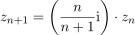
\displaystyle{z_{n+1}=\bigg(\frac{n}{n+1}\mathrm{i}}\bigg)\cdot z_n

is a geometric series of common ratio t:

\displaystyle{t:=\frac{n}{n+1}\mathrm{i}}}.

\begin{aligned} |t| & =\bigg| \frac{n}{n+1} \mathrm{i}\bigg| \\ & = \sqrt{(0)^2+\bigg(\frac{n}{n+1}\bigg)^2} \\ & = \frac{n}{n+1} < 1\enspace \forall\, n\in\mathbb{N} \\ \end{aligned}

\therefore \{ z_n\} converges to the limit 1.


(a) ii.

\begin{aligned} z_n & = (1+\mathrm{i})^{-n} \\ z_{n+1} & = (1+\mathrm{i})^{-(n+1)} \\ & = (1+\mathrm{i})^{-1}(1+\mathrm{i})^{-n} \\ & = \bigg(\frac{1}{1+\mathrm{i}}\bigg) \cdot z_n \\ t & := \frac{1}{1+\mathrm{i}} \\ & = \frac{1}{1+\mathrm{i}} \cdot \frac{1-\mathrm{i}}{1-\mathrm{i}} \\\ & = \frac{1-\mathrm{i}}{1-\mathrm{i}^2} \\ & = \frac{1-\mathrm{i}}{1-(-1)} \\ & = \frac{1}{2} - \frac{1}{2}\mathrm{i} \\ |t| & = \sqrt{\bigg(\frac{1}{2}\bigg)^2 + \bigg( -\frac{1}{2}\bigg)^2} \\ & = \cdots \\ & = \frac{\sqrt{2}}{2}<1 \\ \end{aligned}

\therefore \{ z_n\} converges to the limit 0.


(a) iii.

\begin{aligned} z_n & = \frac{n^2+\mathrm{i}n}{n^2+\mathrm{i}} \\ z_{n+1} & = \frac{(n+1)^2+\mathrm{i}(n+1)}{(n+1)^2+\mathrm{i}} \\ \frac{z_{n+1}}{z_n} & = \frac{(n+1)^2+\mathrm{i}(n+1)}{(n+1)^2+\mathrm{i}}\bigg/ \frac{n^2+\mathrm{i}n}{n^2+\mathrm{i}} \\ & = \frac{(n+1)^2+\mathrm{i}(n+1)}{(n+1)^2+\mathrm{i}}\cdot \frac{n^2+\mathrm{i}}{n^2+\mathrm{i}n} \\ & =: r_n \\ \end{aligned}

By ratio test or root test for convergence the series being undetermined, we had rather adopt another approach.

\begin{aligned} \frac{n^2+\mathrm{i}n}{n^2+\mathrm{i}} & = \frac{(n^2+\mathrm{i}n)(n^2-\mathrm{i})}{(n^2+\mathrm{i})(n^2-\mathrm{i})} \\ z_n & = \frac{(n^4+n)+\mathrm{i}(n^3-n^2)}{n^4+1} \\ \textrm{Re}\, z_n & = \frac{n^4+n}{n^4+1} \\ \textrm{Im}\, z_n & = \frac{n^3-n^2}{n^4+1} \\ \lim_{n\to\infty} \textrm{Re}\, z_n & = \cdots = 1 \\ \lim_{n\to\infty} \textrm{Im}\, z_n & = \cdots = 0 \\ \end{aligned}

\therefore \{ z_n\} converges to the limit 1.


(b) i., ii., and iii. are left the reader as an exercise.