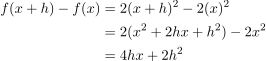
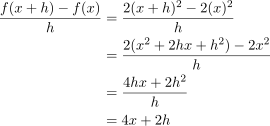
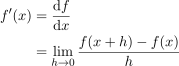
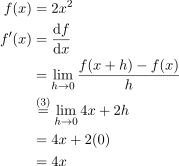
202205250911 Exercise 2.1A (Q1)

Exercises 1-8, show that the given function y=f(x) is one-to-one over the given interval, then find the formulae for the inverse function f^{-1} and its derivative.

1. f(x)=x\quad \forall\, x

2. f(x)=3x\quad \forall\, x
3. f(x)=x^2\quad \forall\, x\ge 0
4. f(x)=\sqrt{x}\quad \forall\, x\ge 0
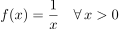
5. f(x)=\displaystyle{\frac{1}{x}}\quad \forall\, x>0
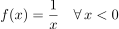
6. f(x)=\displaystyle{\frac{1}{x}}\quad \forall\, x<0
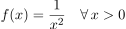
7. f(x)=\displaystyle{\frac{1}{x^2}}\quad \forall\, x>0
8. f(x)=x^5\quad \forall\, x

Extracted from Michael Corral. (2020). Elementary Calculus.


Background. (one-to-one; inverse; derivative of an inverse)

A one-to-one function (aka injection/injective function) is a function f that maps distinct elements to distinct elements; i.e., f(x_1)=f(x_2)\Rightarrow x_1=x_2, or equivalently in the contrapositive that x_1\neq x_2\Rightarrow f(x_1)\neq f(x_2). Not to be confused with one-to-one correspondence that refers to bijection.

Wikipedia on Injective function

The inverse function of a function f (aka inverse of f) is a function that undoes the operation of f. The inverse of f exists if and only if f is bijective, and if it exists, is denoted by f^{-1}. For a function f:X\rightarrow Y, its inverse f^{-1}:Y\rightarrow X admits an explicit description: it sends each element y\in Y to the unique element x\in X such that f(x)=y.

Wikipedia on Inverse function

If y=f(x) is differentiable and has an inverse function x=f^{-1}(y), then f^{-1} is differentiable and its derivative is

\displaystyle{\frac{\mathrm{d}x}{\mathrm{d}y}=\frac{1}{\frac{\mathrm{d}y}{\mathrm{d}x}}}\quad\textrm{ if }\enspace\frac{\mathrm{d}y}{\mathrm{d}x}\neq 0.

Text on pg. 38, Sec. 2.1, Ch. 2


1.

f(x)=x\quad \forall\, x:

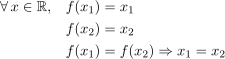
\begin{aligned} \forall\, x\in\mathbb{R},\quad & f(x_1)=x_1 \\ & f(x_2)=x_2 \\ \enspace & f(x_1)=f(x_2) \Rightarrow x_1=x_2 \\ \end{aligned}

\therefore y=f(x)=x is injective/one-to-one.

In order for an inverse f^{-1}(x) to exist, the original function f(x) must be bijective (et injective et surjective). It remains to check whether or not y=f(x)=x is surjective.

A function f:X\rightarrow Y is said to be surjective if \forall\, y\in Y,\enspace \exists\, x\in X\textrm{ s.t. }f(x)=y. In other words, every element of the function’s codomain is the image of at least one element of its domain.

Wikipedia on Surjective function

Assume f(x)=x is a real-valued function, i.e., f:\mathbb{R}\rightarrow\mathbb{R} given by x\mapsto x. Obviously f is surjective. Thus it is bijective enough to have an inverse f^{-1}:\mathbb{R}\rightarrow\mathbb{R}. And apparently f^{-1} is given by x\mapsto x, such that f^{-1}\circ f=f\circ f^{-1}=\textrm{id}_{\,\mathbb{R}}. Its derivative is \displaystyle{\frac{\mathrm{d}}{\mathrm{d}x}\big( f^{-1}(x)\big) =\frac{\mathrm{d}}{\mathrm{d}x}(x)=1}.


The remaining questions are left the reader.

202205231502 Exercise 1.3 A (Q1)

Exercises 1-9, let \mathrm{d}x be an infinitesimal and prove the given formula.

1. (\mathrm{d}x+1)^2=2\,\mathrm{d}x+1

Extracted from Michael Corral. (2020). Elementary Calculus.


Background. (Infinitesimal)

A number \delta is an infinitesimal if the conditions (a)(d) hold: (a) \delta\neq 0; (b) If \delta >0 then \delta is smaller than any positive real number; (c) If \delta <0 then \delta is larger than any negative real number; (d) \delta^2=0 (and hence all higher powers of \delta, such as \delta^3 and \delta^4, are also 0) N.b. Any infinitesimal multiplied by a nonzero real number is also an infinitesimal, while 0 times an infinitesimal is 0.


Proof.

Suppose the contrary is true:

(\mathrm{d}x+1)^2\neq 2\,\mathrm{d}x+1.

\begin{aligned} \textrm{LHS} & = (\mathrm{d}x+1)^2 \\ & = (\mathrm{d}x)^2+2(\mathrm{d}x)(1)+(1)^2 \\ & \stackrel{(\textrm{d})}{=} 0+2\,\mathrm{d}x+1 \\ & = 2\,\mathrm{d}x+1 \\ & = \textrm{RHS} \qquad \perp\\ \end{aligned}

Thus converse is the case.

202109101556 Exercises 1.2.C (Q16)

For Exercises 16-21, assuming that f'(x) exists, prove the given formula.

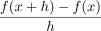
f'(x)=\displaystyle{\lim_{h\to 0}\frac{f(x+2h)-f(x-2h)}{4h}}


Proof.

Renaming by dummy variables.

Let y=x-2h, then x+2h=(x-2h)+4h=y+4h.

Rewrite it as

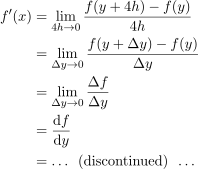
f'(x)=\displaystyle{\lim_{h\to 0}\frac{f(y+4h)-f(y)}{4h}}.

Note that

\displaystyle{\lim_{h\to 0}}[\,\cdots ]\Rightarrow \displaystyle{\lim_{4h\to 0}}[\,\cdots ].

So,

\begin{aligned} f'(x) & = \lim_{4h\to 0}\frac{f(y+4h)-f(y)}{4h} \\ & = \lim_{\Delta y\to 0}\frac{f(y+\Delta y)-f(y)}{\Delta y} \\ & = \lim_{\Delta y\to 0}\frac{\Delta f}{\Delta y}\\ & = \frac{\mathrm{d}f}{\mathrm{d}y}\\ & = \dots\enspace \textrm{(discontinued)}\enspace \dots \\ \end{aligned}

Do you spot the flaw in the Proof?


(revised)

As left-hand limit and right-hand limit are equivalent,

i.e., f'(x)=\displaystyle{\lim_{h\to 0}\frac{f(x+h)-f(x)}{h}=\lim_{h\to 0}\frac{f(x)-f(x-h)}{h}},

in our scenario, do write

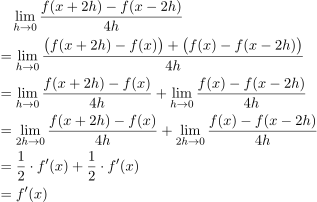
\begin{aligned} f'(x) & = \lim_{2h\to 0}\frac{f(x+2h)-f(x)}{2h}=\lim_{2h\to 0}\frac{f(x)-f(x-2h)}{2h} \\ \frac{1}{2}f'(x) & =\lim_{2h\to 0}\frac{f(x+2h)-f(x)}{4h}=\lim_{2h\to 0}\frac{f(x)-f(x-2h)}{4h}\\ \end{aligned}

Then

\begin{aligned} & \quad \lim_{h\to 0}\frac{f(x+2h)-f(x-2h)}{4h} \\ & = \lim_{h\to 0}\frac{\big( f(x+2h)-f(x)\big) + \big( f(x)-f(x-2h) \big) }{4h} \\ & = \lim_{h\to 0}\frac{f(x+2h)-f(x)}{4h} + \lim_{h\to 0}\frac{f(x)-f(x-2h)}{4h} \\ & = \lim_{2h\to 0}\frac{f(x+2h)-f(x)}{4h} + \lim_{2h\to 0}\frac{f(x)-f(x-2h)}{4h} \\ & = \frac{1}{2}\cdot f'(x)+\frac{1}{2}\cdot f'(x) \\ & = f'(x) \\ \end{aligned}

QED

202109101417 Exercises 1.1.A (Q5)

By equation (1.1), \pi =4(1-\frac{1}{3}+\frac{1}{5}-\frac{1}{7}+\frac{1}{9}-\cdots ), where the n^{\textrm{th}} term in the sum inside the parenthesis is \frac{(-1)^{n+1}}{2n-1} (starting at n=1). So the first approximation of \pi using this formula is \pi\approx 4(1)=4.0, and the second approximation is \pi\approx 4(1-\frac{1}{3})=8/3\approx 2.66667. Continue like this until two consecutive approximations have 3 as the first digit before the decimal point. How many terms in the sum did this require? Be careful with rounding off in the approximations.


Attempts.

1^{\textrm{st}} approximation:

\pi\approx 4(1)=4.0

2^{\textrm{nd}} approximation:

\pi\approx 4(1-\frac{1}{3})=\frac{8}{3}\approx 2.66667

3^{\textrm{rd}} approximation:

\pi\approx 4(1-\frac{1}{3}+\frac{1}{5})=\frac{52}{15}\approx 3.466667\quad (\textrm{5 d.p.})

4^{\textrm{th}} approximation:

\pi\approx 4(1-\frac{1}{3}+\frac{1}{5}-\frac{1}{7})=\frac{304}{105}\approx 2.89523\quad (\textrm{5 d.p.})

5^{\textrm{th}} approximation:

\pi\approx 4(1-\frac{1}{3}+\frac{1}{5}-\frac{1}{7}+\frac{1}{9})=\frac{1052}{315}\approx 3.33968\quad (\textrm{5 d.p.})

6^{\textrm{th}} approximation:

\pi\approx 4(1-\frac{1}{3}+\frac{1}{5}-\frac{1}{7}+\frac{1}{9}-\frac{1}{11})=\frac{10312}{3465}\approx 2.97605\quad (\textrm{5 d.p.})

7^{\textrm{th}} approximation:

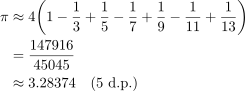
\begin{aligned} \pi & \approx 4\bigg( 1-\frac{1}{3}+\frac{1}{5}-\frac{1}{7}+\frac{1}{9}-\frac{1}{11}+\frac{1}{13}\bigg) \\ & =\frac{147916}{45045} \\ & \approx 3.28374\quad (\textrm{5 d.p.}) \end{aligned}

8^{\textrm{th}} approximation:

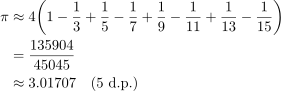
\begin{aligned} \pi & \approx 4\bigg( 1-\frac{1}{3}+\frac{1}{5}-\frac{1}{7}+\frac{1}{9}-\frac{1}{11}+\frac{1}{13}-\frac{1}{15}\bigg) \\ & =\frac{135904}{45045} \\ & \approx 3.01707\quad (\textrm{5 d.p.}) \end{aligned}

9^{\textrm{th}} approximation:

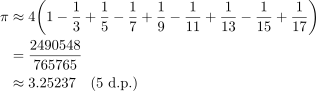
\begin{aligned} \pi & \approx 4\bigg( 1-\frac{1}{3}+\frac{1}{5}-\frac{1}{7}+\frac{1}{9}-\frac{1}{11}+\frac{1}{13}-\frac{1}{15}+\frac{1}{17}\bigg) \\ & =\frac{2490548}{765765} \\ & \approx 3.25237\quad (\textrm{5 d.p.}) \end{aligned}

10^{\textrm{th}} approximation:

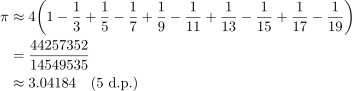
\begin{aligned} \pi & \approx 4\bigg( 1-\frac{1}{3}+\frac{1}{5}-\frac{1}{7}+\frac{1}{9}-\frac{1}{11}+\frac{1}{13}-\frac{1}{15}+\frac{1}{17}-\frac{1}{19}\bigg) \\ & =\frac{44257352}{14549535} \\ & \approx 3.04184\quad (\textrm{5 d.p.}) \end{aligned}

11^{\textrm{th}} approximation:

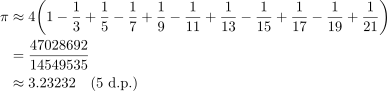
\begin{aligned} \pi & \approx 4\bigg( 1-\frac{1}{3}+\frac{1}{5}-\frac{1}{7}+\frac{1}{9}-\frac{1}{11}+\frac{1}{13}-\frac{1}{15}+\frac{1}{17}-\frac{1}{19}+\frac{1}{21}\bigg) \\ & =\frac{47028692}{14549535} \\ & \approx 3.23232\quad (\textrm{5 d.p.}) \end{aligned}

12^{\textrm{th}} approximation:

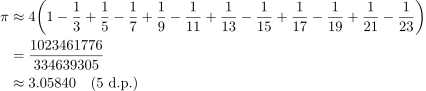
\begin{aligned} \pi & \approx 4\bigg( 1-\frac{1}{3}+\frac{1}{5}-\frac{1}{7}+\frac{1}{9}-\frac{1}{11}+\frac{1}{13}-\frac{1}{15}+\frac{1}{17}-\frac{1}{19}+\frac{1}{21}-\frac{1}{23}\bigg) \\ & =\frac{1023461776}{334639305} \\ & \approx 3.05840\quad (\textrm{5 d.p.}) \end{aligned}

13^{\textrm{th}} approximation:

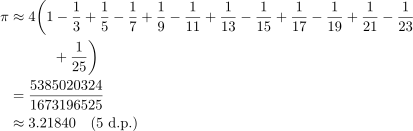
\begin{aligned} \pi & \approx 4\bigg( 1-\frac{1}{3}+\frac{1}{5}-\frac{1}{7}+\frac{1}{9}-\frac{1}{11}+\frac{1}{13}-\frac{1}{15}+\frac{1}{17}-\frac{1}{19}+\frac{1}{21}-\frac{1}{23} \\ & \qquad\quad +\frac{1}{25}\bigg) \\ & =\frac{5385020324}{1673196525} \\ & \approx 3.21840\quad (\textrm{5 d.p.}) \end{aligned}

14^{\textrm{th}} approximation:

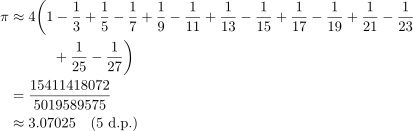
\begin{aligned} \pi & \approx 4\bigg( 1-\frac{1}{3}+\frac{1}{5}-\frac{1}{7}+\frac{1}{9}-\frac{1}{11}+\frac{1}{13}-\frac{1}{15}+\frac{1}{17}-\frac{1}{19}+\frac{1}{21}-\frac{1}{23} \\ & \qquad\quad +\frac{1}{25}-\frac{1}{27}\bigg) \\ & =\frac{15411418072}{5019589575} \\ & \approx 3.07025\quad (\textrm{5 d.p.}) \end{aligned}

15^{\textrm{th}} approximation:

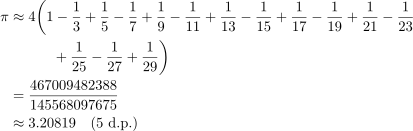
\begin{aligned} \pi & \approx 4\bigg( 1-\frac{1}{3}+\frac{1}{5}-\frac{1}{7}+\frac{1}{9}-\frac{1}{11}+\frac{1}{13}-\frac{1}{15}+\frac{1}{17}-\frac{1}{19}+\frac{1}{21}-\frac{1}{23} \\ & \qquad\quad +\frac{1}{25}-\frac{1}{27}+\frac{1}{29}\bigg) \\ & =\frac{467009482388}{145568097675} \\ & \approx 3.20819\quad (\textrm{5 d.p.}) \end{aligned}

16^{\textrm{th}} approximation:

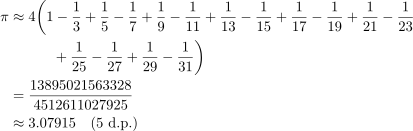
\begin{aligned} \pi & \approx 4\bigg( 1-\frac{1}{3}+\frac{1}{5}-\frac{1}{7}+\frac{1}{9}-\frac{1}{11}+\frac{1}{13}-\frac{1}{15}+\frac{1}{17}-\frac{1}{19}+\frac{1}{21}-\frac{1}{23} \\ & \qquad\quad +\frac{1}{25}-\frac{1}{27}+\frac{1}{29}-\frac{1}{31}\bigg) \\ & =\frac{13895021563328}{4512611027925} \\ & \approx 3.07915\quad (\textrm{5 d.p.}) \end{aligned}

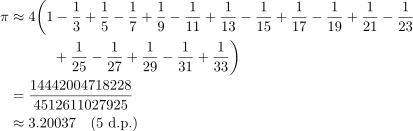
17^{\textrm{th}} approximation:

\begin{aligned} \pi & \approx 4\bigg( 1-\frac{1}{3}+\frac{1}{5}-\frac{1}{7}+\frac{1}{9}-\frac{1}{11}+\frac{1}{13}-\frac{1}{15}+\frac{1}{17}-\frac{1}{19}+\frac{1}{21}-\frac{1}{23} \\ & \qquad\quad +\frac{1}{25}-\frac{1}{27}+\frac{1}{29}-\frac{1}{31}+\frac{1}{33}\bigg) \\ & =\frac{14442004718228}{4512611027925} \\ & \approx 3.20037\quad (\textrm{5 d.p.}) \end{aligned}

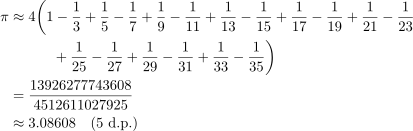
18^{\textrm{th}} approximation:

\begin{aligned} \pi & \approx 4\bigg( 1-\frac{1}{3}+\frac{1}{5}-\frac{1}{7}+\frac{1}{9}-\frac{1}{11}+\frac{1}{13}-\frac{1}{15}+\frac{1}{17}-\frac{1}{19}+\frac{1}{21}-\frac{1}{23} \\ & \qquad\quad +\frac{1}{25}-\frac{1}{27}+\frac{1}{29}-\frac{1}{31}+\frac{1}{33}-\frac{1}{35}\bigg) \\ & =\frac{13926277743608}{4512611027925} \\ & \approx 3.08608\quad (\textrm{5 d.p.}) \end{aligned}

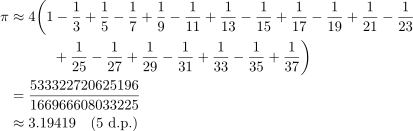
19^{\textrm{th}} approximation:

\begin{aligned} \pi & \approx 4\bigg( 1-\frac{1}{3}+\frac{1}{5}-\frac{1}{7}+\frac{1}{9}-\frac{1}{11}+\frac{1}{13}-\frac{1}{15}+\frac{1}{17}-\frac{1}{19}+\frac{1}{21}-\frac{1}{23} \\ & \qquad\quad +\frac{1}{25}-\frac{1}{27}+\frac{1}{29}-\frac{1}{31}+\frac{1}{33}-\frac{1}{35}+\frac{1}{37}\bigg) \\ & =\frac{533322720625196}{166966608033225} \\ & \approx 3.19419\quad (\textrm{5 d.p.}) \end{aligned}

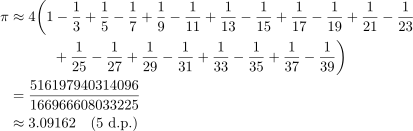
20^{\textrm{th}} approximation:

\begin{aligned} \pi & \approx 4\bigg( 1-\frac{1}{3}+\frac{1}{5}-\frac{1}{7}+\frac{1}{9}-\frac{1}{11}+\frac{1}{13}-\frac{1}{15}+\frac{1}{17}-\frac{1}{19}+\frac{1}{21}-\frac{1}{23} \\ & \qquad\quad +\frac{1}{25}-\frac{1}{27}+\frac{1}{29}-\frac{1}{31}+\frac{1}{33}-\frac{1}{35}+\frac{1}{37}-\frac{1}{39}\bigg) \\ & =\frac{516197940314096}{166966608033225} \\ & \approx 3.09162\quad (\textrm{5 d.p.}) \end{aligned}

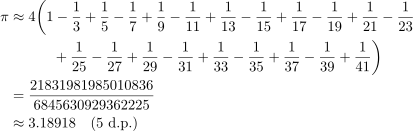
21^{\textrm{st}} approximation:

\begin{aligned} \pi & \approx 4\bigg( 1-\frac{1}{3}+\frac{1}{5}-\frac{1}{7}+\frac{1}{9}-\frac{1}{11}+\frac{1}{13}-\frac{1}{15}+\frac{1}{17}-\frac{1}{19}+\frac{1}{21}-\frac{1}{23} \\ & \qquad\quad +\frac{1}{25}-\frac{1}{27}+\frac{1}{29}-\frac{1}{31}+\frac{1}{33}-\frac{1}{35}+\frac{1}{37}-\frac{1}{39}+\frac{1}{41}\bigg) \\ & =\frac{21831981985010836}{6845630929362225} \\ & \approx 3.18918\quad (\textrm{5 d.p.}) \end{aligned}

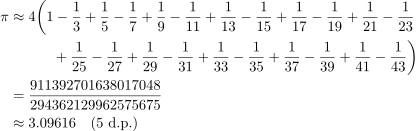
22^{\textrm{nd}} approximation:

\begin{aligned} \pi & \approx 4\bigg( 1-\frac{1}{3}+\frac{1}{5}-\frac{1}{7}+\frac{1}{9}-\frac{1}{11}+\frac{1}{13}-\frac{1}{15}+\frac{1}{17}-\frac{1}{19}+\frac{1}{21}-\frac{1}{23} \\ & \qquad\quad +\frac{1}{25}-\frac{1}{27}+\frac{1}{29}-\frac{1}{31}+\frac{1}{33}-\frac{1}{35}+\frac{1}{37}-\frac{1}{39}+\frac{1}{41}-\frac{1}{43}\bigg) \\ & =\frac{911392701638017048}{294362129962575675} \\ & \approx 3.09616\quad (\textrm{5 d.p.}) \end{aligned}

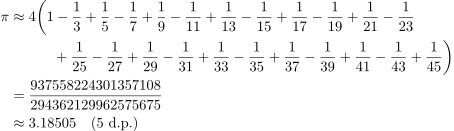
23^{\textrm{rd}} approximation:

\begin{aligned} \pi & \approx 4\bigg( 1-\frac{1}{3}+\frac{1}{5}-\frac{1}{7}+\frac{1}{9}-\frac{1}{11}+\frac{1}{13}-\frac{1}{15}+\frac{1}{17}-\frac{1}{19}+\frac{1}{21}-\frac{1}{23} \\ & \qquad\quad +\frac{1}{25}-\frac{1}{27}+\frac{1}{29}-\frac{1}{31}+\frac{1}{33}-\frac{1}{35}+\frac{1}{37}-\frac{1}{39}+\frac{1}{41}-\frac{1}{43}+\frac{1}{45}\bigg) \\ & =\frac{937558224301357108}{294362129962575675} \\ & \approx 3.18505\quad (\textrm{5 d.p.}) \end{aligned}

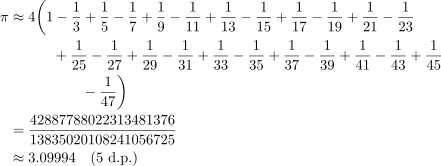
24^{\textrm{th}} approximation:

\begin{aligned} \pi & \approx 4\bigg( 1-\frac{1}{3}+\frac{1}{5}-\frac{1}{7}+\frac{1}{9}-\frac{1}{11}+\frac{1}{13}-\frac{1}{15}+\frac{1}{17}-\frac{1}{19}+\frac{1}{21}-\frac{1}{23} \\ & \qquad\quad +\frac{1}{25}-\frac{1}{27}+\frac{1}{29}-\frac{1}{31}+\frac{1}{33}-\frac{1}{35}+\frac{1}{37}-\frac{1}{39}+\frac{1}{41}-\frac{1}{43}+\frac{1}{45}\\ & \qquad\qquad\quad -\frac{1}{47}\bigg) \\ & =\frac{42887788022313481376}{13835020108241056725} \\ & \approx 3.09994\quad (\textrm{5 d.p.}) \end{aligned}

25^{\textrm{th}} approximation:

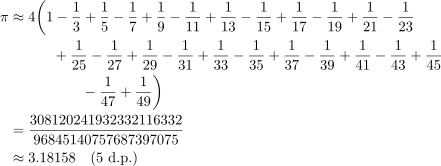
\begin{aligned} \pi & \approx 4\bigg( 1-\frac{1}{3}+\frac{1}{5}-\frac{1}{7}+\frac{1}{9}-\frac{1}{11}+\frac{1}{13}-\frac{1}{15}+\frac{1}{17}-\frac{1}{19}+\frac{1}{21}-\frac{1}{23} \\ & \qquad\quad +\frac{1}{25}-\frac{1}{27}+\frac{1}{29}-\frac{1}{31}+\frac{1}{33}-\frac{1}{35}+\frac{1}{37}-\frac{1}{39}+\frac{1}{41}-\frac{1}{43}+\frac{1}{45}\\ & \qquad\qquad\quad -\frac{1}{47}+\frac{1}{49}\bigg) \\ & =\frac{308120241932332116332}{96845140757687397075} \\ & \approx 3.18158\quad (\textrm{5 d.p.}) \end{aligned}

26^{\textrm{th}} approximation:

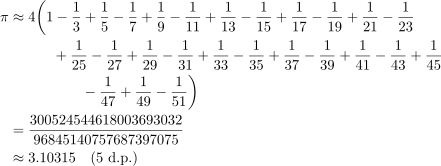
\begin{aligned} \pi & \approx 4\bigg( 1-\frac{1}{3}+\frac{1}{5}-\frac{1}{7}+\frac{1}{9}-\frac{1}{11}+\frac{1}{13}-\frac{1}{15}+\frac{1}{17}-\frac{1}{19}+\frac{1}{21}-\frac{1}{23} \\ & \qquad\quad +\frac{1}{25}-\frac{1}{27}+\frac{1}{29}-\frac{1}{31}+\frac{1}{33}-\frac{1}{35}+\frac{1}{37}-\frac{1}{39}+\frac{1}{41}-\frac{1}{43}+\frac{1}{45}\\ & \qquad\qquad\quad -\frac{1}{47}+\frac{1}{49}-\frac{1}{51}\bigg) \\ & =\frac{300524544618003693032}{96845140757687397075} \\ & \approx 3.10315\quad (\textrm{5 d.p.}) \end{aligned}

27^{\textrm{th}} approximation:

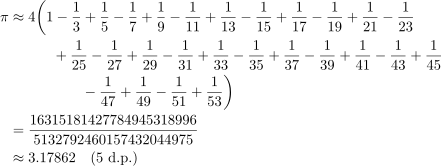
\begin{aligned} \pi & \approx 4\bigg( 1-\frac{1}{3}+\frac{1}{5}-\frac{1}{7}+\frac{1}{9}-\frac{1}{11}+\frac{1}{13}-\frac{1}{15}+\frac{1}{17}-\frac{1}{19}+\frac{1}{21}-\frac{1}{23} \\ & \qquad\quad +\frac{1}{25}-\frac{1}{27}+\frac{1}{29}-\frac{1}{31}+\frac{1}{33}-\frac{1}{35}+\frac{1}{37}-\frac{1}{39}+\frac{1}{41}-\frac{1}{43}+\frac{1}{45}\\ & \qquad\qquad\quad -\frac{1}{47}+\frac{1}{49}-\frac{1}{51}+\frac{1}{53}\bigg) \\ & =\frac{16315181427784945318996}{5132792460157432044975} \\ & \approx 3.17862\quad (\textrm{5 d.p.}) \end{aligned}

28^{\textrm{th}} approximation:

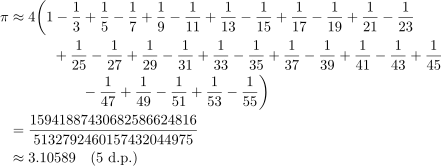
\begin{aligned} \pi & \approx 4\bigg( 1-\frac{1}{3}+\frac{1}{5}-\frac{1}{7}+\frac{1}{9}-\frac{1}{11}+\frac{1}{13}-\frac{1}{15}+\frac{1}{17}-\frac{1}{19}+\frac{1}{21}-\frac{1}{23} \\ & \qquad\quad +\frac{1}{25}-\frac{1}{27}+\frac{1}{29}-\frac{1}{31}+\frac{1}{33}-\frac{1}{35}+\frac{1}{37}-\frac{1}{39}+\frac{1}{41}-\frac{1}{43}+\frac{1}{45}\\ & \qquad\qquad\quad -\frac{1}{47}+\frac{1}{49}-\frac{1}{51}+\frac{1}{53}-\frac{1}{55}\bigg) \\ & =\frac{15941887430682586624816}{5132792460157432044975} \\ & \approx 3.10589\quad (\textrm{5 d.p.}) \end{aligned}

29^{\textrm{th}} approximation:

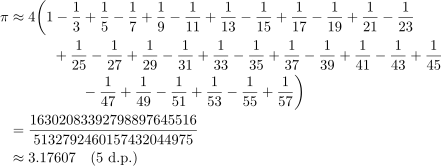
\begin{aligned} \pi & \approx 4\bigg( 1-\frac{1}{3}+\frac{1}{5}-\frac{1}{7}+\frac{1}{9}-\frac{1}{11}+\frac{1}{13}-\frac{1}{15}+\frac{1}{17}-\frac{1}{19}+\frac{1}{21}-\frac{1}{23} \\ & \qquad\quad +\frac{1}{25}-\frac{1}{27}+\frac{1}{29}-\frac{1}{31}+\frac{1}{33}-\frac{1}{35}+\frac{1}{37}-\frac{1}{39}+\frac{1}{41}-\frac{1}{43}+\frac{1}{45}\\ & \qquad\qquad\quad -\frac{1}{47}+\frac{1}{49}-\frac{1}{51}+\frac{1}{53}-\frac{1}{55}+\frac{1}{57}\bigg) \\ & =\frac{16302083392798897645516}{5132792460157432044975} \\ & \approx 3.17607\quad (\textrm{5 d.p.}) \end{aligned}

30^{\textrm{th}} approximation:

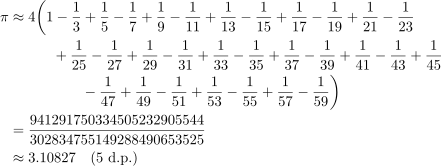
\begin{aligned} \pi & \approx 4\bigg( 1-\frac{1}{3}+\frac{1}{5}-\frac{1}{7}+\frac{1}{9}-\frac{1}{11}+\frac{1}{13}-\frac{1}{15}+\frac{1}{17}-\frac{1}{19}+\frac{1}{21}-\frac{1}{23} \\ & \qquad\quad +\frac{1}{25}-\frac{1}{27}+\frac{1}{29}-\frac{1}{31}+\frac{1}{33}-\frac{1}{35}+\frac{1}{37}-\frac{1}{39}+\frac{1}{41}-\frac{1}{43}+\frac{1}{45}\\ & \qquad\qquad\quad -\frac{1}{47}+\frac{1}{49}-\frac{1}{51}+\frac{1}{53}-\frac{1}{55}+\frac{1}{57}-\frac{1}{59}\bigg) \\ & =\frac{941291750334505232905544}{302834755149288490653525} \\ & \approx 3.10827\quad (\textrm{5 d.p.}) \end{aligned}

31^{\textrm{st}} approximation:

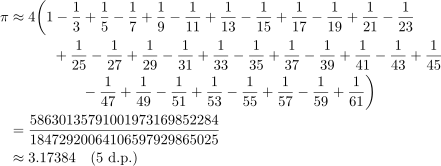
\begin{aligned} \pi & \approx 4\bigg( 1-\frac{1}{3}+\frac{1}{5}-\frac{1}{7}+\frac{1}{9}-\frac{1}{11}+\frac{1}{13}-\frac{1}{15}+\frac{1}{17}-\frac{1}{19}+\frac{1}{21}-\frac{1}{23} \\ & \qquad\quad +\frac{1}{25}-\frac{1}{27}+\frac{1}{29}-\frac{1}{31}+\frac{1}{33}-\frac{1}{35}+\frac{1}{37}-\frac{1}{39}+\frac{1}{41}-\frac{1}{43}+\frac{1}{45}\\ & \qquad\qquad\quad -\frac{1}{47}+\frac{1}{49}-\frac{1}{51}+\frac{1}{53}-\frac{1}{55}+\frac{1}{57}-\frac{1}{59}+\frac{1}{61}\bigg) \\ & =\frac{58630135791001973169852284}{18472920064106597929865025} \\ & \approx 3.17384\quad (\textrm{5 d.p.}) \end{aligned}

32^{\textrm{nd}} approximation:

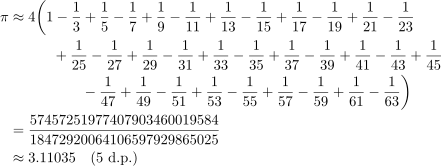
\begin{aligned} \pi & \approx 4\bigg( 1-\frac{1}{3}+\frac{1}{5}-\frac{1}{7}+\frac{1}{9}-\frac{1}{11}+\frac{1}{13}-\frac{1}{15}+\frac{1}{17}-\frac{1}{19}+\frac{1}{21}-\frac{1}{23} \\ & \qquad\quad +\frac{1}{25}-\frac{1}{27}+\frac{1}{29}-\frac{1}{31}+\frac{1}{33}-\frac{1}{35}+\frac{1}{37}-\frac{1}{39}+\frac{1}{41}-\frac{1}{43}+\frac{1}{45}\\ & \qquad\qquad\quad -\frac{1}{47}+\frac{1}{49}-\frac{1}{51}+\frac{1}{53}-\frac{1}{55}+\frac{1}{57}-\frac{1}{59}+\frac{1}{61}-\frac{1}{63}\bigg) \\ & =\frac{57457251977407903460019584}{18472920064106597929865025} \\ & \approx 3.11035\quad (\textrm{5 d.p.}) \end{aligned}

33^{\textrm{rd}} approximation:

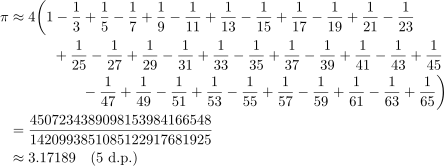
\begin{aligned} \pi & \approx 4\bigg( 1-\frac{1}{3}+\frac{1}{5}-\frac{1}{7}+\frac{1}{9}-\frac{1}{11}+\frac{1}{13}-\frac{1}{15}+\frac{1}{17}-\frac{1}{19}+\frac{1}{21}-\frac{1}{23} \\ & \qquad\quad +\frac{1}{25}-\frac{1}{27}+\frac{1}{29}-\frac{1}{31}+\frac{1}{33}-\frac{1}{35}+\frac{1}{37}-\frac{1}{39}+\frac{1}{41}-\frac{1}{43}+\frac{1}{45}\\ & \qquad\qquad\quad -\frac{1}{47}+\frac{1}{49}-\frac{1}{51}+\frac{1}{53}-\frac{1}{55}+\frac{1}{57}-\frac{1}{59}+\frac{1}{61}-\frac{1}{63}+\frac{1}{65}\bigg) \\ & =\frac{4507234389098153984166548}{1420993851085122917681925} \\ & \approx 3.17189\quad (\textrm{5 d.p.}) \end{aligned}

34^{\textrm{th}} approximation:

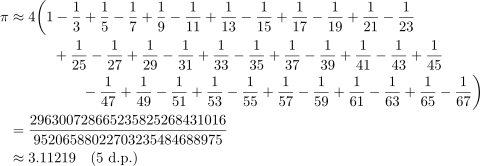
\begin{aligned} \pi & \approx 4\bigg( 1-\frac{1}{3}+\frac{1}{5}-\frac{1}{7}+\frac{1}{9}-\frac{1}{11}+\frac{1}{13}-\frac{1}{15}+\frac{1}{17}-\frac{1}{19}+\frac{1}{21}-\frac{1}{23} \\ & \qquad\quad +\frac{1}{25}-\frac{1}{27}+\frac{1}{29}-\frac{1}{31}+\frac{1}{33}-\frac{1}{35}+\frac{1}{37}-\frac{1}{39}+\frac{1}{41}-\frac{1}{43}+\frac{1}{45}\\ & \qquad\qquad\quad -\frac{1}{47}+\frac{1}{49}-\frac{1}{51}+\frac{1}{53}-\frac{1}{55}+\frac{1}{57}-\frac{1}{59}+\frac{1}{61}-\frac{1}{63}+\frac{1}{65}-\frac{1}{67}\bigg) \\ & =\frac{296300728665235825268431016}{95206588022703235484688975} \\ & \approx 3.11219\quad (\textrm{5 d.p.}) \end{aligned}

Summing without aim, I forgot my purpose. Where am I?

(discontinued)


(refreshed)

Please scroll up to the 7^{\textrm{th}} and 8^{\textrm{th}} approximation.

This required seven or eight terms in the sum for having 3 as the first digit before the decimal point.

202110091141 Exercises 1.1.A (Q1-Q4)

For Exercises 1-4, suppose that an object moves in a straight line such that its position s after time t is the given function s=s(t). Find the instantaneous velocity of the object at a general time t\ge 0. You should mimic the earlier example for the instantaneous velocity when s=-16t^2+100.

1. s=t^2

2. s=9.8t^2

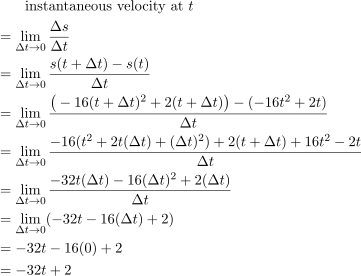
3. s=-16t^2+2t

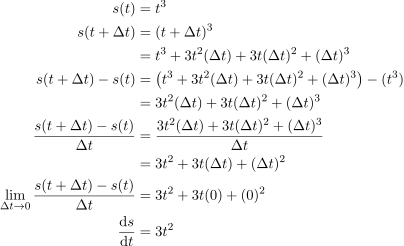
4. s=t^3


Ans.

1. 2t

2. 19.6t

3. -32t+2

4. 3t^2


Solution.

1.

The average velocity of the object over the interval [t,t+\Delta t] is \frac{\Delta s}{\Delta t}, so since s(t)=t^2:

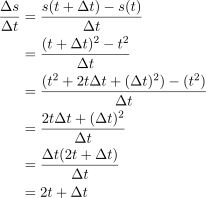
\begin{aligned} \frac{\Delta s}{\Delta t} & = \frac{s(t+\Delta t)-s(t)}{\Delta t} \\ & = \frac{(t+\Delta t)^2 - t^2}{\Delta t} \\ & = \frac{(t^2+2t\Delta t+(\Delta t)^2)-(t^2)}{\Delta t} \\ & = \frac{2t\Delta t+(\Delta t)^2}{\Delta t} \\ & = \frac{\Delta t(2t+\Delta t)}{\Delta t} \\ & = 2t + \Delta t \end{aligned}

Now let the interval [t,t+\Delta t] get smaller and smaller indefinitely—that is let \Delta t get closer and closer to 0. Then the average velocity \frac{\Delta s}{\Delta t}=2t+\Delta t gets closer and closer to 2t+0=2t. Thus, the object has instantaneous velocity 2t at time t. This calculation can be interpreted as taking the limit of \frac{\Delta s}{\Delta t} as \Delta t approaches 0, written as follows:

\begin{aligned} & \qquad \textrm{instantaneous velocity at }t \\ & = \textrm{limit of average velocity over }[t,t+\Delta t]\textrm{ as }\Delta t\textrm{ approaches to }0 \\ & = \lim_{\Delta t\to 0}\frac{\Delta s}{\Delta t} \\ & = \lim_{\Delta t\to 0}(2t+\Delta t) \\ & = 2t+(0) \\ & = 2t \end{aligned}

2.

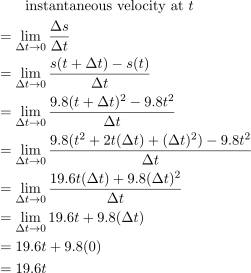
\begin{aligned} &\qquad \textrm{instantaneous velocity at }t\\ & = \lim_{\Delta t\to 0}\frac{\Delta s}{\Delta t}\\ & = \lim_{\Delta t\to 0}\frac{s(t+\Delta t)-s(t)}{\Delta t} \\ & = \lim_{\Delta t\to 0}\frac{9.8(t+\Delta t)^2 - 9.8t^2}{\Delta t} \\ & = \lim_{\Delta t\to 0}\frac{9.8(t^2+2t(\Delta t)+(\Delta t)^2) - 9.8t^2}{\Delta t} \\ & = \lim_{\Delta t\to 0}\frac{19.6t(\Delta t)+9.8(\Delta t)^2}{\Delta t} \\ & = \lim_{\Delta t\to 0}19.6t+9.8(\Delta t) \\ & = 19.6t+9.8(0) \\ & = 19.6t \end{aligned}

3.

\begin{aligned} &\qquad \textrm{instantaneous velocity at }t\\ & = \lim_{\Delta t\to 0}\frac{\Delta s}{\Delta t}\\ & = \lim_{\Delta t\to 0}\frac{s(t+\Delta t)-s(t)}{\Delta t} \\ & = \lim_{\Delta t\to 0}\frac{\big( -16(t+\Delta t)^2+2(t+\Delta t)\big) - (-16t^2+2t)}{\Delta t} \\ & = \lim_{\Delta t\to 0}\frac{-16(t^2+2t(\Delta t)+(\Delta t)^2)+2(t+\Delta t)+16t^2-2t}{\Delta t} \\ & = \lim_{\Delta t\to 0}\frac{-32t(\Delta t)-16(\Delta t)^2+2(\Delta t)}{\Delta t} \\ & = \lim_{\Delta t\to 0}(-32t-16(\Delta t)+2) \\ & = -32t-16(0)+2 \\ & = -32t+2 \end{aligned}

4.

\begin{aligned} s(t) & = t^3 \\ s(t+\Delta t) & = (t+\Delta t)^3 \\ & = t^3+3t^2(\Delta t)+3t(\Delta t)^2+(\Delta t)^3 \\ s(t+\Delta t)-s(t) & = \big( t^3+3t^2(\Delta t)+3t(\Delta t)^2+(\Delta t)^3 \big) - (t^3) \\ & = 3t^2(\Delta t)+3t(\Delta t)^2+(\Delta t)^3 \\ \frac{s(t+\Delta t)-s(t)}{\Delta t} & = \frac{3t^2(\Delta t)+3t(\Delta t)^2+(\Delta t)^3}{\Delta t} \\ & = 3t^2+3t(\Delta t)+(\Delta t)^2 \\ \lim_{\Delta t\to 0}\frac{s(t+\Delta t)-s(t)}{\Delta t} & = 3t^2+3t(0)+(0)^2 \\ \frac{\mathrm{d}s}{\mathrm{d}t} & = 3t^2\\ \end{aligned}

202011110613 Sidenote of Dummy Variables

Q: What is a dummy variable?

A: f(x)=x^2 and g(y)=y^2 are dummy variables because they describe the same pattern.

The indefinite integrals \int x\,\mathrm{d}x=x^2/2+C and \int y\,\mathrm{d}y=y^2/2+C are \textrm{\scriptsize \textbf{NOT}} dummy variables because they are functionals admitting of different functions.

But if we put an upper and a lower limit to make it a definite integral,

i.e.,

\begin{aligned} \int_0^1x\,\mathrm{d}x=\bigg[ \frac{x^2}{2} \bigg]_0^1=\frac{1}{2} \\ \int_0^1 y\,\mathrm{d}y=\bigg[ \frac{y^2}{2} \bigg]_0^1=\frac{1}{2} \\ \end{aligned},

they are dummy variables as the structure preserves the value.

202011051527 Exercise 1 (Q1)

If f(x)=2x^2-4x+1, find the values of f(1), f(0), f(2), f(-2), f(a), f(x+\delta x).


Solution.

Given f(x)=2x^2-4x+1.

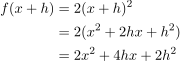
\begin{aligned} f(1) & =2(1)^2-4(1)+1=-1 \\ f(0) & = 2(0)^2 - 4(0) +1 = 1 \\ f(2) & = 2(2)^2-4(2)+1 =1 \\ f(-2) & = 2(-2)^2-4(-2)+1=17\\ f(a) & = 2a^2 - 4a +1 \\ f(x+\delta x) & = 2(x+\delta x)^2 - 4 (x+\delta x) +1 \end{aligned}

This exercise is done.


On reflection.

Suppose you are given the following conditions:

\begin{aligned} x_0 = 0 & \qquad f(x_0) = 1 \\ x_1 = 1 &\qquad  f(x_1) = -1 \\ x_2 = 2 &\qquad f(x_2) =1 \end{aligned}

and you are asked to interpolate by Lagrange polynomials over the range [0,2].

\begin{aligned} \mathcal{L}(x)  & = (1)\bigg( \displaystyle{\frac{x-1}{0-1}} \bigg)\bigg( \displaystyle{\frac{x-2}{0-2}} \bigg) +  (-1)\bigg( \displaystyle{\frac{x-0}{1-0}} \bigg) \bigg( \displaystyle{\frac{x-2}{1-2}} \bigg) + (1)\bigg( \displaystyle{\frac{x-0}{2-0}} \bigg) \bigg( \displaystyle{\frac{x-1}{2-1}} \bigg) \\ & = \displaystyle{\frac{(x-1)(x-2)}{2}} + x(x-2) + \displaystyle{\frac{x(x-1)}{2}} \\ & = \displaystyle{\frac{(x-1)(x-2)+2x(x-2)+x(x-1)}{2}} \\ & = \displaystyle{\frac{x^2-3x+2+2x^2-4x+x^2-x}{2}} \\ & = \displaystyle{\frac{4x^2-8x+2}{2}} \\ & = 2x^2-4x+1\\ \end{aligned}

The interpolating polynomial \mathcal{L}(x) checks with the original function f(x).

202009260344 Exercise 2.5.1

Show that x=e^{2\theta}\sin\theta satisfies the equation x''-4x'+5x=0.


Solution.

(bottom-up)

Let x' denote \displaystyle{\frac{\mathrm{d}x}{\mathrm{d}\theta}}, x'' denote \displaystyle{\frac{\mathrm{d}^2x}{\mathrm{d}\theta^2}}.

\begin{aligned} x' & = \frac{\mathrm{d}}{\mathrm{d}\theta} \big( e^{2\theta} \sin\theta  \big) \\ & = e^{2\theta} \cdot \frac{\mathrm{d}}{\mathrm{d}\theta} \big( \sin\theta  \big) + \sin\theta \cdot \frac{\mathrm{d}}{\mathrm{d}\theta} \big( e^{2\theta} \big) \\ & = e^{2\theta} \cos\theta + 2e^{2\theta}\sin\theta \\ & = e^{2\theta}(\cos\theta + 2\sin\theta ) \\ \end{aligned}

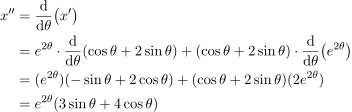
\begin{aligned} x'' & = \frac{\mathrm{d}}{\mathrm{d}\theta} \big( x'  \big) \\ & = e^{2\theta} \cdot \frac{\mathrm{d}}{\mathrm{d}\theta} (\cos\theta +2\sin\theta ) + (\cos\theta + 2\sin\theta )\cdot \frac{\mathrm{d}}{\mathrm{d}\theta} \big( e^{2\theta} \big) \\ & = (e^{2\theta})(-\sin\theta + 2\cos\theta ) + (\cos\theta + 2\sin\theta )(2e^{2\theta }) \\ & = e^{2\theta}(3\sin\theta + 4 \cos\theta ) \\ \end{aligned}

To know whether or not x=e^{2\theta}\sin\theta is a solution, I simply do substitution in the equation x''-4x'+5x=0.

\begin{aligned} \textrm{LHS} & = x''-4x'+5x \\ & = e^{2\theta}(3\sin\theta +4\cos\theta )-4\big[ e^{2\theta}(\cos\theta +2\sin\theta )\big] + 5\big(e^{2\theta}\sin\theta \big) \\ & = \dots \\ & = 0 \\ & = \textrm{RHS} \\ \end{aligned}


Revision.

(top-down)

We are given a second-order linear homogeneous ordinary differential equation (ODE):

x''-4x'+5x = 0

with some independent variable \theta and some dependent variable x(\theta )=e^{2\theta }\sin\theta, the coefficients of x'', x', and x being constants 1, -4, and 5.

Let the primed [ *]' be the function derived wrt. to \theta. Following the routine procedures,

\begin{aligned} x & = e^{r\theta} \\ x' & = re^{r\theta }\\ x'' & = r\cdot ( e^{r\theta })' + r' \cdot ( e^{r\theta }) \\ & = r^2e^{r\theta} \end{aligned}

rewrite it,

\begin{aligned} x''-4x'+5x & = 0 \\ r^2e^{r\theta} - 4re^{r\theta} + 5e^{r\theta} & = 0 \\ \dots  \textrm{\quad excepting\quad} & x=e^{r\theta}=0\textrm{\quad \dots} \\ r^2 -4r+5 & = 0 \\ \end{aligned}

and we shall obtain the auxiliary equation (aka. the characteristic equation) on the very last line.

r=\displaystyle{\frac{-(-4)\pm\sqrt{(-4)^2-4(1)(5)}}{2(1)}}=2\pm \textrm{i}.


Note.

If the roots of the auxiliary equation ar^2+br+c=0 are the complex numbers r_1=\alpha +\textrm{i}\beta and r_2=\alpha -\textrm{i}\beta, the general solution of ay''+by'+cy=0 is

y=e^{\alpha x}(c_1\cos\beta x+c_2\sin\beta x)

(please refer to J. Stewart’s Calculus, Second-Order Linear Differential Equations)


Now that r_1=2+\textrm{i} and r_2=2-\textrm{i} and c_1, c_2 are arbitrary constants, to this 2^{\textrm{nd}}-order ODE, the general solution is

x=e^{2\theta}(c_1\cos\theta +c_2\sin\theta ).


Examination.

It is a good practice, no matter how much time one would allow oneself, to countercheck one’s solution…

Here it goes,

\begin{aligned} x & =e^{2\theta}(c_1\cos\theta +c_2\sin\theta )  \\ & = (c_2e^{2\theta })(\sin\theta ) + (c_1e^{2\theta })(\cos\theta ) \\ \end{aligned}.

\begin{aligned} x' & = e^{2\theta}(-c_1\sin\theta +c_2\cos\theta ) + 2e^{2\theta}(c_1\cos\theta +c_2\sin\theta ) \\ & = (2c_2e^{2\theta }-c_1e^{2\theta})(\sin\theta ) + (2c_1e^{2\theta} + c_2e^{2\theta} )(\cos\theta ) \\ \end{aligned}

\begin{aligned} x''& = \big[ (2c_2e^{2\theta }-c_1e^{2\theta})(\sin\theta ) \big]' + \big[ (2c_1e^{2\theta} + c_2e^{2\theta} )(\cos\theta ) \big]' \\ & = \big[ (2c_2e^{2\theta}-c_1e^{2\theta })(\cos\theta )+(4c_2e^{2\theta }-2c_1e^{2\theta })(\sin\theta ) \big] \\ & \qquad\quad + \big[ (2c_1e^{2\theta }+c_2e^{2\theta })(-\sin\theta )+(4c_1e^{2\theta }+2c_2e^{2\theta })(\cos\theta ) \big] \\ & = (-4c_1e^{2\theta }+3c_2e^{2\theta })(\sin\theta ) + (3c_1e^{2\theta }+4c_2e^{2\theta })(\cos\theta ) \\ \end{aligned}

Then,

\begin{aligned} \textrm{LHS} & =  x'' - 4x' + 5x \\ & = \big( (-4c_1e^{2\theta }+3c_2e^{2\theta })-4(2c_2e^{2\theta}-c_1e^{2\theta})+5c_2e^{2\theta}\big)(\sin\theta ) \\ & \qquad\quad + \big( (3c_1e^{2\theta}+4c_2e^{2\theta}) - 4(2c_1e^{2\theta}+c_2e^{2\theta})+5c_1e^{2\theta} \big)(\cos\theta ) \\ & = 0 \\ & = \textrm{RHS} \end{aligned}


In conclusion, x=e^{2\theta}\sin\theta is a particular solution, the general solution being x=e^{2\theta}(c_1\cos\theta +c_2\sin\theta ).