Q & A
Work and energy transfer
Q. What does mechanical energy include?
Ans. Kinetic energy, gravitational potential energy, and elastic potential energy.
Q. What is the unit of energy?
Ans. Joule (J).
Q. A worker is pushing a trolley loaded with goods from one place to another. What is he doing?
Ans. Work.
Q. What is the definition of work?
Ans. Work is the product of force  parallel to displacement and displacement
  , i.e.
  , where
  is the angle between
  and .
and .
Q. What is the unit(s) of work?
Ans. Joule ( ), or Newton metre (
 ).
).
Q. Are energy and work vectors or scalars?
Ans. Both are scalars.
Q. Is work  done always positive?
Ans. No, work can be negative. From  , where
  are the magnitudes of force and of displacement,
 . Negative work is done when and are in opposite direction, or when they make an obtuse angle.
Q. Can you give an example of negative work done on an object?
Ans. Yes, friction  of a rough surface acts opposite to the displacement . So work done on an object due to friction is
  .
.
Q. Is work either positive or negative?
Ans. Not really, it can be zero. From , assuming there is a force and a displacement, i.e., , still, when  ,
,  . Hence, if the force and the displacement are perpendicular to each other (
 ), work done
  .
.
Kinetic energy and potential energy
Q. What is the formula for the kinetic energy of a body?
Ans.  .
.
Q. What is the formula for the gravitational potential energy of a body?
Ans.  .
.
Q. Is work equivalent to kinetic energy (KE), gravitational potential energy (GPE), or elastic potential energy (EPE)?
Ans. None of them. Work is equivalent to mechanical energy ( ).
).
Q. On a level surface, an object of mass  is acted on by a force such that it accelerates from an initial velocity
  to a final velocity
  after a displacement . Show that in this instance, work done by the force is equivalent solely to the change in kinetic energy (
 ).
).
Ans. Substitute  and
and  into
into  , we get
  . Notice that the downward gravitational force
  is perpendicular to the displacement , so GPE does not contribute to the work done.
Q. On a cliff, an object of mass which is initially at rest is dropped vertically from a height  to a height
  . Show that in this instance, work done by gravity is equivalent solely to the change in gravitational potential energy (
 ).
).
Ans.  .
.
Q. Prove that the dimensions of work and of kinetic energy are the same.
Ans. ![[W]=[Fs]=[ma\cdot s]=\mathrm{kg\cdot\,ms^{-2}\cdot m}=\mathrm{kg\,m^2\,s^{-2}}](https://physicspupil.com/wp-content/ql-cache/quicklatex.com-5d56c4841ab0a680e997b7f90fc718bf_l3.svg "Rendered by QuickLaTeX.com") .
.
![\mathrm{[KE]}=\bigg[\displaystyle{\frac{1}{2}mv^2}\bigg]=\mathrm{kg\cdot (m\,s^{-1})^2}=\mathrm{kg\,m^2\,s^{-2}}](https://physicspupil.com/wp-content/ql-cache/quicklatex.com-22149d4dbf72dd60a646c674979378e3_l3.svg "Rendered by QuickLaTeX.com") .
.
Q. Prove that the dimensions of work and of potential energy are the same.
Ans. ![[W]=\mathrm{kg\,m^2\,s^{-2}}](https://physicspupil.com/wp-content/ql-cache/quicklatex.com-ee05dbf48dadb26dc544bd4878ff0621_l3.svg "Rendered by QuickLaTeX.com") ;
; ![\mathrm{[PE]}=[mgh]=\mathrm{kg\cdot (m\,s^{-2})\cdot m}=\mathrm{kg\,m^2\,s^{-2}}](https://physicspupil.com/wp-content/ql-cache/quicklatex.com-96a692aeb11be921303ebe3ad5444ef0_l3.svg "Rendered by QuickLaTeX.com") .
.
Energy changes and conservation of energy
Q. What is the law of conservation of energy?
Ans. Energy can be changed from one form into another, but it cannot be created or destroyed.
Q. When will mechanical energy (i.e., the sum of KE and PE) not be conserved?
Ans. Mechanical energy is not conserved if frictional force is present, or if mechanical energy is converted to other forms of energy, e.g., electrical energy, thermal energy, sound energy, chemical energy, etc.
Power
Q. What is power? Its unit?
Ans. Power  is the rate at which energy
  is transferred,
  . For energy due only to heat transfer,
  . For energy due only to doing work,
  . Its unit is watt (W).
Q.  . When to use
  , when to use
  ?
?
Ans. : average power; : instantaneous power.
Example 1 (Energy conversion and conservation)

An object of mass begins to move up with initial velocity along a smooth (frictionless) inclined plane of slope angle .
(a) What is the initial kinetic energy of the object?
Answer: (a) 
(b) Use the force approach and the energy approach to find the maximum height  that the object can reach.
Solution:
(Force approach.) As always, we first draw a free-body diagram of the object. Since the normal reaction  does not have a component along the plane, we need only to consider the component of weight along the plane, which is
  .
.

The acceleration along the plane is  . The object will stop at the maximum height, i.e. final velocity
  . By
. By  , we get
  . It follows that the displacement travelled along the plane is
  . Since height is related to displacement by
  , the maximum height should be
  .
.
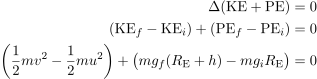
(Energy approach.) Since there is no friction on the inclined plane, we can apply the principle of conservation of mechanical energy. And we ignore the elastic potential energy because the object is rigid.
The final kinetic energy is zero because the final velocity is zero ( it stops momentarily at the maximum height ). Take the ground as the reference level, i.e.,
  .
.
Then,

Example 2 (Work done by which force?)

An object of mass is at rest on a rough surface of a wedge of slope angle . Then the wedge makes a displacement with a constant velocity to the left, while the object remains in the same position on the wedge. Find the work done on the object by i. friction , ii. normal force , and iii. the weight of the object.
Solution:
As always, we first draw a free-body diagram. From the figure, we know friction  and normal force
  .
.

i. Work done by friction  .
.
ii. Work done by normal force  .
.
iii. Work done by gravity  (
( ).
).
Example 3 (instantaneous power  average power)
An object of mass is initially at rest on the top of a rough inclined plane of height  and slope angle . It then accelerates and slides down the plane. When it reaches the ground, its velocity is and it has travelled a displacement . Find i. the instantaneous power of friction at the instant when the object reaches the ground, and ii. the average power of friction during the whole process of sliding.
i. Use force approach:  . Substituting
  (
( ), we have
  . Then the instantaneous power of friction is given by
  .
.
ii. Use energy approach: Work done against friction is  . Hence, work done by friction is
  . Average power of friction is given by
  .
.
If  ,
,  ,
,  ,
,  ,
,  ,
,  ,
,  , and take
  , check that
  .
.

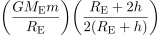 .
.


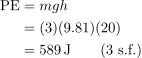
 mass
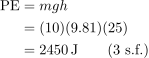
mass  metres above the ground?
 mass is
  above the ground. How much potential energy does it have?
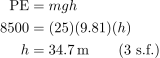
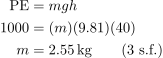
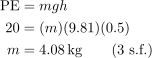
 mass before it has a potential energy of
  ?
? mass before it has a potential energy of
  ?
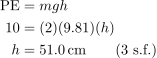
? when it is
  above ground level. What is the mass?
 when it is
  above ground level. What is the mass?