202209271040 Exercise 8.4 (Q53)

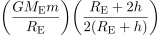
Neglecting the Earth’s rotation, show that the energy needed to launch a satellite of mass m into circular orbit at altitude h is

\displaystyle{\bigg( \frac{GM_\textrm{E}m}{R_{\textrm{E}}}\bigg)\bigg(\frac{R_{\textrm{E}}+2h}{2(R_{\textrm{E}}+h)}\bigg)}.

Extracted from R. Wolfson. (2016). Essential University Physics.


Abortive attempt.

(energy/work-done approach)

By conservation of mechanical energy,
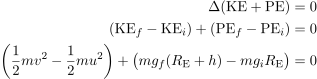
\begin{aligned} \Delta (\textrm{KE}+\textrm{PE}) & = 0 \\ (\textrm{KE}_f-\textrm{KE}_i) + (\textrm{PE}_f-\textrm{PE}_i) & = 0 \\ \bigg(\frac{1}{2}mv^2 - \frac{1}{2}mu^2\bigg) + \big(mg_f(R_\textrm{E}+h)-mg_iR_\textrm{E}\big) & = 0 \\ \end{aligned}

as

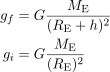
\begin{aligned} g_f & = G\frac{M_\textrm{E}}{(R_\textrm{E}+h)^2} \\ g_i & = G\frac{M_\textrm{E}}{(R_\textrm{E})^2} \\ \end{aligned}

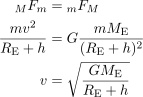
On the one hand, the gravitational pull provides the centripetal force for revolving at the orbital speed v:

\begin{aligned} \text{}_MF_m & = \text{}_mF_M \\ \frac{mv^2}{R_{\textrm{E}}+h} & = G\frac{mM_\textrm{E}}{(R_{\textrm{E}}+h)^2} \\ v & = \sqrt{\frac{GM_\textrm{E}}{R_{\textrm{E}}+h}} \\ \end{aligned}

On the other hand, the escape speed u of the satellite is

\begin{aligned} \frac{1}{2}mu^2 & = G\frac{mM_\textrm{E}}{R_\textrm{E}} \\ u & = \sqrt{\frac{2GM_\textrm{E}}{R_\textrm{E}}} \\ \end{aligned}

but what is this question asking for?

\Delta\textrm{KE}=\displaystyle{\frac{m(v^2-u^2)}{2}}

(to be continued)