201911190435 Homework 1 (Q4)

A point particle moves in space under the influence of force derivable from a generalized potential of the form

U(\mathbf{r},\mathbf{v})=V(r)+\sigma\cdot\textrm{\textbf{L}}

where \mathbf{r} is the radius vector from a fixed point, \textrm{\textbf{L}} is the angular momentum about that point, and \sigma is a fixed vector in space.

1. Find the components of the force on the particle in both Cartesian and spherical polar coordinates, on the basis of Eq. (1.58) in Goldstein’s book.

2. Show that the components in the two coordinates systems are related to each other as in Eq. (1.49) in Goldstein’s book.

3. Obtain the equation of motion in spherical polar coordinates.


Solution. (bad, probably wrong)

1.

i. In Cartesian coordinates (x,y,z), the potential V(r)=V(x,y,z). Here I take the definition of angular momentum \mathbf{L} to be the vector product of position \mathbf{r}=\mathbf{r}(x,y,z) and linear momentum \mathbf{p}=(\mathbf{p}_x,\mathbf{p}_y,\mathbf{p}_z): \begin{aligned} \mathbf{L} & =\mathbf{r}\times \mathbf{p}=\begin{vmatrix} \hat{\mathbf{i}} & \hat{\mathbf{j}} & \hat{\mathbf{k}} \\ x & y & z \\ m\dot{x} & m\dot{y} & m\dot{z}\\ \end{vmatrix}\\ (L_x,L_y,L_z) & =m(y\dot{z}-z\dot{y},z\dot{x}-x\dot{z},x\dot{y}-y\dot{x})\end{aligned}

In passing, \sigma is given as a fixed vector, thus it is, in particular, independent of position \mathbf{r} and vector \dot{\mathbf{r}}, and, in general, independent of generalized coordinates and generalized velocities.

Goldstein’s Classical Mechanics, the generalized force is given by the equation below:

Eq. (1-54):

Q_i=-\displaystyle{\frac{\partial U}{\partial q_i}}+\displaystyle{\frac{\mathrm{d}}{\mathrm{d}t}\bigg( \frac{\partial U}{\partial \dot{q_i}} \bigg)}

In Cartesian coordinates, write the general potential in the form of
U(x,y,z,\dot{x},\dot{y},\dot{z})=V(x,y,z)+\sigma\cdot (L_x,L_y,L_z).
Compute the partial derivatives with respect to x, y, z:
\begin{aligned} \displaystyle{\frac{\partial U}{\partial x}} & = \partial_xV+\sigma\cdot \partial_x(L_x,L_y,L_z)\\ & = -F_x+\sigma\cdot m(0,-\dot{z},\dot{y}) \\ \displaystyle{\frac{\partial U}{\partial y}} & = \partial_yV+\sigma\cdot \partial_y(L_x,L_y,L_z)\\ & = -F_y+\sigma\cdot m(\dot{z},0,-\dot{x}) \\ \displaystyle{\frac{\partial U}{\partial z}} & = \partial_zV+\sigma\cdot \partial_z(L_x,L_y,L_z)\\ & = -F_z+\sigma\cdot m(-\dot{y},\dot{x},0)\\ \end{aligned}
Compute the partial derivatives with respect to \dot{x}, \dot{y}, \dot{z}:
\begin{aligned} \displaystyle{\frac{\partial U}{\partial \dot{x}}} & = \sigma\cdot \partial_{\dot{x}}(L_x,L_y,L_z) \\ & = \sigma\cdot m(0,z,-y)\\ \displaystyle{\frac{\partial U}{\partial \dot{y}}} & = \sigma\cdot \partial_{\dot{y}}(L_x,L_y,L_z)\\ & = \sigma\cdot m(-z,0,x)\\ \displaystyle{\frac{\partial U}{\partial \dot{z}}} & = \sigma\cdot \partial_{\dot{z}}(L_x,L_y,L_z)\\ & = \sigma\cdot m(y,-x,0)\\ \end{aligned}
Finally, taking total derivatives w.r.t. time t on the preceding:
\begin{aligned} \displaystyle{\frac{\mathrm{d}}{\mathrm{d}t}\bigg(\frac{\partial U}{\partial \dot{x}}\bigg)} & = \sigma\cdot m(0,\dot{z},-\dot{y})\\ \displaystyle{\frac{\mathrm{d}}{\mathrm{d}t}\bigg(\frac{\partial U}{\partial \dot{y}}\bigg)} & = \sigma\cdot m(-\dot{z},0,\dot{x})\\ \displaystyle{\frac{\mathrm{d}}{\mathrm{d}t}\bigg(\frac{\partial U}{\partial \dot{z}}\bigg)} & = \sigma\cdot m(\dot{y},-\dot{x},0)\\ \end{aligned}
I shall obtain the following generalized forces:
\begin{aligned} Q_x & = -\Big( -F_x+\sigma\cdot m(0,-\dot{z},\dot{y})\Big)+\Big(\sigma\cdot m(0,\dot{z},-\dot{y})\Big)\\ & = F_x+2\sigma m(0,\dot{z},-\dot{y})\\ Q_y & =-\Big( -F_y+\sigma\cdot m(\dot{z},0,-\dot{x})\Big)+\Big(\sigma\cdot m(-\dot{z},0,\dot{x})\Big)\\ & = F_y+2\sigma m(-\dot{z},0,\dot{x})\\ Q_z & =-\Big( -F_z+\sigma\cdot m(-\dot{y},\dot{x},0)\Big)+\Big(\sigma\cdot m(\dot{y},-\dot{x},0)\Big)\\ & = F_z+2\sigma m(\dot{y},-\dot{x},0)\\ \end{aligned}
ii. In spherical (or, polar, as may be reduced) coordinates (r,\theta ,\phi) we have the potential V(r) with only r-dependence. The angular momentum \mathbf{L} is said to be \mathbf{L}=m(\mathbf{r}\times\mathbf{v}), where the position \mathbf{r}=\mathbf{r}(r,\theta ,\phi ) and the velocity \mathbf{v}=\mathbf{v}(r,\theta ,\phi) are in terms of spherical coordinates.
The transformation between spherical and Cartesian coordinates is:
\begin{aligned} x & =r\sin\theta\cos\phi \\ y & =r\sin\theta\sin\phi \\ z & =r\cos\theta \\ \end{aligned}.
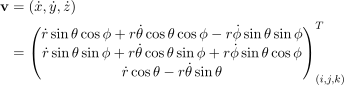
The velocity vector \mathbf{v} may thus be represented as:
\begin{aligned} \mathbf{v} & =(\dot{x},\dot{y},\dot{z})\\ & = \begin{pmatrix} \dot{r}\sin\theta\cos\phi +r\dot{\theta}\cos\theta\cos\phi -r\dot{\phi}\sin\theta\sin\phi \\ \dot{r}\sin\theta\sin\phi +r\dot{\theta}\cos\theta\sin\phi +r\dot{\phi}\sin\theta\cos\phi \\ \dot{r}\cos\theta -r\dot{\theta}\sin\theta \\ \end{pmatrix}^T_{(i,j,k)}\\ \end{aligned}
Using the fact which was derived formerly:

(L_x,L_y,L_z)=m(y\dot{z}-z\dot{y},z\dot{x}-x\dot{z},x\dot{y}-y\dot{x})
and by some direct computation below
\begin{aligned} & L_x/m \\ & = y\dot{z}-z\dot{y} \\ & = (r\sin\theta\sin\phi )(\dot{r}\cos\theta -r\dot{\theta}\sin\theta ) \\ &\qquad\qquad -(r\cos\theta )(\dot{r}\sin\theta\sin\phi +r\dot{\theta}\cos\theta\sin\phi +r\dot{\phi}\sin\theta\cos\phi )\\ & = -r^2\dot{\theta}\sin^2\theta\sin\phi -r^2\dot{\theta}\cos^2\theta\sin\phi +r^2\dot{\phi}\sin 2\theta\cos\phi \\ & = r^2(\dot{\phi}\sin 2\theta\cos\phi -\dot{\theta}\sin\phi )\\ \end{aligned}
\begin{aligned} & L_y/m\\ & = z\dot{x}-x\dot{z} \\ & = (r\cos\theta )(\dot{r}\sin\theta\cos\phi +r\dot{\theta}\cos\theta\cos\phi -r\dot{\phi}\sin\theta\sin\phi )\\ &\qquad\qquad -(r\sin\theta\cos\phi )(\dot{r}\cos\theta -r\dot{\theta}\sin\theta )\\ & = r^2\dot{\theta}\cos^2\theta \cos\phi -r^2\dot{\phi}\sin 2\theta\sin\phi +r^2\dot{\theta}\sin^2\theta\cos\phi \\ & = r^2(\dot{\theta}\cos\phi -\dot{\phi}\sin 2\theta\sin\phi )\\ \end{aligned}
\begin{aligned} & L_z/m \\ & = x\dot{y}-y\dot{x} \\ & = (r\sin\theta\cos\phi )(\dot{r}\sin\theta\sin\phi +r\dot{\theta}\cos\theta\sin\phi +r\dot{\phi}\sin\theta\cos\phi )\\ & \qquad -(r\sin\theta\sin\phi )(\dot{r}\sin\theta\cos\phi +r\dot{\theta}\cos\theta\cos\phi -r\dot{\phi}\sin\theta\sin\phi )\\ & =r^2\dot{\phi}\sin^2\theta\cos^2\phi +r^2\dot{\phi}\sin^2\theta\sin^2\phi \\ & = r^2\dot{\phi}\sin^2\theta \\ \end{aligned}
then summing up what is up till now, the angular momentum \mathbf{L} in terms of spherical coordinate components in Cartesian natural bases is
\mathbf{L}=\begin{pmatrix} L_r \\ L_\theta \\ L_\phi \\ \end{pmatrix}^T=mr^2\begin{pmatrix} \dot{\phi}\sin 2\theta\cos\phi -\dot{\theta}\sin\phi \\ \dot{\theta}\cos\phi -\dot{\phi}\sin 2\theta\sin\phi \\ \dot{\phi}\sin^2\theta \\ \end{pmatrix}^T_{(i,j,k)}
In spherical coordinates, write the general potential in the form of

U(r,\theta ,\phi ,\dot{r},\dot{\theta},\dot{\phi})=V(r)+\sigma\cdot \mathbf{L}(L_r,L_\theta ,L_\phi ).
Then,
\begin{aligned}[t] Q_r & =-\displaystyle{\frac{\partial U}{\partial r}}+\displaystyle{\frac{\mathrm{d}}{\mathrm{d}t}\bigg( \frac{\partial U}{\partial \dot{r}} \bigg)}\\ & = -(\partial_rV+\sigma\cdot \partial_r\mathbf{L})+\displaystyle{\frac{\mathrm{d}}{\mathrm{d}t}(\sigma\cdot \partial_{\dot{r}}\mathbf{L})}\\ & = -\partial_rV-\sigma\cdot \partial_r\mathbf{L}+\displaystyle{\sigma\cdot \frac{\mathrm{d}}{\mathrm{d}t}(\partial_{\dot{r}}\mathbf{L})}\\ \end{aligned}
\begin{aligned} Q_\theta & =-\displaystyle{\frac{\partial U}{\partial \theta}}+\displaystyle{\frac{\mathrm{d}}{\mathrm{d}t}\bigg( \frac{\partial U}{\partial \dot{\theta}} \bigg)}\\ & = -(\sigma\cdot \partial_\theta\mathbf{L})+\displaystyle{\frac{\mathrm{d}}{\mathrm{d}t}(\sigma\cdot \partial_{\dot{\theta}}\mathbf{L})}\\ & = -\sigma\cdot \partial_\theta\mathbf{L}+\displaystyle{\sigma\cdot \frac{\mathrm{d}}{\mathrm{d}t}(\partial_{\dot{\theta}}\mathbf{L})}\\ \end{aligned}
\begin{aligned} Q_\phi & =-\displaystyle{\frac{\partial U}{\partial \phi}}+\displaystyle{\frac{\mathrm{d}}{\mathrm{d}t}\bigg( \frac{\partial U}{\partial \dot{\phi}} \bigg)}\\ & = -(\sigma\cdot \partial_\phi\mathbf{L})+\displaystyle{\frac{\mathrm{d}}{\mathrm{d}t}(\sigma\cdot \partial_{\dot{\phi}}\mathbf{L})}\\ & = -\sigma\cdot \partial_\phi\mathbf{L}+\displaystyle{\sigma\cdot \frac{\mathrm{d}}{\mathrm{d}t}(\partial_{\dot{\phi}}\mathbf{L})}\\ \end{aligned}
Hence I need to compute the following six partial derivatives:
\partial_r\mathbf{L}, \partial_{\dot{r}}\mathbf{L}, \partial_\theta\mathbf{L}, \partial_{\dot{\theta}}\mathbf{L}, \partial_{\phi}\mathbf{L}, and \partial_{\dot{\phi}}\mathbf{L}:
In the case of r,
\begin{aligned} \partial_r\mathbf{L} & = 2mr \begin{pmatrix} \dot{\phi}\sin 2\theta\cos\phi -\dot{\theta}\sin\phi \\ \dot{\theta}\cos\phi -\dot{\phi}\sin 2\theta\sin\phi \\ \dot{\phi}\sin^2\theta \\ \end{pmatrix}^T_{(i,j,k)}\\ \partial_{\dot{r}}\mathbf{L} & = \mathbf{0}\\ \displaystyle{\frac{\mathrm{d}}{\mathrm{d}t}(\partial_{\dot{r}}}\mathbf{L}) & = \mathbf{0} \\ \end{aligned}
In the case of \theta,
\begin{aligned} \partial_\theta\mathbf{L} & = mr^2\begin{pmatrix} 2\dot{\phi}\cos 2\theta\cos\phi -\dot{\theta}\sin\phi \\ \dot{\theta}\cos\phi -2\dot{\phi}\cos 2\theta\sin\phi \\ 2\dot{\phi}\sin 2\theta \\ \end{pmatrix}^T_{(i,j,k)}\\ \partial_{\dot{\theta}}\mathbf{L} & = mr^2\begin{pmatrix} -\sin\phi \\ \cos\phi \\ 0 \\ \end{pmatrix}^T_{(i,j,k)} \\ \displaystyle{\frac{\mathrm{d}}{\mathrm{d}t}(\partial_{\dot{\theta}}}\mathbf{L}) & = 2mr\dot{r}\begin{pmatrix} -\sin\phi \\ \cos\phi \\ 0 \\ \end{pmatrix}^T_{(i,j,k)} + mr^2\begin{pmatrix} -\dot{\phi}\cos\phi \\ -\dot{\phi}\sin\phi \\ 0 \\ \end{pmatrix}^T_{(i,j,k)}\\ & = mr\begin{pmatrix} -2\dot{r}\sin\phi -r\dot{\phi}\cos\phi \\ 2\dot{r}\cos\phi -r\dot{\phi}\sin\phi \\ 0 \\ \end{pmatrix}^T_{(i,j,k)} \\ \end{aligned}
In the case of \phi,
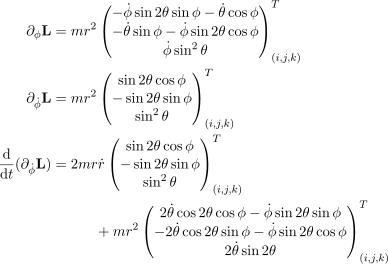
\begin{aligned} \partial_{\phi}\mathbf{L} & = mr^2\begin{pmatrix} -\dot{\phi}\sin 2\theta\sin\phi -\dot{\theta}\cos\phi \\ -\dot{\theta}\sin\phi -\dot{\phi}\sin 2\theta\cos\phi \\ \dot{\phi}\sin^2\theta \\ \end{pmatrix}^T_{(i,j,k)}\\ \partial_{\dot{\phi}}\mathbf{L} & =mr^2\begin{pmatrix} \sin 2\theta\cos\phi \\ -\sin 2\theta\sin\phi \\ \sin^2\theta \\ \end{pmatrix}^T_{(i,j,k)}\\ \displaystyle{\frac{\mathrm{d}}{\mathrm{d}t}}(\partial_{\dot{\phi}}\mathbf{L}) & = 2mr\dot{r} \begin{pmatrix} \sin 2\theta\cos\phi \\ -\sin 2\theta\sin\phi \\ \sin^2\theta \\ \end{pmatrix}^T_{(i,j,k)} \\ & \qquad\quad +mr^2 \begin{pmatrix} 2\dot{\theta}\cos 2\theta\cos\phi -\dot{\phi}\sin 2\theta\sin\phi \\ -2\dot{\theta}\cos 2\theta\sin\phi -\dot{\phi}\sin 2\theta\cos\phi \\ 2\dot{\theta}\sin 2\theta \\ \end{pmatrix}^T_{(i,j,k)} \\ \end{aligned} Substitution of these partial derivatives into the formulae of generalized forces, (recall that [in Goldstein’s Classical Mechanics] the generalized force is given by)
Eq. (1-54):
Q_i=-\displaystyle{\frac{\partial U}{\partial q_i}}+\displaystyle{\frac{\mathrm{d}}{\mathrm{d}t}\bigg( \frac{\partial U}{\partial \dot{q_i}} \bigg)}
one can obtain:
\begin{aligned}Q_r & =-\partial_rV-\sigma\cdot \partial_{r}\mathbf{L}+\sigma\cdot \displaystyle{\frac{\mathrm{d}}{\mathrm{d}t}}\partial_{\dot{r}}\mathbf{L}\\ & =F_r-2mr\sigma\cdot \begin{pmatrix} \dot{\phi}\sin 2\theta\cos\phi -\dot{\theta}\sin\phi \\ \dot{\theta}\cos\phi -\dot{\phi}\sin 2\theta\sin\phi \\ \dot{\phi}\sin^2\theta \\ \end{pmatrix}^T_{(i,j,k)}\\ \end{aligned}
\begin{aligned} Q_\theta & = -\sigma\cdot \partial_\theta\mathbf{L}+\displaystyle{\sigma\cdot \frac{\mathrm{d}}{\mathrm{d}t}(\partial_{\dot{\theta}}\mathbf{L})}\\ & = -mr\sigma \cdot \Bigg\{ r\begin{pmatrix} 2\dot{\phi}\cos 2\theta\cos\phi -\dot{\theta}\sin\phi \\ \dot{\theta}\cos\phi -2\dot{\phi}\cos 2\theta\sin\phi \\ 2\dot{\phi}\sin 2\theta \\ \end{pmatrix}- \begin{pmatrix} -2\dot{r}\sin\phi -r\dot{\phi}\cos\phi \\ 2\dot{r}\cos\phi -r\dot{\phi}\sin\phi \\ 0 \\ \end{pmatrix} \Bigg\} \\ & = -mr\sigma\cdot \begin{pmatrix} (2\cos 2\theta +1)r\dot{\phi}\cos\phi +(2\dot{r}-r\dot{\theta})\sin\phi \\ (1-2\cos 2\theta )r\dot{\phi}\sin\phi +(r\dot{\theta}-2\dot{r})\cos\phi \\ 2r\dot{\phi}\sin 2\theta \\ \end{pmatrix}^T_{(i,j,k)}\\ \end{aligned}
\begin{aligned} Q_\phi & = -\sigma\cdot \partial_\phi\mathbf{L}+\displaystyle{\sigma\cdot \frac{\mathrm{d}}{\mathrm{d}t}(\partial_{\dot{\phi}}\mathbf{L})}\\ & =-mr\sigma\cdot \Bigg\{ r\begin{pmatrix} -\dot{\phi}\sin 2\theta\sin\phi -\dot{\theta}\cos\phi \\ -\dot{\theta}\sin\phi -\dot{\phi}\sin 2\theta\cos\phi \\ \dot{\phi}\sin^2\theta \\ \end{pmatrix}-2\dot{r} \begin{pmatrix} \sin 2\theta\cos\phi \\ -\sin 2\theta\sin\phi \\ \sin^2\theta \\ \end{pmatrix}\\ &\qquad\quad -r \begin{pmatrix} 2\dot{\theta}\cos 2\theta\cos\phi -\dot{\phi}\sin 2\theta\sin\phi \\ -2\dot{\theta}\cos 2\theta\sin\phi -\dot{\phi}\sin 2\theta\cos\phi \\ 2\dot{\theta}\sin 2\theta \\ \end{pmatrix} \Bigg\}\\ & = -mr\sigma \cdot \begin{pmatrix} -(r\dot{\theta}+2\dot{r}\sin 2\theta +2r\dot{\theta}\cos 2\theta )\cos\phi \\ -(r\dot{\theta}+2\dot{r}\sin 2\theta +2r\dot{\theta}\cos 2\theta )\sin\phi \\ \big( (r\dot{\phi}-2\dot{r})\sin\theta -2r\dot{\theta}\cos\theta \big) \sin\theta \\ \end{pmatrix}^T_{(i,j,k)} \end{aligned}

2.

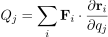
In Goldstein’s Classical Mechanics, the components of the generalized force is defined
Eq. (1.49):
Q_j=\displaystyle{\sum_{i}\mathbf{F}_i\cdot \frac{\partial \mathbf{r}_i}{\partial q_j}}
Hence I am to check the following three identities:
(I): Q_r=\mathbf{F}_x\cdot \displaystyle{\frac{\partial x}{\partial r}}+\mathbf{F}_y\cdot \displaystyle{\frac{\partial y}{\partial r}}+\mathbf{F}_z\cdot \displaystyle{\frac{\partial z}{\partial r}};
(II): Q_\theta =\mathbf{F}_x\cdot \displaystyle{\frac{\partial x}{\partial \theta}}+\mathbf{F}_y\cdot \displaystyle{\frac{\partial y}{\partial \theta}}+\mathbf{F}_z\cdot \displaystyle{\frac{\partial z}{\partial \theta}};
(III): Q_\phi =\mathbf{F}_x\cdot \displaystyle{\frac{\partial x}{\partial \phi}}+\mathbf{F}_y\cdot \displaystyle{\frac{\partial y}{\partial \phi }}+\mathbf{F}_z\cdot \displaystyle{\frac{\partial z}{\partial \phi}}
By abusage of notation, in what follows Q_x shall replace \mathbf{F}_x and be referred to as the generalized force in generalized coordinate x; and F_x shall be referred to as the x-component of the (usual) force F due to the (usual) potential V. The same notation applies likewise to Q_y, Q_z, F_y, F_z, etc.
It is convenient to check from the RHS. And let me begin with identity (I):
\begin{aligned} \textrm{RHS} & = \begin{pmatrix} Q_x\\ Q_y \\ Q_z \\ \end{pmatrix}^T\cdot \begin{pmatrix} \displaystyle{\frac{\partial x}{\partial r}} \\ \displaystyle{\frac{\partial y}{\partial r}} \\ \displaystyle{\frac{\partial z}{\partial r}} \\ \end{pmatrix} = \begin{pmatrix} F_x+2m\sigma\cdot (0,\dot{z},-\dot{y}) \\ F_y+2m\sigma\cdot (-\dot{z},0,\dot{x}) \\ F_z+2m\sigma\cdot (\dot{y},-\dot{x},0) \\ \end{pmatrix}^T\cdot \begin{pmatrix} \displaystyle{\frac{\partial x}{\partial r}} \\ \displaystyle{\frac{\partial y}{\partial r}} \\ \displaystyle{\frac{\partial z}{\partial r}} \\ \end{pmatrix}\\ & = \displaystyle{\sum_{i=x,y,z}F_i\cdot \displaystyle{\frac{\partial r_i}{\partial r}}} + \begin{pmatrix} 2m\sigma\cdot (0,\dot{z},-\dot{y}) \\ 2m\sigma\cdot (-\dot{z},0,\dot{x}) \\ 2m\sigma\cdot (\dot{y},-\dot{x},0) \\ \end{pmatrix}^T\cdot \begin{pmatrix} \sin\theta\cos\phi \\ \sin\theta\sin\phi \\ \cos\theta \\ \end{pmatrix}\\ & =F_r + 2m\sigma\cdot \begin{pmatrix} (0,\dot{z},-\dot{y}) \\ (-\dot{z},0,\dot{x}) \\ (\dot{y},-\dot{x},0) \\ \end{pmatrix}^T\cdot \begin{pmatrix} \sin\theta\cos\phi \\ \sin\theta\sin\phi \\ \cos\theta \\ \end{pmatrix}\\ \end{aligned}
Computing term-by-term, the first term is
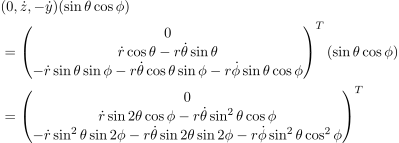
\begin{aligned} & (0,\dot{z},-\dot{y})(\sin\theta\cos\phi) \\ & = \begin{pmatrix} 0 \\ \dot{r}\cos\theta -r\dot{\theta}\sin\theta \\ -\dot{r}\sin\theta\sin\phi -r\dot{\theta}\cos\theta\sin\phi -r\dot{\phi}\sin\theta\cos\phi \\ \end{pmatrix}^T(\sin\theta\cos\phi )\\ & = \begin{pmatrix} 0 \\ \dot{r}\sin 2\theta\cos\phi -r\dot{\theta}\sin^2\theta\cos\phi \\ -\dot{r}\sin^2\theta\sin 2\phi -r\dot{\theta}\sin 2\theta\sin 2\phi -r\dot{\phi}\sin^2\theta\cos^2\phi \\ \end{pmatrix}^T\\ \end{aligned}
the second term is
\begin{aligned} & (-\dot{z},0,\dot{x})(\sin\theta\sin\phi ) \\ & = \begin{pmatrix} -\dot{r}\cos\theta +r\dot{\theta}\sin\theta \\ 0\\ \dot{r}\sin\theta\cos\phi +r\dot{\theta}\cos\theta\cos\phi -r\dot{\phi}\sin\theta\sin\phi \\ \end{pmatrix}^T (\sin\theta\sin\phi ) \\ & = \begin{pmatrix} -\dot{r}\sin 2\theta\sin\phi +r\dot{\theta}\sin^2\theta\sin\phi \\ 0 \\ \dot{r}\sin^2\theta\sin 2\phi +r\dot{\theta}\sin 2\theta\sin 2\phi -r\dot{\phi}\sin^2\theta\sin^2\phi \\ \end{pmatrix}^T\\ \end{aligned}
and the third and last term is
\begin{aligned} & (\dot{y},-\dot{x},0)(\cos\theta )\\ & = \begin{pmatrix} \dot{r}\sin\theta\sin\phi +r\dot{\theta}\cos\theta\sin\phi +r\dot{\phi}\sin\theta\cos\phi \\ -\dot{r}\sin\theta\cos\phi -r\dot{\theta}\cos\theta\cos\phi +r\dot{\phi}\sin\theta\sin\phi \\ 0\\ \end{pmatrix}^T(\cos\theta )\\ & = \begin{pmatrix} \dot{r}\sin 2\theta\sin\phi +r\dot{\theta}\cos^2\theta\sin\phi +r\dot{\phi}\sin 2\theta\cos\phi \\ -\dot{r}\sin 2\theta\cos\phi -r\dot{\theta}\cos^2\theta\cos\phi +r\dot{\phi}\sin 2\theta \sin\phi \\ 0 \\ \end{pmatrix}^T\\ \end{aligned}
Summing over these three terms, i.e.,
(0,\dot{z},-\dot{y})(\sin\theta\cos\phi)+(-\dot{z},0,\dot{x})(\sin\theta\sin\phi )+(\dot{y},-\dot{x},0)(\cos\theta ),
and one shall obtain from it
\begin{pmatrix} r\dot{\theta}\sin\phi +r\dot{\phi}\sin 2\theta \cos\phi \\ r\dot{\phi}\sin 2\theta\sin\phi -r\dot{\theta}\cos\phi \\ -r\dot{\phi}\sin^2\theta \\ \end{pmatrix}^T_{(i,j,k)}
Thus,
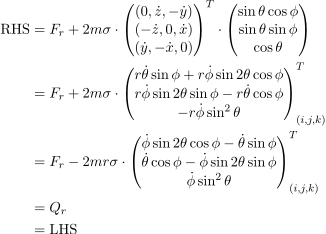
\begin{aligned} \textrm{RHS}& = F_r + 2m\sigma\cdot \begin{pmatrix} (0,\dot{z},-\dot{y}) \\ (-\dot{z},0,\dot{x}) \\ (\dot{y},-\dot{x},0) \\ \end{pmatrix}^T\cdot \begin{pmatrix} \sin\theta\cos\phi \\ \sin\theta\sin\phi \\ \cos\theta \\ \end{pmatrix}\\ & =F_r+2m\sigma \cdot \begin{pmatrix} r\dot{\theta}\sin\phi +r\dot{\phi}\sin 2\theta \cos\phi \\ r\dot{\phi}\sin 2\theta\sin\phi -r\dot{\theta}\cos\phi \\ -r\dot{\phi}\sin^2\theta \\ \end{pmatrix}^T_{(i,j,k)}\\ & = F_r-2mr\sigma\cdot \begin{pmatrix} \dot{\phi}\sin 2\theta\cos\phi -\dot{\theta}\sin\phi \\ \dot{\theta}\cos\phi -\dot{\phi}\sin 2\theta\sin\phi \\ \dot{\phi}\sin^2\theta \\ \end{pmatrix}^T_{(i,j,k)}\\ & = Q_r \\ & = \textrm{LHS}\\ \end{aligned}
The identity (I) is checked.
By applying the same procedure one can easily check that identities (II) and (III) are also satisfied. This is left as a tedious exercise to the reader. And the components of (generalized/usual) force in two coordinates systems are indeed related to each other as
Eq. (1.49):

Q_j=\displaystyle{\sum_{i}\mathbf{F}_i\cdot \frac{\partial \mathbf{r}_i}{\partial q_j}}

3.

In this part I shall obtain the equation of motion, or the Euler-Lagrange equations, where the Lagrangian \mathcal{L} is defined to be the difference of kinetic energy and generalized potential, i.e., \mathcal{L}=T-U.
To begin with, I shall show that owing to its linearity, the Lagrangian is separable in the sense of the following:
\begin{aligned} \displaystyle{\frac{\mathrm{d}}{\mathrm{d}t}\bigg( \frac{\partial \mathcal{L}}{\partial \dot{q_i}} \bigg)}-\displaystyle{\frac{\partial \mathcal{L}}{\partial q_i}} & =0\\ \displaystyle{\frac{\mathrm{d}}{\mathrm{d}t}\bigg( \frac{\partial}{\partial \dot{q_i}}\big( T-U \big)\ \bigg)}-\displaystyle{\frac{\partial }{\partial q_i}}\big( T-U \big) & =0\\ \displaystyle{\frac{\mathrm{d}}{\mathrm{d}t}\bigg( \frac{\partial}{\partial \dot{q_i}}\big( T \big) - \frac{\partial}{\partial \dot{q_i}}\big( U \big) \bigg)}-\displaystyle{\frac{\partial }{\partial q_i}}\big( T \big) + \displaystyle{ \frac{\partial }{\partial q_i}}\big( U \big) & =0\\ \displaystyle{\frac{\mathrm{d}}{\mathrm{d}t}\bigg( \frac{\partial}{\partial \dot{q_i}}\big( T \big) \bigg)}-\displaystyle{\frac{\partial }{\partial q_i}}\big( T \big) & =\displaystyle{\frac{\mathrm{d}}{\mathrm{d}t}\bigg( \frac{\partial}{\partial \dot{q_i}}\big( U \big) \bigg)} - \displaystyle{ \frac{\partial }{\partial q_i}}\big( U \big) \\ \displaystyle{\frac{\mathrm{d}}{\mathrm{d}t}\bigg( \frac{\partial}{\partial \dot{q_i}}\big( T \big) \bigg)}-\displaystyle{\frac{\partial }{\partial q_i}}\big( T \big) & =Q_i \\ \end{aligned}
where Q_i is the generalized force defined in the previous parts (a) & (b).
Based on the transformation equation of velocity between spherical and Cartesian coordinates as derived in part (a):
\begin{aligned} \mathbf{v} & =(\dot{x},\dot{y},\dot{z})\\ & = \begin{pmatrix} \dot{r}\sin\theta\cos\phi +r\dot{\theta}\cos\theta\cos\phi -r\dot{\phi}\sin\theta\sin\phi \\ \dot{r}\sin\theta\sin\phi +r\dot{\theta}\cos\theta\sin\phi +r\dot{\phi}\sin\theta\cos\phi \\ \dot{r}\cos\theta -r\dot{\theta}\sin\theta \\ \end{pmatrix}^T_{(i,j,k)}\\ \end{aligned},
the conversion of kinetic energy T into spherical coordinates can be derived in the form:
\begin{aligned} T & =\displaystyle{\frac{1}{2}m\mathbf{v}^2=\frac{1}{2}m(\dot{x}^2+\dot{y}^2+\dot{z}^2)}\\ & = \cdots \\ & = \displaystyle{\frac{1}{2}mr^2(\dot{\theta}^2+\sin^2\theta \dot{\phi}^2)} \\\end{aligned}
That said, I shall compute the following derivatives:
\displaystyle{\frac{\partial T}{\partial r}}=mr(\dot{\theta}^2+\sin^2\theta\dot{\phi}^2), \displaystyle{\frac{\partial T}{\partial \dot{r}}}=0\displaystyle{\frac{\mathrm{d}}{\mathrm{d}t}\bigg(\frac{\partial T}{\partial \dot{r}}\bigg)}=0
\displaystyle{\frac{\partial T}{\partial \theta}}=mr^2\dot{\phi}^2\sin 2\theta, \displaystyle{\frac{\partial T}{\partial \dot{\theta}}}=mr^2\dot{\theta}, \displaystyle{\frac{\mathrm{d}}{\mathrm{d}t}\bigg(\frac{\partial T}{\partial \dot{\theta}}\bigg)}=mr^2\ddot{\theta}+2m\dot{\theta}r\dot{r}
\displaystyle{\frac{\partial T}{\partial \phi}}=0, \displaystyle{\frac{\partial T}{\partial \dot{\phi}}}=mr^2\dot{\phi}, \displaystyle{\frac{\mathrm{d}}{\mathrm{d}t}\bigg(\frac{\partial T}{\partial \dot{\phi}}\bigg)}=mr^2\ddot{\phi}+2m\dot{\phi}r\dot{r}
Thus, the LHS of the separable Lagrangian equations are
\begin{aligned}\widetilde{T}_r & =-mr(\dot{\theta}^2+\sin^2\theta\dot{\phi}^2)\\ \widetilde{T}_\theta & =mr^2\ddot{\theta}+2m\dot{\theta}r\dot{r}-mr^2\dot{\phi}^2\sin 2\theta \\ \widetilde{T}_\phi & =mr^2\ddot{\phi}+2m\dot{\phi}r\dot{r}\end{aligned}
Equating them with the Q_r, Q_\theta, and Q_\phi which were derived in part (a), we obtain three equations of motion:

-mr(\dot{\theta}^2+\sin^2\theta\dot{\phi}^2)=F_r-2mr\sigma\cdot \begin{pmatrix} \dot{\phi}\sin 2\theta\cos\phi -\dot{\theta}\sin\phi \\ \dot{\theta}\cos\phi -\dot{\phi}\sin 2\theta\sin\phi \\ \dot{\phi}\sin^2\theta \\ \end{pmatrix}^T_{(i,j,k)}
mr^2\ddot{\theta}+2m\dot{\theta}r\dot{r}-mr^2\dot{\phi}^2\sin 2\theta = -mr\sigma\cdot \begin{pmatrix} (2\cos 2\theta +1)r\dot{\phi}\cos\phi +(2\dot{r}-r\dot{\theta})\sin\phi \\ (1-2\cos 2\theta )r\dot{\phi}\sin\phi +(r\dot{\theta}-2\dot{r})\cos\phi \\ 2r\dot{\phi}\sin 2\theta \\ \end{pmatrix}^T_{(i,j,k)}
mr^2\ddot{\phi}+2m\dot{\phi}r\dot{r} =-mr\sigma \cdot \begin{pmatrix} -(r\dot{\theta}+2\dot{r}\sin 2\theta +2r\dot{\theta}\cos 2\theta )\cos\phi \\ -(r\dot{\theta}+2\dot{r}\sin 2\theta +2r\dot{\theta}\cos 2\theta )\sin\phi \\ \big( (r\dot{\phi}-2\dot{r})\sin\theta -2r\dot{\theta}\cos\theta \big) \sin\theta \\ \end{pmatrix}^T_{(i,j,k)}

Remark.

The F_r in the first equation of motion is the central force. The fixed vector \sigma should be in component form \sigma =\sigma (r,\theta ,\phi )=(\sigma_r,\sigma_\theta ,\sigma_\phi ). Once \sigma having dotted with the rightmost row vector, a scalar will be obtained.

201907251221 Short Review (Projectile Motion)

When projected in the air and subjected only to gravity, a projectile performs projectile motion. Its path/trajectory is a parabola. If the projectile is projected at an angle of projection, it is said to be in general projectile motion; else, it is said to be in horizontal projectile motion.

The duration of time from projection to landing is called the time of flight. The maximum height the projectile can reach is usually measured from the launch level. The range of projection is the horizontal distance the projectile has travelled from projection to landing.

Horizontally Projected Motion

When air resistance is negligible, a projectile moves at a uniform horizontal velocity and at a uniform vertical acceleration due to gravity. As its motion in the horizontal and in the vertical are independent of each other, so we separate the projectile motion into two perpendicular directions—the horizontal and the vertical—in order to resolve and analyse it.

i. v=u+at; ii. \displaystyle{s=\frac{(u+v)}{2}t}; iii. \displaystyle{s=ut+\frac{1}{2}at^2}; iv. v^2=u^2+2as are what you need.

At any instant t:

horizontal motion (u_x=u, a_x=0):

v_x=u_x=u;

s_x=u_xt=ut OR t=\displaystyle{\frac{s_x}{u}}

vertical motion (u_y=0, a_y=-g):

v_y=u_y+a_yt=0-gt=-gt;

s_y=u_yt+\frac{1}{2}a_yt^2=0+\frac{1}{2}(-g)t^2=-\frac{1}{2}gt^2;

v_y^2=u_y^2+2a_ys_y=0+2(-g)s_y=-2gs_y;

the velocity v can be found by

\sqrt{v_x^2+v_y^2}=\sqrt{u^2-2gs_y}\enspace (=\sqrt{u^2+g^2t^2})

its trajectory is parabolic: s_y=\displaystyle{-\frac{g}{2u^2}s_x^2}.

General Projectile Motion

A projectile is now projected with an initial velocity u at an angle \theta. As usual, we separate the motion into horizontal and vertical directions. At any instant t, the magnitude of its velocity is v=\sqrt{v_x^2+v_y^2}, and its direction makes an angle \phi with the level, where \tan\phi =\displaystyle{\frac{v_y}{v_x}}.

Horizontal motion: The initial horizontal velocity is u_x=u\cos\theta. After some time t, its horizontal displacement is s_x=u_xt+\frac{1}{2}a_xt^2 OR s_x=u\cos\theta t and its velocity remains to be v_x=u_x+a_xt OR v_x=u_x=u\cos\theta.

(Neglecting air friction, we assume zero horizontal acceleration, i.e., a_x=0.)

Vertical motion: The initial vertical velocity is u_y=u\sin\theta. After some time t, its vertical displacement is s_y=u_yt+\frac{1}{2}a_yt^2 OR s_y=u\sin\theta t-\frac{1}{2}gt^2 and its velocity changes to v_y=u_y+a_yt OR v_y=u\sin\theta -gt.

(Upward taken to be +ve, the vertical acceleration due to gravity is a_y=-g)

Better to know the equations of motion well in deriving, than to simply memorize the formulae in solving, the unknowns, lest it be wrong in some cases, say, on a slant.

Time of flight t: Consider only the vertical motion, by ①: s_y=u_yt+\displaystyle{\frac{1}{2}}a_yt^2

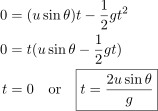
\begin{aligned} 0&=(u\sin\theta)t-\frac{1}{2}gt^2 \\ 0&=t(u\sin\theta -\frac{1}{2}gt) \\ t&= 0\quad \mathrm{or}\quad \boxed{t=\frac{2u\sin\theta}{g}} \end{aligned}

Or, by ②: v=u+at, and that the object lands with the same speed as is launched, we have -u\sin\theta =u\sin\theta -gt, which also gives t=2u\sin\theta /g.

Range R: Consider only the horizontal motion, by s_x=u_xt (\because a_x=0)

\begin{aligned} R&=(u\cos\theta )\bigg( \frac{2u\sin\theta}{g}\bigg) \\ &=\frac{2u^2\sin\theta\cos\theta}{g} \end{aligned}

\boxed{R=\frac{u^2\sin 2\theta}{g}}

^\dagger R is maximum if \theta =45^\circ (\sin 2\theta =1). ^{\dagger\dagger} \sin 2\theta=2\sin\theta\cos\theta. ^{\dagger\dagger\dagger} Both angles \theta and 90^\circ -\theta give the same range.

Maximum height H: Consider only the vertical motion, by ①: v_y^2=u_y^2+2a_ys_y

0^2=(u\sin\theta )^2-2gH

\boxed{H=\frac{u^2\sin^2\theta}{2g}}

Or, by ②: s_y=u_yt+\frac{1}{2}a_yt^2 and that it takes half of the time of flight to reach H, we have H=(u\sin\theta)\bigg( \displaystyle{\frac{u\sin\theta}{g}}\bigg)+\displaystyle{\frac{1}{2}}(-g)\bigg( \displaystyle{\frac{u\sin\theta}{g}}\bigg)^2 and thus the same result.

CONCEPT TEST

  1. As shown in the figure, three objects a, b, and c are projected horizontally and travelled along their respective trajectories. Objects b and c are projected at the same height. Neglecting air resistance, which of the following statements are true?
    1. The time of flight of a is longer than that of b.
    2. The time of flight of b is equal to that of c.
    3. The horizontal velocity of a is less than that of b.
    4. The initial velocity of b is greater than that of c.
    1. (I) and (II)
    2. (I) and (IV)
    3. (II) and (III)
    4. (II) and (IV)
  2. As shown in the figure, two objects A and B are in general projectile motion. They reach the same maximum height. Neglecting air resistance, which of the following statements are wrong?
    1. The acceleration of B is greater than that of A.
    2. The time of flight of B is equal to that of A.
    3. The velocity of B is equal to that of A when they are at the maximum height.
    4. The velocity of B is greater than that of A at the time of landing.
    1. (I) and (II)
    2. (I) and (III)
    3. (II) and (III)
    4. (III) and (IV)
  3. An object is now in general projectile motion. Which of the following graphs are correct?
    1. (I) and (II)
    2. (I) and (III)
    3. (II) and (IV)
    4. (III) and (IV)

Answers:

  1. D
  2. B
  3. B

Explanations:

  1. Since h=\displaystyle{\frac{1}{2}}gt^2, time of flight is given by t=\displaystyle{\sqrt{\frac{2h}{g}}}. From h_b=h_c>h_a, we get t_a<t_b=t_c. Thus (I) is wrong and (II) correct. The horizontal velocity is given by v=\displaystyle{\frac{x}{t}}. From x_a>x_b>x_c, we get v_a>v_b>v_c. Thus (III) is wrong and (IV) correct.
  2. The acceleration of A and of B is due to gravity, and is equal to -g (Upward taken to be +ve). Thus (I) is wrong. Let the vertical component of initial velocity be u_y. From 0=u_y^2-2gh, we know that A and B have the same magnitude in their vertical component of initial velocity. Thus they have the same time of flight and (II) is correct. From v_x=\displaystyle{\frac{x}{t}}, where x_B>x_A, we know that the horizontal velocity of B is greater than that of A. The velocity at maximum height is v=\sqrt{v_x^2+v_y^2}=\sqrt{v_x^2}=v_x. Thus v_B>v_A and (III) is wrong. Again by resolving components, the velocity at the time of landing is \sqrt{v_x^2+v_y^2}. From v_y being equal and v_x of B greater than that of A, it follows that (IV) is correct.
  3. By the conservation of mechanical energy, \Delta \mathrm{KE}+\Delta\mathrm{PE}=0, i.e., \bigg( \displaystyle{\frac{1}{2}}mv^2-\displaystyle{\frac{1}{2}}mu^2\bigg) +(mgh-0)=0. Arranging it into the form y=mx+c, we have \mathrm{KE}(=\frac{1}{2}mv^2)=-\mathrm{PE}(=mgh)+\frac{1}{2}mu^2. Thus (I) is correct. (II) is wrong because during the flight, there must be a non-zero horizontal component of velocity and thus \mathrm{KE}\not\equiv 0. The maximum height H=\displaystyle{\frac{u^2\sin^2\theta}{2g}}. We can readily fit it into the form y=ax^2, where y=H, x=u, and a=\displaystyle{\frac{\sin^2\theta}{2g}}. Hence (III) is correct. From s_y=u_yt+\frac{1}{2}a_yt^2, it follows that H=(u\sin\theta )t-\displaystyle{\frac{gt^2}{2}}. We can likewise fit it into a parabola y=ax^2+bx+c where y=H, x=t, a=-g/2, b=u\sin\theta, and c=0. The graph (IV) is far from correct.

201907241013 Short Review (Work, Energy, and Power)

Q & A

Work and energy transfer

Q. What does mechanical energy include?

Ans. Kinetic energy, gravitational potential energy, and elastic potential energy.

Q. What is the unit of energy?

Ans. Joule (J).

Q. A worker is pushing a trolley loaded with goods from one place to another. What is he doing?

Ans. Work.

Q. What is the definition of work?

Ans. Work is the product of force F_\| parallel to displacement and displacement s, i.e. W=\vec{F}\cdot \vec{s}=Fs\cos\theta, where \theta is the angle between F and s.

Q. What is the unit(s) of work?

Ans. Joule (\mathrm{J}), or Newton metre (\mathrm{N\,m}).

Q. Are energy and work vectors or scalars?

Ans. Both are scalars.

Q. Is work W done always positive?

Ans. No, work W can be negative. From W=Fs\cos\theta, where F,s>0 are the magnitudes of force and of displacement, W<0\Rightarrow \cos\theta <0 \Rightarrow 90^\circ <\theta <180^\circ. Negative work is done when F and s are in opposite direction, or when they make an obtuse angle.

Q. Can you give an example of negative work done on an object?

Ans. Yes, friction f of a rough surface acts opposite to the displacement s. So work done on an object due to friction is W=fs\cos 180^\circ =-fs<0.

Q. Is work W either positive or negative?

Ans. Not really, it can be zero. From W=Fs\cos\theta, assuming there is a force and a displacement, i.e., F,s>0, still, when \theta =90^\circ, \cos\theta =0. Hence, if the force and the displacement are perpendicular to each other (F\perp s), work done W=Fs\cos\theta =0.

Kinetic energy and potential energy

Q. What is the formula for the kinetic energy of a body?

Ans. \mathrm{KE}=\displaystyle{\frac{1}{2}}mv^2.

Q. What is the formula for the gravitational potential energy of a body?

Ans. \mathrm{PE}=mgh.

Q. Is work W equivalent to kinetic energy (KE), gravitational potential energy (GPE), or elastic potential energy (EPE)?

Ans. None of them. Work W is equivalent to mechanical energy (\mathrm{KE} +\mathrm{GPE} +\mathrm{EPE}).

Q. On a level surface, an object of mass m is acted on by a force F such that it accelerates from an initial velocity u to a final velocity v after a displacement s. Show that in this instance, work W done by the force is equivalent solely to the change in kinetic energy (\mathrm{\Delta KE}).

Ans. Substitute F=ma and s=\displaystyle{\frac{v^2-u^2}{2a}} into W=Fs, we get W=(ma)\bigg( \displaystyle{\frac{v^2-u^2}{2a}}\bigg)=\displaystyle{\frac{1}{2}mv^2-\frac{1}{2}mu^2}=\mathrm{KE}_\mathrm{final}-\mathrm{KE}_\mathrm{initial}=\mathrm{\Delta KE}. Notice that the downward gravitational force mg is perpendicular to the displacement s, so GPE does not contribute to the work done.

Q. On a cliff, an object of mass m which is initially at rest is dropped vertically from a height h_1 to a height h_2. Show that in this instance, work W done by gravity is equivalent solely to the change in gravitational potential energy (\mathrm{\Delta GPE}).

Ans. W=Fs=(mg)(h_1-h_2)=\mathrm{GPE_1}-\mathrm{GPE_2}=\Delta \mathrm{GPE}.

Q. Prove that the dimensions of work and of kinetic energy are the same.

Ans. [W]=[Fs]=[ma\cdot s]=\mathrm{kg\cdot\,ms^{-2}\cdot m}=\mathrm{kg\,m^2\,s^{-2}}.

\mathrm{[KE]}=\bigg[\displaystyle{\frac{1}{2}mv^2}\bigg]=\mathrm{kg\cdot (m\,s^{-1})^2}=\mathrm{kg\,m^2\,s^{-2}}.

Q. Prove that the dimensions of work and of potential energy are the same.

Ans. [W]=\mathrm{kg\,m^2\,s^{-2}}; \mathrm{[PE]}=[mgh]=\mathrm{kg\cdot (m\,s^{-2})\cdot m}=\mathrm{kg\,m^2\,s^{-2}}.

Energy changes and conservation of energy

Q. What is the law of conservation of energy?

Ans. Energy can be changed from one form into another, but it cannot be created or destroyed.

Q. When will mechanical energy (i.e., the sum of KE and PE) not be conserved?

Ans. Mechanical energy is not conserved if frictional force is present, or if mechanical energy is converted to other forms of energy, e.g., electrical energy, thermal energy, sound energy, chemical energy, etc.

Power

Q. What is power? Its unit?

Ans. Power P is the rate at which energy E is transferred, P=\displaystyle{\frac{E}{t}}. For energy due only to heat transfer, P=\displaystyle{\frac{Q}{t}}. For energy due only to doing work, P=\displaystyle{\frac{W}{t}}. Its unit is watt (W).

Q. P=\boxed{\displaystyle{\frac{W}{t}}}_{\,\spadesuit}=\displaystyle{\frac{Fs}{t}}=\boxed{Fv}_{\,\clubsuit}. When to use \spadesuit, when to use \clubsuit?

Ans. \spadesuit: average power; \clubsuit: instantaneous power.

Example 1 (Energy conversion and conservation)

An object of mass m begins to move up with initial velocity u along a smooth (frictionless) inclined plane of slope angle \theta.

(a) What is the initial kinetic energy of the object?

Answer: (a) \mathrm{KE}_\mathrm{initial}=\displaystyle{\frac{1}{2}mu^2}

(b) Use the force approach and the energy approach to find the maximum height h that the object can reach.

Solution:

(Force approach.) As always, we first draw a free-body diagram of the object. Since the normal reaction N does not have a component along the plane, we need only to consider the component of weight mg along the plane, which is mg\sin\theta.

The acceleration along the plane is a=\displaystyle{\frac{F}{m}=\frac{-mg\sin\theta}{m}}=-g\sin\theta. The object will stop at the maximum height, i.e. final velocity v=0. By v^2=u^2+2as, we get 0=u^2+2(-g\sin\theta)s. It follows that the displacement travelled along the plane is s=\displaystyle{\frac{u^2}{2g\sin\theta}}. Since height h is related to displacement s by h=s\sin\theta, the maximum height should be h_\mathrm{max.}=\bigg( \displaystyle{\frac{u^2}{2g\sin\theta}}\bigg) (\sin\theta)=\displaystyle{\frac{u^2}{2g}}.

(Energy approach.) Since there is no friction on the inclined plane, we can apply the principle of conservation of mechanical energy. And we ignore the elastic potential energy because the object is rigid.

The final kinetic energy is zero because the final velocity is zero (\Leftarrow it stops momentarily at the maximum height h). Take the ground as the reference level, i.e., h=0.

Then,

\begin{aligned} \mathrm{\Delta\, mechanical\,energy}&=0\\ \Delta \mathrm{KE}+\Delta \mathrm{PE} &=0\\ (\mathrm{KE}_\mathrm{final}-\mathrm{KE}_\mathrm{initial})+(\mathrm{PE}_\mathrm{final}-\mathrm{PE}_\mathrm{initial})&=0\\ (0-\frac{1}{2}mu^2)+(mgh_\mathrm{max.}-0)&=0\\ mgh_\mathrm{max.}&=\frac{1}{2}mu^2\\ h_\mathrm{max.}&=\frac{u^2}{2g}\\ \end{aligned}

Example 2 (Work done by which force?)

An object of mass m is at rest on a rough surface of a wedge of slope angle \theta. Then the wedge makes a displacement s with a constant velocity to the left, while the object remains in the same position on the wedge. Find the work done on the object by i. friction f, ii. normal force N, and iii. the weight mg of the object.

Solution:

As always, we first draw a free-body diagram. From the figure, we know friction f=mg\sin\theta and normal force N=mg\cos\theta.

i. Work done by friction W_f=fs\cos (180^\circ -\theta)=(mg\sin\theta )(s)(-\cos\theta)=-mgs\sin\theta\cos\theta.

ii. Work done by normal force W_N=Ns\cos (180^\circ -90^\circ -\theta )=(mg\cos\theta)(s)(\sin\theta)=mgs\sin\theta\cos\theta.

iii. Work done by gravity W_{mg}=0 (\because mg\perp s).

Example 3 (instantaneous power \neq average power)

An object of mass m is initially at rest on the top of a rough inclined plane of height H and slope angle \theta. It then accelerates and slides down the plane. When it reaches the ground, its velocity is v and it has travelled a displacement s. Find i. the instantaneous power of friction at the instant when the object reaches the ground, and ii. the average power of friction during the whole process of sliding.

i. Use force approach: 0\neq F_\mathrm{net}=ma=mg\sin\theta -f. Substituting a=\frac{v^2-u^2}{2s}=\frac{v^2}{2s} (\because u=0), we have f=mg\sin\theta -\frac{mv^2}{2s}. Then the instantaneous power of friction is given by \boxed{P_\mathrm{ins}=fv}=\bigg(mg\sin\theta -\displaystyle{\frac{mv^2}{2s}}\bigg) v.

ii. Use energy approach: Work done against friction is \Delta \mathrm{KE}+\Delta \mathrm{PE}=(\frac{1}{2}mv^2-0)+(0-mgH)=\frac{1}{2}mv^2-mgH. Hence, work done by friction is W_f=mgH-\frac{1}{2}mv^2. Average power of friction is given by \boxed{P_\mathrm{avg}=\displaystyle{\frac{W_f}{t}}}=\displaystyle{\frac{mgH-\frac{1}{2}mv^2}{t}}.

If m=1\,\mathrm{kg}, v=4\,\mathrm{m\,s^{-1}}, t=1\,\mathrm{s}, f=1\,\mathrm{N}, \theta =30^\circ, H=1\,\mathrm{m}, s=2\,\mathrm{m}, and take g=10\,\mathrm{m\,s^{-2}}, check that 4\,\mathrm{W}=\boxed{P_\mathrm{ins}\neq P_\mathrm{avg}}=2\,\mathrm{W}.

201907181500 Homework 2 (Q3)

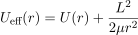
Two mass points, m_1 and m_2, move under the influence of a mutual central force, where the central force potential is given by U(\mathbf{r}_1,\mathbf{r}_2)=U(|\mathbf{r}_1-\mathbf{r}_2|). Assume the center of mass is at the rest, please find the equivalent one-body problem and show that the corresponding Lagrangian can be written as

\mathcal{L}=\displaystyle{\frac{1}{2}}\mu\dot{r}^2-U_{\textrm{eff}}

where r=|\mathbf{r}_1-\mathbf{r}_2| is the relative distance between the two mass points and \mu=\displaystyle{\frac{m_1m_2}{m_1+m_2}} is the reduced mass.


Solution.

(Reference: https://www.physics.rutgers.edu/~shapiro/507/book4(DOT)pdf)

Let \mathbf{R}\stackrel{\textrm{def}}{=}\displaystyle{\frac{m_1\mathbf{r}_1+m_2\mathbf{r}_2}{m_1+m_2}} and \mathbf{r}\stackrel{\textrm{def}}{=}\mathbf{r}_2-\mathbf{r}_1. Expressing \mathbf{r}_1 and \mathbf{r}_2 in terms of \mathbf{R} and \mathbf{r}, we write

\mathbf{r}_1=\mathbf{R}-\displaystyle{\frac{m_2}{M}}\mathbf{r},

\mathbf{r}_2=\mathbf{R}+\displaystyle{\frac{m_1}{M}}\mathbf{r}

where M=m_1+m_2.

The kinetic energy T is computed as follows:

\begin{aligned} T & = \displaystyle{\frac{1}{2}m_1\dot{r}_1^2}+\displaystyle{\frac{1}{2}m_2\dot{r}_2^2} \\ & = \displaystyle{\frac{1}{2}m_1\Bigg[ \displaystyle{\frac{\mathrm{d} }{\mathrm{d}t}} \bigg( \mathbf{R}-\displaystyle{\frac{m_2}{M}}\mathbf{r} \bigg)\Bigg]^2}+\displaystyle{\frac{1}{2}m_2\Bigg[ \displaystyle{\frac{\mathrm{d} }{\mathrm{d}t}} \bigg( \mathbf{R}+\displaystyle{\frac{m_1}{M}}\mathbf{r}\bigg)\Bigg]^2} \\ & = \displaystyle{\frac{1}{2}}(m_1+m_2)\dot{R}^2+\displaystyle{\frac{1}{2}\frac{m_1m_2}{M}}\dot{r}^2 \\ & = \displaystyle{\frac{1}{2}}M\dot{R}^2+\displaystyle{\frac{1}{2}\mu\dot{r}^2} \\ \end{aligned}

where \mu is the reduced mass \displaystyle{\frac{m_1m_2}{m_1+m_2}}.

From its formula above, T can be seen as the sum of the kinetic energy of the motion of the centre of mass, i.e., \displaystyle{\frac{1}{2}}M\dot{R}^2, and the kinetic energy of motion about the centre of mass, i.e., \displaystyle{\frac{1}{2}\mu\dot{r}^2}.

And from the fact that the Lagrangian \mathcal{L}=\displaystyle{\frac{1}{2}}M\dot{R}^2+\displaystyle{\frac{1}{2}\mu\dot{r}^2}-U(r) is cyclic on R, the centre of mass is either at rest or in uniform motion.

Thus the equation of motion for r will not contain terms involving \mathbf{R} or \dot{\mathbf{R}}. We may hence ignore the first term, and what remains in the Lagrangian is

\mathcal{L}=\displaystyle{\frac{1}{2}\mu\dot{r}^2}-U(r).

Now that we introduce a spherical coordinate system given by its equation of transformation from the Cartesian as:

\begin{aligned} x & =r\sin\theta\cos\phi \\ y & =r\sin\theta\sin\phi \\ z & =r\cos\theta \\ \end{aligned}

we can write the kinetic energy as

\begin{aligned} T & =\displaystyle{\frac{1}{2}}\mu (\dot{x}^2+\dot{y}^2+\dot{z}^2) \\ & = \displaystyle{\frac{1}{2}}\mu[(\dot{r}\sin\theta\cos\phi+\dot{\theta}r\cos\theta\cos\phi -\dot{\phi}r\sin\theta\sin\phi)^2\\ & \qquad +(\dot{r}\sin\theta\sin\phi+\dot{\theta}r\cos\theta\sin\phi+\dot{\phi}r\sin\theta\cos\phi)^2\\ & \qquad +(\dot{r}\cos\theta -\dot{\theta}r\sin\theta)^2]\\ & = \displaystyle{\frac{1}{2}}\mu [\dot{r}^2+r^2\dot{\theta}^2+r^2\sin^2\theta\dot{\phi}^2]\\ \end{aligned}

(Note that the kinetic energy is cyclic on the coordinate \phi and the conjugate momentum P_\phi=\displaystyle{\frac{\partial\mathcal{L}}{\partial\dot{\phi}}}=\mu r^2\sin^2\theta\dot{\phi}=\textrm{constant}. Observe that r\sin\theta is the distance between the particle and the z-axis, and it can be easily seen that P_\phi is the z-component of the angular momentum \mathbf{L}.)

To simplify things, we choose the direction of angular momentum \mathbf{L} as the z-direction. It follows that \theta=\pi/2, \dot{\theta}=0, and L=\mu r^2\dot{\phi}.

I wish to obtain the Euler-Lagrange equation for r. Hence I compute the following:

\begin{aligned} \displaystyle{\frac{\partial \mathcal{L}}{\partial r}} & = \mu r\dot{\phi}^2- \partial_r U\\ \displaystyle{\frac{\partial \mathcal{L}}{\partial \dot{r}}} & = \mu\dot{r}\\ \displaystyle{\frac{\mathrm{d}}{\mathrm{d}t}\bigg(\frac{\partial \mathcal{L}}{\partial \dot{r}}}\bigg) & = \mu\ddot{r}\\ \end{aligned}

Then one can express the one-body problem as:

\mu\ddot{r}-\mu r\dot{\phi}^2+\displaystyle{\frac{\mathrm{d}U}{\mathrm{d}r}}=0,

or,

\mu\ddot{r}-\displaystyle{\frac{L^2}{\mu r^3}}+\displaystyle{\frac{\mathrm{d}U}{\mathrm{d}r}}=0,

or,

\mu\ddot{r}+\displaystyle{\frac{\mathrm{d}}{\mathrm{d}r}U_{\textrm{eff}}(r)}=0,

where U_{\textrm{eff}}(r)=U(r)+\displaystyle{\frac{L^2}{2\mu r^2}} is the effective potential.

201907181434 Homework 1 (Q3)

Obtain the equation of motion for a particle falling vertically under the influence of gravity when the frictional forces obtainable from a dissipation function kv^2/2 are present. Integrate the equation to obtain the velocity as a function of time and show that maximum possible velocity for a fall from rest is v=mg/k.


Solution.

Write the Lagrangian \mathcal{L}=T-V by noting

T=\displaystyle{\frac{1}{2}m\dot{\mathbf{y}}^2} and V=-mg|\mathbf{y}|,

where the upward direction is taken to be positive. The frictional force is

\mathcal{F}=\displaystyle{\frac{k\dot{\mathbf{y}}^2}{2}}.

I wish to obtain the Euler-Lagrange equation, by computing the derivatives below:

\begin{aligned} \displaystyle{\frac{\partial \mathcal{L}}{\partial y}} & = mg \\ \displaystyle{\frac{\partial \mathcal{L}}{\partial \dot{y}}} & =m\dot{y} \\ \displaystyle{\frac{\mathrm{d}}{\mathrm{d}t}}\bigg( \displaystyle{\frac{\partial \mathcal{L}}{\partial \dot{y}}}\bigg) & = m\ddot{y} \\ \displaystyle{\frac{\partial \mathcal{F}}{\partial \dot{y}}} & = k\dot{y}\\ \end{aligned}

Hence I obtain the E-L equation (with dissipation):

\begin{aligned} \displaystyle{\frac{\mathrm{d}}{\mathrm{d}t}}\bigg( \displaystyle{\frac{\partial \mathcal{L}}{\partial \dot{y}}}\bigg) -\displaystyle{\frac{\partial \mathcal{L}}{\partial y}}+\displaystyle{\frac{\partial \mathcal{F}}{\partial \dot{y}}} & =0\\ m\ddot{y}-mg+k\dot{y} & =0\\ \ddot{y}+\displaystyle{\frac{k}{m}}\dot{y} & =g\\ \end{aligned}

Treating u=\dot{y} as variable, I may obtain a first-order differential equation:

\dot{u}+\displaystyle{\frac{k}{m}u}-g=0

Solving it,

\begin{aligned} v(t) & =e^{\int \frac{k}{m}\mathrm{d}t}=e^{kt/m}\\ e^{kt/m}\dot{u}+\frac{k}{m}ue^{kt/m} & =ge^{kt/m}\\ \displaystyle{\frac{\mathrm{d}}{\mathrm{d}t}}(ue^{kt/m}) & = ge^{kt/m}\\ ue^{kt/m} & = \displaystyle{\frac{mg}{k}}e^{kt/m}+\textrm{constant }C\\ u(t)& =\displaystyle{\frac{mg}{k}}+Ce^{-kt/m}\\ v_{\textrm{max.}}=\dot{y} & =\displaystyle{\frac{mg}{k}}\qquad\qquad (e^{-\frac{kt}{m}}\rightarrow 0\enspace \textrm{as}\enspace t\rightarrow \infty )\\ \end{aligned}

In conclusion, it is proven that the maximum possible speed for a fall from rest is v=mg/k.

201907141627 Homework 1 (Q1)

Use the \varepsilon_{ijk} notation and derive the following two identities:

\begin{aligned} \mathbf{A}\times (\mathbf{B}\times \mathbf{C})=(\mathbf{A}\cdot \mathbf{C})\mathbf{B}-(\mathbf{A}\cdot\mathbf{B})\mathbf{C} \end{aligned}\hfill (1)

\begin{aligned} (\mathbf{A}\times\mathbf{B})\times (\mathbf{C}\times\mathbf{D})=(\mathbf{ABD})\mathbf{C}-(\mathbf{ABC})\mathbf{D} \end{aligned}\hfill (2)

where \mathbf{ABC} denotes the triple scalar product (\mathbf{A}\times \mathbf{B})\cdot \mathbf{C}.


Solution.

In attempting the following proof, extensive reference was made to the article found on the Internet (http://www.ucl.ac.uk/~ucappgu/seminars/levi-civita(DOT)pdf):

\begin{aligned} \textrm{LHS} = \mathbf{D}& \stackrel{\textrm{def}}{=} \mathbf{A}\times (\mathbf{B}\times\mathbf{C}) \\ d_m & =\varepsilon_{mni}a_n(\varepsilon_{ijk}b_jc_k)\\ & = \varepsilon_{imn}\varepsilon_{ijk}a_nb_jc_k \\ & = (\delta_{mj}\delta_{nk}-\delta_{mk}\delta_{nj})a_nb_jc_k \\ & = b_ma_kc_k-c_ma_jb_j \\ & = (\mathbf{A}\cdot \mathbf{C})\mathbf{B}-(\mathbf{A}\cdot\mathbf{B})\mathbf{C} \\ & = \textrm{RHS}\\ \end{aligned}

This completes the proof of identity (1).

For identity (2), I can make use of identity (1) by substituting \mathbf{A}\times\mathbf{B} for \mathbf{A}, \mathbf{C} for \mathbf{B}, and \mathbf{D} for \mathbf{C}, and get the following:

\begin{aligned} \textrm{LHS} & = (\mathbf{A}\times\mathbf{B})\times (\mathbf{C}\times\mathbf{D}) \\ & \stackrel{\textrm{(1)}}{=} \big( (\mathbf{A}\times \mathbf{B})\cdot \mathbf{D}\big)\mathbf{C} -\big( (\mathbf{A}\times \mathbf{B})\cdot \mathbf{C}\big)\mathbf{D}\\ & = (\mathbf{ABD})\mathbf{C}-(\mathbf{ABC})\mathbf{D}\qquad\quad \textrm{where}\enspace \mathbf{ABC}\stackrel{\textrm{def}}{=}(\mathbf{A}\times\mathbf{B})\cdot\mathbf{C} \\ & = \textrm{RHS} \\ \end{aligned}

This completes the proof of identity (2).


Improvement on presentation

The i-component of \mathbf{A}\times (\mathbf{B}\times\mathbf{C}) is:

\begin{aligned} & \quad [\mathbf{A} \times (\mathbf{B} \times \mathbf{C})]_i \\ & = \sum_{jk}\epsilon_{ijk}A_j(\mathbf{B}\times\mathbf{C})_k \\ & = \sum_{jk}\epsilon_{ijk}A_j\sum_{lm}\epsilon_{klm}B_lC_m \\ & = \sum_{jk}\sum_{lm}\epsilon_{ijk}\epsilon_{klm}A_jB_lC_m \\ \dots\, &\textrm{ by } \sum_k \epsilon_{ijk}\epsilon_{klm}=\delta_{il}\delta_{jm}-\delta_{im}\delta_{jl}\,\dots\\ & = \sum_{j}\sum_{lm}(\delta_{il}\delta_{jm}-\delta_{im}\delta_{jl})A_jB_iC_m \\ & = \sum_j (A_jB_iC_j - A_jB_jC_i ) \\ & = (\mathbf{A}\cdot \mathbf{C})B_i-(\mathbf{A}\cdot\mathbf{B})C_i \end{aligned}

In compact form resulted identity (1):

\mathbf{A}\times (\mathbf{B}\times \mathbf{C})=(\mathbf{A}\cdot \mathbf{C})\mathbf{B}-(\mathbf{A}\cdot\mathbf{B})\mathbf{C}

201902210054 Exercise 17 Chapter 2

It sometimes occurs that the generalized coordinates appear separately in the kinetic energy and the potential energy in such a manner that T and V may be written in the form

T=\displaystyle{\sum_i}f_i(q_i)\dot{q_i}^2 and V=\displaystyle{\sum_iV_i(q_i)}.

Show that Lagrange’s equations then separate, and that the problem can always be reduced to quadratures.


Solution.

This solution is not mine. It was found on the Internet some years ago, to whose author(s) I lost references.

From the fact that

\begin{aligned} \mathcal{L} & =T-V \\ & =\displaystyle{\sum_i f_i(q_i)\dot{q_i}^2-\sum_iV_i(q_i)}\\ & =\sum_i\bigg( f_i(q_i)\dot{q_i}^2-V_i(q_i)\bigg)\\ & =\sum_i(T_i-V_i)\\ & =\sum_iL_i\\\end{aligned},

the Lagrange’s equation can be separated into i Lagrange’s equations.


Remark.

The solution is incomplete. It remains to be shown how the problem can always be reduced to quadratures.

201902200847 Exercise 11 Chapter 2

When two billiard balls collide, the instantaneous forces between them are very large but act only in an infinitesimal time \Delta t, in such a manner that the quantity

\displaystyle{\int_{\Delta t}}F\,\mathrm{d}t

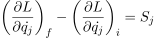
remains finite. Such forces are described as impulsive forces, and the integral over \Delta t is known as the impulse of the force. Show that if impulsive forces are present Lagrange’s equations may be transformed into

\bigg( \displaystyle{\frac{\partial \mathcal{L}}{\partial \dot{q}_j}} \bigg)_f-\bigg( \displaystyle{\frac{\partial \mathcal{L}}{\partial \dot{q}_j}} \bigg)_i=S_j,

where the subscripts i and f refer to the state of the system before and after the impulse, S_j is the impulse of the generalized impulsive force corresponding to q_j, and \mathcal{L} is the Lagrangian including all the non-impulsive forces.


Solution.

This solution is not mine. It was found on the Internet some years ago, to whose author(s) I lost references.

For billiard-balls collision, the Euler-Lagrange (E-L) equation is

\displaystyle{\frac{\mathrm{d}}{\mathrm{d}t}}\bigg( \frac{\partial L}{\partial \dot{q_j}}\bigg)-\bigg( \frac{\partial L}{\partial q_j}\bigg)=Q_j,

where Q_j is the generalised impulsive force corresponding to q_j and not derivable from the potential.

Taking integral over \Delta t on both sides,

LHS becomes

\displaystyle{\int_{\Delta t}\frac{\displaystyle{\mathrm{d}\bigg( \frac{\partial L}{\partial \dot{q_j}}\bigg)}}{\mathrm{d}t}\,\mathrm{d}t}-\int_{\Delta t}\bigg( \frac{\partial L}{\partial q_j}\bigg) \,\mathrm{d}t.

The second term upon integration is zero,

because \displaystyle{\bigg( \frac{\partial L}{\partial q_j}}\bigg) \Delta t=0 for infinitesimal time \Delta t\to 0.

The first term is

\displaystyle{\int_{\Delta t}\mathrm{d}\bigg( \frac{\partial L}{\partial \dot{q_j}} \bigg)}=\bigg[ \frac{\partial L}{\partial \dot{q_j}}\bigg]^{t+\Delta t}_{t}.

Rename t+\Delta t the (final) state of system f after the impulse and t the (initial) state of system i before the impulse.

LHS reads

\displaystyle{\bigg( \frac{\partial L}{\partial \dot{q_j}}\bigg)_f}-\bigg( \frac{\partial L}{\partial \dot{q_j}}\bigg)_i

whereas RHS reads

\displaystyle{\int_{\Delta t}Q_j \,\mathrm{d}t=S_j},

i.e., the impulse of generalised impulsive force.

The transformed E-L equation in the presence of impulsive forces is

\displaystyle{\bigg( \frac{\partial L}{\partial \dot{q_j}}\bigg)_f}-\bigg( \frac{\partial L}{\partial \dot{q_j}}\bigg)_i=S_j,

as desired.

201902200839 Exercise 5 Chapter 2

A particle is subjected to the potential V(x)=-Fx, where F is a constant. The particle travels from x=0 to x=a in a time interval t_0. Assume the motion of the particle can be expressed in the form x(t)=A+Bt+Ct^2. Find the values of A, B, and C such that the action is a minimum.


Solution.

The solution is not mine. It was found on the Internet some years ago, to whose author(s) I lost references.

1D-case:

\mathcal{L}=T-V=\displaystyle{\frac{1}{2}}m\dot{x}^2+Fx.

Euler-Lagrange (E-L) equation:

\displaystyle{\frac{\mathrm{d}}{\mathrm{d}t}}\bigg( \displaystyle{\frac{\partial \mathcal{L}}{\partial \dot{x}}}\bigg) =\frac{\partial \mathcal{L}}{\partial x}

gives the path over which the action is stationary.

That is,

\begin{aligned} \displaystyle{\frac{\mathrm{d}}{\mathrm{d}t}}( m\dot{x}) & = F \\  \Rightarrow \ddot{x} & =\displaystyle{\frac{F}{m}}\\ \end{aligned}.

On x(t)=A+Bt+Ct^2 taking derivative twice,

\ddot{x}(t)=2C.

Equate them,

C=\displaystyle{\frac{F}{2m}}.

The event (x=0,t=0) gives

A=0.

And the event (x=a,t=t_0) gives

a=x(t_0)=Bt_0+\displaystyle{\frac{F}{2m}}t_0^2.

Express it as

B=\displaystyle{\frac{a-\frac{F}{2m}t_0^2}{t_0}}.

Thus,

x(t)=(0)+\Bigg( \displaystyle{\frac{a-\frac{F}{2m}t_0^2}{t_0}}\Bigg) t+\bigg( \displaystyle{\frac{F}{2m}}\bigg) t^2

is recovered.

201902200829 Derivation 2.3

Prove that the shortest distance between two points in space is a straight line.


Solution.

This solution is not mine. It was found on the Internet some years ago, to whose author(s) I lost references.

Assume the path (of any curve C) connecting two points (a,y(a)) and (b,y(b)) is given by a function C(x)=(x,y(x)), with \displaystyle{\frac{\mathrm{d}}{\mathrm{d}x}}C(x)=(1,y') being the first derivative of the curve.

To minimise the path distance

\displaystyle{\mathcal{L}=\int \| C'\| \,\mathrm{d}x=\int_a^b\sqrt{1+y'^2}\,\mathrm{d}x},

define now

f(x,y,y')=\sqrt{1+y'^2},

having \displaystyle{\frac{\mathrm{d}f}{\mathrm{d}y}}=0 and \displaystyle{\frac{\mathrm{d}f}{\mathrm{d}y'}}=\frac{y'}{\sqrt{1+y'^2}}.

From Euler-Lagrange (E-L) equation it follows that

\displaystyle{\frac{\mathrm{d}}{\mathrm{d}x}}\bigg( \displaystyle{\frac{y'}{\sqrt{1+y'^2}}}\bigg) =0,

i.e., y'=\mathrm{Const.}

In conclusion, the shortest distance between two points in space is a straight line.


Lemma. (Fundamental lemma of the calculus of variations)

If \displaystyle{\int_{x_1}^{x_2}M(x)\eta (x)\,\mathrm{d}x=0} for any \eta (x) continuous through second derivative, then M(x) must identically vanish in the interval x_1,x_2.

Text on pg.38, Goldstein