202202071039 Dynamics Figures (Elementary) Q2

The ends of a rope are fastened at separate but horizontal points on a ceiling. A 10\,\mathrm{lb} weight is hung from the rope such that the two segments of the rope make angles of 30^\circ and 45^\circ with the ceiling. Compute the tension in each segment of the rope.

Extracted from R. L. Gray. (1973). Physics Problems: Mechanics and Heat.


Solution.

Draw a free-body diagram below:

Separating the vertical and the horizontal component:

\begin{aligned} T_1\cos 45^\circ + T_2\cos 60^\circ & = W \\ T_1\sin 45^\circ & = T_2\sin 60^\circ \\ \end{aligned}

we have two equations with two unknowns (i.e., T_1 and T_2).

The rest is left the reader as an exercise.

202202070828 Dynamics Figures (Elementary) Q1

As shown in the sketch above, a mass m is suspended from a string of length L. Gravity \mathbf{g} is acting downward in the diagram. A second string exerts a horizontal force \mathbf{F} such that m is in equilibrium at a horizontal distance x.

(a) Draw a diagram showing all forces acting on m.

(b) What is the tension in the suspension string? Give both direction and magnitude.

Extracted from R. L. Gray. (1973). Physics Problems: Mechanics and Heat.


Solution.

(a) The free body diagram is shown below:

(b) Obviously,

\begin{aligned} \mathbf{T} & =F\,\hat{\mathbf{i}}+mg\,\hat{\mathbf{j}} \\ T & =|\mathbf{T}|=\sqrt{(F)^2+(mg)^2} \\ \end{aligned}.

Or, in an old-school way, we have horizontally

F=T\cos\theta

and vertically

mg=T\sin\theta,

squaring and summing up the equations,

\begin{aligned} (F)^2+(mg)^2 & =(T\cos\theta )^2+(T\sin\theta )^2 \\ F^2+m^2g^2 & = T^2(\cos^2\theta +\sin^2\theta ) \\ F^2+m^2g^2 & = T^2 \\ T & = \sqrt{F^2+m^2g^2} \\ \end{aligned}

Dividing the equation of the vertical by the horizontal,

\begin{aligned} \frac{mg}{F} & = \frac{T\sin\theta}{T\cos\theta} \\ \frac{mg}{F} & = \tan\theta \\ \theta & = \tan^{-1}\bigg(\frac{mg}{F}\bigg) \\ \end{aligned}

the direction of tension makes an angle \theta =\tan^{-1}(\frac{mg}{F}) with the level.

202201211321 Problem 1.1

Two particles move along the x-axis uniformly with speeds v_1=8\,\mathrm{m/s} and v_2=4\,\mathrm{m/s}. At the initial moment the first point was 21\,\mathrm{m} to the left of the origin and the second 7\,\mathrm{m} to the right of the origin. When will the first point catch up with the second? Where will this take place? Plot the graph of the motion.

Extracted from A. A. Pinsky. (1980). Problems in Physics.


Set-up.

Rename the two particles by a and b. The velocity of particle a is \mathbf{v}_a=+8\,\mathrm{(m\, s^{-1})}\enspace\hat{\mathbf{i}} and that of particle b is \mathbf{v}_b=+4\,\mathrm{(m\, s^{-1})}\enspace\hat{\mathbf{i}}. The particles at time t=0 are located on the x-axis with x-coordinates x_a=-21 and x_b=+7 respectively.


Roughwork.

When t=0:

when t=1:

when t=2:

when t=3:

when t=4:

when t=5:

when t=6:

when t=7:


Solution.

The positions x_a(t), x_b(t) of particle a, b can be expressed in a function of discrete time interval

t=\{ t_i\in\mathbb{Z^{+}}\textrm{ s.t. } t_{i+1}-t_{i}=t_{i}-t_{i-1}=1\},

i.e.,

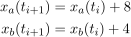
\begin{aligned} x_a(t_{i+1}) & =x_a(t_{i})+8 \\ x_b(t_{i+1}) & =x_b(t_{i})+4 \\ \end{aligned}

or simply, in continuous time intervals,

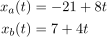
\begin{aligned} x_a(t) & =-21+8t \\ x_b(t) & = 7+4t \\ \end{aligned}

Particle a will meet particle b when x_a(t)=x_b(t) at some time t', as

\begin{aligned} x_a(t') & = x_b(t') \\ -21+8t' & = 7+4t' \\ 4t' & = 28 \\ t' & = 7 \\ \end{aligned}

so the place of meeting is

x_a(7)=-21+8(7)=\boxed{35}=7+4(7)=x_b(7).

202112100933 Kinematics graphs (Elementary) Q2

This post is depreciated as it is misleading the reader about the speed of train.

The number 038 should be the “mission order” of the train which indicates to stationed staff of its running railway, service time, and need of assistance if any (MTR Academy, 2017).


An MTR train enters the station at a speed of 38 kilometres an hour, i.e., 38\,\mathrm{km/h}.

Retrieved image from http://mtr.hk365day.com/

If the subway is 100\,\mathrm{m} long and the train terminates at the stop with constant deceleration, i.e., \mathbf{a}=-a\,\hat{\mathbf{i}}\quad (a=\textrm{Const.}>0),

Modified figures retrieved from https://www.shutterstock.com/

what is the time required for the train to come to a full stop?


Background. (Equations of linear motion in uniform acceleration)

\begin{cases} \enspace & v = u + at \\ \enspace & s = \displaystyle{\frac{(u+v)}{2}t} \\ \enspace & s = \displaystyle{ut+\frac{1}{2}at^2} \\ \enspace & v^2 = u^2 + 2as \\ \end{cases}


Solution.

Take the rightward to be positive direction.

Provided that the initial velocity \mathbf{u} is

\begin{aligned} \mathbf{u} & =+38\,(\mathrm{km\, h^{-1}})\,\hat{\mathbf{i}} \\ & = +38\times\frac{1000}{60\times 60}\,(\mathrm{m\, s^{-1}})\,\hat{\mathbf{i}} \\ & = +10.5556\,(\mathrm{m\, s^{-1}})\,\hat{\mathbf{i}}\quad (4\,\mathrm{d.p.}) \\ \end{aligned}

the final velocity \mathbf{v} is

\mathbf{0}, or simply put, 0;

and the displacement \mathbf{s} for the duration is

\begin{aligned} \mathbf{s} & =s\,\hat{\mathbf{i}} \\ & =+100\,\hat{\mathbf{i}}\\ \end{aligned},

so, out of five variables:

a, s, t, u, and v,

we already know three exactly:

\mathbf{s} (of magnitude s);
\mathbf{u} (of magnitude u);
\mathbf{v} (of magnitude v).

If the first step were to solve for only one unknown in the equations of motion i iv below,

i. v=u+at is \textrm{\scriptsize{NOT}} solvable for there are two unknowns a and t;

ii. s=\frac{(u+v)}{2}t solvable for there is \textrm{\scriptsize{ONLY}} one unknown t;

iii. s=ut+\frac{1}{2}at^2 \textrm{\scriptsize{NOT}} solvable for there are two unknowns a and t;

iv. v^2=u^2+2as solvable for there is \textrm{\scriptsize{ONLY}} one unknown a.

thus, we should pick equation ii. to calculate the unknown t.

That said, solving for time t,

\begin{aligned} s & = \frac{(u+v)}{2}t \\ 100 & = \frac{(10.5556+0)}{2}t \\ t & = 18.9\,\mathrm{s}\quad \textrm{(3 s.f.)} \\ \end{aligned}


Afterword.

\dagger If you wish to know about the rate of deceleration -a, you can use equation iv., yet this is left the reader.

\ddagger The time t might seem longer than expected, because normally the deceleration of train is non-constant.

202112031054 Kinematics graphs (Elementary) Q1

The graph below illustrates three paths in Red (R), Green (G), and Blue (B).

For a person walking along paths R, G, and B at a constant speed 2\,\mathrm{m\, s^{-1}}, find, in each path,

(a) the distance travelled;
(b) the time needed from start to finish; and
(c) the displacement and velocity on the journey.


Solution.

(a)

Along path R, the walking distance d is

\begin{aligned} \textrm{Distance }d & = \bigg(\frac{1}{2}\bigg) \big(\pi (90-50)\big) + \bigg(\frac{1}{2}\bigg) \big( \pi (50-30)\big) \\ & = \bigg(\frac{1}{2}\bigg) (40\pi ) + \bigg(\frac{1}{2}\bigg) (20\pi ) \\ & = 20\pi + 10\pi \\ & = 30\pi\,\mathrm{m} \\ \end{aligned}

Along path G, the walking distance d is

\begin{aligned} \textrm{Distance }d & = \sqrt{(30-0)^2+(60-20)^2} + \sqrt{(30-0)^2+(100-60)^2} \\ & = \sqrt{900+1600} + \sqrt{900+1600} \\ & = \sqrt{2500} + \sqrt{2500} \\ & = 50+50 \\ & = 100\,\mathrm{m} \end{aligned}

Along path B, the walking distance d is

\begin{aligned} \textrm{Distance }d & = (20-0) + (20-0) + (50-20) + (50-20) \\ & \qquad\quad + (100-50) + (100-50) \\ & = 20+20+30+30+50+50 \\ & = 200\,\mathrm{m} \\ \end{aligned}

(b)

Along path R, the time t needed is

\begin{aligned} \textrm{Time }t & = \frac{30\pi\,\mathrm{m}}{2\,\mathrm{m\, s^{-1}}} \\ & = 47.1\,\mathrm{s}\\ \end{aligned}

Along path G, the time t needed is

\begin{aligned} \textrm{Time }t & = \frac{100\,\mathrm{m}}{2\,\mathrm{m\, s^{-1}}} \\ & = 50\,\mathrm{s}\\ \end{aligned}

Along path B, the time t needed is

\begin{aligned} \textrm{Time }t & = \frac{200\,\mathrm{m}}{2\,\mathrm{m\, s^{-1}}} \\ & = 100\,\mathrm{s}\\ \end{aligned}

(c)

Read the following graph, and you shall see each and every displacement in dashed lines.

For path R, the displacement \mathbf{s} travelled is

\begin{aligned} \textrm{Displacement }\mathbf{s} & = - s\,\hat{\mathbf{i}} \\ & = - (90-30)\,\hat{\mathbf{i}} \\ & = - 60\,\mathrm{m}\,\hat{\mathbf{i}} \\ \end{aligned}

and the velocity \mathbf{v} is

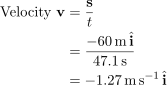
\begin{aligned} \textrm{Velocity }\mathbf{v} & = \frac{\mathbf{s}}{t} \\ & = \frac{- 60\,\mathrm{m}\,\hat{\mathbf{i}}}{47.1\,\mathrm{s}} \\ & = -1.27\,\mathrm{m\, s^{-1}}\,\hat{\mathbf{i}} \\ \end{aligned}

For path G, the displacement \mathbf{s} travelled is

\begin{aligned} \textrm{Displacement }\mathbf{s} & = s\,\hat{\mathbf{j}} \\ & = (100-20)\,\hat{\mathbf{j}} \\ & = 80\,\mathrm{m}\,\hat{\mathbf{j}} \\ \end{aligned}

and the velocity \mathbf{v} is

\begin{aligned} \textrm{Velocity }\mathbf{v} & = \frac{\mathbf{s}}{t} \\ & = \frac{80\,\mathrm{m}\,\hat{\mathbf{j}}}{50\,\mathrm{s}} \\ & = +1.6\,\mathrm{m\, s^{-1}}\,\hat{\mathbf{j}} \\ \end{aligned}

For path B, the displacement \mathbf{s} travelled is

\begin{aligned} \textrm{Displacement }\mathbf{s} & = 100\,\mathrm{m}\,\hat{\mathbf{i}} + 100\,\mathrm{m}\,\hat{\mathbf{j}} \\ \end{aligned}

or, the magnitude s of displacement \mathbf{s} is

\begin{aligned} s & = \sqrt{(100)^2+(100)^2} \\ & = 100\sqrt{2}\,\mathrm{m} \\ \end{aligned}

such that

\mathbf{s} = s\cos 45^\circ\,\hat{\mathbf{i}} + s\sin 45^\circ\,\hat{\mathbf{j}}

the velocity \mathbf{v} is

\begin{aligned} \textrm{Velocity }\mathbf{v} & = \frac{\mathbf{s}}{t} \\ & = \frac{100\,\mathrm{m}\,\hat{\mathbf{i}} + 100\,\mathrm{m}\,\hat{\mathbf{j}}}{100\,\mathrm{s}} \\ & = +1\,\mathrm{m\, s^{-1}}\,\hat{\mathbf{i}} + 1\,\mathrm{m\, s^{-1}}\,\hat{\mathbf{j}}\\ \end{aligned}

202112021037 Exercise 1.4 Lagrangian actions

For a free particle an appropriate Lagrangian is

Eq. (1.8):

\mathcal{L}(t,x,v)=\displaystyle{\frac{1}{2}mv^2}.

Suppose that x is the constant-velocity straight-line path of a free particle, such that x_a=x(t_a) and x_b=x(t_b). Show that the action on the solution path is

Eq. (1.9):

\displaystyle{\frac{m}{2}\frac{(x_b-x_a)^2}{t_b-t_a}}.

Extracted from Structure and Interpretation of Classical Mechanics, SICP, 2e


Background. (Lagrangians and Lagrangian actions)

The function \mathcal{L} is called a Lagrangian for the system, and the resulting action,

Eq. (1.4):

S[q](t_1,t_2)=\displaystyle{\int_{t_1}^{t_2}\mathcal{L}\circ\Gamma [q]},

is called the Lagrangian action. For Lagrangians that depend only on time, positions, and velocities the action can also be written

Eq. (1.5):

S[q](t_1,t_2)=\displaystyle{\int_{t_1}^{t_2}\mathcal{L}(t,q(t),\mathrm{D}q(t))\,\mathrm{d}t}.

(Section 1.3 The Principle of Stationary Action)


Working. (roughly)

\begin{aligned} S & = \int_{t_a}^{t_b}\frac{1}{2}mv^2\,\mathrm{d}t \\ & = \frac{m}{2}\int_{t_a}^{t_b}(\mathbf{v}\cdot\mathbf{v})\,\mathrm{d}t \\ & = \frac{m}{2}\int_{t_a}^{t_b}\bigg( \frac{\mathrm{d}\mathbf{x}}{\mathrm{d}t}\cdot\frac{\mathrm{d}\mathbf{x}}{\mathrm{d}t}\bigg) \,\mathrm{d}t \\ & = \frac{m}{2}\int_{x_a,t_a}^{x_b,t_b}\frac{(\mathrm{d}x)^2}{(\mathrm{d}t)} \\ & = \frac{m}{2}\frac{(x_b-x_a)^2}{t_b-t_a} \\ \end{aligned}

202104160754 Homework 1 (Q3)

A ship A, which can sail at a constant speed 60\,\mathrm{km/hr} to meet a second ship B which is 100\,\mathrm{km} away in the direction of \mathrm{S60^\circ W} and is sailing due east at constant speed 30\,\mathrm{km/hr}. Find the sailing direction of A and the time required to meet B.


Solution.

(The solution below is based on the manuscript of 2014-2015 PHYS1250 Fundamental Physics Homework Solutions.)

Draw a diagram as follows:


Setup.

\begin{aligned} v_A & = |\mathbf{v}_A| \\ v_B & = |\mathbf{v}_B| \\ \mathbf{v}_{AB} & = \mathbf{v}_A - \mathbf{v}_B \\ v_{AB} & = |\mathbf{v}_{AB}|= |\mathbf{v}_A - \mathbf{v}_B| \end{aligned}


By the law of sines,

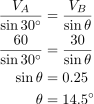
\begin{aligned} \frac{V_A}{\sin 30^\circ} & = \frac{V_B}{\sin\theta} \\ \frac{60}{\sin 30^\circ} & = \frac{30}{\sin\theta} \\ \sin\theta & = 0.25 \\ \theta & = 14.5^\circ \end{aligned}

Direction of \mathbf{v}_A: \mathrm{S45.5^\circ W}


\because 180^\circ -30^\circ -14.5^\circ - 90^\circ = 45.5^\circ


Calculating v_{AB}:

\begin{aligned} |\mathbf{v}_{AB}| & = |\mathbf{v}_{A}|\cos\theta + |\mathbf{v}_{B}|\cos 30^\circ \\ & = 60 \cos 14.5^\circ + 30\cos 30^\circ \\ & = 84.1\,\mathrm{km/hr} \end{aligned}

The time needed to meet ship B is

\begin{aligned} t & = \frac{100\,\mathrm{km}}{|\mathbf{v}_{AB}|} \\ & = \frac{100\,\mathrm{km}}{84.1\,\mathrm{km/hr}} \\ & = 1.19\,\mathrm{hr} \end{aligned}

202104160620 Homework 1 (Q4)

A particle is projected from a point O on the horizontal floor. The range of the projectile is R and the maximum height that the particle can reach is h. Show that the equation of trajectory of the particle is

\displaystyle{\frac{y}{h}=\frac{4x}{R}\bigg( 1-\frac{x}{R}\bigg)}.


Solution.

(The solution below is based on the manuscript of 2014-2015 PHYS1250 Fundamental Physics Homework Solutions.)

The trajectory of projectile motion must be a parabola, which can be expressed in the form of a quadratic equation:

y=ax^2+bx+c;

And since the particle passes through the points (0,0) and (R,0), the equation of trajectory can be expressed in the form:

y=A(x-0)(x-R).

When the particle has traveled a horizontal distance x=\displaystyle{\frac{R}{2}}, it reaches the maximum height y=h.

Inserting the point (\frac{R}{2},h) into the trajectory equation, we solve for the unknown A:

\begin{aligned} h & = A\bigg(\frac{R}{2}-0\bigg)\bigg(\frac{R}{2}-R\bigg) \\ h & = -\frac{AR^2}{4} \\ \Rightarrow \qquad A & = -\frac{4h}{R^2} \end{aligned}

Thus,

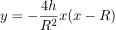
y = -\displaystyle{\frac{4h}{R^2}}x(x-R),

or,

\boxed{\frac{y}{h} = \frac{4x}{R}\bigg( 1-\frac{x}{R}\bigg)}

202104150814 Homework 1 (Q2)

A particle is thrown with speed v_0 and an elevated angle \theta on the floor. The air resistance is negligible.

(a) During the flight, the following quantities are investigated. Determine whether the following items are constants.

i. \displaystyle{\frac{\mathrm{d}v}{\mathrm{d}t}}, where v is the speed of the particle.

ii. \displaystyle{\frac{\mathrm{d}\mathbf{v}}{\mathrm{d}t}}, where \mathbf{v} is the velocity of the particle.

(b) What is the radius of curvature of the path when the particle reaches the highest point?


Answer.

(The solution below is based on the manuscript of 2014-2015 PHYS1250 Fundamental Physics Homework Solutions.)

(a)

i. \displaystyle{\frac{\mathrm{d}v}{\mathrm{d}t}} varies with time.

ii. \displaystyle{\frac{\mathrm{d}\mathbf{v}}{\mathrm{d}t}}=\mathbf{a}=\mathbf{g}=\textrm{Const.}


Explanation.

\begin{aligned} \mathbf{v} & =v_x\,\hat{\mathbf{i}}+v_y\,\hat{\mathbf{j}} \\ & = v_0\cos\theta\,\hat{\mathbf{i}}+\big(v_0\sin\theta -gt\big)\,\hat{\mathbf{j}}\\ v & = |\mathbf{v}| \\ & = \sqrt{(v_0\cos\theta )^2+(v_0\sin\theta -gt)^2} \\ & = \sqrt{v_0^2-2gtv_0\sin\theta +g^2t^2}\\ \frac{\mathrm{d}\mathbf{v}}{\mathrm{d}t} & = \bigg( \frac{\mathrm{d}}{\mathrm{d}t}(v_0\cos\theta ) \bigg)\,\hat{\mathbf{i}} + \bigg(\frac{\mathrm{d}}{\mathrm{d}t}(v_0\sin\theta -gt)\bigg)\,\hat{\mathbf{j}}\\ & = -g\,\hat{\mathbf{j}}\\ & = \mathbf{g} \\ \frac{\mathrm{d}v}{\mathrm{d}t} & = \bigg( \sqrt{v_0^2-2gtv_0\sin\theta +g^2t^2}\bigg)'\\ & = \frac{1}{2}\Big( \sqrt{v_0^2-2gtv_0\sin\theta +g^2t^2}\Big)^{-1} \cdot (-2gv_0\sin\theta + 2g^2t)\\ & \propto t \end{aligned}


(b)

\begin{aligned} a=\frac{v^2}{r} & \Rightarrow g=\frac{v_0^2\cos^2\theta}{r} \\ & \Rightarrow r=\frac{v_0^2\cos^2\theta}{g} \end{aligned}

202104150729 Homework 1 (Q1)

A man starts from the origin and walks 30\,\mathrm{m} due east in 25\,\mathrm{s}. Then, he walks 10\,\mathrm{m} due south in 10\,\mathrm{s} and 18\,\mathrm{m} due northwest in 15\,\mathrm{s}. Please take the paths due east and due north as the positive x and y directions respectively in the Cartesian plane.

(a) Sketch the man’s path on the Cartesian plane.

(b) What is the average velocity of the man?

(c) What is the average speed of the man?


Solution.

(The solution below is based on the manuscript of 2014-2015 PHYS1250 Fundamental Physics Homework Solutions.)

(a)

(b) The average velocity of the man is

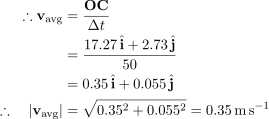
\begin{aligned} \mathbf{OC} & = \mathbf{OA} + \mathbf{AB} + \mathbf{BC} \\ & = 30\,\hat{\mathbf{i}} - 10\,\hat{\mathbf{j}} + 18\bigg( -\frac{1}{\sqrt{2}}\,\hat{\mathbf{i}} + \frac{1}{\sqrt{2}}\,\hat{\mathbf{j}} \bigg) \\ & = \bigg( 30-\frac{18}{\sqrt{2}} \bigg) \hat{\mathbf{i}} + \bigg( \frac{18}{\sqrt{2}}-10 \bigg) \,\hat{\mathbf{j}}\\ & = 17.27\,\hat{\mathbf{i}} + 2.73\,\hat{\mathbf{j}} \end{aligned}

\begin{aligned} \therefore \mathbf{v}_{\textrm{avg}}& =\frac{\mathbf{OC}}{\Delta t} \\ & = \frac{17.27\,\hat{\mathbf{i}} + 2.73\,\hat{\mathbf{j}}}{50} \\ & = 0.35\,\hat{\mathbf{i}} + 0.055\,\hat{\mathbf{j}} \\ \therefore\quad |\mathbf{v}_{\textrm{avg}}| & = \sqrt{0.35^2+0.055^2} = 0.35\,\mathrm{m\, s^{-1}} \end{aligned}

Direction of \mathbf{v}_{\textrm{avg}}:

\begin{aligned} \tan\theta & = \frac{0.055}{0.35}=0.16 \\ \theta & = 8.9^\circ \end{aligned}

(c) The average speed of the man is

\begin{aligned} v_{\textrm{avg}} & = \frac{OA+AB+BC}{\Delta t} \\ & = \frac{30+10+18}{50} \\ & = 1.16\,\mathrm{m\,s^{-1}} \end{aligned}