202301101150 Solution to 1999-IBHL-PHY-I-7

Two 10\,\mathrm{kg} blocks on a smooth horizontal surface are tied together. They are accelerated by a horizontal force of 30\,\mathrm{N} which acts as shown below:

If frictional effects are negligible, what is the tension in the connecting rope?


Roughwork.

As always start with free-body diagrams. Take rightward positive. Considering first the bodies as a whole:

so as to write the equation of motion by Newton 2nd law:

\begin{aligned} F_{\textrm{net}} & =ma \\ 30 & = 20a\\ a & = 1.5\,\mathrm{m\,s^{-2}} \\ \end{aligned}

where the tension regarded as internal force does not count. Considering then as individuals,

so as to write:

\begin{aligned} F_{\textrm{net}} & =ma \\ 30 - T & = (10)(1.5)\\ T & = 15\,\mathrm{N} \\ \end{aligned}

One may also do with the left block, but an exercise left the reader.

202212281204 Solution to 2015-DSE-PHY-IA-5

A constant net force acting on an object of mass m_1 produces an acceleration a_1 while the same force acting on another object of mass m_2 produces an acceleration a_2. If this net force acts on an object of mass (m_1+m_2), what would be the acceleration produced?


Roughwork.

Write

\begin{aligned} F_\textrm{net} & = m_1a_1 = m_2a_2 \\ & = (m_1+m_2)a_3 \\ \end{aligned}

Provided are four options. Let’s check them one by one.

A. a_3\stackrel{?}{=}a_1+a_2

\begin{aligned} (m_1+m_2)a_3 & = (m_1+m_2)(a_1+a_2) \\ & = (m_1a_1) + (m_2a_2) +m_1a_2+m_2a_1 \\ & = F_\textrm{net} + F_\textrm{net} +m_1a_2+m_2a_1 \\ & \gneq 2F_\textrm{net} \\ \therefore\enspace a_3 & \neq a_1+a_2 \\ \end{aligned}

B. a_3\stackrel{?}{=}\displaystyle{\frac{a_1+a_2}{2}}

\begin{aligned} (m_1+m_2)a_3 & = (m_1+m_2)\bigg(\frac{a_1+a_2}{2}\bigg) \\ & \stackrel{\textrm{(A)}}{=} F_\textrm{net} + \frac{m_1a_2+m_2a_1}{2} \\ & \gneq F_\textrm{net} \\ \therefore\enspace a_3 & \neq \frac{a_1+a_2}{2} \\ \end{aligned}

C. a_3\stackrel{?}{=}\displaystyle{\frac{a_1a_2}{a_1+a_2}}

\begin{aligned} (m_1+m_2)a_3 & = (m_1+m_2)\bigg(\frac{a_1a_2}{a_1+a_2}\bigg) \\ & = \frac{(m_1a_1)a_2+(m_2a_2)a_1}{a_1+a_2} \\ & = \frac{(F_\textrm{net})(a_1+a_2)}{a_1+a_2} \\ & = F_\textrm{net} \\ \therefore\enspace a_3 & = \frac{a_1a_2}{a_1+a_2} \\ \end{aligned}

D. a_3\stackrel{?}{=}\displaystyle{\frac{2a_1a_2}{a_1+a_2}} is so not to check.

Try-and-err was slower if steadier paced than fright-but-fight from head start,

\begin{aligned} a_3 & = \frac{F_\textrm{net}}{m_1+m_2} \\ & = \bigg(\frac{m_1}{F_\textrm{net}}+\frac{m_2}{F_\textrm{net}}\bigg)^{-1} \\ & = \bigg(\frac{1}{a_1}+\frac{1}{a_2}\bigg)^{-1} \\ & = \bigg(\frac{a_1+a_2}{a_1a_2}\bigg)^{-1} \\ & = \frac{a_1a_2}{a_1+a_2} \\ \end{aligned}

And the answer is C.

This problem is not to be attempted.

202212051136 Solution to 1978-AL-AMATH-II-3

A smooth homogeneous hollow right circular cylinder with open, flat ends stands freely on smooth horizontal ground so that its axis is vertical. Two spheres A and B of radii a and b (a<b) and weights W_a and W_b respectively rest in equilibrium inside the cylinder as shown in the diagram. Suppose that the internal and external radii of the cylinder are c and d respectively, where c<(a+b).

i. Show that the vertical forces acting on the spheres reduce to a couple. Determine the moment of the couple.
ii. Determine the minimum weight of the cylinder such that it will not overturn.
iii. A third sphere C, identical to A, is then placed on top of B in contact with the cylinder. Determine the minimum weight of the cylinder so that it will not overturn for the two possible equilibrium positions of C.

You may assume that the cylinder is tall enough to hold all the spheres.


Roughwork.

WLOG reduce the problem from three-dimensional to two. Begin with three free-body diagrams as follow:

So many unknowns I don’t know how to get set.

(to be continued)

202212020955 Solution to 1978-HL-PHY-II-4

A rectangular loop of length 0.2\,\mathrm{m} and width 0.1\,\mathrm{m}, carrying a steady current I of 2\,\mathrm{A} is hinged along the y-axis, and is situated in a uniform magnetic field \mathbf{B} of 0.5\,\mathrm{T} parallel to the x-axis.

If the plane of the loop makes an angle of 60^\circ with the xy plane,

(a) calculate the force exerted by the magnetic field on each side of the loop, and
(b) calculate the torque required to hold the loop in this position.


Roughwork.

Force on a current-carrying conductor in a magnetic field is in magnitude

\boxed{F=BIl\sin\theta}

its direction to be determined by Fleming’s left hand rule.

(a) Have in mind a picture as viewing cross-sectionally:

and as down the top:

where

\begin{aligned} F_1 = F_3 & = (0.5)(2)(0.2)\sin 90^\circ \\ F_2 = F_4 & = (0.5)(2)(0.1)\sin 60^\circ \\ \end{aligned}

(b) This part is not to be attempted.

202212011713 Solution to 1974-HL-PHY-I-2

A uniform ladder 6\,\mathrm{m} long and weighing 390\,\mathrm{N} rests with one end on the rough ground and the other end against a smooth wall. The ladder makes an angle of 60^\circ with the ground, and the coefficient of friction between the ladder and ground is 0.8.

(a) Draw a diagram to indicate the forces acting on the ladder.
(b) How far can a man weighing 980\,\mathrm{N} go up the ladder before the ladder begins to slip?


Roughwork.

(a)

Taking moment about the lower end of the ladder:

\begin{aligned} \textrm{Torque}_\textrm{clockwise}\,(\tau_{\circlearrowright}) & = \textrm{Torque}_\textrm{anticlockwise}\,(\tau_{\circlearrowleft}) \\ (W\cos\theta )(d/2) & = (N_2\sin\theta )(d) \\ \end{aligned}

whereas about its upper tip:

\begin{aligned} (N_1\cos\theta )(d)  & =(W\cos\theta )(d/2) + (f\sin\theta )(d) \\ \end{aligned}

we have two equations.

(b)

This part is not to be attempted.

202211031053 Statics Figures (Elementary) Q2

87. A homogeneous chain (i.e., \rho =\textrm{Const.}) with a length l lies on a table. What is the maximum length l_1 of the part of the chain hanging over the table if the coefficient of friction between the chain and the table is k?

Extracted from B. Bukhovtsev et al. (1978). Problems in Elementary Physics.


Roughwork.

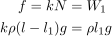
\begin{aligned} f = kN & = W_1 \\ k\rho (l-l_1)g & = \rho l_1g \\ \end{aligned}

Answer. \displaystyle{l_1=l\frac{k}{k+1}}.

202211021054 Dynamics Figures (Elementary) Q9

Referring to the figure below, the pulleys are assumed to be weightless and frictionless and the ropes massless and inextensible.

Prove that m_1=2m_2 if the system is in equilibrium. Find the equation of motion for each mass, i. if m_1>2m_2; and ii. if m_1<2m_2.


Roughwork.

In equilibrium,

\textrm{Net }\mathbf{F}=m\mathbf{a}=\mathbf{0}.

Thus

\begin{cases} W_1-2T =m_1(0) \\ W_2-T =m_2(0) \end{cases} \Longrightarrow\quad \begin{cases} m_1g =2T \\ m_2g =T \\ \end{cases}

\therefore m_1=2m_2.

Mass m_1 will move down and m_2 up if m_1>2m_2, and the reverse if m_1<2m_2. When m_1 makes displacement of \Delta h the vertical, m_2 makes 2\Delta h.

Without gain of speciality, one may obtain the equations of motion by either (a) Newton’s second law, or (b) conservation of mechanical energy, or (c) Euler-Lagrange method.

Take downward positive. When m_1>2m_2, in one’s mind one can draw two free-body diagrams giving two equations:

\begin{cases} W_1(=m_1g)-2T=m_1a_1\\ W_2(=m_2g)-T=-m_2a_2 \end{cases}

Hence,

\begin{cases} 2T = m_1(g-a_1) \\ T = m_2(g+a_2) \end{cases}

note that 2a_1=a_2. And so

\begin{aligned} a_1 & = \bigg( 1-\frac{6m_2}{m_1+4m_2}\bigg)\cdot g \\ a_2 & = \bigg( \frac{3m_1}{m_1+4m_2}-1\bigg)\cdot g \\ \end{aligned}

Note the inequalities 0\leqslant a_1\leqslant a_2<g. One can thus find tension in magnitude T, yet this is left the reader.

The Lagrangian \mathcal{L}=T-V of the system is

\mathcal{L}=\frac{1}{2}m_1v_1^2+\frac{1}{2}m_2v_2^2+m_1g\Delta h-2m_2g\Delta h,

or,

\mathcal{L}=\frac{1}{2}m_1\dot{x}^2+\frac{1}{2}m_2(\dot{2x})^2+m_1gx-2m_2gx.

where v_1=v_1(t) and v_2=v_2(t) vary with time t as are subjected to acceleration, and v_2=2v_1.

Euler-Lagrange equation reads

\displaystyle{\frac{\mathrm{d}}{\mathrm{d}t}\bigg(\frac{\partial \mathcal{L}}{\partial\dot{x}}\bigg)-\frac{\partial\mathcal{L}}{\partial x}=0}.

Computing term by term,

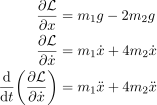
\begin{aligned} \frac{\partial \mathcal{L}}{\partial x} & = m_1g-2m_2g \\ \frac{\partial\mathcal{L}}{\partial \dot{x}} & = m_1\dot{x}+4m_2\dot{x} \\ \frac{\mathrm{d}}{\mathrm{d}t}\bigg(\frac{\partial\mathcal{L}}{\partial\dot{x}}\bigg) & = m_1\ddot{x}+4m_2\ddot{x} \\ \end{aligned}

and the result follows.

(to be continued)

202210261208 Dynamics Figures (Elementary) Q8

215. A cylindrical tube with a radius r is connected by means of spokes to two hoops with a radius R. The mass of both the hoops is M. The mass of the tube and the spokes in comparison with the mass M can be neglected. A string passed over a weightless pulley is wound around the tube. A weight with a mass m is attached to the end of the string.

Find the acceleration a=|\mathbf{a}| of the weight, the tension T=|\mathbf{T}| of the string and the force of friction f=|\mathbf{f}| acting between the hoops and the surface. (Assume that the hoops do not slip.) Also determine k the coefficient of friction at which the hoops will slip.

Extracted from B. Bukhovtsev et al. (1978). Problems In Elementary Physics.


Setup.

The kinetic energy T of the dumbbell M is in two parts, translational (/linear) and rotational (/angular), i.e.,
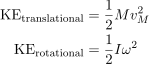
\begin{aligned} \textrm{KE}_{\textrm{translational}} & = \frac{1}{2}Mv_M^2 \\ \textrm{KE}_{\textrm{rotational}} & = \frac{1}{2}I\omega^2 \\ \end{aligned}

where the velocity of its centre of gravity (CG) is v_M, and its moment of inertia for discs I=MR^2. It has no potential energy V of its position h=0.

The kinetic energy T of the weight m is given by \textrm{KE}=\frac{1}{2}mv_m^2, and its potential energy V by \textrm{PE}=mgh.

The Lagrangian \mathcal{L} of a system is obtained from

\mathcal{L}=T-V,

whereby the Euler–Lagrange equation is given as

\displaystyle{\frac{\mathrm{d}}{\mathrm{d}t}\bigg(\frac{\partial\mathcal{L}}{\partial \dot{x}}\bigg)-\frac{\partial\mathcal{L}}{\partial x}=0}

Note the relationship between r, R, v_M, v_m, and \omega, i.e.,

\begin{aligned} v_m & = r\omega \\ v_M & = R\omega \\ \end{aligned}

Also beware that forces F of any kinds, e.g., weight \mathbf{W}=m\mathbf{g}, tension \mathbf{T}, normal reaction \mathbf{N}, and friction \mathbf{f}, have not been taken into consideration.


(to be continued)

202210251204 Dynamics Figures (Elementary) Q7

126. Two carts are pushed apart by an explosion of a powder charge Q placed between them. The cart weighing 100\,\mathrm{kg} travels a distance of 18 metres and stops. What distance will be covered by the other cart weighing 300\,\mathrm{kg}? The coefficients of friction k between the ground and the carts are the same.

Modified from B. Bukhovtsev et al. (1978). Problems In Elementary Physics.


First, have a picture in mind:

Applying the law of conservation of linear momentum at the instant of impact,

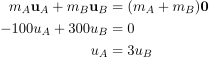
\begin{aligned} m_A\mathbf{u}_A+m_B\mathbf{u}_B & = (m_A+m_B)\mathbf{0} \\ -100u_A+300u_B & = 0 \\ u_A & = 3u_B \\ \end{aligned}

and the law of conservation of mechanical energy after then,

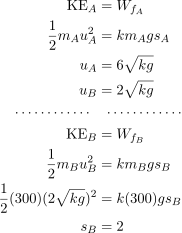
\begin{aligned} \textrm{KE}_A & = W_{f_A} \\ \frac{1}{2}m_Au_A^2 & = km_Ags_A \\ u_A & = 6\sqrt{kg} \\ u_B & = 2\sqrt{kg} \\ \cdots\cdots\cdots\cdots\enspace & \enspace\cdots\cdots\cdots\cdots \\ \textrm{KE}_B & = W_{f_B} \\ \frac{1}{2}m_Bu_B^2 & = km_Bgs_B \\ \frac{1}{2}(300)(2\sqrt{kg})^2 & = k(300)gs_B \\ s_B & = 2\\ \end{aligned}

\therefore The other cart will travel a distance of 2\,\mathrm{m}.

202209281521 Problem 5.37

A bead can slide without friction on a circular hoop of radius R in a vertical plane. The hoop rotates at a constant rate of \omega about a vertical diameter, as shown in the figure below.

(a) Find the angle \theta at which the bead is in vertical equilibrium. (Of course it has a radial acceleration toward the axis.)
(b) Is it possible for the bead to “ride” at the same elevation as the centre of the hoop?
(c) What will happen if the hoop rotates at a slower rate \omega' = \omega /2?

Modified from H. D. Young. (1989). University Physics.


Roughwork.

(a)

Kinetic energy T:

\begin{aligned} T & = \frac{1}{2}mv^2 \\ \dots\enspace v & = r\omega \enspace\dots \\ T & = \frac{1}{2}mr^2\omega^2 \\ \dots\enspace r & = R\sin\theta \enspace\dots \\ T & = \frac{1}{2}mR^2\omega^2\sin^2\theta \\ \end{aligned}

Potential energy V:

\begin{aligned} V & = mg(R-R\cos\theta ) \\ & = mgR(1-\cos\theta ) \\ \end{aligned}

Lagrangian \mathcal{L}=T-V:

\displaystyle{\mathcal{L}=\frac{1}{2}mR^2\omega^2\sin^2\theta-mgR(1-\cos\theta )}

Euler–Lagrange equation:

\displaystyle{\frac{\mathrm{d}}{\mathrm{d}t}\bigg(\frac{\partial\mathcal{L}}{\partial \dot{\theta}}\bigg)-\frac{\partial\mathcal{L}}{\partial \theta}=0}

Thereby

\begin{aligned} \frac{\partial\mathcal{L}}{\partial\dot{\theta}} & = 0 \quad \textrm{and}\quad \frac{\mathrm{d}}{\mathrm{d}t}\bigg(\frac{\partial\mathcal{L}}{\partial\dot{\theta}}\bigg) = 0 \\ \frac{\partial\mathcal{L}}{\partial\theta} & = mR^2\omega^2\sin\theta\cos\theta -mgR\sin\theta \\ \end{aligned}

The bead is in vertical equilibrium when:

mR^2\omega^2\sin\theta\cos\theta -mgR\sin\theta =0

solving for \theta then :

\begin{aligned} 0 & = (mR\sin\theta )(R\omega^2\cos\theta -g) \\ \theta & = 0\enspace\textrm{ (rej.)}\quad\textrm{\scriptsize{OR}}\quad \cos^{-1}\bigg(\frac{g}{R\omega^2}\bigg) \\ \end{aligned}

(b)

\theta\to 90^\circ iff R\omega^2\gg g.

(c) This is left as an exercise to the reader.