202310171238 Exercise 18.6.8

A particle moves along a straight line so that its distance (s) from a fixed point O on the line after t\,\mathrm{s} is given by

s=t^3-12t^2+45t.

Find the distances from O when the particle is momentarily at rest and the accelerations at these times.

Extracted from A. Godman & J. F. Talbert. (1973). Additional Mathematics Pure and Applied in SI units


Roughwork.

We give the direction to the right a positive sign.

By substituting t=0 for time, we found the original position of the particle to be at a distance:

\begin{aligned} s(t=0) & = |\mathbf{s}(0)| \\ & = |(0)^3-12(0)^2+45(0)\,\hat{\mathbf{i}}| \\ & = 0\,\mathrm{unit} \\ \end{aligned}

from point O, which shall be called the origin hence.

The instantaneous velocity being

\begin{aligned} \mathbf{v}(t)& =\lim_{\Delta t\to 0}\frac{\Delta \mathbf{s}}{\Delta t} \\ & = \frac{\mathrm{d}\mathbf{s}}{\mathrm{d}t} \\ & = \frac{\mathrm{d}}{\mathrm{d}t}(t^3-12t^2+45t)\,\hat{\mathbf{i}} \\ & = (3)t^{(3)-1} - 12(2)t^{(2)-1} + 45(1)t^{(1)-1} \\ & = 3t^2 -24t + 45\,\hat{\mathbf{i}} \\ \end{aligned}

the average velocity during time interval of t\in [0,t'] being

\begin{aligned} v_{\textrm{avg}}(t') & = \frac{s(t')}{t'} \\ & = \frac{(t')^3-12(t')^2+45(t')}{t'} \\ & = t'^2-12t'+45 \\ \end{aligned}

in magnitude; the instantaneous acceleration being

\begin{aligned} a(t) & = \bigg| \frac{\mathrm{d}^2}{\mathrm{d}t^2}(s(t))\,\hat{\mathbf{i}}\bigg| \\ & = \frac{\mathrm{d}}{\mathrm{d}t}\bigg(\frac{\mathrm{d}}{\mathrm{d}t}(t^3-12t^2+45t) \bigg) \\ & = \frac{\mathrm{d}}{\mathrm{d}t}(3t^2-24t+45) \\ & = 6t-24\\ \end{aligned}

in magnitude; the momentum being

\begin{aligned} p & =mv\\ & = m(3t^2 -24t + 45) \\ \end{aligned}

in magnitude; and the displacement

\begin{aligned} s(t) & = t^3-12t^2+45t \\ & = t(t-3)(t-15) \\ \end{aligned}

in magnitude; such that the particle is at the origin O when

t=\{ 0\}\cup\{ 3\}\cup \{ 15\}.

The particle is momentarily at rest when the direction of velocity changes signs, or the instant speed is v=\lVert \mathbf{v}\rVert = 0:

\begin{aligned} v(t) & = 3t^2-24t+45 \\ & = 3(t-5)(t-3) \\ \end{aligned}

such as t=\{ 3\}\cup\{ 5\} that the distances from O are respectively

\begin{aligned} s(3) & =(3)^3-12(3)^2+45(3) = 0 \\ s(5) & =(5)^3-12(5)^2+45(5) = 50 \\ \end{aligned}

and the accelerations at these times

\begin{aligned} \mathbf{a}(3) & =6(3)-24 = 6\,(-)\hat{\mathbf{i}} \\ \mathbf{a}(5) & =6(5)-24 = 6\,(+)\hat{\mathbf{i}} \\ \end{aligned}.


This problem is not to be attempted.

202307251108 Dynamics Figures (Elementary) Q10

On a wedge of slope \tan\theta with friction, a trolley has a composite mass (M+2m)\,\mathrm{kg} by counting M the mass of body and 2m the masses of its two wheels, each having moment of inertia I=\frac{1}{2}mr^2 for r the radius. The front wheel \text{}_{F} and the rear wheel \text{}_{R} are separated by a distance d.

Parallel to the plane,

F_{\textrm{net}}=W\sin\theta -f_{F}-f_{R} = (M+2m)a

perpendicular to the plane,

\begin{aligned} & \qquad \begin{cases} N_{F}+N_{R} =W\cos\theta \\ xN_F+(x+d)N_R =(x+\frac{d}{2}) W\cos\theta \\ \end{cases} \\ & \Longrightarrow N_F=N_R=\frac{1}{2}(W\cos\theta )\\ \end{aligned}

Note the coefficient of friction (COF) for the static \mu=\mu_\textrm{s} and the kinetic \mu=\mu_\textrm{k}. For each case,

v(t)\begin{cases} v=0 \\ v>0\textrm{ and }\frac{\mathrm{d}v}{\mathrm{d}t}=0 \\ v>0\textrm{ and }\frac{\mathrm{d}v}{\mathrm{d}t}>0 \\ \end{cases}

discuss it.


Roughwork.

For the system, the kinetic energy is

\begin{aligned} T & = \frac{1}{2}(M+2m)v^2+\frac{1}{2}I\omega^2\times 2 \\ & = \frac{1}{2}(M+2m)\dot{x}^2+\bigg(\frac{1}{2}mr^2\bigg)\bigg(\frac{v}{r}\bigg)^2 \\ & = \frac{1}{2}(M+2m)\dot{x}^2+\frac{1}{2}m\dot{x}^2 \\ & = \frac{1}{2}(M+3m)\dot{x}^2 \\ \end{aligned}

and the potential energy

V=-(M+2m)gx\sin\theta.

such that \mathcal{L}=T-V the Lagrangian is

\mathcal{L}(x,\dot{x})\displaystyle{=\frac{1}{2}(M+3m)\dot{x}^2+(M+2m)gx\sin\theta}

Recall Euler-Lagrange equation:

\displaystyle{\frac{\mathrm{d}}{\mathrm{d}t}\bigg(\frac{\partial \mathcal{L}}{\partial \dot{x}}\bigg) -\frac{\partial\mathcal{L}}{\partial x}=0}

Ignoring frictional dissipation (viz. nonsense), one will see

\ddot{x}=\displaystyle{\bigg(\frac{M+2m}{M+3m}\bigg)g\sin\theta}.

With a scalar dissipation function D(x,\dot{x}), the Euler-Lagrange equation reads

\displaystyle{\frac{\mathrm{d}}{\mathrm{d}t}\bigg(\frac{\partial\mathcal{L}}{\partial\dot{x}}\bigg)-\frac{\partial\mathcal{L}}{\partial x}=-\frac{\partial D}{\partial \dot{x}}}}

where D=\mu_\textrm{k}Nv shall answer.


(to be continued)

202305231027 Problem 8.21-22

In the figure below, two objects are connected by a string which is threaded through a pulley.

Using its weight, object 2 moves object 1 along a flat surface. The acceleration a of the two objects can be determined by the following formula

\displaystyle{a=\frac{m_2g-\mu m_1g}{m_1+m_2}}

where m_1 and m_2 are the masses of object 1 and object 2, respectively, in kilograms, g is the acceleration due to Earth’s gravity measured in \displaystyle{\frac{\mathrm{m}}{\mathrm{sec}^2}}, and \mu is a constant known as the coefficient of friction. Which of the following expresses \mu in terms of the other variables?

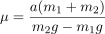
A. \displaystyle{\mu=\frac{a(m_1+m_2)}{m_1m_2g^2}}
B. \displaystyle{\mu=\frac{a(m_1+m_2)}{m_2g-m_1g}}
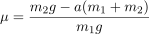
C. \displaystyle{\mu=\frac{m_2g-a(m_1+m_2)}{m_1g}}
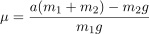
D. \displaystyle{\mu=\frac{a(m_1+m_2)-m_2g}{m_1g}}

If the masses of both object 1 and object 2 were doubled, how would the acceleration of the two objects be affected?

A. The acceleration would stay the same.
B. The acceleration would be halved.
C. The acceleration would be doubled.
D. The acceleration would be quadrupled (multipled by a factor of 4).

Extracted from Phu Nielson. (2015). SAT Math Advanced Guide and Workbook.


Roughwork.

First, begin with free-body diagrams:

Next, carry on by Newton’s 2nd law:

\mathbf{F}_{\mathrm{net}}=m\mathbf{a}

jotting positive the motion directing to,

\begin{aligned} (T-\mu m_1g)\,\hat{\mathbf{i}} & = m_1a\,\hat{\mathbf{i}} \\ (m_2g-T)\,\hat{\mathbf{j}} & = m_2a\,\hat{\mathbf{j}} \\ \end{aligned}

then writing Euler-Lagrange (E-L) equation with Rayleigh dissipation function \mathcal{F}:

\displaystyle{\frac{\mathrm{d}}{\mathrm{d}t}\bigg(\frac{\partial\mathcal{L}}{\partial\dot{x}}\bigg) -\frac{\partial\mathcal{L}}{\partial x} = -\frac{\partial\mathcal{F}}{\partial\dot{x}}}

where

\begin{aligned} \mathcal{L} & = T-V \\ T & = \frac{1}{2}(m_1+m_2)\dot{x}^2 \\ V & = m_2gx \\ \mathcal{F} & = k\dot{x}^2 \enspace (\leqslant \mu m_1g) \\ \end{aligned}

or by noting the undissipated Hamiltonian \mathcal{H}(\mathbf{p},\mathbf{q})=T+V as in:

\begin{aligned} \frac{\mathrm{d}\mathbf{q}}{\mathrm{d}t} & = \frac{\partial\mathcal{H}}{\partial\mathbf{p}} \\ \frac{\mathrm{d}\mathbf{p}}{\mathrm{d}t} & = -\frac{\partial\mathcal{H}}{\partial\mathbf{q}} \\ \end{aligned}

where though it is not uncommon for some few to despise differentiating with respect to vectors whom I hereby ignore.

\displaystyle{\mathcal{H}=\frac{p_1^2}{2m_1}+\frac{p_2^2}{2m_2}+m_2gq-\mu m_1gq}.


This problem is not to be attempted.

202302101153 Exercise 26.2

If required take g=9.8\,\mathrm{m\,s^{-2}}.

1. Two trucks, masses 30\,\mathrm{kg} and 20\,\mathrm{kg}, travelling at 6\,\mathrm{m\,s^{-1}} and 2\,\mathrm{m\,s^{-1}} respectively in the same direction, collide and continue together. Find the loss of KE due to the collision, and the percentage loss of energy.
2. Two masses, of 3\,\mathrm{kg} and 2\,\mathrm{kg}, move towards each other at speeds 2\,\mathrm{m\,s^{-1}} and 1\,\mathrm{m\,s^{-1}} respectively. After colliding they move together. Find the percentage loss of energy in the collision.
3. A force of 2\,\mathrm{N} is applied for 5\,\mathrm{s} to a mass of 2\,\mathrm{kg} resting on a smooth horizontal surface. The mass now collides with a second mass of 3\,\mathrm{kg} at rest, and they continue together. Find the common velocity and the loss of KE in the impact.

Extracted from A. Godman & J. F. Talbert. (1975). Additional Mathematics Pure and Applied in SI Units.


Roughwork.

1.

\begin{aligned} m_1u_1+m_2u_2 & = (m_1+m_2)v \\ (30)(6) + (20)(2) & = (30+20)v \\ v& = 4.4\,\mathrm{m\,s^{-1}}\\ \end{aligned}

\begin{aligned} \textrm{KE}_\textrm{initial} & = \frac{1}{2}(30)(6)^2 + \frac{1}{2}(20)(2)^2 = 580\,\mathrm{J} \\ \textrm{KE}_\textrm{final} & = \frac{1}{2}(30+20)(4.4)^2 = 484\,\mathrm{J}\\ \Delta\textrm{KE} & =  -96\,\mathrm{J}\\ \end{aligned}

2. Not to be attempted.

3.

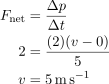
\begin{aligned} F_{\textrm{net}} & = \frac{\Delta p}{\Delta t} \\ 2 & = \frac{(2)(v-0)}{5} \\ v & = 5\,\mathrm{m\,s^{-1}} \\ \end{aligned}

\begin{aligned} m_1u_1+m_2u_2 & = (m_1+m_2)v \\ (2)(5)+(3)(0) & = (2+3)v \\ v & = 2\,\mathrm{m\,s^{-1}} \\ \end{aligned}

Not to be completed.

202302091224 Exercise 20.2

(All accelerations are to be taken as uniform and in a straight line.)

1. A particle starts with velocity 3\,\mathrm{m\,s^{-1}} and accelerates at 0.5\,\mathrm{m\,s^{-2}}. What is its velocity after i. 3\,\mathrm{s}, ii. 10\,\mathrm{s}, iii. t\,\mathrm{s}? How far has it travelled in these times?
2. A body, decelerating at 0.8\,\mathrm{m\,s^{-2}}, passes a certain point with a speed of 30\,\mathrm{m\,s^{-1}}. Find its velocity after 10\,\mathrm{s}, the distance covered in that time and how much further the body will go until it stops.
3. A particle travelling with acceleration of 0.75\,\mathrm{m\,s^{-2}} passes a point O with speed 5\,\mathrm{m\,s^{-1}}. How long will it take to cover a distance of 250\,\mathrm{m}? What will its speed be at that time?
4. If a particle passes a certain point with speed 5\,\mathrm{m/s} and is accelerating at 3\,\mathrm{m/s^{2}} how far will it travel in the next 2\,\mathrm{s}? How long will it take (from the start) to travel 44\,\mathrm{m}?
5. A body falls from rest with an acceleration of 10\,\mathrm{m\,s^{-2}}. What is its velocity 5\,\mathrm{s} afterwards? How far has it fallen by then?

Extracted from A. Godman & J. F. Talbert. (1975). Additional Mathematics Pure and Applied in SI Units.


Roughwork.

1.

\begin{aligned} v(t) & = u+at = 3 + 0.5t \\ v(3) & = 3+0.5(3) = 4.5\,\mathrm{m\,s^{-1}}\\ v(10) & = 3+0.5(10) = 8\,\mathrm{m\,s^{-1}} \\ \end{aligned}

\begin{aligned} s(t) & =ut+\frac{1}{2}at^2 = 3t+\frac{t^2}{4} \\ s(3) & = 3(3)+\frac{(3)^2}{4} = 11.25\,\mathrm{m}\\ s(10) & = 3(10)+\frac{(10)^2}{4} = 55\,\mathrm{m}\\ \end{aligned}

2.

Not to be attempted.

3.

\begin{aligned} s & = ut+\frac{1}{2}at^2 \\ (250) & = (5)t+\frac{1}{2}(0.75)t^2 \\ 0 & = 3t^2 + 40t - 2000 \\ 0 & = (3t+100)(t-20) \\ t & = 20\,\mathrm{s}\textrm{ \scriptsize{OR} }-\frac{100}{3}\,\mathrm{s}\textrm{ (rej.)} \\ \end{aligned}

\begin{aligned} v & = u+at \\ & = (5)+(0.75)(20) \\ & = 20\,\mathrm{m\,s^{-1}} \\ \end{aligned}

or,

\begin{aligned} v^2 & =u^2+2as \\ v & = \pm\sqrt{(5)^2+2(0.75)(250)} \\ & = 20\,\mathrm{m\,s^{-1}}\textrm{ \scriptsize{OR} }-20\,\mathrm{m\,s^{-1}}\textrm{ (rej.)} \\ \end{aligned}

4. Not to be attempted.

5. Not to be attempted.

202301161044 Exercise 3.5.12

A stone is thrown upwards with a velocity of u\,\mathrm{m\,s^{-1}} at the same instant that a stone is let fall from the top of a cliff immediately above the first stone. They meet after t\,\mathrm{s}. What is the height of the cliff?

Extracted from L. H. Clarke & F. G. J. Norton. (1972). Additional Applied Mathematics.


Roughwork.

Let the height of the cliff be H\,\mathrm{m}. Take upward positive, and the ground s=0 the reference level.

For the stone let fall, parametrize its trajectory:

\mathbf{s}\Big(t\in \Big[0,\sqrt{\frac{2H}{g}}\Big]\Big)=\displaystyle{\bigg(H-\frac{1}{2}gt^2\bigg)\,\hat{\mathbf{j}}},

and for the stone thrown upward, also:

\mathbf{s}\big(t\in \big[ 0,\frac{2u}{g}\big]\big)=\displaystyle{\bigg(ut-\frac{1}{2}gt^2\bigg)\,\hat{\mathbf{j}}}.

As the two stones meet at time t=t':

\begin{aligned} H-\frac{1}{2}gt'^2 & = ut'-\frac{1}{2}gt'^2 \\ H & = ut' \end{aligned}

This problem is not to be attempted.

202301130941 Solution to 2014-IBHL-PHY-I-5

Two blocks of weight 5\,\mathrm{N} and 2\,\mathrm{N} are attached to two ropes, \textrm{X} and \textrm{Y}.

The blocks hang vertically. The mass of the ropes is negligible. What is the tension in \textrm{X} and the tension in \textrm{Y}?


Roughwork.

As always start with free-body diagrams. Take upward positive. First the lower block:

Then the higher block:

Or alternatively,

Ans. \begin{cases} T_\textrm{X}=7\,\mathrm{N} \\ T_\textrm{Y}=2\,\mathrm{N} \\ \end{cases}

This problem is not to be attempted.

202301130918 Solution to 2011-IBHL-PHY-I-3

A skydiver of mass 80\,\mathrm{kg} falls vertically with a constant speed of 50\,\mathrm{m\,s^{-1}}. The upward force acting on the skydiver is approximately

A. 0\,\mathrm{N}.
B. 80\,\mathrm{N}.
C. 800\,\mathrm{N}.
D. 4000\,\mathrm{N}.


Roughwork.

As always start with a free-body diagram.

Take upward positive. Write the equation of motion by Newton’s 2nd law:

\begin{aligned} \mathbf{F}_{\textrm{net}} & = m\mathbf{a} \\ f-mg & = m(0) \\ f & = mg \\ & \approx (80)(10) \\ & = 800 \\ \end{aligned}

And the answer is C.

This problem is not to be attempted.

202301120908 Solution to 2002-IBHL-PHY-I-9

A pendulum has a bob of mass m and swings in the arc shown below.

As the bob swings through the lowest point of its motion, the tension in the string will be

A. zero.
B. less than mg.
C. equal to mg.
D. greater than mg.


Roughwork.

Assumed the string is l long, taut and inextensible.

Derivation. Read More

    \begin{aligned} T & = \frac{1}{2}ml^2\dot{\theta}^2 \\ V & = mgl(1-\cos\theta ) \\ \mathcal{L} & = T-V \\ \frac{\partial \mathcal{L}}{\partial\theta} & = -mgl\sin\theta \\ \frac{\partial \mathcal{L}}{\partial\dot{\theta}} &  = ml^2\dot{\theta} \\ 0 & =\frac{\mathrm{d}}{\mathrm{d}t}\bigg(\frac{\partial\mathcal{L}}{\partial \dot{\theta}}\bigg) - \frac{\partial\mathcal{L}}{\partial \theta} \\ \end{aligned}

    A simple pendulum, under gravity, has

    \textrm{EoM: }\qquad\displaystyle{\ddot{\theta}+\frac{g}{l}\cdot\sin\theta =0}

    the equation of motion, independent of mass m, neglecting friction.

    Lemma. (not in use) Read More

    \begin{aligned} \begin{bmatrix} \hat{\mathbf{e}}_r \\ \hat{\mathbf{e}}_\theta \end{bmatrix} & = \begin{bmatrix} \displaystyle{\frac{\partial x}{\partial r}} & \displaystyle{\frac{\partial y}{\partial r}} \\[2mm]\displaystyle{\frac{1}{r}\frac{\partial x}{\partial\theta}} & \displaystyle{\frac{1}{r}\frac{\partial y}{\partial\theta}} \end{bmatrix}\begin{bmatrix} \hat{\mathbf{e}}_x \\ \hat{\mathbf{e}}_y \end{bmatrix} \\ \begin{bmatrix} \hat{\mathbf{e}}_x \\ \hat{\mathbf{e}}_y \end{bmatrix} & = \begin{bmatrix} \displaystyle{\frac{1}{r}\frac{\partial y}{\partial \theta}} & \displaystyle{-\frac{\partial y}{\partial r}} \\[2mm]\displaystyle{-\frac{1}{r}\frac{\partial x}{\partial\theta}} & \displaystyle{\frac{\partial x}{\partial r}} \end{bmatrix} \begin{bmatrix} \hat{\mathbf{e}}_r \\ \hat{\mathbf{e}}_\theta \end{bmatrix} \\ \end{aligned}

    The net force for this non-uniform circular motion, being centripetal force producing radial plus tangential accelerations,

    \mathbf{a} = -l(\dot{\theta}^2\cos\theta +\ddot{\theta}\sin\theta)\,\hat{\mathbf{i}} + l(\ddot{\theta}\cos\theta -\dot{\theta}^2\sin\theta )\,\hat{\mathbf{j}}

    is the resultant of tension

    \begin{aligned} T & = |\mathbf{T}| \\ \mathbf{T} & =T\sin\theta\,\hat{\mathbf{i}}+T\cos\theta\,\hat{\mathbf{j}}} \end{aligned}

    and weight \mathbf{W}=m\mathbf{g}=-mg\,\hat{\mathbf{j}}. Write, with a free-body diagram in mind,

    \begin{aligned} \because\enspace & \mathbf{F}_{\textrm{net}}  =\mathbf{T}+\mathbf{W}=m\mathbf{a} \\ \therefore\enspace & \begin{cases} T\sin\theta = -ml(\dot{\theta}^2\cos\theta+\ddot{\theta}\sin\theta ) \\ T\cos\theta - mg = ml(\ddot{\theta}\cos\theta-\dot{\theta}^2\sin\theta ) \\ \end{cases} \\ \end{aligned}

    When the bob is at the lowest point, i.e., \theta =0,

    \begin{aligned} T & = mg + ml\ddot{\theta} \\ & = mg - mg\sin\theta \qquad (\textrm{by EoM})\\ & \approx mg-mg\theta \qquad (\because\enspace \sin\theta\approx\theta\textrm{ for small }\theta)\\ & \lneq mg \\ \end{aligned}

    The official answer is D but mine B.  Could that be E: more or less mg? If I am wrong, I must have omitted some simple facts of noble truth.

    This problem is not to be attempted.

202301110923 Solution to 1980-AL-PHY-IA-26

A charged ball X is suspended by a string.

When a uniform electric field E is applied horizontally, the ball is displaced a horizontal distance a such that the string makes an angle \theta with the vertical.


Roughwork.

As always start with a free-body diagram. Hence, draw

Resolving components, write

\begin{cases} \textrm{Horizontal:}\quad & T\sin\theta = qE \\ \textrm{Vertical:}\quad & T\cos\theta = mg \\ \end{cases}

Squaring and summing, write

\begin{aligned} (T\sin\theta )^2+ (T\cos\theta)^2 &=  (qE)^2 + (mg)^2\\ T & = \sqrt{q^2E^2+m^2g^2} \\ \end{aligned}

By considering the electric field strength E as an independent variable, and the angle of elevation \theta the dependent variable, make differentiation

\displaystyle{\mathrm{d}E = \bigg(\frac{T\cos\theta}{q}\bigg)\,\mathrm{d}\theta}\qquad(\theta\in [0,90^\circ])

This problem is not to be attempted.