202211021054 Dynamics Figures (Elementary) Q9

Referring to the figure below, the pulleys are assumed to be weightless and frictionless and the ropes massless and inextensible.

Prove that m_1=2m_2 if the system is in equilibrium. Find the equation of motion for each mass, i. if m_1>2m_2; and ii. if m_1<2m_2.


Roughwork.

In equilibrium,

\textrm{Net }\mathbf{F}=m\mathbf{a}=\mathbf{0}.

Thus

\begin{cases} W_1-2T =m_1(0) \\ W_2-T =m_2(0) \end{cases} \Longrightarrow\quad \begin{cases} m_1g =2T \\ m_2g =T \\ \end{cases}

\therefore m_1=2m_2.

Mass m_1 will move down and m_2 up if m_1>2m_2, and the reverse if m_1<2m_2. When m_1 makes displacement of \Delta h the vertical, m_2 makes 2\Delta h.

Without gain of speciality, one may obtain the equations of motion by either (a) Newton’s second law, or (b) conservation of mechanical energy, or (c) Euler-Lagrange method.

Take downward positive. When m_1>2m_2, in one’s mind one can draw two free-body diagrams giving two equations:

\begin{cases} W_1(=m_1g)-2T=m_1a_1\\ W_2(=m_2g)-T=-m_2a_2 \end{cases}

Hence,

\begin{cases} 2T = m_1(g-a_1) \\ T = m_2(g+a_2) \end{cases}

note that 2a_1=a_2. And so

\begin{aligned} a_1 & = \bigg( 1-\frac{6m_2}{m_1+4m_2}\bigg)\cdot g \\ a_2 & = \bigg( \frac{3m_1}{m_1+4m_2}-1\bigg)\cdot g \\ \end{aligned}

Note the inequalities 0\leqslant a_1\leqslant a_2<g. One can thus find tension in magnitude T, yet this is left the reader.

The Lagrangian \mathcal{L}=T-V of the system is

\mathcal{L}=\frac{1}{2}m_1v_1^2+\frac{1}{2}m_2v_2^2+m_1g\Delta h-2m_2g\Delta h,

or,

\mathcal{L}=\frac{1}{2}m_1\dot{x}^2+\frac{1}{2}m_2(\dot{2x})^2+m_1gx-2m_2gx.

where v_1=v_1(t) and v_2=v_2(t) vary with time t as are subjected to acceleration, and v_2=2v_1.

Euler-Lagrange equation reads

\displaystyle{\frac{\mathrm{d}}{\mathrm{d}t}\bigg(\frac{\partial \mathcal{L}}{\partial\dot{x}}\bigg)-\frac{\partial\mathcal{L}}{\partial x}=0}.

Computing term by term,

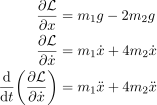
\begin{aligned} \frac{\partial \mathcal{L}}{\partial x} & = m_1g-2m_2g \\ \frac{\partial\mathcal{L}}{\partial \dot{x}} & = m_1\dot{x}+4m_2\dot{x} \\ \frac{\mathrm{d}}{\mathrm{d}t}\bigg(\frac{\partial\mathcal{L}}{\partial\dot{x}}\bigg) & = m_1\ddot{x}+4m_2\ddot{x} \\ \end{aligned}

and the result follows.

(to be continued)

202210261208 Dynamics Figures (Elementary) Q8

215. A cylindrical tube with a radius r is connected by means of spokes to two hoops with a radius R. The mass of both the hoops is M. The mass of the tube and the spokes in comparison with the mass M can be neglected. A string passed over a weightless pulley is wound around the tube. A weight with a mass m is attached to the end of the string.

Find the acceleration a=|\mathbf{a}| of the weight, the tension T=|\mathbf{T}| of the string and the force of friction f=|\mathbf{f}| acting between the hoops and the surface. (Assume that the hoops do not slip.) Also determine k the coefficient of friction at which the hoops will slip.
Extracted from B. Bukhovtsev et al. (1978). Problems In Elementary Physics.


Setup.

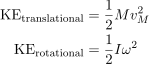
The kinetic energy T of the dumbbell M is in two parts, translational (/linear) and rotational (/angular), i.e.,

\begin{aligned} \textrm{KE}_{\textrm{translational}} & = \frac{1}{2}Mv_M^2 \\ \textrm{KE}_{\textrm{rotational}} & = \frac{1}{2}I\omega^2 \\ \end{aligned}

where the velocity of its centre of gravity (CG) is v_M, and its moment of inertia for discs I=MR^2. It has no potential energy V of its position h=0.

The kinetic energy T of the weight m is given by \textrm{KE}=\frac{1}{2}mv_m^2, and its potential energy V by \textrm{PE}=mgh.

The Lagrangian \mathcal{L} of a system is obtained from

\mathcal{L}=T-V,

whereby the Euler–Lagrange equation is given as

\displaystyle{\frac{\mathrm{d}}{\mathrm{d}t}\bigg(\frac{\partial\mathcal{L}}{\partial \dot{x}}\bigg)-\frac{\partial\mathcal{L}}{\partial x}=0}

Note the relationship between r, R, v_M, v_m, and \omega, i.e.,

\begin{aligned} v_m & = r\omega \\ v_M & = R\omega \\ \end{aligned}

Also beware that forces F of any kinds, e.g., weight \mathbf{W}=m\mathbf{g}, tension \mathbf{T}, normal reaction \mathbf{N}, and friction \mathbf{f}, have not been taken into consideration.


(to be continued)

202210251204 Dynamics Figures (Elementary) Q7

126. Two carts are pushed apart by an explosion of a powder charge Q placed between them. The cart weighing 100\,\mathrm{kg} travels a distance of 18 metres and stops. What distance will be covered by the other cart weighing 300\,\mathrm{kg}? The coefficients of friction k between the ground and the carts are the same.

Modified from B. Bukhovtsev et al. (1978). Problems In Elementary Physics.


First, have a picture in mind:

Applying the law of conservation of linear momentum at the instant of impact,

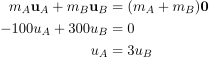
\begin{aligned} m_A\mathbf{u}_A+m_B\mathbf{u}_B & = (m_A+m_B)\mathbf{0} \\ -100u_A+300u_B & = 0 \\ u_A & = 3u_B \\ \end{aligned}

and the law of conservation of mechanical energy after then,

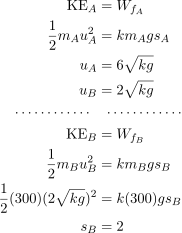
\begin{aligned} \textrm{KE}_A & = W_{f_A} \\ \frac{1}{2}m_Au_A^2 & = km_Ags_A \\ u_A & = 6\sqrt{kg} \\ u_B & = 2\sqrt{kg} \\ \cdots\cdots\cdots\cdots\enspace & \enspace\cdots\cdots\cdots\cdots \\ \textrm{KE}_B & = W_{f_B} \\ \frac{1}{2}m_Bu_B^2 & = km_Bgs_B \\ \frac{1}{2}(300)(2\sqrt{kg})^2 & = k(300)gs_B \\ s_B & = 2\\ \end{aligned}

\therefore The other cart will travel a distance of 2\,\mathrm{m}.

202209281521 Problem 5.37

A bead can slide without friction on a circular hoop of radius R in a vertical plane. The hoop rotates at a constant rate of \omega about a vertical diameter, as shown in the figure below.

(a) Find the angle \theta at which the bead is in vertical equilibrium. (Of course it has a radial acceleration toward the axis.)
(b) Is it possible for the bead to “ride” at the same elevation as the centre of the hoop?
(c) What will happen if the hoop rotates at a slower rate \omega' = \omega /2?

Modified from H. D. Young. (1989). University Physics.


Roughwork.

(a)

Kinetic energy T:

\begin{aligned} T & = \frac{1}{2}mv^2 \\ \dots\enspace v & = r\omega \enspace\dots \\ T & = \frac{1}{2}mr^2\omega^2 \\ \dots\enspace r & = R\sin\theta \enspace\dots \\ T & = \frac{1}{2}mR^2\omega^2\sin^2\theta \\ \end{aligned}

Potential energy V:

\begin{aligned} V & = mg(R-R\cos\theta ) \\ & = mgR(1-\cos\theta ) \\ \end{aligned}

Lagrangian \mathcal{L}=T-V:

\displaystyle{\mathcal{L}=\frac{1}{2}mR^2\omega^2\sin^2\theta-mgR(1-\cos\theta )}

Euler–Lagrange equation:

\displaystyle{\frac{\mathrm{d}}{\mathrm{d}t}\bigg(\frac{\partial\mathcal{L}}{\partial \dot{\theta}}\bigg)-\frac{\partial\mathcal{L}}{\partial \theta}=0}

Thereby

\begin{aligned} \frac{\partial\mathcal{L}}{\partial\dot{\theta}} & = 0 \quad \textrm{and}\quad \frac{\mathrm{d}}{\mathrm{d}t}\bigg(\frac{\partial\mathcal{L}}{\partial\dot{\theta}}\bigg) = 0 \\ \frac{\partial\mathcal{L}}{\partial\theta} & = mR^2\omega^2\sin\theta\cos\theta -mgR\sin\theta \\ \end{aligned}

The bead is in vertical equilibrium when:

mR^2\omega^2\sin\theta\cos\theta -mgR\sin\theta =0

solving for \theta then :

\begin{aligned} 0 & = (mR\sin\theta )(R\omega^2\cos\theta -g) \\ \theta & = 0\enspace\textrm{ (rej.)}\quad\textrm{\scriptsize{OR}}\quad \cos^{-1}\bigg(\frac{g}{R\omega^2}\bigg) \\ \end{aligned}

(b)

\theta\to 90^\circ iff R\omega^2\gg g.

(c) This is left as an exercise to the reader.

202209271004 Exercise 4.5 (Q31)

An elevator accelerates downward at 2.4\,\mathrm{m\, s^{-2}}. What force does the elevator’s floor exert on a 52\,\mathrm{kg} passenger?

Extracted from R. Wolfson. (2016). Essential University Physics.


Roughwork.

Take downward positive, \downarrow\textrm{+ve}. By Newton’s 2nd Law,

\mathbf{F}_{\textrm{net}}=m\mathbf{a}.

Given m=52\,\mathrm{kg}. Let F be the unknown magnitude of force:

\begin{aligned} \mathbf{a} & = 2.4\,\hat{\mathbf{k}} \\ \mathbf{F}_\textrm{net} & = -F\,\hat{\mathbf{k}}+mg\,\hat{\mathbf{k}} \\ & = (-F+mg)\,\hat{\mathbf{k}} \\ \end{aligned}

Then,

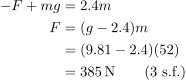
\begin{aligned} -F+mg & = 2.4m \\ F & = (g-2.4)m \\ & = (9.81-2.4)(52) \\ & = 385\,\mathrm{N}\qquad \textrm{(3 s.f.)} \end{aligned}

\therefore The force the elevator’s floor exerts on the passenger is 385\,\mathrm{N} upward.

202207081631 Statics Figures (Elementary) Q1

In a lift, the panel screen displays signs on an array of seven bars of light-emitting diodes (LEDs):

such that the numeric digits 0, 1, 2, 3, 4, 5, 6, 7, 8 and 9 when lit up are as follow:

For each configuration of lit-up cells, assuming that the mass distribution is uniform and the plate thickness negligible, find the centre of mass (CM), and hence the centre of gravity (CG).


Intuition.

Try arguing \textrm{\scriptsize{NOT}} by symmetry in mathematics, \textrm{\scriptsize{BUT}} by moment in physics.

We state without proof the centre of mass (CM) in each cell is as shown below:


For N particles in 2-D:

\begin{aligned} x_{\textrm{CM}} & = \frac{m_1x_1+m_2x_2+\cdots +m_Nx_N}{m_1+m_2+\cdots +m_N} = \frac{\sum_{i=1}^{N}m_ix_i}{M} \\ y_{\textrm{CM}} & = \frac{m_1y_1+m_2y_2+\cdots +m_Ny_N}{m_1+m_2+\cdots +m_N} = \frac{\sum_{i=1}^{N}m_iy_i}{M} \\ \end{aligned}

Define the center at the origin O(0,0), and let \mathbf{r}_1, \mathbf{r}_2, \mathbf{r}_3, \mathbf{r}_4, \mathbf{r}_5, and \mathbf{r}_6 be the vectors pointing to the CM of each cell:

such that

\begin{aligned} \mathbf{r}_1 & = 2\,\hat{\mathbf{j}} \\ \mathbf{r}_2 & = -1\,\hat{\mathbf{i}} + 1\,\hat{\mathbf{j}} \\ \mathbf{r}_3 & = 1\,\hat{\mathbf{i}} + 1\,\hat{\mathbf{j}} \\ \mathbf{r}_4 & = -1\,\hat{\mathbf{i}} -1\,\hat{\mathbf{j}} \\ \mathbf{r}_5 & = -2\,\hat{\mathbf{j}} \\ \mathbf{r}_6 & = 1\,\hat{\mathbf{i}} -1\,\hat{\mathbf{j}} \\ \end{aligned}

To illustrate how to get the CM for the number signs, we first begin with 1:

\mathbf{1}_{\textrm{CM}} = (x_{\textrm{CM,1}},y_{\textrm{CM,1}}).

\begin{aligned} \mathbf{1}_{\textrm{CM}} & = \frac{m\mathbf{r}_3+m\mathbf{r}_6}{m+m} \\ & = \frac{1}{2}\mathbf{r_3} + \frac{1}{2}\mathbf{r_6} \\ & = \frac{1}{2}(1,1) + \frac{1}{2}(1,-1) \\ & = (1,0) \\ \end{aligned}

The remaining are left the reader as an exercise.

202202081217 Dynamics Figures (Elementary) Q6

13. Two identical 2\,\mathrm{kg} trolleys are connected by a light string and pulled by a 12\,\mathrm{N} force as shown. Assuming the surface to be frictionless,

(a) calculate the acceleration of the two trolleys;

(b) find the tension T in the string.

Extracted from B. Kennedy. (2001). Higher Physics Progressive Problems.


Solution.

We draw three free-body diagrams of i. m_a; ii. m_b; and iii. m_a+m_b:

In respective diagrams there are three equations of motion.

By Newton’s second law,

\textrm{Net }\mathbf{F}=m\mathbf{a}:

we have

\begin{aligned} T & = m_aa \\ 12-T & = m_ba \\ 12 & = (m_a+m_b)a \\ \end{aligned}

Answers. (a) acceleration a=3\,\mathrm{m\, s^{-2}}; (b) tension T=6\,\mathrm{N}.

202202080958 Dynamics Figures (Elementary) Q5

2. A man walking with a speed v constant in magnitude and direction passes under a lantern hanging at a height H above the ground. Find the velocity which the edge of the shadow of the man’s head moves over the ground with if his height is h.

Extracted from B. Bukhovtsev et al. (1978). Problems in Elementary Physics.


Solution.

Let x=0 be the position of the lantern; let the man walk in the positive x-direction; and let the position of the man be x_m(t) and that of the shadow of his head x_s(t). So the length s of his shadow is |x_s-x_m|.

By comparing similar triangles, we have

\displaystyle{\frac{H}{x_s} = \frac{h}{s}}.

Thus,

\begin{aligned} \frac{H}{x_s} & = \frac{h}{x_s-x_m} \\ x_s & = \bigg(\frac{H}{H-h}\bigg) x_m \\ \dot{x}_s & = \bigg(\frac{H}{H-h}\bigg) \dot{x}_m \\ \dot{x}_s & = \bigg(\frac{H}{H-h}\bigg) v \\ \end{aligned}

\therefore The edge of the shadow of the man’s head moves with a velocity (\frac{H}{H-h}) v\,\hat{\mathbf{i}} over the ground.

202202071621 Dynamics Figures (Elementary) Q4

1.3.10. A 2\,\mathrm{kg} mass and a 3\,\mathrm{kg} mass are linked by a light string passed over a frictionless pulley. Calculate the acceleration of the system.

Extracted from B. Kennedy. (2001). Higher Physics Progressive Problems.


Solution.

At first glance, as mass m_2 is heavier than mass m_1, one can expect that the heavier mass will fall down and the lighter mass will move up.

Draw the free body diagram of each mass below:

Write the equation of motion for both masses:

\begin{aligned} T-m_1g & = m_1a \\ m_2g-T & = m_2a \\ & \\ T-2g & = 2a \\ 3g-T & = 3a \\ & \\ a & = \frac{g}{5} \\ T & = \frac{12g}{5} \\ \end{aligned}

\therefore Both masses m_1 and m_2 will accelerate with a magnitude of g/5=1.96\,\mathrm{m\, s^{-2}}.

202202071437 Dynamics Figures (Elementary) Q3

1.17. A stationary object explodes into two fragments of relative mass 1:100. At the instant of break-up, the larger mass has a velocity of 10\,\mathrm{m\, s^{-1}}. Calculate i. the velocity of the smaller mass, ii. the ratio of their kinetic energies at this instant.

Extracted from M. Nelkon. (1971). Graded Exercises and Worked Examples in Physics.


Solution.

Provided that u=0, m_1:m_2=1:100, and v_2=10\,\mathrm{m\, s^{-1}}.

By the law of conservation of linear momentum,

\begin{aligned} M\mathbf{u} & = m_1\mathbf{v}_1+m_2\mathbf{v}_2 \\ (M)(0\,\hat{\mathbf{i}}) & = \bigg(\frac{1}{101}M\bigg) (-v_1\,\hat{\mathbf{i}})+\bigg(\frac{100}{101}M\bigg) (+10\,\hat{\mathbf{i}}) \\ v_1 & = 1000 \\ \mathbf{v}_1 & = -1000\,\hat{\mathbf{i}}\\ \end{aligned}

The ratio of their kinetic energies is given by

\begin{aligned} &\quad \textrm{KE}_1:\textrm{KE}_2 \\ & = \frac{\frac{1}{2}m_1v_1^2}{\frac{1}{2}m_2v_2^2} \\ & = \frac{(\frac{1}{2})(\frac{1}{101}M)(1000)^2}{(\frac{1}{2})(\frac{100}{101}M)(10)^2} \\ & = 100:1 \\ \end{aligned}