202305231027 Problem 8.21-22

In the figure below, two objects are connected by a string which is threaded through a pulley.

Using its weight, object 2 moves object 1 along a flat surface. The acceleration a of the two objects can be determined by the following formula

\displaystyle{a=\frac{m_2g-\mu m_1g}{m_1+m_2}}

where m_1 and m_2 are the masses of object 1 and object 2, respectively, in kilograms, g is the acceleration due to Earth’s gravity measured in \displaystyle{\frac{\mathrm{m}}{\mathrm{sec}^2}}, and \mu is a constant known as the coefficient of friction. Which of the following expresses \mu in terms of the other variables?

A. \displaystyle{\mu=\frac{a(m_1+m_2)}{m_1m_2g^2}}
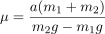
B. \displaystyle{\mu=\frac{a(m_1+m_2)}{m_2g-m_1g}}
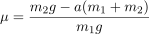
C. \displaystyle{\mu=\frac{m_2g-a(m_1+m_2)}{m_1g}}
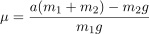
D. \displaystyle{\mu=\frac{a(m_1+m_2)-m_2g}{m_1g}}

If the masses of both object 1 and object 2 were doubled, how would the acceleration of the two objects be affected?

A. The acceleration would stay the same.
B. The acceleration would be halved.
C. The acceleration would be doubled.
D. The acceleration would be quadrupled (multipled by a factor of 4).

Extracted from Phu Nielson. (2015). SAT Math Advanced Guide and Workbook.


Roughwork.

First, begin with free-body diagrams:

Next, carry on by Newton’s 2nd law:

\mathbf{F}_{\mathrm{net}}=m\mathbf{a}

jotting positive the motion directing to,

\begin{aligned} (T-\mu m_1g)\,\hat{\mathbf{i}} & = m_1a\,\hat{\mathbf{i}} \\ (m_2g-T)\,\hat{\mathbf{j}} & = m_2a\,\hat{\mathbf{j}} \\ \end{aligned}

then writing Euler-Lagrange (E-L) equation with Rayleigh dissipation function \mathcal{F}:

\displaystyle{\frac{\mathrm{d}}{\mathrm{d}t}\bigg(\frac{\partial\mathcal{L}}{\partial\dot{x}}\bigg) -\frac{\partial\mathcal{L}}{\partial x} = -\frac{\partial\mathcal{F}}{\partial\dot{x}}}

where

\begin{aligned} \mathcal{L} & = T-V \\ T & = \frac{1}{2}(m_1+m_2)\dot{x}^2 \\ V & = m_2gx \\ \mathcal{F} & = k\dot{x}^2 \enspace (\leqslant \mu m_1g) \\ \end{aligned}

or by noting the undissipated Hamiltonian \mathcal{H}(\mathbf{p},\mathbf{q})=T+V as in:

\begin{aligned} \frac{\mathrm{d}\mathbf{q}}{\mathrm{d}t} & = \frac{\partial\mathcal{H}}{\partial\mathbf{p}} \\ \frac{\mathrm{d}\mathbf{p}}{\mathrm{d}t} & = -\frac{\partial\mathcal{H}}{\partial\mathbf{q}} \\ \end{aligned}

where though it is not uncommon for some few to despise differentiating with respect to vectors whom I hereby ignore.

\displaystyle{\mathcal{H}=\frac{p_1^2}{2m_1}+\frac{p_2^2}{2m_2}+m_2gq-\mu m_1gq}.


This problem is not to be attempted.

202301130941 Solution to 2014-IBHL-PHY-I-5

Two blocks of weight 5\,\mathrm{N} and 2\,\mathrm{N} are attached to two ropes, \textrm{X} and \textrm{Y}.

The blocks hang vertically. The mass of the ropes is negligible. What is the tension in \textrm{X} and the tension in \textrm{Y}?


Roughwork.

As always start with free-body diagrams. Take upward positive. First the lower block:

Then the higher block:

Or alternatively,

Ans. \begin{cases} T_\textrm{X}=7\,\mathrm{N} \\ T_\textrm{Y}=2\,\mathrm{N} \\ \end{cases}

This problem is not to be attempted.

202301130918 Solution to 2011-IBHL-PHY-I-3

A skydiver of mass 80\,\mathrm{kg} falls vertically with a constant speed of 50\,\mathrm{m\,s^{-1}}. The upward force acting on the skydiver is approximately

A. 0\,\mathrm{N}.
B. 80\,\mathrm{N}.
C. 800\,\mathrm{N}.
D. 4000\,\mathrm{N}.


Roughwork.

As always start with a free-body diagram.

Take upward positive. Write the equation of motion by Newton’s 2nd law:

\begin{aligned} \mathbf{F}_{\textrm{net}} & = m\mathbf{a} \\ f-mg & = m(0) \\ f & = mg \\ & \approx (80)(10) \\ & = 800 \\ \end{aligned}

And the answer is C.

This problem is not to be attempted.

202301120908 Solution to 2002-IBHL-PHY-I-9

A pendulum has a bob of mass m and swings in the arc shown below.

As the bob swings through the lowest point of its motion, the tension in the string will be

A. zero.
B. less than mg.
C. equal to mg.
D. greater than mg.


Roughwork.

Assumed the string is l long, taut and inextensible.

Derivation. Read More

    \begin{aligned} T & = \frac{1}{2}ml^2\dot{\theta}^2 \\ V & = mgl(1-\cos\theta ) \\ \mathcal{L} & = T-V \\ \frac{\partial \mathcal{L}}{\partial\theta} & = -mgl\sin\theta \\ \frac{\partial \mathcal{L}}{\partial\dot{\theta}} &  = ml^2\dot{\theta} \\ 0 & =\frac{\mathrm{d}}{\mathrm{d}t}\bigg(\frac{\partial\mathcal{L}}{\partial \dot{\theta}}\bigg) - \frac{\partial\mathcal{L}}{\partial \theta} \\ \end{aligned}

    A simple pendulum, under gravity, has

    \textrm{EoM: }\qquad\displaystyle{\ddot{\theta}+\frac{g}{l}\cdot\sin\theta =0}

    the equation of motion, independent of mass m, neglecting friction.

    Lemma. (not in use) Read More

    \begin{aligned} \begin{bmatrix} \hat{\mathbf{e}}_r \\ \hat{\mathbf{e}}_\theta \end{bmatrix} & = \begin{bmatrix} \displaystyle{\frac{\partial x}{\partial r}} & \displaystyle{\frac{\partial y}{\partial r}} \\[2mm]\displaystyle{\frac{1}{r}\frac{\partial x}{\partial\theta}} & \displaystyle{\frac{1}{r}\frac{\partial y}{\partial\theta}} \end{bmatrix}\begin{bmatrix} \hat{\mathbf{e}}_x \\ \hat{\mathbf{e}}_y \end{bmatrix} \\ \begin{bmatrix} \hat{\mathbf{e}}_x \\ \hat{\mathbf{e}}_y \end{bmatrix} & = \begin{bmatrix} \displaystyle{\frac{1}{r}\frac{\partial y}{\partial \theta}} & \displaystyle{-\frac{\partial y}{\partial r}} \\[2mm]\displaystyle{-\frac{1}{r}\frac{\partial x}{\partial\theta}} & \displaystyle{\frac{\partial x}{\partial r}} \end{bmatrix} \begin{bmatrix} \hat{\mathbf{e}}_r \\ \hat{\mathbf{e}}_\theta \end{bmatrix} \\ \end{aligned}

    The net force for this non-uniform circular motion, being centripetal force producing radial plus tangential accelerations,

    \mathbf{a} = -l(\dot{\theta}^2\cos\theta +\ddot{\theta}\sin\theta)\,\hat{\mathbf{i}} + l(\ddot{\theta}\cos\theta -\dot{\theta}^2\sin\theta )\,\hat{\mathbf{j}}

    is the resultant of tension

    \begin{aligned} T & = |\mathbf{T}| \\ \mathbf{T} & =T\sin\theta\,\hat{\mathbf{i}}+T\cos\theta\,\hat{\mathbf{j}}} \end{aligned}

    and weight \mathbf{W}=m\mathbf{g}=-mg\,\hat{\mathbf{j}}. Write, with a free-body diagram in mind,

    \begin{aligned} \because\enspace & \mathbf{F}_{\textrm{net}}  =\mathbf{T}+\mathbf{W}=m\mathbf{a} \\ \therefore\enspace & \begin{cases} T\sin\theta = -ml(\dot{\theta}^2\cos\theta+\ddot{\theta}\sin\theta ) \\ T\cos\theta - mg = ml(\ddot{\theta}\cos\theta-\dot{\theta}^2\sin\theta ) \\ \end{cases} \\ \end{aligned}

    When the bob is at the lowest point, i.e., \theta =0,

    \begin{aligned} T & = mg + ml\ddot{\theta} \\ & = mg - mg\sin\theta \qquad (\textrm{by EoM})\\ & \approx mg-mg\theta \qquad (\because\enspace \sin\theta\approx\theta\textrm{ for small }\theta)\\ & \lneq mg \\ \end{aligned}

    The official answer is D but mine B.  Could that be E: more or less mg? If I am wrong, I must have omitted some simple facts of noble truth.

    This problem is not to be attempted.

202301110923 Solution to 1980-AL-PHY-IA-26

A charged ball X is suspended by a string.

When a uniform electric field E is applied horizontally, the ball is displaced a horizontal distance a such that the string makes an angle \theta with the vertical.


Roughwork.

As always start with a free-body diagram. Hence, draw

Resolving components, write

\begin{cases} \textrm{Horizontal:}\quad & T\sin\theta = qE \\ \textrm{Vertical:}\quad & T\cos\theta = mg \\ \end{cases}

Squaring and summing, write

\begin{aligned} (T\sin\theta )^2+ (T\cos\theta)^2 &=  (qE)^2 + (mg)^2\\ T & = \sqrt{q^2E^2+m^2g^2} \\ \end{aligned}

By considering the electric field strength E as an independent variable, and the angle of elevation \theta the dependent variable, make differentiation

\displaystyle{\mathrm{d}E = \bigg(\frac{T\cos\theta}{q}\bigg)\,\mathrm{d}\theta}\qquad(\theta\in [0,90^\circ])

This problem is not to be attempted.

202301101150 Solution to 1999-IBHL-PHY-I-7

Two 10\,\mathrm{kg} blocks on a smooth horizontal surface are tied together. They are accelerated by a horizontal force of 30\,\mathrm{N} which acts as shown below:

If frictional effects are negligible, what is the tension in the connecting rope?


Roughwork.

As always start with free-body diagrams. Take rightward positive. Considering first the bodies as a whole:

so as to write the equation of motion by Newton 2nd law:

\begin{aligned} F_{\textrm{net}} & =ma \\ 30 & = 20a\\ a & = 1.5\,\mathrm{m\,s^{-2}} \\ \end{aligned}

where the tension regarded as internal force does not count. Considering then as individuals,

so as to write:

\begin{aligned} F_{\textrm{net}} & =ma \\ 30 - T & = (10)(1.5)\\ T & = 15\,\mathrm{N} \\ \end{aligned}

One may also do with the left block, but an exercise left the reader.

202212051136 Solution to 1978-AL-AMATH-II-3

A smooth homogeneous hollow right circular cylinder with open, flat ends stands freely on smooth horizontal ground so that its axis is vertical. Two spheres A and B of radii a and b (a<b) and weights W_a and W_b respectively rest in equilibrium inside the cylinder as shown in the diagram. Suppose that the internal and external radii of the cylinder are c and d respectively, where c<(a+b).

i. Show that the vertical forces acting on the spheres reduce to a couple. Determine the moment of the couple.
ii. Determine the minimum weight of the cylinder such that it will not overturn.
iii. A third sphere C, identical to A, is then placed on top of B in contact with the cylinder. Determine the minimum weight of the cylinder so that it will not overturn for the two possible equilibrium positions of C.

You may assume that the cylinder is tall enough to hold all the spheres.


Roughwork.

WLOG reduce the problem from three-dimensional to two. Begin with three free-body diagrams as follow:

So many unknowns I don’t know how to get set.

(to be continued)

202212020955 Solution to 1978-HL-PHY-II-4

A rectangular loop of length 0.2\,\mathrm{m} and width 0.1\,\mathrm{m}, carrying a steady current I of 2\,\mathrm{A} is hinged along the y-axis, and is situated in a uniform magnetic field \mathbf{B} of 0.5\,\mathrm{T} parallel to the x-axis.

If the plane of the loop makes an angle of 60^\circ with the x–y plane,

(a) calculate the force exerted by the magnetic field on each side of the loop, and
(b) calculate the torque required to hold the loop in this position.


Roughwork.

Force on a current-carrying conductor in a magnetic field is in magnitude

\boxed{F=BIl\sin\theta}

its direction to be determined by Fleming’s left hand rule.

(a) Have in mind a picture as viewing cross-sectionally:

and as down the top:

where

\begin{aligned} F_1 = F_3 & = (0.5)(2)(0.2)\sin 90^\circ \\ F_2 = F_4 & = (0.5)(2)(0.1)\sin 60^\circ \\ \end{aligned}

(b) This part is not to be attempted.

202212011713 Solution to 1974-HL-PHY-I-2

A uniform ladder 6\,\mathrm{m} long and weighing 390\,\mathrm{N} rests with one end on the rough ground and the other end against a smooth wall. The ladder makes an angle of 60^\circ with the ground, and the coefficient of friction between the ladder and ground is 0.8.

(a) Draw a diagram to indicate the forces acting on the ladder.
(b) How far can a man weighing 980\,\mathrm{N} go up the ladder before the ladder begins to slip?


Roughwork.

(a)

Taking moment about the lower end of the ladder:

\begin{aligned} \textrm{Torque}_\textrm{clockwise}\,(\tau_{\circlearrowright}) & = \textrm{Torque}_\textrm{anticlockwise}\,(\tau_{\circlearrowleft}) \\ (W\cos\theta )(d/2) & = (N_2\sin\theta )(d) \\ \end{aligned}

whereas about its upper tip:

\begin{aligned} (N_1\cos\theta )(d)  & =(W\cos\theta )(d/2) + (f\sin\theta )(d) \\ \end{aligned}

we have two equations.

(b)

This part is not to be attempted.

202211031053 Statics Figures (Elementary) Q2

87. A homogeneous chain (i.e., \rho =\textrm{Const.}) with a length l lies on a table. What is the maximum length l_1 of the part of the chain hanging over the table if the coefficient of friction between the chain and the table is k?

Extracted from B. Bukhovtsev et al. (1978). Problems in Elementary Physics.


Roughwork.

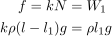
\begin{aligned} f = kN & = W_1 \\ k\rho (l-l_1)g & = \rho l_1g \\ \end{aligned}

Answer. \displaystyle{l_1=l\frac{k}{k+1}}.