202409051606 Pastime Exercise 012

About the figure below, tell some stories as probable as probable can be.


Roughwork.

Ignoring gravitational effect, denote the initial and the final velocity before and after impact by \mathbf{u}=(u_x,u_y) and \mathbf{v}=(v_x,v_y). Taking the positive an up and a right, then u_x,u_y,v_x<0 and v_y>0. Under conservation of momentum,

\begin{aligned} m|\mathbf{u}|+M|\mathbf{U}| & =m|\mathbf{v}|+M|\mathbf{V}| \\ m|(u_x\,\hat{\mathbf{i}}+u_y\,\hat{\mathbf{j}})| + M|(\mathbf{0})| & = m|(v_x\,\hat{\mathbf{i}}+v_y\,\hat{\mathbf{j}})| + M|(\mathbf{0})| \\ |u_x| & = |v_x| \\ |u_y| & = |v_y| \\ \textrm{( } |u_i| & = |v_i| \textrm{ )}\\ \end{aligned}

and conservation of energy

\begin{aligned} \frac{1}{2}mu^2 + \frac{1}{2}MU^2 & = \frac{1}{2}mv^2 + \frac{1}{2}MV^2 \\ m(u_x^2+u_y^2) + M(0)^2 & = m(v_x^2+v_y^2) + M(0)^2 \\ u_x^2+u_y^2 & = v_x^2 + v_y^2 \\ \sum u_i^2 & = \sum v_i^2 \\ \end{aligned}

Therefore

\begin{aligned} \frac{|u_x|}{|u_y|} & = \frac{|v_x|}{|v_y|} \\ \tan\theta_i & = \tan\theta_r \\ \theta_i & = \theta_r \\ \end{aligned}


(to be continued)

202408211136 Exercise 14.C.10

A stone is thrown vertically upwards so that its height, s metres, above the ground, after t seconds is given by s=40t-5t^2. Find

(a) its velocity after 2\,\mathrm{s};
(b) its height above the ground when it is momentarily at rest;
(c) its initial velocity;
(d) its velocity when it is 15\,\mathrm{m} above the ground, giving your answer correct to the nearest \mathrm{m\,s^{-1}}.

Extracted from K. S. Teh & C. Y. Loh. (2007). New Syllabus Additional Mathematics (8e)


Roughwork.

Initially (i.e., at t=0), the stone is

s(t=0)=40(0)-5(0)^2=0\,\mathrm{m}

above the ground, i.e., at ground level s=0.

\begin{aligned} & s = 40t-5t^2 = t(40-5t) \\ \Rightarrow & \begin{cases} s =0 \Leftrightarrow t = \{0\}\cup\{ 8\} \\ s > 0 \Leftrightarrow t\in (0,8) \\ s < 0 \Leftrightarrow t<0\enspace\textrm{(rej.)}\enspace\textrm{\scriptsize{OR}}\enspace t>8 \\ \end{cases} \\ \end{aligned}

Take upward positive. The (vertical) displacement of the stone is

\begin{aligned} \mathbf{s}(t) & =s(t)\,\hat{\mathbf{j}} \\ & = (40t-5t^2)\,\hat{\mathbf{j}} \\ \end{aligned}

its (vertical) instantaneous velocity

\begin{aligned} \mathbf{v}(t) & = v(t)\,\hat{\mathbf{j}} \\ & = \frac{\mathrm{d}s(t)}{\mathrm{d}t}\,\hat{\mathbf{j}} \\ & = (40t-5t^2)'\,\hat{\mathbf{j}} \\ & = (40-10t)\,\hat{\mathbf{j}} \\ \end{aligned}

and its (vertical) instantaneous acceleration

\begin{aligned} \mathbf{a}(t) & = a(t)\,\hat{\mathbf{j}} \\ & = \frac{\mathrm{d}v(t)}{\mathrm{d}t}\,\hat{\mathbf{j}} \\ & = (40-10t)'\,\hat{\mathbf{j}} \\ \mathbf{a} & = -10\,\hat{\mathbf{j}} \\ \end{aligned}

so are the answers to

(a) \mathbf{v}(2)
(b) t'\in\{ t:v(t)=0\}\enspace\rightsquigarrow\enspace s(t')
(c) \mathbf{v}(0)
(d) t'\in\{ t:\mathbf{s}(t)=+15\,\hat{\mathbf{j}}\} \enspace\rightsquigarrow\enspace \mathbf{v}(t')


This problem is not to be attempted.

202405091824 Pastime Exercise 011

About the graph below, tell some stories as probable as probable can be.


Roughwork.

Assuming linear (/rectilinear) motion in a single direction.

Assuming uniform acceleration, there are two cases: i. zero acceleration and ii. non-zero (constant) acceleration; in the former velocity being (a) constant and the latter (b) non-constant.

Assuming a flat spacetime metric of which the spatial part does not expands with the temporal part.

Imagine a man walking along a straight line from point (x_1,y_1) to point (x_2,y_2). From

\displaystyle{\textrm{Speed }(v)=\frac{\textrm{Distance }(s)}{\textrm{Time }(t)}}

as the path is fixed, i.e., \Delta s=\textrm{Const.}, we see speed v and time t

\begin{aligned} v\uparrow\enspace \Leftrightarrow \enspace& t\downarrow \\ v\downarrow\enspace\Leftrightarrow\enspace& t\uparrow \\ \end{aligned}

in an inverse relationship. As the man keeps his own fair pace and makes himself a good timekeeper, we can treat speed v as an independent variable, and time t a dependent variable.

\textrm{\scriptsize{CASE} \textbf{\texttt{(a)}}}: velocity being constant

Parameterize the Cartesian equation y=mx+c by the parameter t' (*as distinguished from the natural/unit-speed/arc-length parameter time t) so as to write a set of parametric equations:

\begin{aligned} & \begin{cases} s_x(t')=t' \\ s_y(t')=mt'+c \\ \end{cases} \\ & \\ & \begin{cases} v_x(t') =s_x'(t') = 1 \\ v_y(t') = s_y'(t') = m \\ \end{cases} \\ \end{aligned}

\begin{aligned} v^2(t') & = v_x^2(t')+v_y^2(t') \\ v(t') & = \displaystyle{\sqrt{\bigg(\frac{\mathrm{d}s_x(t')}{\mathrm{d}t'}\bigg)^2 +\bigg(\frac{\mathrm{d}s_y(t')}{\mathrm{d}t'}\bigg)^2}} \\ |\mathbf{v}(t')| & = \sqrt{1+m^2} \\ t & = \int_{0}^{t'}|\mathbf{v}(t)|\,\mathrm{d}t \\ & = (\sqrt{1+m^2})t'\\ \end{aligned}

\textrm{\scriptsize{CASE} \textbf{\texttt{(b)}}}: velocity being non-constant

The man begins with initial speed v_1 at start point (x_1,y_1) and ends with final speed v_2 at finish point (x_2,y_2). We have

\displaystyle{\textrm{Acceleration }(a)=\frac{\textrm{Change in speed }(v-u)}{\textrm{Time }(t)}}

Write by SUVAT equations of motion:

\begin{aligned} \mathbf{u} & = (u_x,u_y) \\ \mathbf{v} & = (v_x,v_y) \\ \mathbf{a} & = (a_x,a_y) \\ & = \bigg( \frac{v_x-u_x}{t}, \frac{v_y-u_y}{t}\bigg) \\ \mathbf{s} & = (s_x,s_y) \\ & = \bigg( u_xt+\frac{1}{2}a_xt^2, u_yt+\frac{1}{2}a_yt^2\bigg) \\ & = \bigg(\frac{1}{2}(u_x+v_x)t, \frac{1}{2}(u_y+v_y)t\bigg) \\ & = (x_2-x_1,y_2-y_1) \\ \end{aligned}

Is this time t also a natural parameter?

For a given parametric curve, the natural parametrization is unique up to a shift of parameter.

Wikipedia on Differentiable curve


(to be continued)

202403051417 Revision Paper XIII Q10

To a man walking along a horizontal road at 1.5\,\mathrm{m/s} the rain is coming towards him and appears to be falling at 3.5\,\mathrm{m/s} at an angle of 30^\circ to the vertical. Find, by calculation or drawing, the true speed of the rain and the angle this makes with the vertical.

Extracted from A. Godman & J. F. Talbert. (1973). Additional Mathematics Pure and Applied in SI Units.


Setup.

As always, visualise the scene.

Two observers in different reference frames S and S' can give different descriptions of the same physical event (x,y,z,t). Where something is depends on when you check on it and on the movement of your own reference frame. Time and space are not independent quantities; they are related by relative velocity.

If S' is moving with speed v in the positive x-direction relative to S, then its coordinates in S' are

\begin{aligned} x' & = x-vt \\ y' & = y \\ z' & = z \\ t' & = t \\ \end{aligned}

and if an object has velocity \mathbf{u} in frame S, then velocity \mathbf{u}' of the object in frame S' is

\begin{aligned} u' & = \frac{\mathrm{d}x'(t)}{\mathrm{d}t} \\ & = \frac{\mathrm{d}}{\mathrm{d}t}(x(t)-vt) \\ & = \frac{\mathrm{d}x(t)}{\mathrm{d}t}-v \\ & = u-v \\ \end{aligned}

in magnitude.

Cf. Ming-chang Chen. (2017). NTHU EE211000 Modern Physics.


Roughwork.

Recall that a triangle is uniquely determined by not all but some of its three sides and three angles:

\begin{aligned} \textrm{SSS} & \quad \textrm{(Side-Side-Side)} \\ \textrm{SAS} & \quad \textrm{(Side-Angle-Side)} \\ \textrm{ASA} & \quad \textrm{(Angle-Side-Angle)} \\ \textrm{AAS} & \quad \textrm{(Angle-Angle-Side)} \\ \textrm{RHS} & \quad \textrm{(Right angle-Hypotenus-Side)} \\ \end{aligned}

Hence, provided in part

\begin{aligned} u' & = 3.5 \\ v & = 1.5 \\ \measuredangle (u',v) & = 60^\circ \\ \end{aligned}

we can supply in whole

\begin{aligned} u & = \cdots \\ \measuredangle (v,u) & = \cdots \\ \measuredangle (u,u') & = \cdots \\ \end{aligned}


This problem is not to be attempted.

202403041703 Revision Paper II Q10

A body travels in a straight line but its speed at any time does not exceed 5\,\mathrm{m\,s^{-1}}. If it accelerates and decelerates at 2\,\mathrm{m\,s^{-2}}, find the shortest time needed to cover a distance of 30\,\mathrm{m} from rest to rest.

Extracted from A. Godman & J. F. Talbert. (1973). Additional Mathematics Pure and Applied in SI Units.


Roughwork.

For avoidance of physics is one by mathematical formulation.


\begin{aligned} v & = u+at \\ 5 & = 0 + 2t_1 \\ \textrm{Eq. (1):}\qquad\qquad t_1 & = 2.5\,\mathrm{s} \\ & \\ v & = u+at \\ 0 & = 5-2(t_3-t_2) \\ \textrm{Eq. (2):}\qquad t_3-t_2 & = 2.5\,\mathrm{s} \\ & \\ s & = \frac{((t_2-t_1)+(t_3-0))(v_{\textrm{max}})}{2} \\ 30 & = \frac{(t_2-2.5+t_3)(5)}{2} \\ \textrm{Eq. (3):}\qquad t_2+t_3 & = 14.5\,\mathrm{s} \\ \end{aligned}

What is t_3 then, in unit \textrm{sec}?


This problem is not to be attempted.

202402051319 Pastime Exercise 009

The blogger claims no originality of his problem below.


On a rollover road,

a vehicle performs circular motion:

Discuss how the driver could prevent a traffic accident.


Roughwork.

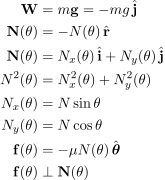
Take positive both, the angle \theta in an anti-clockwise direction, and the displacement \mathbf{s} in a rightward and an upward direction.
\begin{aligned} \mathbf{W} & = m\mathbf{g} = -mg\,\hat{\mathbf{j}} \\ \mathbf{N}(\theta ) & = -N(\theta )\,\hat{\mathbf{r}} \\ \mathbf{N}(\theta ) & = N_x(\theta )\,\hat{\mathbf{i}} + N_y(\theta )\,\hat{\mathbf{j}} \\ N^2(\theta ) & = N_x^2(\theta )+N_y^2(\theta ) \\ N_x(\theta ) & = N\sin\theta \\ N_y(\theta ) & = N\cos\theta \\ \mathbf{f}(\theta ) & = -\mu N(\theta )\,\hat{\boldsymbol{\theta}} \\ \mathbf{f}(\theta ) & \perp \mathbf{N}(\theta ) \\ \end{aligned}

In order for the vehicle not to leave the track, the radius of curvature r \textrm{\scriptsize{MUST}} be kept constant, i.e., r=R(=\textrm{Const.}).

Recall, in uniform circular motion there isn’t any (angular) acceleration in angular velocity, i.e.,
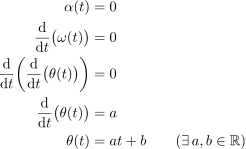
\begin{aligned} \alpha (t) & = 0 \\ \frac{\mathrm{d}}{\mathrm{d}t}\big(\omega (t)\big) & = 0 \\ \frac{\mathrm{d}}{\mathrm{d}t}\bigg( \frac{\mathrm{d}}{\mathrm{d}t}\big(\theta (t)\big)\bigg) & = 0 \\ \frac{\mathrm{d}}{\mathrm{d}t}\big(\theta (t)\big) & = a \\ \theta (t) & = at+b\qquad (\exists\, a,b\in\mathbb{R}) \\ \end{aligned}

If uniform circular motion is \textrm{\scriptsize{NOT}} assumed,

i.e., \alpha \neq 0\textrm{ \scriptsize{OR} }r\neq\textrm{Const.},

then angular displacement \theta (t) wrt time t will be a polynomial in an indeterminate t of degree 2 or higher,

i.e., O(t)=O(t^c)\qquad\exists\, c\, (\in\mathbb{Z}^+)\geqslant 2.

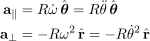
Angular acceleration \boldsymbol{\alpha} is less often mentioned than is its parallel tangential acceleration \mathbf{a}_{\parallel}\, (=r\boldsymbol{\alpha}) as the pair to centripetal (/centrifugal) acceleration \mathbf{a}_{\perp}.

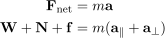
By Newton 2nd Law, write

\begin{aligned} \mathbf{F}_{\textrm{net}} & = m\mathbf{a} \\ \mathbf{W}+\mathbf{N}+\mathbf{f} & = m(\mathbf{a}_{\parallel}+\mathbf{a}_{\perp}) \\ \end{aligned}

The presence of a centripetal acceleration, i.e., \exists\,\mathbf{a}_{\perp}\neq\mathbf{0}, is necessary for any circular motion, be it uniform or not; but not sufficient for the absence of a tangential acceleration \forall\,\mathbf{a}_{\parallel}= 0 (why?). One knows instinctively, that the vehicle should possess a minimum angular speed \min (\omega ) to do this dangerous stunt. And so much the better if beyond this bound \min (\omega )\leqslant \omega \leqslant \max (\omega ) \ll c one has all degrees of freedom.

By definition,
\begin{aligned} \mathbf{a}_{\parallel} & = R\dot{\omega}\,\hat{\boldsymbol{\theta}} = R\ddot{\theta}\,\hat{\boldsymbol{\theta}} \\ \mathbf{a}_{\perp} & = -R\omega^2\,\hat{\mathbf{r}} = -R\dot{\theta}^2\,\hat{\mathbf{r}} \\ \end{aligned}

Stepping on and off the accelerator (/gas pedal), however delicately, is \textrm{\scriptsize{NOT}} designed to keep a constant acceleration for the gear.


This problem is not to be attempted.

202401300926 Exercise 81.b.1

A particle is projected at an angle of 45^\circ with the horizon from a point on a horizontal plane, with a velocity \textrm{1,000} feet per second. Find its range, and find its distance from the point of projection at the end of \textrm{5} seconds.

Gage, Alfred Payson. (1887). The High School Physics.


Roughwork.

Draw a picture for the scenario.

We set up the notation system below:

\begin{aligned} \textrm{Displacement} &:\mathbf{s}(x(t),y(t))=s_x\,\hat{\mathbf{i}}+s_y\,\hat{\mathbf{j}} \\ \textrm{Velocity} &: \mathbf{v}(t)=v_x\,\hat{\mathbf{i}}+v_y\,\hat{\mathbf{j}} \\ \textrm{Acceleration} &: \mathbf{a}=-10\,\mathrm{m\,s^{-1}}\,\hat{\mathbf{j}} \\ \end{aligned}

and resolve them into their components:

\begin{aligned} v^2(t) & = v_x^2(t)+v_y^2(t) \\ v_x(t_0) & = v_y(t_0)=\frac{\sqrt{2}}{2}v(t_0) \\ v_y(t) & = (v_y(t_0))+(- a)(t)\\ s(t) & = s_x^2(t) + s_y^2(t) \\ s_x(t) & = (v_x(t_0))(t) \\ s_y(t) & = h+(v_y(t_0))(t)+\frac{1}{2}(-a)(t)^2 \end{aligned}

its range being s_x(t=5) and its distance from the point of projection s(t=5)=|\mathbf{s}(t=5)| at the end of \textrm{5} seconds.


This problem is not to be attempted.

202401031807 Pastime Exercise 007

The blogger claims no originality of his problem below.

A ball of mass m is being passed through a smooth extensible light string, the two ends of which being attached to walls a distance d apart.

When time t=t_0:

when t=t_1:

when t=t_2:

when t=t_3:

when t=t_4:

when t=t_5:

when t=t_6:

such that stroboscopically for t\in [t_0,t_6], we see the ball’s trajectory fits into a parabola as can be described by some quadratic equation:

The tension T(t) of the string and the speed v(t) of the ball are time-varying variables dependent on mass m and distance d as well. By considering the free-body diagrams of the ball and of the string in discrete time frames t_i‘s (where i\in\{ 0,1,2,3,4,5,6\}), find the equation of motion at continuous time intervals of \Delta t=t_6-t_0.


This problem is not to be attempted.

202312181044 Exercise 21.2.27

The figure below shows two masses connected by a light inextensible string on a smooth incline where \sin\theta =\frac{1}{40}. Find the acceleration of the masses when the system is released from rest. (g=9.8)

Extracted from A. Godman & J. F. Talbert. (1973). Additional Mathematics Pure and Applied in SI Units.


Roughwork.

As always, begin with free-body diagrams. Hence, draw

\begin{aligned} m_Aa_A & =\textrm{Net }F_{A}=-T+W_{A}\sin\theta \\ m_Ba_B & =\textrm{Net }F_{B}=T+W_{B}\sin\theta \\ \end{aligned}

where

\begin{aligned} W_A & = m_Ag \\ W_B & = m_Bg \\ T & : \left\{\begin{array}{lr} =0 \textrm{ for }a_A\leqslant a_B & \text{} \\ >0 \textrm{ for }a_A>a_B & \text{}\\ \end{array} \\ \end{aligned}

Note that

\begin{aligned} a_A & = -\frac{T}{m_A}+g\sin\theta \\ a_B & = \frac{T}{m_B}+g\sin\theta \\ \cdots\cdots & \cdots\cdots\cdots \\ \because\quad a_A & \leqslant a_B \\ \therefore\quad T & = 0 \\ \end{aligned}

Thus,

a_A,a_B = g\sin\theta.


This problem is not to be attempted.

202311091202 Exercise 23.2.8

A block of weight 30\,\mathrm{N} rests on a smooth plane inclined at an angle of 20^\circ to the horizontal. Find the least horizontal force required to keep it in equilibrium and the reaction of the plane.

Extracted from A. Godman & J. F. Talbert. (1973). Additional Mathematics Pure and Applied in SI Units.


Roughwork.

As always, begin with free-body diagrams. Here we combine the two in one force diagram below.

The equation of motion for block m is

\begin{aligned} m\mathbf{a}_{\parallel} & =\mathbf{F}_{\textrm{net},m} \\ & = \mathrm{}_M\mathbf{N}_m + \mathrm{}_E\mathbf{W}_m + \mathbf{f}_m \\ \end{aligned}

along the plane; and for wedge M

\begin{aligned} M\mathbf{a}_{\perp} & =\mathbf{F}_{\textrm{net},M} \\ & = \mathrm{}_E\mathbf{N}_M + \mathrm{}_m\mathbf{N}_M + \mathrm{}_E\mathbf{W}_M + \mathbf{f}_M \\ \end{aligned}

along the earth E. Intuitively, when block m slides leftward down the slope, wedge M will slide rightward on the earth.


This problem is not to be attempted.