
Given two vectors  and
and  .
.
(a) Determine the angle  between
  and
and  .
.
(b) Determine the angle that the vector makes with the  -axis, and the angle that the vector makes on the
  -plane when it is projected on it.
(c) The vector  is the projection of vector on the
  -plane. Determine the unit vector along the direction of
  .
.
(d) Express the vector in terms of cylindrical coordinates, i.e.,  , with vectors
  ,
,  , and
, and  defined by the vector . Determine the unit vectors , , and in terms of
  ,
,  , and , and the values of the coefficients
  ,
,  , and
, and  .
.
Solution.
(a) By the identity  where is the angle between vectors and ,
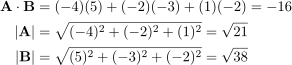
![\begin{aligned} \cos\theta & = \frac{\mathbf{A}\cdot\mathbf{B}}{|\mathbf{A}||\mathbf{B}|} \\ & = \frac{(-16)}{(\sqrt{21})(\sqrt{38})} \\ & = \frac{-16}{\sqrt{798}} \\ \theta & = \arccos \bigg( \frac{-16}{\sqrt{798}} \bigg) \\ & \Bigg[ \textrm{\scriptsize{OR}} \quad \cos^{-1}\bigg( \frac{-16}{\sqrt{798}} \bigg) \Bigg] \end{aligned}](https://physicspupil.com/wp-content/ql-cache/quicklatex.com-f78fea4161372f62dbf5880f9704698f_l3.svg "Rendered by QuickLaTeX.com")
(b) Let the -axis be denoted by the vector  .
.
Then
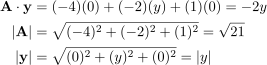
The angle between vector and -axis  is given by
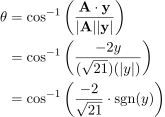
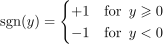
where the sign function  is defined below
Let the -plane be denoted by the plane of vectors  for any
  .
.
Then,
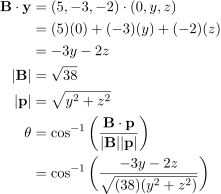
Hold on, I smell a rat. Let’s go another way round. Find the angle  between vector and the
  -axis
-axis  .
.
As a matter of routine, take dot product on and  .
.
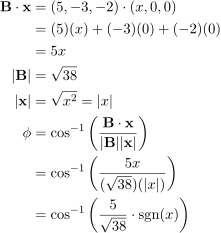
The angle that the vector makes on the -plane is thus  .
.
Back to the original line of thought. I.e.,
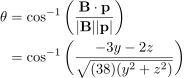
When the vector is projected onto the -plane (i.e.,  ), the angle of projection is defined the angle between and its orthogonal projection
  on that plane. It is clear that
  .
.
The more careful should have I written
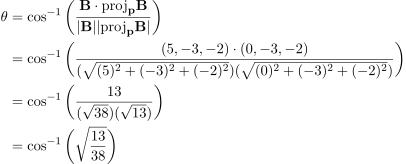
As  , or,
, or, 
 .
.
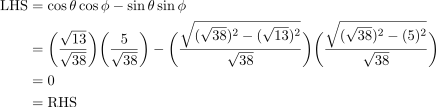
One should check that
 .
.
By brute force
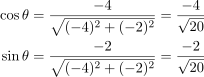
(c) 
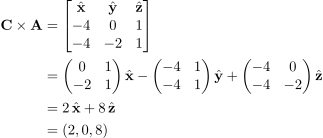
Thus,
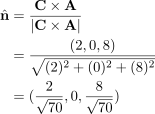
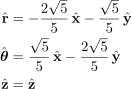
(d)
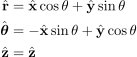
As
 .
.