202104150814 Homework 1 (Q2)

A particle is thrown with speed v_0 and an elevated angle \theta on the floor. The air resistance is negligible.

(a) During the flight, the following quantities are investigated. Determine whether the following items are constants.

i. \displaystyle{\frac{\mathrm{d}v}{\mathrm{d}t}}, where v is the speed of the particle.

ii. \displaystyle{\frac{\mathrm{d}\mathbf{v}}{\mathrm{d}t}}, where \mathbf{v} is the velocity of the particle.

(b) What is the radius of curvature of the path when the particle reaches the highest point?


Answer.

(The solution below is based on the manuscript of 2014-2015 PHYS1250 Fundamental Physics Homework Solutions.)

(a)

i. \displaystyle{\frac{\mathrm{d}v}{\mathrm{d}t}} varies with time.

ii. \displaystyle{\frac{\mathrm{d}\mathbf{v}}{\mathrm{d}t}}=\mathbf{a}=\mathbf{g}=\textrm{Const.}


Explanation.

\begin{aligned} \mathbf{v} & =v_x\,\hat{\mathbf{i}}+v_y\,\hat{\mathbf{j}} \\ & = v_0\cos\theta\,\hat{\mathbf{i}}+\big(v_0\sin\theta -gt\big)\,\hat{\mathbf{j}}\\ v & = |\mathbf{v}| \\ & = \sqrt{(v_0\cos\theta )^2+(v_0\sin\theta -gt)^2} \\ & = \sqrt{v_0^2-2gtv_0\sin\theta +g^2t^2}\\ \frac{\mathrm{d}\mathbf{v}}{\mathrm{d}t} & = \bigg( \frac{\mathrm{d}}{\mathrm{d}t}(v_0\cos\theta ) \bigg)\,\hat{\mathbf{i}} + \bigg(\frac{\mathrm{d}}{\mathrm{d}t}(v_0\sin\theta -gt)\bigg)\,\hat{\mathbf{j}}\\ & = -g\,\hat{\mathbf{j}}\\ & = \mathbf{g} \\ \frac{\mathrm{d}v}{\mathrm{d}t} & = \bigg( \sqrt{v_0^2-2gtv_0\sin\theta +g^2t^2}\bigg)'\\ & = \frac{1}{2}\Big( \sqrt{v_0^2-2gtv_0\sin\theta +g^2t^2}\Big)^{-1} \cdot (-2gv_0\sin\theta + 2g^2t)\\ & \propto t \end{aligned}


(b)

\begin{aligned} a=\frac{v^2}{r} & \Rightarrow g=\frac{v_0^2\cos^2\theta}{r} \\ & \Rightarrow r=\frac{v_0^2\cos^2\theta}{g} \end{aligned}

202104150729 Homework 1 (Q1)

A man starts from the origin and walks 30\,\mathrm{m} due east in 25\,\mathrm{s}. Then, he walks 10\,\mathrm{m} due south in 10\,\mathrm{s} and 18\,\mathrm{m} due northwest in 15\,\mathrm{s}. Please take the paths due east and due north as the positive x and y directions respectively in the Cartesian plane.

(a) Sketch the man’s path on the Cartesian plane.

(b) What is the average velocity of the man?

(c) What is the average speed of the man?


Solution.

(The solution below is based on the manuscript of 2014-2015 PHYS1250 Fundamental Physics Homework Solutions.)

(a)

(b) The average velocity of the man is

\begin{aligned} \mathbf{OC} & = \mathbf{OA} + \mathbf{AB} + \mathbf{BC} \\ & = 30\,\hat{\mathbf{i}} - 10\,\hat{\mathbf{j}} + 18\bigg( -\frac{1}{\sqrt{2}}\,\hat{\mathbf{i}} + \frac{1}{\sqrt{2}}\,\hat{\mathbf{j}} \bigg) \\ & = \bigg( 30-\frac{18}{\sqrt{2}} \bigg) \hat{\mathbf{i}} + \bigg( \frac{18}{\sqrt{2}}-10 \bigg) \,\hat{\mathbf{j}}\\ & = 17.27\,\hat{\mathbf{i}} + 2.73\,\hat{\mathbf{j}} \end{aligned}

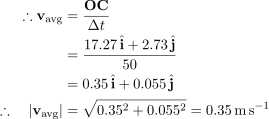
\begin{aligned} \therefore \mathbf{v}_{\textrm{avg}}& =\frac{\mathbf{OC}}{\Delta t} \\ & = \frac{17.27\,\hat{\mathbf{i}} + 2.73\,\hat{\mathbf{j}}}{50} \\ & = 0.35\,\hat{\mathbf{i}} + 0.055\,\hat{\mathbf{j}} \\ \therefore\quad |\mathbf{v}_{\textrm{avg}}| & = \sqrt{0.35^2+0.055^2} = 0.35\,\mathrm{m\, s^{-1}} \end{aligned}

Direction of \mathbf{v}_{\textrm{avg}}:

\begin{aligned} \tan\theta & = \frac{0.055}{0.35}=0.16 \\ \theta & = 8.9^\circ \end{aligned}

(c) The average speed of the man is

\begin{aligned} v_{\textrm{avg}} & = \frac{OA+AB+BC}{\Delta t} \\ & = \frac{30+10+18}{50} \\ & = 1.16\,\mathrm{m\,s^{-1}} \end{aligned}