202211241532 Solution to 2019-DSE-PHY-IA-6

A small ball after projection moves under the effect of gravity only. Its velocity at a certain instant is shown below. What is the speed of the ball 1\,\mathrm{s} before? Neglect air resistance. (g=9.81\,\mathrm{m\,s^{-2}})

This figure is not one original but a modified.


Roughwork.

Assume the angle of projection be \theta (t_0) =\theta_0 with speed v(t_0)=v_0 at launch time t=t_0 such that the resolved x-, y– components

\begin{aligned} v_x(v_0,\theta_0 ) & = v_0\cos\theta_0 \\ v_y(v_0,\theta_0 ,t) & = v_0\sin\theta_0 -gt \\ \end{aligned}

are combined to give the resultant speed at certain instant t:

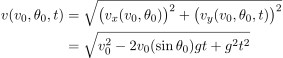
\begin{aligned} v(v_0,\theta_0,t) & =\sqrt{\big(v_x(v_0,\theta_0)\big)^2+\big(v_y(v_0,\theta_0,t)\big)^2} \\ & = \sqrt{v_0^2-2v_0(\sin\theta_0)gt+g^2t^2} \\ \end{aligned}

making with the level angle \theta (t)

\begin{aligned} \theta (v_0,\theta_0,t) & = \arctan\bigg( \frac{v_y(v_0,\theta_0,t)}{v_x(v_0,\theta_0)}\bigg) \\ & = \arctan\bigg( \frac{v_0\sin\theta_0-gt}{v_0\cos\theta_0} \bigg) \\ \end{aligned}

Now that for some instant t=T we are given

\begin{aligned} \theta (v_0,\theta_0,T) & =180^\circ -90^\circ -27^\circ =63^\circ \\ v(v_0,\theta_0,T) & =11\,\mathrm{m\,s^{-1}} \\ \end{aligned}

recall

\displaystyle{y(x) = \bigg(-\frac{g}{2v_0^2\cos^2\theta_0}\bigg) x^2+(\tan\theta_0)x}

Equating

\begin{aligned} \tan\theta \big|_{\theta =63^\circ} & = \frac{\mathrm{d}y}{\mathrm{d}x}\bigg|_{(x_0,y_0)} \\ & = \bigg(-\frac{g}{v_0^2\cos^2\theta_0}\bigg)x_0 +\tan\theta_0 \\ \end{aligned}

Differentiating on \theta (v_0,\theta_0,t) wrt time t:

\begin{aligned} \frac{\mathrm{d}\theta}{\mathrm{d}t} & = \frac{\mathrm{d}}{\mathrm{d}t}\bigg[\arctan \bigg(\frac{v_0\sin\theta_0-gt}{v_0\cos\theta_0}\bigg)\bigg] \\ & = \frac{1}{1+\Big(\frac{v_0\sin\theta_0-gt}{v_0\cos\theta_0}\Big)^2} \\ \theta'(t) & = \frac{v_0^2\cos^2\theta_0}{v_0^2-2v_0(\sin\theta_0)gt+g^2t^2} \\ \end{aligned}

and also on v(v_0,\theta_0,t):

\begin{aligned} \frac{\mathrm{d}v}{\mathrm{d}t} & = \frac{\mathrm{d}}{\mathrm{d}t}\bigg( \sqrt{v_0^2-2v_0\sin\theta_0gt+g^2t^2}\bigg) \\ v'(t) & = \frac{v_0(\sin\theta_0)g+g^2t}{\sqrt{v_0^2-2v_0(\sin\theta_0)gt+g^2t^2}} \\ & = \frac{v_0(\sin\theta_0)g+g^2t}{v_0\cos\theta_0} \cdot \sqrt{\theta'(t)} \\ \end{aligned}

(to be continued)

202211241139 Solution to 1970-HL-PHY-I-4

Two spherical copper bulbs A and B are interconnected through a fine tube. The bulbs are filled with one mole of an ideal gas at temperature 27\,^\circ\mathrm{C}. The gas pressure is found to be one atmosphere, and the volume of bulb B is four times that of bulb A. Now bulb B is immersed in a bath at constant temperature 327\,^\circ\mathrm{C}, while bulb A is maintained at its original temperature. Find the final pressure inside the bulbs, assuming that the volume of the fine tube can be neglected. The coefficient of linear expansion of copper is given as 2\times 10^{-5} per degree Celsius.


Roughwork.

For isotropic materials the volumetric thermal expansion coefficient is three times the linear coefficient:

\alpha_V=3\alpha_L

Wikipedia on Thermal Expansion

Initially,

\begin{aligned} P(V_A+V_B) & = nRT \\ (1.01\times 10^5)(5V_A) & = (1)(8.31)(300) \\ V_A & = 4940\,\mathrm{cm^3} \\ V_B & = 19760\,\mathrm{cm^3}\\ \end{aligned}

finally,

\begin{aligned} P_AV_A & =n_ART_A \\ P_BV_V & =n_BRT_B \\ \end{aligned}

where

\begin{aligned} n_A+n_B & =1 \\ V_A & = 0.00494 \\ V_B & = 0.01976 (1+(3)(2\times 10^{-5})(300))\\ T_A & = 300 \\ T_B & = 600 \\ \end{aligned}

The remaining are left as an exercise to the reader.

202211241033 Solution to 1970-HL-PHY-I-1

Show that, when an object of mass m is weighed by a spring-balance suspended from the ceiling of a lift moving upwards with acceleration a, the reading W' in the spring-balance is given by m(g+a), where g is the acceleration due to gravity. W' is called the apparent weight of the object, and mg the true weight.

It is known that a passenger in a lift will experience discomfort if his appparent weight exceeds his true weight by more than one sixth, or falls short of his true weight by more than one eighth. A lift in a hotel is designed to transport passengers from the ground floor direct to the top floor in the shortest possible time without causing discomfort. Find this time if the distance between the ground floor and the top floor is 100 metres.


Roughwork.

By Newton’s 2nd law,

\begin{aligned} F_{\textrm{net}}& = ma \\ W'-mg & = ma \\ W' & = m(g+a) \\ \end{aligned}

By boundary conditions,

\begin{aligned} & \quad \enspace \begin{cases} \displaystyle{\frac{W'-W}{W}\leqslant \frac{1}{6} }\\ \displaystyle{\frac{W-W'}{W}\leqslant \frac{1}{8} }\\ \end{cases} \\ & \Rightarrow \frac{8W}{9} \leqslant W' \leqslant \frac{7W}{6} \\ & \Rightarrow \frac{8}{9}mg\leqslant m(g+a)\leqslant \frac{7}{6}mg \\ & \Rightarrow -\frac{g}{9} \leqslant a\leqslant \frac{g}{6} \\ & \Rightarrow |a|\leqslant \frac{g}{9} \\ \end{aligned}

Take upward positive and let g=10\,\mathrm{m\,s^{-2}},

\begin{aligned} s & = ut+\frac{1}{2}at^2 \\ (100) & = (0)t + \frac{1}{2}\bigg(\frac{10}{9}\bigg) t^2 \\ t & = 6\sqrt{5}\,\mathrm{s} \\ \end{aligned}

This problem is not to be attempted.

202211240932 Solution to 1965-HL-PHY-I-2

A 1.0\,\mathrm{kg} object rests on a table 1.0\,\mathrm{m} above the floor, and the floor is 4.0\,\mathrm{m} above the street.

(a) What is the potential energy of the object with reference to i. the table top, ii. the floor, and iii. the street?
(b) Now the object is put on the floor. Find the change in potential energy for this decrease of 1.0\,\mathrm{m} in the height of the object when the reference level is i. the table top, ii. the floor, and iii. the street?
(c) Let the object fall freely from the original position on the table. Find its speed and kinetic energy when it reaches the floor.


Roughwork.

(a) Take g=10\,\mathrm{m\,s^{-2}},

i. \textrm{PE}=mgh=(1)(10)(0)=0
ii. \textrm{PE}=mgh=(1)(10)(1)=10\,\mathrm{J}
iii. \textrm{PE}=mgh=(1)(10)(1+4)=50\,\mathrm{J}

(b)

i. h_{\textrm{table}}=0:

\begin{aligned} \Delta\textrm{PE} & = \textrm{PE}_{\textrm{final}} - \textrm{PE}_{\textrm{initial}} \\ & = mgh_f - mgh_i \\ & = (1)(10)(-1) - (1)(10)(0) \\ & = -10\,\mathrm{J} \\ \end{aligned}

ii. h_{\textrm{floor}}=0:

\begin{aligned} \Delta\textrm{PE} & = \textrm{PE}_{\textrm{final}} - \textrm{PE}_{\textrm{initial}} \\ & = mgh_f - mgh_i \\ & = (1)(10)(0) - (1)(10)(1) \\ & = -10\,\mathrm{J} \\ \end{aligned}

iii. h_{\textrm{street}}=0:

\begin{aligned} \Delta\textrm{PE} & = \textrm{PE}_{\textrm{final}} - \textrm{PE}_{\textrm{initial}} \\ & = mgh_f - mgh_i \\ & = (1)(10)(4) - (1)(10)(1+4) \\ & = -10\,\mathrm{J} \\ \end{aligned}

(c) Take downward positive,

\begin{aligned} s & = ut+\frac{1}{2}at^2 \\ (1) & = (0)t + \frac{1}{2}(10)t^2 \\ t & = \frac{\sqrt{5}}{5}\,\mathrm{s} \\ \end{aligned}

\begin{aligned} v & = u + at \\ & = (0) + (10)\bigg(\frac{\sqrt{5}}{5}\bigg) \\ & = 2\sqrt{5}\,\mathrm{m\,s^{-1}} \\ \end{aligned}

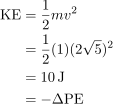
\begin{aligned} \textrm{KE} & =\frac{1}{2}mv^2} \\ & = \frac{1}{2}(1)(2\sqrt{5})^2 \\ & = 10\,\mathrm{J} \\ & = -\Delta\textrm{PE} \\ \end{aligned}

This problem is not to be attempted.