202209300929 Theorem 4.1.3

Prove Theorem 4.1.3.

Let (X,d) and (Y,\rho ) be metric spaces and f:X\to Y be a function. Then, f is continuous at a point x_0 if and only if f(x_n)\to f(x_0), for every sequence \{ x_n\} \subset X with x_n\to x_0.

Extracted from K. J. Pawan & A. Khalil. (2004). Metric Spaces.


Background.

Define, by open spheres, continuity of a function f at a point x_0:

\forall\, x,\exists\, x_0\in X, \forall\, \epsilon >0, \exists\,\delta >0, d(x,x_0)<\delta\Rightarrow \rho (f(x),f(x_0))<\epsilon

in other words,

x\in S_\delta (x_0)\Rightarrow f(x)\in S_\epsilon (f(x_0)),

or the same,

f(S_\delta (x_0))\subset S_\epsilon (f(x_0)).


Proof.

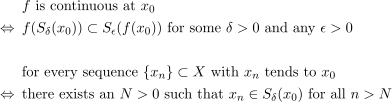
\begin{aligned} & f\textrm{ is continuous at }x_0 \\ \Leftrightarrow\enspace & f(S_\delta (x_0))\subset S_\epsilon (f(x_0))\textrm{ for some } \delta>0\textrm{ and any }\epsilon >0 \\ & \\ & \textrm{for every sequence }\{ x_n\}\subset X\textrm{ with }x_n\textrm{ tends to }x_0 \\ \Leftrightarrow\enspace & \textrm{there exists an }N>0\textrm{ such that }x_n\in S_{\delta}(x_0)\textrm{ for all }n>N \\ \end{aligned}

\begin{aligned} & x_n\in S_\delta (x_0) \Longrightarrow f(x_n)\in f(S_\delta (x_0))\subset S_\epsilon (f(x_0)) \\ \Leftrightarrow\enspace & f(x_n) \to f(x_0) \\ \end{aligned}

202209281521 Problem 5.37

A bead can slide without friction on a circular hoop of radius R in a vertical plane. The hoop rotates at a constant rate of \omega about a vertical diameter, as shown in the figure below.

(a) Find the angle \theta at which the bead is in vertical equilibrium. (Of course it has a radial acceleration toward the axis.)
(b) Is it possible for the bead to “ride” at the same elevation as the centre of the hoop?
(c) What will happen if the hoop rotates at a slower rate \omega' = \omega /2?

Modified from H. D. Young. (1989). University Physics.


Roughwork.

(a)

Kinetic energy T:

\begin{aligned} T & = \frac{1}{2}mv^2 \\ \dots\enspace v & = r\omega \enspace\dots \\ T & = \frac{1}{2}mr^2\omega^2 \\ \dots\enspace r & = R\sin\theta \enspace\dots \\ T & = \frac{1}{2}mR^2\omega^2\sin^2\theta \\ \end{aligned}

Potential energy V:

\begin{aligned} V & = mg(R-R\cos\theta ) \\ & = mgR(1-\cos\theta ) \\ \end{aligned}

Lagrangian \mathcal{L}=T-V:

\displaystyle{\mathcal{L}=\frac{1}{2}mR^2\omega^2\sin^2\theta-mgR(1-\cos\theta )}

Euler–Lagrange equation:

\displaystyle{\frac{\mathrm{d}}{\mathrm{d}t}\bigg(\frac{\partial\mathcal{L}}{\partial \dot{\theta}}\bigg)-\frac{\partial\mathcal{L}}{\partial \theta}=0}

Thereby

\begin{aligned} \frac{\partial\mathcal{L}}{\partial\dot{\theta}} & = 0 \quad \textrm{and}\quad \frac{\mathrm{d}}{\mathrm{d}t}\bigg(\frac{\partial\mathcal{L}}{\partial\dot{\theta}}\bigg) = 0 \\ \frac{\partial\mathcal{L}}{\partial\theta} & = mR^2\omega^2\sin\theta\cos\theta -mgR\sin\theta \\ \end{aligned}

The bead is in vertical equilibrium when:

mR^2\omega^2\sin\theta\cos\theta -mgR\sin\theta =0

solving for \theta then :

\begin{aligned} 0 & = (mR\sin\theta )(R\omega^2\cos\theta -g) \\ \theta & = 0\enspace\textrm{ (rej.)}\quad\textrm{\scriptsize{OR}}\quad \cos^{-1}\bigg(\frac{g}{R\omega^2}\bigg) \\ \end{aligned}

(b)

\theta\to 90^\circ iff R\omega^2\gg g.

(c) This is left as an exercise to the reader.

202209281050 Exercise 22.2 (Q23)

An electric field is given by \overrightarrow{E}=E_0\,\hat{\jmath}, where E_0 is a constant. Find the potential as a function of position, taking V=0 at y=0.

Extracted from R. Wolfson. (2016). Essential University Physics.


Background.

Electric field vector \overrightarrow{E} is related to electric potential V by:

\displaystyle{\overrightarrow{E}= -\bigg( \frac{\partial V}{\partial x}\,\hat{\mathbf{i}} + \frac{\partial V}{\partial y}\,\hat{\mathbf{j}} + \frac{\partial V}{\partial z}\,\hat{\mathbf{k}} \bigg)}

or reversely,

\displaystyle{V(r)=-\int\overrightarrow{E}\cdot\mathrm{d}\vec{r}}.


Write

\displaystyle{(0,E_0,0) = \bigg( -\frac{\partial V}{\partial x},-\frac{\partial V}{\partial y},-\frac{\partial V}{\partial z}\bigg) }

that implies V=V(y) is x– and z-independent.

Hence

\begin{aligned} V(y) & = -\int E_0\,\mathrm{d}y \\ & = -E_0y+C\qquad \textrm{for some constant }C \\ \because\enspace 0 & = V(y=0) = -E_0(0)+C \\ \Rightarrow C& = 0 \\ \therefore\enspace V&=V(y)=-E_0y\\ \end{aligned}

202209281002 Exercise 14.2 (Q24)

Analysis of waves in shallow water (depth much less than wavelength) yields the following wave equation:

\displaystyle{\frac{\partial^2y}{\partial x^2}=\frac{1}{gh}\frac{\partial^2y}{\partial t^2}}

where h is the water depth and g the gravitational acceleration. Give an expression for the wave speed.

Extracted from R. Wolfson. (2016). Essential University Physics.


(top-down approach)

Write a traveling sinusoidal wave in the form

y(x,t)=A\cos (kx\pm \omega t)

the wave speed v being such as

\displaystyle{v=\frac{\lambda}{T}=\frac{2\pi /k}{2\pi /\omega}=\frac{\omega}{k}}.

\begin{aligned} \textrm{LHS} & = \frac{\partial^2y}{\partial x^2} \\ & = \frac{\partial}{\partial x}\bigg(\frac{\partial}{\partial x}\big( A\cos (kx\pm\omega t)\big) \bigg) \\ & = \frac{\partial}{\partial x}\big( kA\sin (kx\pm\omega t)\big) \\ & = -k^2A\cos (kx\pm\omega t) \\ \textrm{RHS} & = \frac{1}{gh}\frac{\partial^2y}{\partial t^2} \\ & = \frac{1}{gh}\frac{\partial}{\partial t}\bigg(\frac{\partial}{\partial t}\big( A\cos (kx\pm\omega t)\big)\bigg) \\ & = \frac{1}{gh}\frac{\partial}{\partial t}\big(\omega A\sin (kx\pm\omega t)\big) \\ & = \frac{1}{gh}\big( -\omega^2A\cos (kx\pm\omega t)\big) \\ \textrm{LHS} & = \textrm{RHS} \\ \Rightarrow v = \frac{\omega}{k} & = \sqrt{gh} \\ \end{aligned}

\therefore The wave speed v is given by v=\sqrt{gh}.

202209271040 Exercise 8.4 (Q53)

Neglecting the Earth’s rotation, show that the energy needed to launch a satellite of mass m into circular orbit at altitude h is

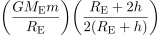
\displaystyle{\bigg( \frac{GM_\textrm{E}m}{R_{\textrm{E}}}\bigg)\bigg(\frac{R_{\textrm{E}}+2h}{2(R_{\textrm{E}}+h)}\bigg)}.

Extracted from R. Wolfson. (2016). Essential University Physics.


Abortive attempt.

(energy/work-done approach)

By conservation of mechanical energy,

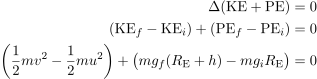
\begin{aligned} \Delta (\textrm{KE}+\textrm{PE}) & = 0 \\ (\textrm{KE}_f-\textrm{KE}_i) + (\textrm{PE}_f-\textrm{PE}_i) & = 0 \\ \bigg(\frac{1}{2}mv^2 - \frac{1}{2}mu^2\bigg) + \big(mg_f(R_\textrm{E}+h)-mg_iR_\textrm{E}\big) & = 0 \\ \end{aligned}

as

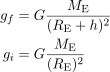
\begin{aligned} g_f & = G\frac{M_\textrm{E}}{(R_\textrm{E}+h)^2} \\ g_i & = G\frac{M_\textrm{E}}{(R_\textrm{E})^2} \\ \end{aligned}

On the one hand, the gravitational pull provides the centripetal force for revolving at the orbital speed v:

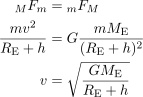
\begin{aligned} \text{}_MF_m & = \text{}_mF_M \\ \frac{mv^2}{R_{\textrm{E}}+h} & = G\frac{mM_\textrm{E}}{(R_{\textrm{E}}+h)^2} \\ v & = \sqrt{\frac{GM_\textrm{E}}{R_{\textrm{E}}+h}} \\ \end{aligned}

On the other hand, the escape speed u of the satellite is

\begin{aligned} \frac{1}{2}mu^2 & = G\frac{mM_\textrm{E}}{R_\textrm{E}} \\ u & = \sqrt{\frac{2GM_\textrm{E}}{R_\textrm{E}}} \\ \end{aligned}

but what is this question asking for?

\Delta\textrm{KE}=\displaystyle{\frac{m(v^2-u^2)}{2}}

(to be continued)

202209271004 Exercise 4.5 (Q31)

An elevator accelerates downward at 2.4\,\mathrm{m\, s^{-2}}. What force does the elevator’s floor exert on a 52\,\mathrm{kg} passenger?

Extracted from R. Wolfson. (2016). Essential University Physics.


Roughwork.

Take downward positive, \downarrow\textrm{+ve}. By Newton’s 2nd Law,

\mathbf{F}_{\textrm{net}}=m\mathbf{a}.

Given m=52\,\mathrm{kg}. Let F be the unknown magnitude of force:

\begin{aligned} \mathbf{a} & = 2.4\,\hat{\mathbf{k}} \\ \mathbf{F}_\textrm{net} & = -F\,\hat{\mathbf{k}}+mg\,\hat{\mathbf{k}} \\ & = (-F+mg)\,\hat{\mathbf{k}} \\ \end{aligned}

Then,

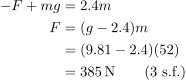
\begin{aligned} -F+mg & = 2.4m \\ F & = (g-2.4)m \\ & = (9.81-2.4)(52) \\ & = 385\,\mathrm{N}\qquad \textrm{(3 s.f.)} \end{aligned}

\therefore The force the elevator’s floor exerts on the passenger is 385\,\mathrm{N} upward.

202209270930 Exercise 5.3.B (Q1-Q6)

1. What is the potential energy of a 10\,\mathrm{kg} mass 25 metres above the ground?
2. A 3\,\mathrm{kg} mass is 20\,\mathrm{m} above the ground. How much potential energy does it have?
3. How high must you raise a 25\,\mathrm{kg} mass before it has a potential energy of 8500\,\mathrm{J}?
4. How high must you raise a 2\,\mathrm{kg} mass before it has a potential energy of 10\,\mathrm{J}?
5. A mass has a potential energy of 1000\,\mathrm{J} when it is 40\,\mathrm{m} above ground level. What is the mass?
6. A mass has a potential energy of 20\,\mathrm{J} when it is 50\,\mathrm{cm} above ground level. What is the mass?
Extracted from B. Kennedy. (1999). Progressive Problems for ‘S’ Grade Physics.


Background.

\textrm{PE}=mgh

Roughwork.

1.

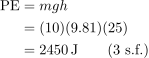
\begin{aligned} \textrm{PE} & = mgh \\ & = (10)(9.81)(25) \\ & = 2450\,\mathrm{J}\qquad \textrm{(3 s.f.)} \\ \end{aligned}

2.

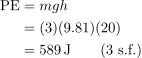
\begin{aligned} \textrm{PE} & = mgh \\ & = (3)(9.81)(20) \\ & = 589\,\mathrm{J}\qquad \textrm{(3 s.f.)} \end{aligned}

3.

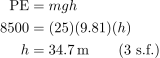
\begin{aligned} \textrm{PE} & = mgh \\ 8500 & = (25)(9.81)(h) \\ h & = 34.7\,\mathrm{m}\qquad \textrm{(3 s.f.)} \end{aligned}

4.

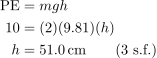
\begin{aligned} \textrm{PE} & = mgh \\ 10 & = (2)(9.81)(h) \\ h & = 51.0\,\mathrm{cm}\qquad \textrm{(3 s.f.)} \end{aligned}

5.

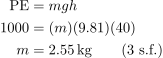
\begin{aligned} \textrm{PE} & = mgh \\ 1000 & = (m)(9.81)(40) \\ m & = 2.55\,\mathrm{kg}\qquad \textrm{(3 s.f.)} \end{aligned}

6.

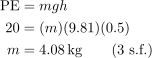
\begin{aligned} \textrm{PE} & = mgh \\ 20 & = (m)(9.81)(0.5) \\ m & = 4.08\,\mathrm{kg}\qquad \textrm{(3 s.f.)} \end{aligned}