

202104142106 Notes on Schrödinger equation for the delta-function barrier
The Schrödinger equation for the delta-function barrier reads

It yields both bound states ( ) and scattering states (
 ). For the time being we consider only scattering states.
For  ,
,  .
.
The Schrödinger equation reads
 ,
,
where  is real and positive.
The general solution being
 ,
,
and this time we cannot rule out either term, since neither of them blows up. Similarly, for  ,
,

The continuity of  at
at  requires that

The derivatives are
 for ;
for ;
 for .
for .
Here we define

Hence,  .
.
By the second boundary condition, we have
 ,
,
which in turn gives
 .
.
Combining the results of first derivative continuity and second boundary condition, we write
 ,
,
Calculations:

Suppose the wave is coming from the left so that there will be no wave scattering from the right, i.e.,  .
.
Recall that  by the continuity condition.
Calculations:


Reflection coefficient  :
:

We could find the transmission coefficient  in two ways:
(1) By the formula  ; or
; or
(2) By the fact that the sum of reflection coefficient and transmission coefficient has to be unity,
i.e.,  .
.
Calculations:
By (2):

Notice that and are functions of  , hence:
 ,
,
 .
.
Readers should verify this result.
Compare this delta-function barrier with the delta-function trap, we notice that the reflection coefficient and transmission coefficient are each identical respectively in two cases.
202104142057 Sidenote on “deriving momentum operator”
![\begin{aligned} \langle x\rangle &:= \int_{-\infty}^{+\infty}x|\Psi (x,t)|^2\,\mathrm{d}x.\\ \frac{\mathrm{d}\langle x\rangle}{\mathrm{d}t} & = \int_{-\infty}^{+\infty}x\frac{\partial}{\partial t}|\Psi (x,t)|^2\,\mathrm{d}x.\\ & = \int_{-\infty}^{+\infty}x\frac{i\hbar}{2m}\Bigr(\Psi^*\frac{\partial^2\Psi}{\partial x^2}-\frac{\partial^2\Psi^*}{\partial x^2}\Psi \Bigr)\,\mathrm{d}x\\ & = \frac{i\hbar}{2m}\int_{-\infty}^{+\infty}(x)\Bigr(\Psi^*\frac{\partial^2\Psi}{\partial x^2}+ \frac{\partial \Psi \partial \Psi^*}{\partial x^2}-\frac{\partial^2\Psi^*}{\partial x^2}\Psi -\frac{\partial \Psi \partial \Psi^*}{\partial x^2}\Bigr)\,\mathrm{d}x\\ & =\frac{i\hbar}{2m}\int_{-\infty}^{+\infty}(x)\Bigr[\frac{\partial}{\partial x}\Bigr(\Psi^*\frac{\partial \Psi}{\partial x}\Bigr)- \frac{\partial}{\partial x}\Bigr(\Psi \frac{\partial \Psi^*}{\partial x}\Bigr)\Bigr]\,\mathrm{d}x\\ &= \frac{i\hbar}{2m}\int_{-\infty}^{+\infty}\frac{\partial}{\partial x}(x)\Bigr(\Psi^*\frac{\partial \Psi}{\partial x}-\Psi \frac{\partial \Psi^*}{\partial x}\Bigr)\,\mathrm{d}x\\ &= -\frac{i\hbar}{2m}\int_{-\infty}^{+\infty}\Bigr(\Psi^*\frac{\partial \Psi}{\partial x}-\Psi \frac{\partial \Psi^*}{\partial x}\Bigr)\,\mathrm{d}x\\ &= -\frac{i\hbar}{2m}\Bigr[\int_{-\infty}^{+\infty}\Bigr(\Psi^*\frac{\partial \Psi}{\partial x}\,\mathrm{d}x\Bigr)-\int_{-\infty}^{+\infty}\Bigr(\Psi \frac{\partial \Psi^*}{\partial x}\Bigr)\,\mathrm{d}x\Bigr]\\ &= -\frac{i\hbar}{2m}\Bigr[\Bigr(\Psi^*\Psi \Bigr|^{+\infty}_{-\infty}-\int_{-\infty}^{+\infty}\Psi \frac{\partial \Psi^*}{\partial x}\,\mathrm{d}x\Bigr)-\Bigr(\Psi \Psi^* \Bigr|^{+\infty}_{-\infty}-\int_{-\infty}^{+\infty}\Psi^* \frac{\partial \Psi}{\partial x}\,\mathrm{d}x\Bigr) \Bigr]\\ & = -\frac{i\hbar}{2m}\Bigr( 0-\int_{-\infty}^{+\infty}\Psi \frac{\partial \Psi^*}{\partial x}\,\mathrm{d}x-0+\int_{-\infty}^{+\infty}\Psi^* \frac{\partial \Psi}{\partial x}\,\mathrm{d}x\Bigr) \end{aligned}](https://physicspupil.com/wp-content/ql-cache/quicklatex.com-a7f1de4cb98287d401545aa67323709f_l3.svg "Rendered by QuickLaTeX.com")
![\begin{aligned} \frac{\mathrm{d}\langle x\rangle}{\,\mathrm{d}t} & = -\frac{i\hbar}{2m}\Bigr[-\Bigr(\Psi \Psi^* \Bigr|^{+\infty}_{-\infty}-\int_{-\infty}^{+\infty}\Psi^* \frac{\partial \Psi}{\partial x}\,\mathrm{d}x\Bigr)+\int_{-\infty}^{+\infty}\Psi^* \frac{\partial \Psi}{\partial x}\,\mathrm{d}x\Bigr]\\ &= -\frac{i\hbar}{2m}\Bigr(2 \int_{-\infty}^{+\infty}\Psi^* \frac{\partial \Psi}{\partial x}\,\mathrm{d}x\Bigr)\\ &= -\frac{i\hbar}{m}\int_{-\infty}^{+\infty}\Psi^* \frac{\partial \Psi}{\partial x}\,\mathrm{d}x\\ &= \frac{\hbar}{im}\int_{-\infty}^{+\infty}\Psi^* \frac{\partial \Psi}{\partial x}\,\mathrm{d}x\\ \langle p\rangle & := m\frac{\mathrm{d}\langle x\rangle}{\,\mathrm{d}t}\\ & = \int_{-\infty}^{+\infty}\Psi^* \Bigr(\frac{\hbar}{i}\frac{\partial}{\partial x}\Bigr)\Psi \,\mathrm{d}x \end{aligned}](https://physicspupil.com/wp-content/ql-cache/quicklatex.com-d94103f9d986840349fc21aa7ccb9e8f_l3.svg "Rendered by QuickLaTeX.com")
202104161839 Homework 1 (Q2)
At time  a particle is represented by the wave function

where  ,
,  are constants.
(a) Normalize  (that is, find in terms of
  ).
).
(b) Sketch  as a function of .
(c) Where is the particle most likely to be found, at ?
(d) What is the probability of finding the particle to the left of .
(e) What is the expectation value of ?
(a)
![\begin{aligned} 1 & = \int_{-\infty}^{+\infty}|\Psi |^2\,\mathrm{d}x \\ & = \int_{0}^{a}\frac{|A|^2x^2}{a^2}\,\mathrm{d}x + \int_{a}^{2a}|A|^2[(x-a)+1]^2\,\mathrm{d}x+\int_{2a}^{3a}|A|^2(a+1)^2\bigg( \frac{3a-x}{a}\bigg)^2\,\mathrm{d}x \\ & = \frac{|A|^2}{a^2}\bigg[\frac{x^3}{3}\bigg]\bigg|^a_{0} + |A|^2\bigg[\frac{\big( (x-a)+1\big)^3}{3}\bigg]\bigg|_{1}^{a+1} + |A|^2\bigg(\frac{a+1}{a}\bigg)^2\bigg[\frac{(x-3a)^3}{3}\bigg]\bigg|_{-a}^{0} \\ & = \frac{|A|^2a}{3} + |A|^2\bigg(\frac{(2)^3}{3} - \frac{(2-a)^3}{3} \bigg) + |A|^2\bigg( \frac{a+1}{a} \bigg)^2\bigg( \frac{(-3a)^3}{3} - \frac{(-4a)^3}{3} \bigg) \\ \dots \enspace & \textrm{ (to be continued) }\dots \end{aligned}](https://physicspupil.com/wp-content/ql-cache/quicklatex.com-7c25859cda6f633a23a1cd20c586d619_l3.svg "Rendered by QuickLaTeX.com")
Roughwork.
Simplifying the second term,
![\begin{aligned} &\quad |A|^2\bigg(\frac{(2)^3}{3} - \frac{(2-a)^3}{3} \bigg) \\ & = |A|^2\bigg[ \bigg(\frac{8}{3}\bigg) -\bigg( \frac{8-12a+6a^2-a^3}{3}\bigg) \bigg] \\ & = |A|^2\bigg( \frac{4}{3}a - 2a^2 + \frac{a^3}{3}\bigg) \end{aligned}](https://physicspupil.com/wp-content/ql-cache/quicklatex.com-b5598d83f3f607e81840ab69661cf4fa_l3.svg "Rendered by QuickLaTeX.com")
Simplifying the third term,

![\begin{aligned} \dots\enspace &\textrm{ (continue) }\dots \\ 1 & = |A|^2 \bigg[ \bigg( \frac{1}{3} + \frac{4}{3} + \frac{37}{3} \bigg) a + \bigg( -2+\frac{74}{3} \bigg) a^2 + \bigg( \frac{1}{3}+\frac{37}{3} \bigg) a^3 \bigg] \\ 1 & = |A|^2 \bigg( 14a + \frac{68}{3}a^2 + \frac{38}{3}a^3 \bigg) \\ A & = \frac{1}{\sqrt{14a+\frac{68}{3}a^2+\frac{38}{3}a^3}} \end{aligned}](https://physicspupil.com/wp-content/ql-cache/quicklatex.com-0f7d4e3939a7b65ea4c5576753d6c767_l3.svg "Rendered by QuickLaTeX.com")
(b)

(c)
at  where
where  attains its maximum value.
(d)

(e)
![\begin{aligned} \langle x\rangle & = \int_{0}^{3a}x|\Psi |^2\,\mathrm{d}x \\ & = |A|^2\bigg( \int_{0}^{a}\frac{x^3}{a^2}\,\mathrm{d}x + \int_{a}^{2a}[(x-a)^2+1]^2x\,\mathrm{d}x + \int_{2a}^{3a}(a^2+1)^2\bigg(\frac{3a-x}{a}\bigg)^2 x\,\mathrm{d}x \bigg) \\ \dots\enspace & \textrm{ (to be continued) }\dots \end{aligned}](https://physicspupil.com/wp-content/ql-cache/quicklatex.com-5ac422628c70bb566b887d4e55d6b18d_l3.svg "Rendered by QuickLaTeX.com")
202104080551 Solution to 1973-AL-AMATH-I-5
A particle of mass  moving in a straight line in a medium with a velocity
  is subjected to a force
  in the direction opposite to the velocity, where
  and are constants. Show that, at any subsequent time
  , the velocity is related to the initial velocity
  by
by
 .
.
Show that for any value of the initial velocity, no matter how large, the particle will never travel a distance greater than  .
.
Background.
Newton's second law: 

(to be continued)
Roughwork.
Let  . Then,


Thus,

(continue)

The first term is
![\begin{aligned} \int_{v_0}^v\frac{1}{a^2\dot{x}}\,\mathrm{d}\dot{x} & = \bigg[ \frac{\ln \dot{x}}{a^2} \bigg]\bigg|_{v_0}^{v} \\ & = \bigg( \frac{\ln v}{a^2} \bigg) - \bigg( \frac{\ln v_0}{a^2} \bigg) \\ & = \frac{1}{a^2}\ln \bigg( \frac{v}{v_0} \bigg) \end{aligned}](https://physicspupil.com/wp-content/ql-cache/quicklatex.com-731780f929bb3577e564cb7867616e7d_l3.svg "Rendered by QuickLaTeX.com")
and the second term is
![\begin{aligned} &\quad -\int_{v_0}^v \frac{\dot{x}}{a^2(\dot{x}^2+a^2)}\,\mathrm{d}\dot{x}\\ \dots & \textrm{ let } \dot{x}=a\tan\theta \enspace\dots \\ \dots & \textrm{ let } \theta = \tan^{-1}\bigg(\frac{v}{a}\bigg) \textrm{ and } \theta_0 = \tan^{-1}\bigg(\frac{v_0}{a}\bigg) \\ & = -\int_{\theta_0}^{\theta} \frac{a\tan\theta}{a^2(a^2\tan^2\theta +a^2)}\cdot (a\sec^2\theta)\,\mathrm{d}\theta \\ & = -\int_{\theta_0}^{\theta} \frac{\tan\theta}{a(a^2\sec^2\theta)}\cdot (a\sec^2\theta )\,\mathrm{d}\theta \\ & = -\int_{\theta_0}^{\theta} \frac{\tan\theta}{a^2}\,\mathrm{d}\theta \\ & = -\bigg[ -\frac{\ln |\cos\theta |}{a^2} \bigg]\bigg|_{\theta_0}^{\theta} \\ & = \frac{1}{a^2} \bigg[\ln \bigg| \frac{a}{\sqrt{\dot{x}^2+a^2}} \bigg|\bigg]\bigg|_{v_0}^{v} \\ & = \frac{1}{a^2} \bigg( \ln\bigg| \frac{a}{\sqrt{v^2+a^2}} \bigg| -\ln\bigg| \frac{a}{\sqrt{v_0^2+a^2}} \bigg| \bigg) \\ & = \frac{1}{a^2} \ln \bigg( \frac{\sqrt{v_0^2+a^2}}{\sqrt{v^2+a^2}} \bigg) \\ \end{aligned}](https://physicspupil.com/wp-content/ql-cache/quicklatex.com-221495c4abeae3d861ff252f381d62f4_l3.svg "Rendered by QuickLaTeX.com")
Back to an earlier line

we have

or,

as desired.
It remains to be shown that for any value of the initial velocity, no matter how large, the particle will never travel a distance greater than .
(to be continued)
202104060103 Solution to 1973-AL-AMATH-I-2
When a pan of mass is put on top of a vertical spring scale of negligible weight, the downward displacement of the spring is observed to be  . A ball of mass
  is now dropped from a height
  above the pan onto the pan. Suppose that the coefficient of restitution is equal to zero.
i. Show that the velocity of the pan immediately after the impact is
 .
.
ii. From energy considerations, determine the maximum deflection of the pan after the ball has been dropped onto it.
Note: Force in spring scale is proportional to displacement.
Solution. (bad, if not wrong)
i.
Background.
1. If the coefficient of restitution is zero, the collision is perfectly inelastic.
2. Recall Hooke’s law:

Let be the time it takes for the ball to free-fall a vertical distance .

The velocity of the ball right before the impact is given by

By conservation of linear momentum,

is the velocity of the ball and the pan immediately after collision.
ii.
Setup.
From Hooke’s law, the spring force is given by  , or
, or  . The spring constant, characteristic of the spring, is
  . Let be the magnitude of downward displacement of the spring from its relaxed position in reaching the final state of equilibrium. Then,

By the law of conservation of energy,


Thus,

 The maximum deflection of the pan after the ball has been dropped onto it is
 .
.
Done. Let’s overdo.
ii. (energy approach)
One can derive the equation of motion by considering energy conservation:

or, by considering the Euler-Lagrange equation

where the Lagrangian  is defined

and then computing,

the Euler-Lagrange equation now reads

which agrees with the equation of motion derived previously.
ii. (force approach)
One can also derive the equation of motion by considering Newton’s second law:

(to be continued)
Remark.
The effective displacement  is defined by
 .
.
Substituting the spring constant with
 ,
,
can be rewritten as
 .
.
As seen in ii. Setup,

is the equilibrium position.
The effective displacement is thus the distance extended or compressed with reference to the equilibrium position.
(continue)

The constant coefficients (i.e.,  ,
,  ) should be obtained from the initial and boundary conditions.
Let be the instant the ball hits on the pan.
When ,

As the velocity of the pan immediately after the impact
was found in part (i) to be
,
so


If there is no friction or none any other dissipation of energy, the spring will continue indefinitely and uninhibitedly its simple harmonic motion.
(to be continued)
Aside.
The angular frequency  (
( ) is
) is
 .
.
Hence the frequency  is
is
 ,
,
and the period is
 .
.
At time  , the spring is at the equilibrium position (i.e.,
  ), whereas at time(s)
  , it reaches the extreme points (i.e.,
  ).
).
(continue)
Lemma.
The sinusoidal function

can be written in the form

where  and
and  .
.
The amplitude (i.e., above) is the maximum displacement of the spring from its equilibrium position.

202104160738 Solution to 1970-AL-PMATH-II-8
(a) Find the values of the constants ,  so that
 for all .
Hence or otherwise, find the indefinite integral
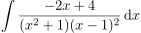 .
.
(b) Find the following indefinite integrals:
i.  ;
;
ii. 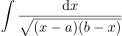 .
.
Solution.
(a)
![\begin{aligned} \textrm{RHS} & = \frac{(Ax+B)(x-1)^2-2(x^2+1)(x-1)+(x^2+1)}{(x^2+1)(x-1)^2} \\ & = \frac{[Ax^3+(B-2A)x^2+(A-2B)x+B]-[2(x^3-x^2+x-1)]+(x^2+1)}{(x^2+1)(x-1)^2} \\ & = \frac{(A-2)x^3+(B-2A+3)x^2+(A-2B-2)x+(B+3)}{(x^2+1)(x-1)^2} \\ & = \textrm{LHS} \end{aligned}](https://physicspupil.com/wp-content/ql-cache/quicklatex.com-356b6f2c0f7f264a2475ee0049d2c1c2_l3.svg "Rendered by QuickLaTeX.com")
Comparing coefficients,
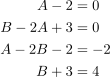
one gets  and
and  .
.
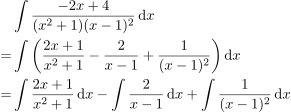
Evaluating term-by-term, the first term
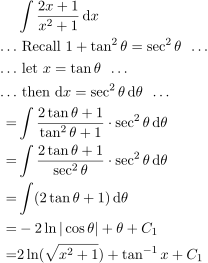
the second term
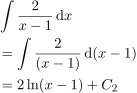
and the third term
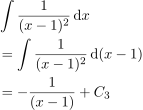
Therefore
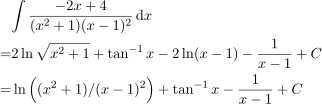
(b)
i.
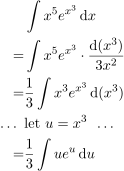
(to be continued)
Recall integration by parts from the product rule of differentiation
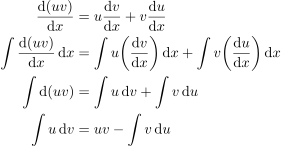
(continue)
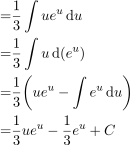
ii. It is left the reader.
202104031305 Homework 1 (Q1)
Given two vectors  and
and  .
.
(a) Determine the angle  between
  and
and  .
.
(b) Determine the angle that the vector makes with the  -axis, and the angle that the vector makes on the
  -plane when it is projected on it.
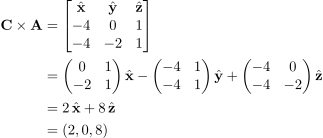
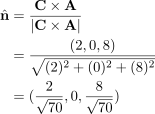
(c) The vector  is the projection of vector on the
  -plane. Determine the unit vector along the direction of
  .
.
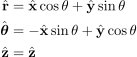
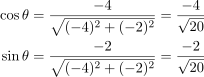
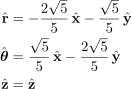
(d) Express the vector in terms of cylindrical coordinates, i.e.,  , with vectors
  ,
,  , and
, and  defined by the vector . Determine the unit vectors , , and in terms of
  ,
,  , and , and the values of the coefficients
  ,
,  , and
, and  .
.
Solution.
(a) By the identity  where is the angle between vectors and ,
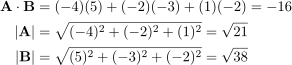
![\begin{aligned} \cos\theta & = \frac{\mathbf{A}\cdot\mathbf{B}}{|\mathbf{A}||\mathbf{B}|} \\ & = \frac{(-16)}{(\sqrt{21})(\sqrt{38})} \\ & = \frac{-16}{\sqrt{798}} \\ \theta & = \arccos \bigg( \frac{-16}{\sqrt{798}} \bigg) \\ & \Bigg[ \textrm{\scriptsize{OR}} \quad \cos^{-1}\bigg( \frac{-16}{\sqrt{798}} \bigg) \Bigg] \end{aligned}](https://physicspupil.com/wp-content/ql-cache/quicklatex.com-f78fea4161372f62dbf5880f9704698f_l3.svg "Rendered by QuickLaTeX.com")
(b) Let the -axis be denoted by the vector  .
.
Then
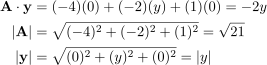
The angle between vector and -axis  is given by
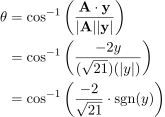
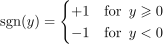
where the sign function  is defined below
Let the -plane be denoted by the plane of vectors  for any
  .
.
Then,
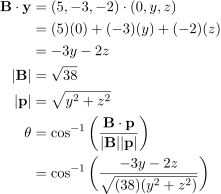
Hold on, I smell a rat. Let’s go another way round. Find the angle  between vector and the -axis
  .
.
As a matter of routine, take dot product on and  .
.
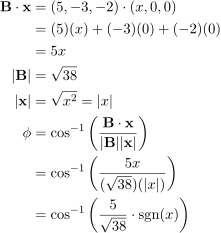
The angle that the vector makes on the -plane is thus  .
.
Back to the original line of thought. I.e.,
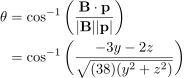
When the vector is projected onto the -plane (i.e.,  ), the angle of projection is defined the angle between and its orthogonal projection
  on that plane. It is clear that
  .
.
The more careful should have I written
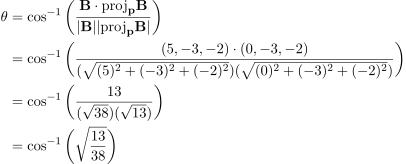
As  , or,
, or, 
 .
.
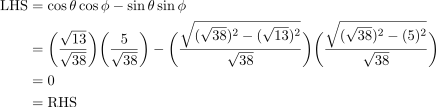
One should check that
 .
.
By brute force
(c) 
Thus,
(d)
As
 .
.