Suppose  is differentiable. Find the expression

in terms of polar coordinates  and
and  .
.
Solution.

Setup.


(to be continued)
Lemma.

Wikipedia on Cramer’s rule
(continue)
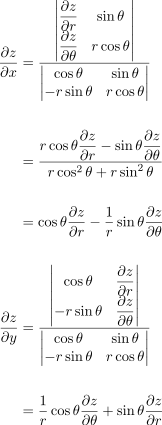
Thus,
![\begin{aligned} & \quad\bigg( \frac{\partial z}{\partial x}\bigg)^2 + \bigg( \frac{\partial z}{\partial y}\bigg)^2 \\ \\ & = \bigg[ \cos\theta\frac{\partial z}{\partial r} - \frac{1}{r}\sin\theta\frac{\partial z}{\partial \theta} \bigg]^2 + \bigg[ \frac{1}{r}\cos\theta\frac{\partial z}{\partial \theta} + \sin\theta\frac{\partial z}{\partial r} \bigg]^2 \\ \\ & = \cos^2\theta \bigg( \frac{\partial z}{\partial r}\bigg)^2 - \frac{\sin 2\theta}{r}\bigg(\frac{\partial z}{\partial r}\bigg)\bigg(\frac{\partial z}{\partial \theta}\bigg) + \frac{1}{r^2}\sin^2\theta \bigg(\frac{\partial z}{\partial \theta}\bigg)^2 \\ & \qquad\qquad + \frac{1}{r^2}\cos^2\theta \bigg(\frac{\partial z}{\partial \theta}\bigg)^2 + \frac{\sin 2\theta}{r}\bigg(\frac{\partial z}{\partial r}\bigg)\bigg(\frac{\partial z}{\partial \theta}\bigg) + \sin^2\theta \bigg( \frac{\partial z}{\partial r}\bigg)^2 \\ \\ & = \bigg( \frac{\partial z}{\partial r} \bigg)^2 + \frac{1}{r^2} \bigg( \frac{\partial z}{\partial \theta} \bigg)^2 \end{aligned}](https://physicspupil.com/wp-content/ql-cache/quicklatex.com-027fe494b0d143e6a6833563a4b3825b_l3.svg "Rendered by QuickLaTeX.com")

物理子衿
Suppose is differentiable. Find the expression
in terms of polar coordinates and .
Solution.
Setup.
(to be continued)
Lemma.
Wikipedia on Cramer’s rule
(continue)
Thus,
The angle  of a triangle
  is increasing at a rate of
  , the side of
  is increasing at a rate of
  , and the side of
  is decreasing at a rate of
  . How fast is the side
  changing when
  ,
,  , and
, and  ? Is the length of increasing or decreasing?
Solution.
Draw a figure below:

Rephrase the problem.
Given that

If ,  , and
, and  ,
,
then 
By cosine law,
 .
.
Taking ordinary derivatives w.r.t. time  ,
,

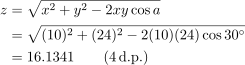
Plugging in the value of each,

you will know what  is.
is.
But now, I intend to treat it with partial derivatives.
Let  .
.

After  is sought, recognise that

you could have it also.
(to be continued)
A ship  , which can sail at a constant speed
  to meet a second ship
  which is
  away in the direction of
  and is sailing due east at constant speed
  . Find the sailing direction of and the time required to meet .
Solution.
(The solution below is based on the manuscript of 2014-2015 PHYS1250 Fundamental Physics Homework Solutions.)
Draw a diagram as follows:


Setup.

By the law of sines,
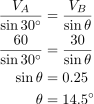
Direction of  :
: 

Calculating  :
:

The time needed to meet ship is

A particle is projected from a point  on the horizontal floor. The range of the projectile is
  and the maximum height that the particle can reach is
  . Show that the equation of trajectory of the particle is
 .
.

Solution.
(The solution below is based on the manuscript of 2014-2015 PHYS1250 Fundamental Physics Homework Solutions.)
The trajectory of projectile motion must be a parabola, which can be expressed in the form of a quadratic equation:
 ;
;
And since the particle passes through the points  and
and  , the equation of trajectory can be expressed in the form:
 .
.
When the particle has traveled a horizontal distance  , it reaches the maximum height
  .
.
Inserting the point  into the trajectory equation, we solve for the unknown :

Thus,
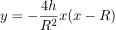 ,
,
or,
