Derive the Planck function  .
.
HINTS: You can make the following steps.
(1) Show that the density of states for photons is given by
 ,
,
(2) the photon density per unit frequency is given by
 , and
, and
(3) the definition of the specific intensity  is the energy flux per unit frequency per unit solid angle.
Note: the energy and momentum of photons are related as
 ,
,
the energy flux per unit frequency is given by
 ,
,
and total solid angle for isotropic emission is  .
.
Attempts.
In attempting to derive the Planck function, extensive reference was made to the following several sources found on the Internet:
i. G. B. Rybicki & A. P. Lightman. (1979). Radiative Processes in Astrophysics. John Wiley & Sons, Inc.
ii. https://edisciplinas.usp.br/pluginfile.php/48089/course/section/16461/qsp_chapter10-plank(DOT)pdf
iii. https://en.wikipedia(DOT)org/wiki/Planck\%27s_law#Derivation
iv. http://web.phys.ntnu.no/~stovneng/TFY4165_2013/BlackbodyRadiation(DOT)pdf
Here I follow Rybicki and Lightman’s derivation (pp. 20–22, 1979) direct, and have changed only some wordings.
Solution.
The wave vector of the photon of frequency  propagating in direction
  is
is  . For a photon gas in a box of dimension
  , the number of nodes of the standing wave is
  for each direction
  and for some wave number
  . For all directions, write the variation of the number of nodes with the wave number

The three-dimensional wave vector element  has the number of states to be

By the fact that  is the volume of the box and the fact that photons have two independent polarizations (i.e., two states per wave vector
  ), for each 3D-wave vector, the number of states for every unit volume is
 .
.
Using solid angle as in spherical coordinates, rewrite
 .
.
Then, the density of states, i.e., the number of states per solid angle per volume per frequency, is given by
 .
.
As each state of  photons each of energy
  is of energy
  , and according to statistical mechanics the probability of a state of energy
  is proportional to
  (where
  and
and  ), the average energy of each state is
 .
.
Recall the formula for the sum of a geometric series:
 ,
,
one has therefore the result (in Bose-Einstein statistics)
 .
.
where it can be seen that the occupation number
![n_\nu =\bigg[ \mathrm{exp}\bigg( \displaystyle{\frac{h\nu}{kT}}\bigg) -1\bigg]^{-1}](https://physicspupil.com/wp-content/ql-cache/quicklatex.com-d9f123b9ad3304c95bf8abc2d4175896_l3.svg "Rendered by QuickLaTeX.com")
means the average number of photons in some frequency , as one energy corresponds to one frequency .
The energy per solid angle per volume per frequency is the product of i.  , the average energy of each state, and
 ii.  , the density of states.
I.e., 
Define the specific energy density  the energy per unit volume per unit frequency range. Then the energy density per unit solid angle can be expressed as

Observe that the specific energy density and the specific intensity (or brightness)  are related by
 .
.
Now that the specific intensity, , is the same as the source function (of specific emission mechanism), .
The frequency distribution is said to be a blackbody form, i.e.,
The Planck function is expressed as
![\boxed{I_\nu =B_\nu (T)=\displaystyle{\frac{2h\nu^3}{c^2}}\bigg[ \mathrm{exp}\bigg( \displaystyle{\frac{h\nu}{kT}} \bigg) -1\bigg]^{-1}}](https://physicspupil.com/wp-content/ql-cache/quicklatex.com-abb61655169aaf0abc842d24365971ca_l3.svg "Rendered by QuickLaTeX.com")
(Units:  )
)

 and an
  approximation to
  . Compare those approximate values to the actual value
  when
when  . Correct answers in this question to seven decimal places.
![f\in C[a,b]](https://physicspupil.com/wp-content/ql-cache/quicklatex.com-aa973c4452cb7fd6f54b403646a32450_l3.svg "Rendered by QuickLaTeX.com") , and
, and  exists on
  . For every
 ![x\in [a,b]](https://physicspupil.com/wp-content/ql-cache/quicklatex.com-3d713e1ad32e4d969c10e514cd71b7d0_l3.svg "Rendered by QuickLaTeX.com") and some
and some ![x_0\in [a,b]](https://physicspupil.com/wp-content/ql-cache/quicklatex.com-450e2bddd15e8e315ac1c77f3296ac20_l3.svg "Rendered by QuickLaTeX.com") ,
,
 is between
  and
and  .
.![f\in C^n[a,b]](https://physicspupil.com/wp-content/ql-cache/quicklatex.com-fd013c411398972c03a5a7e81ff07d27_l3.svg "Rendered by QuickLaTeX.com") , and
, and  exists on
  and some
  , where
 , and
, and .
. . Then we have
  ,
,  ,
,  ,
,  ,
,  , etc. By Taylor expansion of
  at
at 
 , we obtain further that

 .
.
 .
. ;
; .
. , the
, the  and a relative error of
  . And the
  and thus a relative error of zero.
 error is owing to the correction of 7 decimal places in both the direct computation of
  and its
  ;
; ;
; (where
  );
); .
. :
: .
. :
: .
. and
and  :
: .
. and
and  :
: .
. : For any positive integer
  .
. and
and  are evident.
 ,
,
 is true.
 is also true.
 holds.
 ,
, .
. , denoted by
  , is defined by
 denotes the non-negative square root of
  are real numbers then
 .
. non-positive, one has

 ,
, .
. , one gets
 ,
, .
. , one gets
 ,
, .
. , one gets
 ,
,

 ,
, .
. be a finite group of even order. Prove that there exists an element
  such that
  and
and  .
. , either
  or
or  ,
, . And the set
  . This contradicts with the assumption that its order be even.
 .
. for all
  and
and  are abhorrent to the basic axioms of a group. So perhaps to my discretion
  ) member apart from the other members.
 and
and  for
for  , provided from the definition of a group that the inverse of each element must exist and, as it follows, that it must be unique. That is, if
  , I may relabel
  as
as  . By such a construction I can guarantee that all elements, except the identity
  , the
, the  counted from the pairs, and the single
  the identity
  be of even parity.
 for all
  .
. , there is
  , because a group satisfies, first, the inverse axiom
  under the notation
  being the inverse of
  .
. I may change brackets and obtain as follows:
 ,
,  , etc. Thus,
 , hence
  , and
, and  is an example of one abelian group whose order is greater than
  and the Cayley table of
 a group?
 ,
,  such that the following axioms be satisfied:
 ;
; such that
  for all
  ; and
; and such that
  .
. , it suffices to check
  operations. And I found that the following operation failed axiom (i):
 but
but  .
. is not a group.
 for all
  . Axiom (ii) is thus satisfied.
 , such that for all
  ,
, .
. which is detected to emit an energy flux
  ? The distance to this neutron star is
  .
. of a blackbody defines the frequency-integrated intensity of radiation at the source:
 is the Stefan-Boltzmann constant.
 of a source is related to the energy flux
  detected at some distance
  away from the source by
 ,
,
 is given.
 ,
,
 , the Sun’s luminosity being the reference, is given by the formula
 ,
, is the distance (in parsec) from the source to the Earth,
  the solar luminosity.
 is
is  .
. due to reflection of sunlight, is related to the solar luminosity
 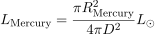 ,
, .
.
 of Mercury is
 is
is  .
. due to reflection of sunlight, is related to the solar luminosity
 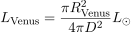 ,
,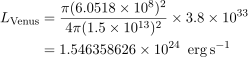
 of Venus is
 and
and 
 and
and 
 and
and 
 and
and 
 are called parallel if
  for some nonzero real number
  . (Thus nonzero vectors having the same or opposite directions are parallel.)
 and
and  . Apparently
  such that
  , the system of equations
 and
and  , then
  . The vectors
  and
and  . Observe that they are in equal magnitude but in opposite direction, i.e.,
  . They are also parallel.
 and
and  . Assume
  s.t.
s.t. 