
From  ,
,
upon integration it becomes

where  .
.

Similarly one can obtain
 ,
,
 .
.
From ,
upon integration it becomes
where .
Similarly one can obtain
,
.
Exercise 4.6.1. Use a similar approach (involving renaming indices and grouping like terms) to prove equation 4.20.
Eq. (4.20):

Eq. (4.10):

Then,
![\begin{aligned} \displaystyle{\frac{\mathrm{d}}{\mathrm{d}\tau}}(A^2) & = \displaystyle{\frac{\mathrm{d}}{\mathrm{d}\tau}}(\eta_{\mu\nu}A^\mu A^\nu )\\ & = \eta_{\mu\nu} \bigg[ A^{\mu}\displaystyle{\frac{\mathrm{d}}{\mathrm{d}\tau}(A^\mu )} + \displaystyle{\frac{\mathrm{d}}{\mathrm{d}\tau}}(A^\mu )\cdot A^\nu \bigg] \\ & = 2\eta_{\mu\nu}A^\mu \displaystyle{\frac{\mathrm{d}A^\nu}{\mathrm{d}\tau}} \end{aligned}](https://physicspupil.com/wp-content/ql-cache/quicklatex.com-c6983a2094eb3feb81262ee8a900e29d_l3.svg "Rendered by QuickLaTeX.com")
The Schwarzschild metric is given by Eq. (9.3):

whereas the metric for spherical coordinates in flat spacetime is given by Eq. (9.2):

Along a purely radial worldline  ,
,  and
and  , of the Schwarzschild metric will become
 .
.
Now that the Schwarzschild radius  is
is  , there is Eq. (9.15):
 .
.
The total radial distance between two events differing only by  -coordinates, i.e.,
  and
and  is calculated by definite integration, given by Eq. (9.16):

Trying binomial approximation:

then,

Considering only first-order approximation:
 .
.
Upon integration, there is Eq. (9.17):
![\begin{aligned} \Delta s & \approx \displaystyle{\int_{r_A}^{r_B}}\bigg( 1+\displaystyle{\frac{GM}{r}}\bigg) \,\mathrm{d}r \\ & = \bigg[ r+GM\ln \bigg( \displaystyle{\frac{r_B}{r_A}} \bigg) \bigg]\bigg|_{r_A}^{r_B} \\ & = (r_B-r_A) + GM\ln \bigg( \frac{r_B}{r_A} \bigg) \end{aligned}](https://physicspupil.com/wp-content/ql-cache/quicklatex.com-025c1b4bad22f40fcbd862e2164169ba_l3.svg "Rendered by QuickLaTeX.com")
Eq. (14.7):

Let Eq.(14.8):

From the event horizon  to
to  , it corresponds to
  and
and  .
.
From  , by quotient rule:
 ,
,
and
 .
.
Substituting these into Eq. (14.7), I get Eq. (14.9):

![\begin{aligned} \mathrm{d}\mathbf{A} & =\mathrm{d} (A^\mu \mathbf{e}_\mu )\\ & = \bigg( \displaystyle{\frac{\partial A^\mu}{\partial x^\sigma}}\, \mathrm{d}x^\sigma \bigg) \,\mathbf{e}_\mu + A^\mu \displaystyle{\frac{\partial \mathbf{e}_\mu}{\partial x^\alpha}} \,\mathrm{d}x^\alpha \\ & = \bigg( \displaystyle{\frac{\partial A^\mu}{\partial x^\sigma}} \, \mathrm{d}x^\sigma \bigg) \,\mathbf{e}_\mu + A^\mu \Big( \Gamma^\nu_{\alpha\mu} \mathbf{e}_\nu \Big) \,\mathrm{d}x^\alpha \\ \dots &\, \textrm{changing dummy variables: }\mu\Leftrightarrow \nu\textrm{ and }\alpha\Rightarrow \sigma\,\dots \\ & = \bigg[ \displaystyle{\frac{\partial A^\mu}{\partial x^\sigma}} + \Gamma^\mu_{\sigma\nu}A^\nu \bigg] \,\mathbf{e}_\mu \,\mathrm{d}x^\sigma \\ & \stackrel{\mathrm{def}}{=} (\nabla_\sigma A^\mu )\,\mathbf{e}_\mu \,\mathrm{d}x^\sigma \end{aligned}](https://physicspupil.com/wp-content/ql-cache/quicklatex.com-c431bebe52f43c33418b872ca56f1034_l3.svg "Rendered by QuickLaTeX.com")
Eq. (14.9):

Since the indefinite integral evaluated by Eq. (14.10):

and the identity given by Eq. (14.11):

are combined to give
 .
.
From ,
 .
.

and it checks with Eq. (14.3):
 .
.
Check that the physical distance from  to
to  is indeed
  . (If your calculator cannot handle inverse hyperbolic functions, use equation 14.11 to eliminate
  .)
.)
Eq. (14.3):
and the identity given by Eq. (14.11):
are combined to give the following

which measures the physical distance  from the event horizon .
Now that , the physical distance will be

Eq. (8.41):

Eq. (8.42):

Integrating on Eq. (8.42) gives Eq. (8.43):
 .
.
The definition of pathlength along the curve is given by Eq. (8.16):
 .
.
Previously to Exercise 8.5.2., the metric tensor is given by Eq. (8.40):
 .
.
Eq. (8.45) begins:

and this is Eq. (8.46).
Write out the implied sum in  for
for  and show that it is equivalent to the
  component of equation (4.22) at low velocities.
Eq. (4.22):

Eq. (4.15):

the electromagnetic field tensor  of which is given by Eq. (4.14):

and the Minkowski metric tensor  of which is given by Eq. (4.6):

In the case , beginning with Eq. (4.15):

The electrostatic force  acting on the charge
  at
at  due to another charge
  at
at  is given by Coulomb’s Law:
 ,
,
whereas the electrostatic force  due to another charge at
  is given similarly by:
 .
.
When a fourth charge  is placed on
  , which is at a distance of
  from where is the side length of the square, the magnitude of electrostatic force
  is given by:
 .
.
The electrostatic force  is then given by:

When the net electrostatic force acting on position is in the left direction only, by summing over the above-calculated three forces, i.e.,

the vertical component of the electrostatic force must be zero, i.e.,
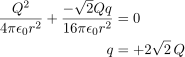
And the answer is E.