
 0 Foreword
This article is sheer homework submitted for earning a grade. And it is not intended to survive academic rigor that it may have any contribution to the current literature.
1 Introduction
May the author introduce his readers to the history of conceptual change approach.
The term “conceptual change” originated from The Structure of Scientific Revolutions published by Thomas Kuhn in 1962. Kuhn, first a theoretical physicist and later a scholar in the history of science and philosophy, recorded the scientific revolutionary change that took place in physics at that time—from Newtonian mechanics to quantum mechanics. It was nevertheless the tension beneath that surface that loaned its name— the tension between the Received View  and the Theory Reduction
  (Vosniadou, 2007, pp. 1–2). The idea of “conceptual change” and “paradigm shift” transitioned from the philosophy of science into the science education circle equally appropriately, as did the idea of “gestalt switch” and Piaget’s stages of cognitive development from the study of psychology (Lillian Hoddeson, 2007, pp. 26–27).
(The Received View)
"... [t]he attempts by logical positivists and logical empiricists to treat scientific theories as sets of axioms that could be formulated in mathematical logic."
(The Theory Reduction)
"According to theory reduction, a theory that enjoys a high degree of confirmation cannot ever be disconfirmed, but can only be expanded to a theory with a wider scope, or absorbed into a more inclusive and comprehensive theory (see Suppe, 1977)."
Criticisms brought about to ”conceptual change approach” in teaching science are in many aspects, just to list a few:
- “… [C]onceptual change is a slow and gradual process and not a dramatic, gestalt shift that happens over a short period of time.” (Caravita & Hallden, 1994; Vosniadou, 2003; Hatano & Inagaki, 1994; as cited in Vosniadou, 2007, pg. 3)
- “… [S]cience learning does not require the replacement of ‘incorrect’ with ‘correct’ conceptions, but the ability on the part of the learner to take different points of view and understand when different conceptions are appropriate depending on the context of use.” (e.g., Pozo, Gomez, & Sanz, 1999; Spada, 1994; as cited in Vosniadou, 2007, pg. 3)
- “… [C]ognitive conflict is not a successful instructional strategy for producing conceptual change, as students tend to patch up local inconsistencies in a superficial way.” (Chinn & Brewer, 1993; Smith, diSessa, & Roschelle, 1993; Vosniadou, 1999; as cited in Vosniadou, 2007, pg. 3)
Hoddeson (2007, pg.27) recalled how his PhD teacher Kuhn studied the “conceptual change” as in “Werner Heisenberg’s intellectual route to his formulation of quantum mechanics”. It can be seen that the term “conceptual change” was originally intended to:
 : make reference to the leap of philosophy of science from the Received View to the Theory Reduction.
 : it is an intrinsic end,
  an instrumental end, i.e., this approach is descriptive of how science, in particular physics, evolves, but not prescriptive of how science education, inclusive of high school physics, should be attained or designed.
Von Aufschnaiter and Rogge (2010), arguing both theoretically with literature and empirically with their studies on pupils’ conceptual development in physics, posited that pupils are typically lacking in any explanatory conceptual understanding of the content knowledge, and a focus on missing conceptions is much more promising than on misconceptions.
The author couldn’t agree more with all their conclusions, and one of which he cannot overemphasize but ought to restate here is their lately approach—the importance of inclusion of pupils’ misconceptions to teaching is attached to the design of instruction rather than making them an explicit discussion and contrasting them with scientific concepts.
2 Research questions
Andrew A. diSessa (2017, pg. 10) defined “clinical interviewing” to be the technical version of “just talking with people”, and explained how clinical interviewing is connected to instruction. Namely, there are three ways of input.
Input to conjectures and expectations
“Knowing how people think within their zone of felt competence provides important, general and often very specific conjectures about how they can learn from instruction.”
Input to design
“… [S]uch research affects the very goals of instruction (what and when topics should be taught, and how they should be construed), in addition to instructional strategies.”
Input to observation
The clinical interviewer is able to observe “[b]oth the productive and sometimes less productive roles of pre-instructional knowledge”.
Research question
To what extent the argument proposed by Von Aufschnaiter and Rogge, namely, that missing conceptions should be focused prior to misconceptions, is confirmed by a clinical interview with a high school physics pupil?
3 Methodology
One interview was held with a Form 5 pupil, which lasted for eight minutes. A transcript of the interview is in the appendix.
The interviewee had not been taught uniform circular motion before. And the author found it good to have a closed-book talk on this topic with him.
During the interview, there is not any rigid interview protocol, as long as any digression from the subject might still maintain a good understanding between the interviewer and the interviewee.
Delimitation.
Notwithstanding that the interview questions should reveal equally likely misconceptions and missing conceptions, the interviewer must have confirmation bias towards a greater likelihood of missing conceptions.
One single interview alone can demonstrate but that at most one interviewee is able to get along with a pre-lesson discussion on expertise and argumentation. And without following up the interviewee’s learning progress, it cannot give evidence to whether such an axiomatic approach as concerns classical physics is a better alternative to the prevailing conceptual change approach.
Findings of interviews with more interviewees and on more diverse and deeper physics topics are in order for presenting themselves to the current literature.
4 Findings and discussion
Misconception 1: Impetus theory—there exists a force acting upon an object moving with constant velocity
Referring to the transcript from line 25 to 32. The interviewer prompted the interviewee to recall Newton’s first law of motion. The interviewee self-corrected his statement later on though, it might not be an over-extrapolation that he held the impetus theory which is common to physics beginners and laymen.
Such misconception is an instance of ontologically inappropriate miscategorisation of concepts.
Misconception 2: Vector vs. scalar—inability to distinguish speed and velocity.
Referring to the transcript from line 40 to 65. The interviewee was asked whether or not he could differentiate between speed and velocity. Although the reply being affirmative, it can be inferred that he had not mastered the notion of vectors, and could not tell speed and velocity apart.
When debriefed after the interview, he said that he had never studied vectors in mathematics, as the teaching was not then compulsory. What he could tell was by reciting his bookwork, that speed is the rate of change of distance, and that velocity the rate of change of displacement.
Missing conception 1: Centripetal force can be non-contact force.
Referring to the transcript from line 68 to 79. It can be extrapolated that a beginner, when first introduced to the centripetal force acting upon an object in circular motion, might be inclined to think there must be some tension between the centre and the orbiter, and dismiss the fact that centripetal force can account for non-contact force, let alone the fact that it is not a force a priori, but a posteriori the net force.
Missing conception 2: Force vs. pseudo force—distinguishing centripetal and centrifugal forces by inertial or non-inertial frame of reference.
Referring to the transcript from line 97 to 118. It can be observed, that in the scenario when a bus was taking a turn, the interviewee maintained that he should term the force centripetal, despite the fact that its pulling the passenger away from his seat should naturally be termed centrifugal. As an aside, the answer shall depend on which frame—the ground’s or the bus’—is taken reference to, and at this stage it is all too demanding of one high school pupil to tell the difference between inertial and non-inertial frames of reference.
It is worth mentioning, however, that the interviewee admitted that he opted for the term “centripetal” because he had had his supposition that “centrifugal force is a pseudo-force”, based on what disseminated from popular science.
This echoes with that of Ivarsson, Schoultz, and Säljö‘s sociocultural perspective, that human cognition is an interactive process in sociocultural context rather than a purely cognitve one, and “prior knowledge is neither an obstacle nor a prerequisite for conceptual change” (Mayer, 2002, pg. 106).
Misconception 3: The motion of an object is always in the same direction of the net force which it is applied.
Referring to the transcript from line 130 to 152. The interviewer asked the interviewee to consider the situation where there is a centripetal force acting on the satellite by the Earth but the satellite will not clash into the Earth. One reading between the lines could identify there might be one assumption held by the interviewee, that “the motion of an object is the same as that of its net force it experiences”.
The interviewee had previously been taught about electrostatics, and he should have rejected the wrong assumption above by giving a counterexample: the path of a charged particle in an E-field is not necessarily the same as the path of field lines.
Missing conception 3: Relating pre-conceptions to form new ones—from projectile motion to circular motion
Referring to the transcript from line 18 to 20. The interviewee was asked whether he could deduce from definition of uniform circular motion that there must exist a net force acting upon it, still less defining it the centripetal force. It was not until in halfway of the interview that he could understand the axiomatic deduction that come up to its existence.
Referring to the transcript from line 147 to 160. The interviewee could not account for the reason that in the presence of a centripetal force an orbiter and the centre are able to keep their distance. The failure might be mostly due to misconception 3, and partly attributed to an over-compartmentalisation of interrelated physics concepts. That is to say, should he relate an orbiter as a projectile with some initial velocity and a downward constant acceleration perpendicular to its motion, he might be given a clue.
5 Conclusions and implications on teaching
Conceptual change approach has had a long standing reputation for three decades in not only tertiary science teacher education, but teaching high school science also. Care and caution must be taken by educators, to cite Mayer (2002, pg. 127), that it is “… [n]ot a simple process of deletion or replacement of p-prims (i.e., phenomenological primitives), as in contrasting views of conceptual change, but rather a complex process of integration and reorganization”.
The author contends that a pre-instructional talk, chat, or, informal discussion, can help the teacher to design his instruction. Judging misconceptions is with the benefit of hindsight, as searching for missing conceptions is with the benefit of the doubt. Focusing on missing conceptions is indeed more promising than on misconceptions, at least in physics.
Last but not least, as food for thought, if what taught in high school physics is not only classical, but also non-classical (quantum), we have an excuse not to spare the big words—paradigm shift, gestalt switch, conceptual change, and what not. Otherwise, in the senior secondary school physics curriculum, as one in Asian countries, should we not found our education upon normal science, in Kuhn’s terms?
6 Reference
diSessa, A. A. (2017). Knowledge in pieces: an evolving framework for understanding knowing and learning. In Amin, T. G., & Levrini, O. (Eds.). (2017). Converging perspectives on conceptual change: Mapping an emerging paradigm in the learning sciences. Routledge.
Hoddeson, L. (2007). In the wake of Thomas Kuhn’s theory of scientific revolutions: The perspective of an historian of science. In Vosniadou, S., Baltas, A., & Vamvakoussi, X. (Eds.). (2007). Re-framing the conceptual change approach in learning and instruction. Elsevier Ltd.
Mayer, R. E. (2002). Understanding conceptual change: a commentary. In Limón, M. & Mason, L. (Eds.). (2002). Reconsidering conceptual change: issues in theory and practice. Kluwer Academic Publishers
Von Aufschnaiter, C., & Rogge, C. (2010). Misconceptions or missing conceptions?. Eurasia Journal of Mathematics, Science & Technology Education, 6(1).
Vosniadou, S. (2007). The conceptual change approach and its re-framing. In Vosniadou, S., Baltas, A., & Vamvakoussi, X. (Eds.). (2007). Re-framing the conceptual change approach in learning and instruction. Elsevier Ltd.
7 Appendix
Please turn this page over and see Transcript of Interview attached thereafter.
(Submitted on Saturday, 4 May, 2019)
 if
if ;
; .
. .
. ,
,
 is a function independent of
  . Then
 .
. ;
;
 ,
,
 ;
; .
. for some constant
  .
. ;
;  is analytic.
 is analytic. Then, writing
 and
and  , we have the Cauchy-Riemann equations
 .
. is of class
  ,
,  . Then
  satisfies the Cauchy-Riemann equations if and only if
  is analytic.
 and
and  ,
,
 ,
,
 and
and  .
. ,
,  ,
,  ,
, 
 , working entirely in the Cartesian representation.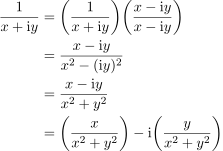

 and
and 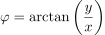 .
. is
is![\begin{aligned} \frac{1}{z} & = \frac{1}{re^{\mathrm{i}\varphi}} \\ & = \frac{1}{r}\, e^{\mathrm{i}(-\varphi )} \\ & = \frac{1}{r}\, \mathrm{cis}(-\varphi )\\ & = \frac{1}{r}\big(\cos (-\varphi)+\mathrm{i}\sin (-\varphi )\big)\\ & = \frac{1}{r}(\cos\varphi -\mathrm{i}\sin\varphi ) \\ & = \frac{1}{\sqrt{x^2+y^2}}\bigg[ \frac{x}{\sqrt{x^2+y^2}} - \mathrm{i}\Big( \frac{y}{\sqrt{x^2+y^2}} \Big) \bigg] \\ & = \bigg( \frac{x}{x^2+y^2} \bigg) - \mathrm{i}\bigg( \frac{y}{x^2+y^2} \bigg) \end{aligned}](https://physicspupil.com/wp-content/ql-cache/quicklatex.com-83d96b05396a5ba91612cfd121bbabad_l3.svg "Rendered by QuickLaTeX.com")
 .
. and the maps
  for
for  . Is
. Is  surjective? (Use the notation
  to denote the map sending from
  to
to  and from
  .
. is the set of all bijective maps from
  to itself.
  is the group where
  is the composition of maps.
 into
into  , where
 are altogether the following bijections:
![\begin{aligned} & \\ [0] & \mapsto [0] \\ [1] & \mapsto [1] \end{aligned}](https://physicspupil.com/wp-content/ql-cache/quicklatex.com-b50b1e5a1bb77cfd2775c1ff0f4d2412_l3.svg "Rendered by QuickLaTeX.com")
![\begin{aligned} & \\ [0] & \mapsto [1] \\ [1] & \mapsto [0] \end{aligned}](https://physicspupil.com/wp-content/ql-cache/quicklatex.com-53b254300bac960438e700342f99e691_l3.svg "Rendered by QuickLaTeX.com") ,
, and
and  is
is
![[0]+[0]=[0]\quad (\mathrm{mod}\,2)](https://physicspupil.com/wp-content/ql-cache/quicklatex.com-2057c82fcf182c6454d58ed5d076919c_l3.svg "Rendered by QuickLaTeX.com") and
and ![[0]+[1]=[1]\quad (\mathrm{mod}\,2)](https://physicspupil.com/wp-content/ql-cache/quicklatex.com-d80aa925cbd485ba0a331a3ae5570520_l3.svg "Rendered by QuickLaTeX.com") ,
, is
is
![[1]+[0]=[1]\quad (\mathrm{mod}\,2)](https://physicspupil.com/wp-content/ql-cache/quicklatex.com-f4cff6bdd3028598d82bf0e34c93a0a8_l3.svg "Rendered by QuickLaTeX.com") and
and ![[1]+[1]=[0]\quad (\mathrm{mod}\,2)](https://physicspupil.com/wp-content/ql-cache/quicklatex.com-68765ec0b17cc8fd57c275d7c9ea441c_l3.svg "Rendered by QuickLaTeX.com") ,
, , the mappings of which are explicitly the following two:
 and
and  ;
;![l(a): a\mapsto l_a\qquad \forall\, a\in\{ [0],[1]\}=\mathbb{Z}_2](https://physicspupil.com/wp-content/ql-cache/quicklatex.com-c9a2d55f34d4a86462c0b4d51c0d81ba_l3.svg "Rendered by QuickLaTeX.com") .
.![G=\mathbb{Z}_3(=\{ [0],[1],[2] \})](https://physicspupil.com/wp-content/ql-cache/quicklatex.com-307dd37bf2e00c030341eb3791342c0f_l3.svg "Rendered by QuickLaTeX.com") .
. .
.
![[0]+[0]=[0]\quad (\mathrm{mod}\,3)](https://physicspupil.com/wp-content/ql-cache/quicklatex.com-20029d40f298b8ef6a01f807724eace0_l3.svg "Rendered by QuickLaTeX.com") ,
, ![[0]+[1]=[1]\quad (\mathrm{mod}\,3)](https://physicspupil.com/wp-content/ql-cache/quicklatex.com-15b30d55655276b606599bedfbb634d4_l3.svg "Rendered by QuickLaTeX.com") , and
, and ![[0]+[2]=[2]\quad (\mathrm{mod}\,3)](https://physicspupil.com/wp-content/ql-cache/quicklatex.com-b6c60586f80f4eb589dc5b7d4c163d34_l3.svg "Rendered by QuickLaTeX.com") , I may write
, I may write .
.
![[1]+[0]=[1]\quad (\mathrm{mod}\,3)](https://physicspupil.com/wp-content/ql-cache/quicklatex.com-82561d79c35e3e112953ac65d9e3a81e_l3.svg "Rendered by QuickLaTeX.com") ,
, ![[1]+[1]=[2]\quad (\mathrm{mod}\,3)](https://physicspupil.com/wp-content/ql-cache/quicklatex.com-b3d3cd5aba19197c2dea23c6451d648e_l3.svg "Rendered by QuickLaTeX.com") , and
, and ![[1]+[2]=[0]\quad (\mathrm{mod}\,3)](https://physicspupil.com/wp-content/ql-cache/quicklatex.com-f8f3d03a4893721a97768f4019470331_l3.svg "Rendered by QuickLaTeX.com") , I may write
, I may write .
. is
is
![[2]+[0]=[2]\quad (\mathrm{mod}\,3)](https://physicspupil.com/wp-content/ql-cache/quicklatex.com-216755ac897610110bc9d821f5e366e0_l3.svg "Rendered by QuickLaTeX.com") ,
, ![[2]+[1]=[0]\quad (\mathrm{mod}\,3)](https://physicspupil.com/wp-content/ql-cache/quicklatex.com-b211878f7f2f30baec90ce7416454d54_l3.svg "Rendered by QuickLaTeX.com") , and
, and ![[2]+[2]=[1]\quad (\mathrm{mod}\,3)](https://physicspupil.com/wp-content/ql-cache/quicklatex.com-293dfc89ba0dd997d2fd648eb6104422_l3.svg "Rendered by QuickLaTeX.com") , I may write
, I may write .
.
 , the mappings of which are explicitly the following three:
 ,
,  , and
, and  .
.![l(a): a\mapsto l_a\qquad \forall\, a\in\{ [0],[1],[2]\}=\mathbb{Z}_2](https://physicspupil.com/wp-content/ql-cache/quicklatex.com-8a8a21b3702ab3f296ad71f484b54030_l3.svg "Rendered by QuickLaTeX.com") .
. is
is  surjective because in the codomain
  ,
,  , and
, and 
 is said to be a group embedding if it is an injective group homomorphism.
 , we define the left translation of
 ,
,  .
. .
.

 , or
, or  , or,
, or,  for
for  , then
  guaranteed that the inverse of
  .
. in which
  is the identity of
  .
. , show that
  .
. where
where  is an integer.
 if
if  and
and  where
where  .
. , show that for any
  , there exists a subgroup of order
  in
in  or
or  for some
  and
and  . Then one may write
  . It can be seen that
  must be
  where
where  contradicts to the assumption that
  where
where  . Thus
  , and
, and  .
. . Secondly, if
  such that
  , from the result of part
  because if
  and
and  , then
  (here
(here  ),
),  , and
, and  . Such a
  will always be greater than or equal to
  . Thus
  .
. .
. where
where  is given in the problem. The order of the cyclic subgroup
  of
of  , in view of the result in part
  where
where  is a subgroup of
  , then
  . Note that
  . Consider the subgroup
  . Because
  divides
  and thus
  . From the result of part
  . Thus
  and
and  whenever
  .
. and
and  is inside
  . Thus
  is inside
  in
in  (by the condition
  whenever
  , one proves the existence of the inverse. Thirdly,
  because
  and also
  .
.  , find expressions for:
 .
. .
.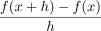 .
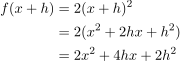
.
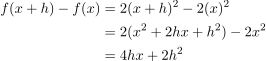
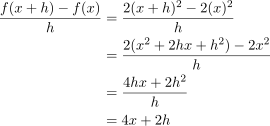

 , i.e.,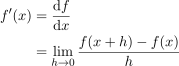
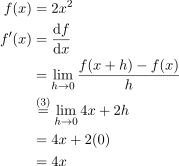

 ).
). ) of a body is the energy due to its motion.

 ) of a body is the energy due to its position or configuration.
 ) of a body is the sum of the (total molecular) kinetic energy (KE) and (total molecular) potential energy (PE) of all its molecules. It is the total energy stored in a body.

 is the energy transferred from a hot object to a cold object as a result of temperature difference. Its unit is also joule (
 to speak of heat as a
  is the rate of transferring energy, and it is measured in watts (
 ).
).
 ), we may not assume
  and we may not write
  .
. of a substance is the energy
  by
by  .
. :
:


 , defined
  . Heat capacity
  or
or  .
.  flow of heat, i.e., thermal equilibrium.
 Total KE
 no. of molecules
  a decrease in total KE,
  a decrease in total PE. (III) is correct.
 of the substance by
  .
.
 is in thermal equilibrium with object
  , and
, and 
 , so that
  . (III) is correct by definition.