
Prove that the divergence of a curl is always zero; and the curl of a gradient is always zero.
Solution.
First,
Let  .
.
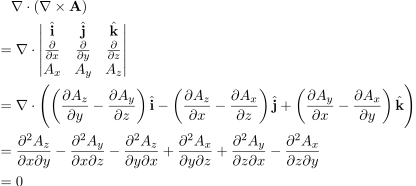
 The divergence of a curl is always zero.
Second,


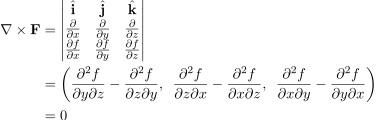
The curl of a gradient is always zero.
Prove that the divergence of a curl is always zero; and the curl of a gradient is always zero.
Solution.
First,
Let .
The divergence of a curl is always zero.
Second,
The curl of a gradient is always zero.
Let  be the separation vector from a fixed point
  to the point
  , and let
  be its length. Show that
(a) 
(b) 
(c) What is the general formula for  .
.
Solution.
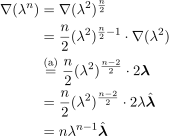
(a)
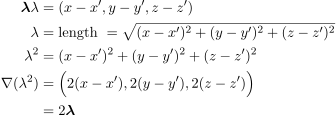
(b)
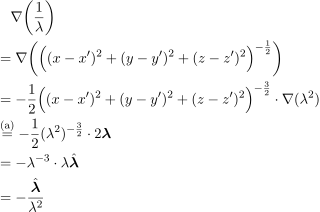
(c)
The height of a mountain is given by  , where the
  -axis points east, the
  -axis points north, and all distances are measured in meters. Suppose a mountain climber is at the point
  , will he ascend or descend if he moves in the southwest direction?
Solution.
(The solution below is based on the manuscript of 2015-2016 PHYS2155 Methods of Physics II Homework Solutions.)

The altitude  is given by a function of and :
.
Now that the climber moves in the southwest direction


At point ,

he will ascend southwesterly.
Find the gradients of the following functions:
(a)  ;
;
(b)  .
.
Solution.
(a)
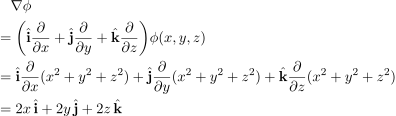
(b) It is left as an exercise to the reader.
Evaluate the limit, or explain why the limit fails to exist.
(a)  ;
;
(b) 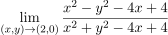
Solution.
(a)
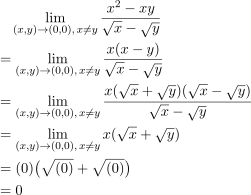
(b)
Roughwork.

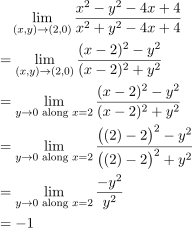
If we take limits along the path  ,
,
whereas if we take limits along the path  ,
,
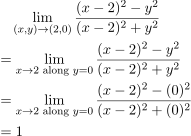
The limit fails to exist because the limiting values vary with the paths of taking the limit  .
.
i. Find the infinitesimal small vector  in the cylindrical coordinate induced by an infinitesimal small changes of
  ,
,  , and
, and  in terms of
  ,
,  ,
,  , , , and the corresponding unit vector.
ii.  is defined in
  coordinate. Its gradient is defined

where  and
and  are respectively the changes in length and functional value induced purely by the infinitesimal change in
  .
.  is the unit vector of
  . Thus find the gradient of
  in cylindrical coordinate.
Solution.
(The solution below is based on the manuscript of 2015-2016 PHYS2155 Methods of Physics II Homework Solutions.)
i.

Compare to the figure below.

ii.

Suppose  is differentiable. Find the expression

in terms of polar coordinates  and .
and .
Solution.

Setup.


(to be continued)
Lemma.

Wikipedia on Cramer’s rule
(continue)
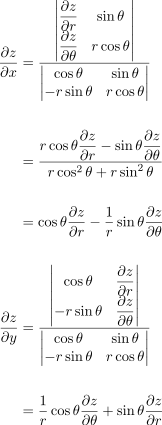
Thus,
![\begin{aligned} & \quad\bigg( \frac{\partial z}{\partial x}\bigg)^2 + \bigg( \frac{\partial z}{\partial y}\bigg)^2 \\ \\ & = \bigg[ \cos\theta\frac{\partial z}{\partial r} - \frac{1}{r}\sin\theta\frac{\partial z}{\partial \theta} \bigg]^2 + \bigg[ \frac{1}{r}\cos\theta\frac{\partial z}{\partial \theta} + \sin\theta\frac{\partial z}{\partial r} \bigg]^2 \\ \\ & = \cos^2\theta \bigg( \frac{\partial z}{\partial r}\bigg)^2 - \frac{\sin 2\theta}{r}\bigg(\frac{\partial z}{\partial r}\bigg)\bigg(\frac{\partial z}{\partial \theta}\bigg) + \frac{1}{r^2}\sin^2\theta \bigg(\frac{\partial z}{\partial \theta}\bigg)^2 \\ & \qquad\qquad + \frac{1}{r^2}\cos^2\theta \bigg(\frac{\partial z}{\partial \theta}\bigg)^2 + \frac{\sin 2\theta}{r}\bigg(\frac{\partial z}{\partial r}\bigg)\bigg(\frac{\partial z}{\partial \theta}\bigg) + \sin^2\theta \bigg( \frac{\partial z}{\partial r}\bigg)^2 \\ \\ & = \bigg( \frac{\partial z}{\partial r} \bigg)^2 + \frac{1}{r^2} \bigg( \frac{\partial z}{\partial \theta} \bigg)^2 \end{aligned}](https://physicspupil.com/wp-content/ql-cache/quicklatex.com-027fe494b0d143e6a6833563a4b3825b_l3.svg "Rendered by QuickLaTeX.com")
The angle  of a triangle
  is increasing at a rate of
  , the side of
  is increasing at a rate of
  , and the side of
  is decreasing at a rate of
  . How fast is the side
  changing when
  ,
,  , and
, and  ? Is the length of increasing or decreasing?
Solution.
Draw a figure below:

Rephrase the problem.
Given that

If ,  , and
, and  ,
,
then 
By cosine law,
 .
.
Taking ordinary derivatives w.r.t. time  ,
,

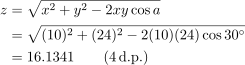
Plugging in the value of each,

you will know what  is.
is.
But now, I intend to treat it with partial derivatives.
Let  .
.

After  is sought, recognise that

you could have it also.
(to be continued)
A ship  , which can sail at a constant speed
  to meet a second ship
  which is
  away in the direction of
  and is sailing due east at constant speed
  . Find the sailing direction of and the time required to meet .
Solution.
(The solution below is based on the manuscript of 2014-2015 PHYS1250 Fundamental Physics Homework Solutions.)
Draw a diagram as follows:


Setup.

By the law of sines,
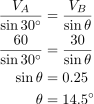
Direction of  :
: 

Calculating  :
:

The time needed to meet ship is

A particle is projected from a point  on the horizontal floor. The range of the projectile is
  and the maximum height that the particle can reach is
  . Show that the equation of trajectory of the particle is
 .
.

Solution.
(The solution below is based on the manuscript of 2014-2015 PHYS1250 Fundamental Physics Homework Solutions.)
The trajectory of projectile motion must be a parabola, which can be expressed in the form of a quadratic equation:
 ;
;
And since the particle passes through the points  and
and  , the equation of trajectory can be expressed in the form:
 .
.
When the particle has traveled a horizontal distance  , it reaches the maximum height
  .
.
Inserting the point  into the trajectory equation, we solve for the unknown :

Thus,
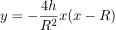 ,
,
or,
