202301200900 Problem 2.1

Suppose you flip four fair coins.

(a) Make a list of all the possible outcomes, as in Table 2.1.
(b) Make a list of all the different “macrostates” and their probabilities.
(c) Compute the multiplicity of each macrostate using the combinatorial formula 2.6, and check that these results agree with what you got by brute-force counting.

Extracted from D. V. Schroeder. (2000). An Introduction to Thermal Physics.


Background.

For a fair coin, the probabilities of heads-up (\textrm{H}) and tails-up (\textrm{T}) are 50:50 odds, i.e., P(\textrm{H})=P(\textrm{T})=\displaystyle{\frac{1}{2}} the same.

\begin{tabular}{cccc} Coin 1 & Coin 2 & Coin 3 & Coin 4 \\\hline H & H & H & H \\ H & H & H & T \\ H & H & T & H \\ H & H & T & T \\ H & T & H & H \\ H & T & H & T \\ H & T & T & H \\ H & T & T & T \\ T & H & H & H \\ T & H & H & T \\ T & H & T & H \\ T & H & T & T \\ T & T & H & H \\ T & T & H & T \\ T & T & T & H \\ T & T & T & T \\ \end{tabular}

Any one possibility of the

P_\textrm{w/ rplc}(2,4)=\text{}^2P_4=2^4=16

permutations is called a microstate, and all (sixteen) microstates compose ensemble the probability distribution of the

5=\mathrm{ord}(\{4\textrm{H}0\textrm{T},3\textrm{H}1\textrm{T},2\textrm{H}2\textrm{T},1\textrm{H}3\textrm{T},0\textrm{H}4\textrm{T}\})

combinations, called the (five) macrostates. The number of microstates corresponding to a given macrostate is called the multiplicity of that macrostate. With full knowledge of the microstates of a system are its macrostates fully known; the reverse is not true.

If there are N coins, the multiplicity of the macrostate with n heads is

\displaystyle{\Omega (N,n)=\frac{N!}{n!\cdot (N-n)!}=\begin{pmatrix}N\\n\end{pmatrix}}.

\begin{aligned} \Omega (4,0) & = 1\\ \Omega (4,1) & = 4\\ \Omega (4,2) & = 6\\ \Omega (4,3) & = 4\\ \Omega (4,4) & = 1\\ \end{aligned}

This problem is not to be attempted.

202301171158 Problem 1.45

As an illustration of why it matters which variables you hold fixed when taking partial derivatives, consider the following mathematical example. Let w=xy and x=yz.

(a) Write w purely in terms of x and z, and then purely in terms of y and z.
(b) Compute the partial derivatives

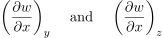
\displaystyle{\bigg(\frac{\partial w}{\partial x}\bigg)_y}\quad\textrm{ and }\quad\displaystyle{\bigg(\frac{\partial w}{\partial x}\bigg)_z},

and show that they are not equal. (Hint: To compute (\partial w/\partial x)_y, use a formula for w in terms of x and y, not z. Similarly, compute (\partial w/\partial x)_z from a formula for w in terms of only x and z.)
(c) Compute the other four partial derivatives of w (two each with respect to y and z), and show that it matters which variable is held fixed.

Extracted from D. V. Schroeder. (2000). An Introduction to Thermal Physics.


Roughwork.

(a) Write on one hand

\begin{aligned} w & = xy \\ & = x\bigg(\frac{x}{z}\bigg) \\ & = \frac{x^2}{z} \\ \end{aligned}

and the other

\begin{aligned} w & = xy \\ & = (yz)y \\ & = y^2z \\ \end{aligned}

(b)

\begin{aligned} \bigg(\frac{\partial w}{\partial x}\bigg)_y &=\frac{\partial}{\partial x}(w(x,y)) = \frac{\partial}{\partial x}(xy) = y \\ \bigg(\frac{\partial w}{\partial x}\bigg)_z & =\frac{\partial}{\partial x}(w(x,z)) = \frac{\partial}{\partial x}\bigg(\frac{x^2}{z}\bigg) = \frac{2x}{z} \\ \end{aligned}

(c) Not to be attempted.

202010220700 Problem 1, Chapter 1.1

The Fahrenheit temperature scale is defined so that ice melts at 32^\circ \textrm{F} and water boils at 212^\circ \textrm{F}.

(a) Derive the formulas for converting from Fahrenheit to Celsius and back.

(b) What is absolute zero on the Fahrenheit scale?


Solution.

Given that the melting point is 32^\circ\textrm{F} and the boiling point 212^\circ \textrm{F}.

Therefore 1\,\textrm{C}^\circ =\displaystyle{\frac{212-32}{100}}\textrm{F}^\circ = 1.8\,\textrm{F}^\circ.

Then F=32+1.8C and C=\displaystyle{\frac{F-32}{1.8}}.

Absolute zero on Fahrenheit scale is F=32+1.8(-273)=-459.4^\circ\textrm{F}.