202312201537 Solution to 1980-CE-PHY-II-13

6\times 10^{-3}\,\mathrm{m^3} of a gas is contained in a vessel at 91^\circ\mathrm{C} and a pressure of 4\times 10^5\,\mathrm{Pa}. If the density of the gas at s.t.p. (0^\circ\mathrm{C} and 10^5\,\mathrm{Pa}) is 1.2\,\mathrm{kg\, m^{-3}}, what is the mass of the gas?

A. 7.2\,\mathrm{g}
B. 14.4\,\mathrm{g}
C. 21.6\,\mathrm{g}
D. 28.8\,\mathrm{g}

Official answer: C


Roughwork.

\textrm{\textbf{\scriptsize{CASE I}}} (closed vessel)

Assumed a closed vessel, its volume V=\textrm{Const.} a constant. Then, that 6\times 10^{-3}\,\mathrm{m^3} of gas fully occupied the closed vessel, implies that the volume of the vessel is also

V=6\times 10^{-3}\,\mathrm{m^3}.

Hence may we write

\begin{aligned} \textrm{density }(\rho ) & = \frac{\textrm{mass }(m)}{\textrm{volume }(V)} \\ m & = \rho V \\ & = (1.2\,\mathrm{kg\,m^{-3}})(6\times 10^{-3}\,\mathrm{m^3}) \\ & = 7.2\,\mathrm{g} \\ \end{aligned}

And we get option A, which is different from the official answer C. Hence, we need to look into

\textrm{\textbf{\scriptsize{CASE II}}} (open vessel)

We set up the background below.

******************

1. Ideal gas law:

An ideal gas satisfies the general gas equation

pV=nRT

where p, V, n, R, and T are the pressure, the volume, the amount of substance (/number of moles), the ideal (/universal) gas constant, and the temperature of the gas.

2. Conversion of scales of temperature:

x\,^\circ\mathrm{C} \approx (x+273)\,\mathrm{K}

3. Relationship between chemical amount (/number of moles) n, total mass m, and molar mass M, of a substance.

\displaystyle{n=\frac{m}{M}}

Note that total mass m and number of moles n are extensive (/extrinsic) properties; whereas molar mass M is an intensive (/intrinsic) property.

******************

At the start t=t_0,

\begin{aligned} p(t_0) & = 4\times 10^5\,\mathrm{Pa} \\ V(t_0) & = 6\times 10^{-3}\,\mathrm{m^3} \\ T(t_0) & = 364\,\mathrm{K} \\ R & = 8.31\mathrm{m^3\,Pa\,K^{-1}\,mol^{-1}} \\ \end{aligned}

substituting,

\begin{aligned} p(t_0)V(t_0) & = n(t_0)RT(t_0) \\ (4\times 10^5)(6\times 10^{-3}) & = n(t_0)(8.31)(364) \\ n(t_0) & = 0.7722\,\mathrm{mol}\quad\mathrm{(4\, s.f.)}\\ \end{aligned}

at some point later t=t_{1} the gas in standard temperature and pressure (s.t.p.),

\begin{aligned} p(t_1) & = 10^5\,\mathrm{Pa} \\ V(t_1) & = 6\times 10^{-3}\,\mathrm{m^3} \\ T(t_1) & = 273\,\mathrm{K} \\ R & = 8.31\mathrm{m^3\,Pa\,K^{-1}\,mol^{-1}} \\ \end{aligned}

substituting,

\begin{aligned} p(t_1)V(t_1) & = n(t_1)RT(t_1) \\ (10^5)(6\times 10^{-3}) & = n(t_1)(8.31)(273) \\ n(t_1) & = 0.2645\,\mathrm{mol}\quad\mathrm{(4\, s.f.)}\\ \end{aligned}

From n(t_1)<n(t_0), it can be inferred that some portion of the gas was leaking from the open vessel to the atmosphere throughout the experiment.

\begin{aligned} \frac{m(t_1)}{n(t_1)} & = \frac{m(t_0)}{n(t_0)} = M \\ m(t_1) & = \bigg(\frac{n(t_1)}{n(t_0)}\bigg) m(t_0) \\ & = \bigg(\frac{0.2645}{0.7722}\bigg) m(t_0) \\ m(t_1) & = 0.3425m(t_0) \\ \end{aligned}

Provided \rho (t_1)=1.2\,\mathrm{kg\,m^{-3}}, we know

\begin{aligned} \rho (t_1) & = \frac{m(t_1)}{V(t_1)} \\ \rho (t_1) & = \frac{Mn(t_1)}{V(t_1)} \\ 1.2 & = \frac{0.2645M}{6\times 10^{-3}} \\ M & = 0.0272212\,\mathrm{kg\,mol^{-1}}\\ \end{aligned}

Hence

\begin{aligned} m(t_1) & =Mn(t_1) \\ & = (0.0272212)(0.2645) \\ & = 0.0072000074\,\mathrm{kg} \\ & = 7.2\,\mathrm{g} \\ \end{aligned}

And we get option A again, which is far from the official answer C.


Neither \textrm{\textbf{\scriptsize{CASE I}}} nor \textrm{\textbf{\scriptsize{CASE II}}} gives option C; have I actually made a circular argument?

Circular reasoning is a logical fallacy in which the reasoner begins with what they are trying to end with.

Wikipedia on Circular reasoning

Have I really?


No, just that you do so in the way than intended.

202301200900 Problem 2.1

Suppose you flip four fair coins.

(a) Make a list of all the possible outcomes, as in Table 2.1.
(b) Make a list of all the different “macrostates” and their probabilities.
(c) Compute the multiplicity of each macrostate using the combinatorial formula 2.6, and check that these results agree with what you got by brute-force counting.

Extracted from D. V. Schroeder. (2000). An Introduction to Thermal Physics.


Background.

For a fair coin, the probabilities of heads-up (\textrm{H}) and tails-up (\textrm{T}) are 50:50 odds, i.e., P(\textrm{H})=P(\textrm{T})=\displaystyle{\frac{1}{2}} the same.

\begin{tabular}{cccc} Coin 1 & Coin 2 & Coin 3 & Coin 4 \\\hline H & H & H & H \\ H & H & H & T \\ H & H & T & H \\ H & H & T & T \\ H & T & H & H \\ H & T & H & T \\ H & T & T & H \\ H & T & T & T \\ T & H & H & H \\ T & H & H & T \\ T & H & T & H \\ T & H & T & T \\ T & T & H & H \\ T & T & H & T \\ T & T & T & H \\ T & T & T & T \\ \end{tabular}

Any one possibility of the

P_\textrm{w/ rplc}(2,4)=\text{}^2P_4=2^4=16

permutations is called a microstate, and all (sixteen) microstates compose ensemble the probability distribution of the

5=\mathrm{ord}(\{4\textrm{H}0\textrm{T},3\textrm{H}1\textrm{T},2\textrm{H}2\textrm{T},1\textrm{H}3\textrm{T},0\textrm{H}4\textrm{T}\})

combinations, called the (five) macrostates. The number of microstates corresponding to a given macrostate is called the multiplicity of that macrostate. With full knowledge of the microstates of a system are its macrostates fully known; the reverse is not true.

If there are N coins, the multiplicity of the macrostate with n heads is

\displaystyle{\Omega (N,n)=\frac{N!}{n!\cdot (N-n)!}=\begin{pmatrix}N\\n\end{pmatrix}}.

\begin{aligned} \Omega (4,0) & = 1\\ \Omega (4,1) & = 4\\ \Omega (4,2) & = 6\\ \Omega (4,3) & = 4\\ \Omega (4,4) & = 1\\ \end{aligned}

This problem is not to be attempted.

202301171158 Problem 1.45

As an illustration of why it matters which variables you hold fixed when taking partial derivatives, consider the following mathematical example. Let w=xy and x=yz.

(a) Write w purely in terms of x and z, and then purely in terms of y and z.
(b) Compute the partial derivatives

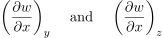
\displaystyle{\bigg(\frac{\partial w}{\partial x}\bigg)_y}\quad\textrm{ and }\quad\displaystyle{\bigg(\frac{\partial w}{\partial x}\bigg)_z},

and show that they are not equal. (Hint: To compute (\partial w/\partial x)_y, use a formula for w in terms of x and y, not z. Similarly, compute (\partial w/\partial x)_z from a formula for w in terms of only x and z.)
(c) Compute the other four partial derivatives of w (two each with respect to y and z), and show that it matters which variable is held fixed.

Extracted from D. V. Schroeder. (2000). An Introduction to Thermal Physics.


Roughwork.

(a) Write on one hand

\begin{aligned} w & = xy \\ & = x\bigg(\frac{x}{z}\bigg) \\ & = \frac{x^2}{z} \\ \end{aligned}

and the other

\begin{aligned} w & = xy \\ & = (yz)y \\ & = y^2z \\ \end{aligned}

(b)

\begin{aligned} \bigg(\frac{\partial w}{\partial x}\bigg)_y &=\frac{\partial}{\partial x}(w(x,y)) = \frac{\partial}{\partial x}(xy) = y \\ \bigg(\frac{\partial w}{\partial x}\bigg)_z & =\frac{\partial}{\partial x}(w(x,z)) = \frac{\partial}{\partial x}\bigg(\frac{x^2}{z}\bigg) = \frac{2x}{z} \\ \end{aligned}

(c) Not to be attempted.

202212231640 Solution to 2016-DSE-PHY-IA-2

0.3\,\mathrm{kg} of water at temperature 50\,^\circ\mathrm{C} is mixed with 0.2\,\mathrm{kg} of ice at temperature 0\,^\circ\mathrm{C} in an insulated container of negligible heat capacity. What is the final temperature of the mixture?

Given: specific heat capacity of water =4200\,\mathrm{J\,kg^{-1}\,^\circ C^{-1}}; specific latent heat of fusion of ice 3.34\times 10^5\,\mathrm{J\, kg^{-1}}.


Roughwork.

For all 0.3\,\mathrm{kg} liquid water, a temperature drop of 50\,\mathrm{C^\circ} will release

\begin{aligned} \textrm{Sensible heat} & = (0.3)(4200)(50) \\ & = \textrm{63,000}\,\mathrm{J} \\ \end{aligned}

and a phase transition of freezing will release further latent heat (of fusion)

\begin{aligned} \textrm{Latent heat}& = ml_f \\ & = (0.3)(3.34\times 10^5) \\ & = \textrm{100,200}\,\mathrm{J} \\ \end{aligned}

whereas for 0.2\,\mathrm{kg} of solid ice to melt all at once, latent heat (of liquidization)

\begin{aligned} \textrm{Latent heat} & = ml_f \\ & = (0.2)(3.34\times 10^5) \\ & = \textrm{66,800}\,\mathrm{J} \\ \end{aligned}

is to be absorbed.


Lemma.

Heat always moves from hotter objects to colder objects, unless energy in some form is supplied to reverse the direction of heat flow.

Wikipedia on Second law of thermodynamics


By the inequalities

0<\textrm{66,800}-\textrm{63,000}<\textrm{100,200}

one will know.

202212091158 Solution to 1965-HL-PHY-3

(a) State the three different types of heat transfer, and give a simple example for each type of heat transfer.
(b) Calculate the amount of heat required to change 10\,\mathrm{g} of ice in a sealed container of volume 1\,\mathrm{L} and pressure at 1\,\mathrm{atm} at -20\,^\circ\mathrm{C} to steam at 120\,^\circ\mathrm{C}. (Neglect the heat absorbed by the air and the container. The specific heat of ice and steam is 0.5\,\mathrm{cal\,g^{-1}\,^\circ C^{-1}}). What is the pressure inside the container expressed in atmospheric pressure, when the 10\,\mathrm{g} of ice is completely changed to steam at 120\,^\circ\mathrm{C}?


Roughwork.

(a) Skip it.

(b) Stuck. Any equation of state f(P,V,T)=0 as may well be applicable to solids and liquids as the ideal gas law PV=nRT to gases, lacking the enthalpies of fusion and vaporisation unknown?

(to be continued)

202203071449 Exercises 13.1

A given mass of gas has a volume of 144\,\mathrm{cm^3} at 15\mathrm{^\circ C}. Calculate its volume at i. 33\mathrm{^\circ C}, ii. 0\mathrm{^\circ C}, iii. -67\mathrm{^\circ C}, the pressure being constant.

Extracted from M. Nelkon. (1971). Graded Exercises and Worked Examples in Physics.


Solution.

Converting cubic centimetres to cubic metres:

144\,\mathrm{cm^3}=144\,\mathrm{(0.01\,m)^3}=0.000144\,\mathrm{m^3}.

Converting degree Celsius to Kelvin:

15\mathrm{^\circ C}=(15+273.15)\,\mathrm{K}=288.15\,\mathrm{K}.


Background. (ideal gas equation)

By ideal gas law PV=nRT, where P, V, and T are the pressure, volume, and temperature; n is the amount of substance; and R is the ideal gas constant.

Wikipedia on Ideal gas law


Arranging pV=nRT for change of subject,

\displaystyle{V=\bigg( \frac{nR}{p}\bigg) T}.

Then plugging in V=0.000144 and T=288.15, one obtains

\begin{aligned} 0.000144 & = \bigg( \frac{nR}{p} \bigg) (288.15) \\ \frac{nR}{p} & = \frac{0.000144}{288.15} \textrm{ ( = constant)} \\ \end{aligned}

Thus we have volume V as a function V(T) of temperature T:

V(T)=(4.9974\times 10^{-7})\times T.

We are asked about its volume as the temperature varies:

\begin{aligned} 33\mathrm{^\circ C} & \Leftrightarrow (33+273.15)\,\mathrm{K} = 306.15\,\mathrm{K} \\ 0\mathrm{^\circ C} & \Leftrightarrow (0+273.15)\,\mathrm{K} = 273.15\,\mathrm{K} \\ -67\mathrm{^\circ C} & \Leftrightarrow (-67+273.15)\,\mathrm{K} = 206.15\,\mathrm{K} \\ \end{aligned}

(to be continued)

202110110958 Sidenote (Section 3.8.2)

Given that the binomial coefficient is so defined as

\begin{pmatrix} N \\ n \end{pmatrix} \stackrel{\textrm{def}}{=} \displaystyle{\frac{N!}{n!(N-n)!}}.

Prove the identities (3.49), (3.50), and (3.51) in Section 3.8.2 Useful Identities for the Binomial Coefficients. Namely,

Eq. (3.49):

\begin{pmatrix} N \\ 0 \end{pmatrix} = \begin{pmatrix} N \\ N \end{pmatrix} = 1

Eq. (3.50):

\begin{pmatrix} N - 1 \\ n \end{pmatrix} + \begin{pmatrix} N - 1 \\ n-1 \end{pmatrix} = \begin{pmatrix} N \\ n \end{pmatrix}

Eq. (3.51):

\begin{pmatrix} N \\ n+1 \end{pmatrix} = \displaystyle{\frac{N-n}{n+1}}\begin{pmatrix} N \\ n \end{pmatrix}

R. H. Swendsen. (2012). An Introduction to Statistical Mechanics and Thermodynamics


Proof of Eq. (3.49).

\begin{aligned} \begin{pmatrix} N \\ 0 \end{pmatrix} & = \frac{N!}{0!(N-0)!} \\ & = \frac{N!}{1\times N!} \\ & = 1 \end{aligned}
\begin{aligned} \begin{pmatrix} N \\ N \end{pmatrix} & = \frac{N!}{N!(N-N)!} \\ & = \frac{N!}{N!\times 1} \\ & = 1 \end{aligned}

Proof of Eq. (3.50).

\begin{aligned} & \quad \begin{pmatrix} N-1 \\ n \end{pmatrix} + \begin{pmatrix} N-1 \\ n-1 \end{pmatrix} \\ & = \frac{(N-1)!}{(n)!(N-1-n)!} + \frac{(N-1)!}{(n-1)!\big((N-1)-(n-1)\big)!} \\ & = \frac{(N-1)!}{(n)!(N-1-n)!} + \frac{(N-1)!}{(n-1)!(N-n)!} \\ & = \frac{(N-n)(N-1)!+(n)(N-1)!}{(n)(n-1)!(N-n)(N-n-1)!} \\ & = \frac{N(N-1)!}{n!(N-n)!} \\ & = \frac{N!}{n!(N-n)!} \\ & = \begin{pmatrix} N \\ n \end{pmatrix} \\ \end{aligned}

Proof of Eq. (3.51).

\begin{aligned} &\quad \begin{pmatrix} N \\ n+1 \end{pmatrix} \\ & = \frac{N!}{(n+1)!\big(N-(n+1)\big) !} \\ & = \frac{(N!)(N-n)}{\big( (n+1)(n!)\big) \big( (N-n)(N-n-1)! \big)} \\ & = \bigg(\frac{N-n}{n+1}\bigg)\bigg(\frac{N!}{n!(N-n)!}\bigg) \\ & = \frac{N-n}{n+1}\begin{pmatrix} N \\n \end{pmatrix} \\ \end{aligned}

QED

202109151444 CYU 3.4

When 1.00\,\mathrm{g} of ammonia boils at atmospheric pressure and -33.0\,^\circ\mathrm{C}, its volume changes from 1.47\,\mathrm{cm^3} to 1130\,\mathrm{cm^3}. Its heat of vaporization at this pressure is 1.37\times 10^6\,\mathrm{J/kg}. What is the change in the internal energy of the ammonia when it vaporizes?


Solution.

With L_v representing the latent heat of vaporization, the heat required to vaporize ammonia is

\begin{aligned} Q & =mL_v \\ & =(0.001\,\mathrm{kg})(1.37\times 10^6\,\mathrm{J/kg}) \\ & =1.37\times 10^3\,\mathrm{J} \\ \end{aligned}

Since the pressure on the system is constant at 1.00\,\mathrm{atm}=1.01\times 10^5\,\mathrm{N/m^2}, the work done by ammonia as it is vaporized is

\begin{aligned} W & =p\Delta V \\ & =(1.01\times 10^5\,\mathrm{N/m^2})\big( (1130-1.47)\times (0.01\,\mathrm{m})^3 \big) \\ & = (1.01\times 10^5\,\mathrm{N\, m})(0.00112853) \\ & = 113.98153\,\mathrm{J} \\ \end{aligned}

By the first law of thermodynamics, the internal (/thermal) energy of ammonia during its vaporization changes by

\begin{aligned} \Delta E_{\textrm{int}} & =Q-W \\ & =1.37\times 10^3\,\mathrm{J} - 113.98153\,\mathrm{J}\\ & = 1256.01847\,\mathrm{J} \\ & \approx 1.26\,\mathrm{kJ} \end{aligned}

202109151432 CYU 1.3

If 25\,\mathrm{kJ} is necessary to raise the temperature of a rock from 25^\circ\mathrm{C} to 30^\circ\mathrm{C}, how much heat is necessary to heat the rock from 45^\circ\mathrm{C} to 50^\circ\mathrm{C}?


Eq. (1.5):

Q=mc\Delta T

Substituting 25\,\mathrm{kJ}=25000\,\mathrm{J} for heat transferred Q and 30\,^\circ\textrm{C} - 25\,^\circ\textrm{C} = 5\,\mathrm{C}^\circ for temperature change \Delta T, we have

mc=\displaystyle{\frac{Q}{\Delta T}=\frac{25000}{5}}=5000\,\mathrm{unit}

To heat the rock from 45\,^\circ\mathrm{C} to 50\,^\circ\mathrm{C}, the heat needed is

\begin{aligned} Q & = mc\Delta T \\ & = (5000)(50-45) \\ & = 25000\,\mathrm{J} \\ & = 25\,\mathrm{kJ} \end{aligned}

202109151235 CYU 1.7

How does the rate of heat transfer by conduction change when all spatial dimensions are doubled?


Background. (Rate of conductive heat transfer)

The rate of conductive heat transfer through a slab of material is given by P=\displaystyle{\frac{\mathrm{d}Q}{\mathrm{d}t}=\frac{kA(T_{\textrm{h}}-T_{\textrm{c}})}{d}} where P is the power or rate of heat tranfer, A and d are its surface area and thickness, T_{\textrm{h}}-T_{\textrm{c}} is the temperature difference across the slab, and k is the thermal conductivity of the material. More generally, P=-kA\displaystyle{\frac{\mathrm{d}T}{\mathrm{d}x}} where x is the coordinate in the direction of heat flow.


\begin{aligned} A_{\textrm{initial}} & = l^2 \\ A_{\textrm{final}} & = l'^2 \\ (\,\dots\enspace \textrm{as } l' & =2l\enspace \dots\, ) \\ A_{\textrm{final}}  & = (2l)^2 \\ & = 4l^2 \\ & = 4A_{\textrm{initial}} \end{aligned}

and

d_{\textrm{final}}=2d_{\textrm{initial}},

so,

\begin{aligned} P_{\textrm{final}} & = \frac{kA_{\textrm{final}}(T_{\textrm{h}}-T_{\textrm{c}})}{d_{\textrm{final}}} \\ & = \frac{k(4A_{\textrm{initial}})(T_{\textrm{h}}-T_{\textrm{c}})}{(2d_{\textrm{initial}})} \\ & = 2\cdot \frac{kA_{\textrm{initial}}(T_{\textrm{h}}-T_{\textrm{c}})}{d_{\textrm{initial}}} \\ & = 2P_{\textrm{initial}} \end{aligned}

\therefore The rate of heat transfer by conduction increases by a factor of two.