Derive the Planck function  .
.
HINTS: You can make the following steps.
(1) Show that the density of states for photons is given by
 ,
,
(2) the photon density per unit frequency is given by
 , and
, and
(3) the definition of the specific intensity  is the energy flux per unit frequency per unit solid angle.
Note: the energy and momentum of photons are related as
 ,
,
the energy flux per unit frequency is given by
 ,
,
and total solid angle for isotropic emission is  .
.
Attempts.
In attempting to derive the Planck function, extensive reference was made to the following several sources found on the Internet:
i. G. B. Rybicki & A. P. Lightman. (1979). Radiative Processes in Astrophysics. John Wiley & Sons, Inc.
ii. https://edisciplinas.usp.br/pluginfile.php/48089/course/section/16461/qsp_chapter10-plank(DOT)pdf
iii. https://en.wikipedia(DOT)org/wiki/Planck\%27s_law#Derivation
iv. http://web.phys.ntnu.no/~stovneng/TFY4165_2013/BlackbodyRadiation(DOT)pdf
Here I follow Rybicki and Lightman’s derivation (pp. 20–22, 1979) direct, and have changed only some wordings.
Solution.
The wave vector of the photon of frequency  propagating in direction
  is
is  . For a photon gas in a box of dimension
  , the number of nodes of the standing wave is
  for each direction
  and for some wave number
  . For all directions, write the variation of the number of nodes with the wave number

The three-dimensional wave vector element  has the number of states to be

By the fact that  is the volume of the box and the fact that photons have two independent polarizations (i.e., two states per wave vector
  ), for each 3D-wave vector, the number of states for every unit volume is
 .
.
Using solid angle as in spherical coordinates, rewrite
 .
.
Then, the density of states, i.e., the number of states per solid angle per volume per frequency, is given by
 .
.
As each state of  photons each of energy
  is of energy
  , and according to statistical mechanics the probability of a state of energy
  is proportional to
  (where
  and
and  ), the average energy of each state is
 .
.
Recall the formula for the sum of a geometric series:
 ,
,
one has therefore the result (in Bose-Einstein statistics)
 .
.
where it can be seen that the occupation number
![n_\nu =\bigg[ \mathrm{exp}\bigg( \displaystyle{\frac{h\nu}{kT}}\bigg) -1\bigg]^{-1}](https://physicspupil.com/wp-content/ql-cache/quicklatex.com-d9f123b9ad3304c95bf8abc2d4175896_l3.svg "Rendered by QuickLaTeX.com")
means the average number of photons in some frequency , as one energy corresponds to one frequency .
The energy per solid angle per volume per frequency is the product of i.  , the average energy of each state, and
 ii.  , the density of states.
I.e., 
Define the specific energy density  the energy per unit volume per unit frequency range. Then the energy density per unit solid angle can be expressed as

Observe that the specific energy density and the specific intensity (or brightness)  are related by
 .
.
Now that the specific intensity, , is the same as the source function (of specific emission mechanism), .
The frequency distribution is said to be a blackbody form, i.e.,
The Planck function is expressed as
![\boxed{I_\nu =B_\nu (T)=\displaystyle{\frac{2h\nu^3}{c^2}}\bigg[ \mathrm{exp}\bigg( \displaystyle{\frac{h\nu}{kT}} \bigg) -1\bigg]^{-1}}](https://physicspupil.com/wp-content/ql-cache/quicklatex.com-abb61655169aaf0abc842d24365971ca_l3.svg "Rendered by QuickLaTeX.com")
(Units:  )
)

 ,
,  , and
, and  are defined to act as follow upon a (well-behaved) function
  :
: .
. .
. , writing your result in terms of the variable
  . Do
. Do  and
and  .
. is linear if, for arbitrary well-behaved functions
  and
and  , the following property holds:
![\hat{Q}\,[c_1f_1(x)+c_2f_2(x)]=c_1\,\hat{Q}\,f_1(x)+c_2\,\hat{Q}\,f_2(x)](https://physicspupil.com/wp-content/ql-cache/quicklatex.com-b6c3c1119f58d7e463363e9697fbe519_l3.svg "Rendered by QuickLaTeX.com") .
.![\begin{aligned} \hat{Q}_1\,f(x) & =\bigg[\frac{\mathrm{d}}{\mathrm{d}x}f(x)\bigg]^2 \\ \hat{Q}_2\,f(x) & = \frac{\mathrm{d}^2}{\mathrm{d}x^2}f(x) \\ \hat{Q}_3\,f(x) & = x^4f(x) \\ \end{aligned}](https://physicspupil.com/wp-content/ql-cache/quicklatex.com-2eae90422c8d93f7e6c724ae2195c1aa_l3.svg "Rendered by QuickLaTeX.com")
 , we say

 , by
, by  :
:

 representations and a one-to-one mapping onto each other.

 in terms of
  , deduce equation (33):
 .
.


![\begin{aligned} \langle x\rangle & = \int \psi^*x\psi (x)\,\mathrm{d}x \\ & = \frac{1}{2\pi\hbar}\iiint\mathrm{d}x\,\mathrm{d}p\,\mathrm{d}p'\,\big( \phi^*(p')\exp (ip'x/\hbar )\big) x\big( \phi (p)\exp (ipx/\hbar )\big)\\ \dots &\enspace \textrm{by the fact }x\exp (ipx/\hbar )=-\frac{\hbar}{i}\frac{\mathrm{d}}{\mathrm{d}p}\exp (ipx/\hbar )\enspace \dots \\ \langle x\rangle & = \frac{1}{2\pi\hbar}\iiint\mathrm{d}x\,\mathrm{d}p\,\mathrm{d}p'\phi^*(p')\exp (ip'x/\hbar )\phi (p)\bigg( -\frac{\hbar}{i}\frac{\mathrm{d}}{\mathrm{d}p}\exp (ipx/\hbar ) \bigg) \\ \dots &\enspace \textrm{integrating wrt }x\textrm{ by parts }\enspace \dots \\ \langle x\rangle & = \frac{1}{2\pi\hbar}\iiint\mathrm{d}x\,\mathrm{d}p\,\mathrm{d}p'\,\phi^*(p')\exp [ix(p'-p)/\hbar ]\,\frac{\hbar}{i}\frac{\mathrm{d}\phi (p)}{\mathrm{d}p} \\ \dots &\enspace \textrm{doing }x\textrm{ integration }\enspace\dots \\ & = \iint \mathrm{d}p\,\mathrm{d}p'\,\phi^*(p')\frac{\hbar}{i}\frac{\mathrm{d}\phi (p)}{\mathrm{d}p}\delta (p'-p) \\ & = \int\mathrm{d}p\,\phi^*(x)\frac{\hbar}{i}\frac{\mathrm{d}}{\mathrm{d}p}\phi (p) \\ \end{aligned}](https://physicspupil.com/wp-content/ql-cache/quicklatex.com-95b0239afc467d84aff844cb28614a89_l3.svg "Rendered by QuickLaTeX.com")
 , which necessarily vanish at infinity, we see that
![\begin{aligned} & \quad \langle p|[\hat{x},\hat{p}]|\psi\rangle \\ & = \langle p|\hat{x}\hat{p}-\hat{p}\hat{x}|\psi\rangle \\ & = \langle p|\hat{x}\hat{p}|\psi\rangle - \langle p|\hat{p}\hat{x}|\psi\rangle \\ & = \langle p|\hat{x}\hat{p}|\psi\rangle - p\langle p|\hat{x}|\psi\rangle \\ \end{aligned}](https://physicspupil.com/wp-content/ql-cache/quicklatex.com-af3a5405b9f61acb882bdc4afc8b26a1_l3.svg "Rendered by QuickLaTeX.com")
![[\hat{x},\hat{p}]=i\hbar\hat{I}](https://physicspupil.com/wp-content/ql-cache/quicklatex.com-d6335a66851c7a761f665205b39a2828_l3.svg "Rendered by QuickLaTeX.com")
 is the identity operator, we have

 .
. normally shines on a metal surface. The metal is made up of a simple cubic lattice of atoms with lattice spacing
  . Each atom has one free electron. The binding energy at the metal surface is
  . Suppose further that the light is uniformly distributed over the surface and all its energy is absorbed by the surface electrons.
 , what is the product
  ?
? is equal to
  .
.
 .
. ,
,  ,
,  and
and  so that
  is a solution of the Eq. (1).
 and
and  are solutions of Eq. (1), then so is
  where
where  ,
,  are constants. (Mathematically, we say that the solutions form a linear space or vector space.)
 is a solution of Eq. (1) provided that each of the two terms is also a solution of Eq. (1). What could be said about the frequency of the wave described by this linear-superpositioned solution?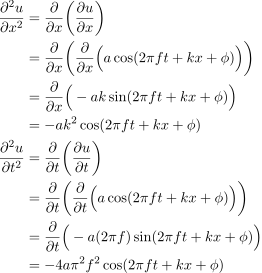
 ,
, .
. and
and 
 .
. and
and 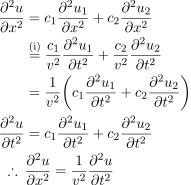

 ) and scattering states (
 ). For the time being we consider only scattering states.
 ,
,  .
. ,
, is real and positive.
 ,
, ,
,
 at
at 
 for
for  for
for 
 .
. ,
, .
. ,
,
 .
. by the continuity condition.

 :
:
 in two ways:
 ; or
; or .
.
 , hence:
 ,
, .
.![\begin{aligned} \langle x\rangle &:= \int_{-\infty}^{+\infty}x|\Psi (x,t)|^2\,\mathrm{d}x.\\ \frac{\mathrm{d}\langle x\rangle}{\mathrm{d}t} & = \int_{-\infty}^{+\infty}x\frac{\partial}{\partial t}|\Psi (x,t)|^2\,\mathrm{d}x.\\ & = \int_{-\infty}^{+\infty}x\frac{i\hbar}{2m}\Bigr(\Psi^*\frac{\partial^2\Psi}{\partial x^2}-\frac{\partial^2\Psi^*}{\partial x^2}\Psi \Bigr)\,\mathrm{d}x\\ & = \frac{i\hbar}{2m}\int_{-\infty}^{+\infty}(x)\Bigr(\Psi^*\frac{\partial^2\Psi}{\partial x^2}+ \frac{\partial \Psi \partial \Psi^*}{\partial x^2}-\frac{\partial^2\Psi^*}{\partial x^2}\Psi -\frac{\partial \Psi \partial \Psi^*}{\partial x^2}\Bigr)\,\mathrm{d}x\\ & =\frac{i\hbar}{2m}\int_{-\infty}^{+\infty}(x)\Bigr[\frac{\partial}{\partial x}\Bigr(\Psi^*\frac{\partial \Psi}{\partial x}\Bigr)- \frac{\partial}{\partial x}\Bigr(\Psi \frac{\partial \Psi^*}{\partial x}\Bigr)\Bigr]\,\mathrm{d}x\\ &= \frac{i\hbar}{2m}\int_{-\infty}^{+\infty}\frac{\partial}{\partial x}(x)\Bigr(\Psi^*\frac{\partial \Psi}{\partial x}-\Psi \frac{\partial \Psi^*}{\partial x}\Bigr)\,\mathrm{d}x\\ &= -\frac{i\hbar}{2m}\int_{-\infty}^{+\infty}\Bigr(\Psi^*\frac{\partial \Psi}{\partial x}-\Psi \frac{\partial \Psi^*}{\partial x}\Bigr)\,\mathrm{d}x\\ &= -\frac{i\hbar}{2m}\Bigr[\int_{-\infty}^{+\infty}\Bigr(\Psi^*\frac{\partial \Psi}{\partial x}\,\mathrm{d}x\Bigr)-\int_{-\infty}^{+\infty}\Bigr(\Psi \frac{\partial \Psi^*}{\partial x}\Bigr)\,\mathrm{d}x\Bigr]\\ &= -\frac{i\hbar}{2m}\Bigr[\Bigr(\Psi^*\Psi \Bigr|^{+\infty}_{-\infty}-\int_{-\infty}^{+\infty}\Psi \frac{\partial \Psi^*}{\partial x}\,\mathrm{d}x\Bigr)-\Bigr(\Psi \Psi^* \Bigr|^{+\infty}_{-\infty}-\int_{-\infty}^{+\infty}\Psi^* \frac{\partial \Psi}{\partial x}\,\mathrm{d}x\Bigr) \Bigr]\\ & = -\frac{i\hbar}{2m}\Bigr( 0-\int_{-\infty}^{+\infty}\Psi \frac{\partial \Psi^*}{\partial x}\,\mathrm{d}x-0+\int_{-\infty}^{+\infty}\Psi^* \frac{\partial \Psi}{\partial x}\,\mathrm{d}x\Bigr) \end{aligned}](https://physicspupil.com/wp-content/ql-cache/quicklatex.com-a7f1de4cb98287d401545aa67323709f_l3.svg "Rendered by QuickLaTeX.com")
![\begin{aligned} \frac{\mathrm{d}\langle x\rangle}{\,\mathrm{d}t} & = -\frac{i\hbar}{2m}\Bigr[-\Bigr(\Psi \Psi^* \Bigr|^{+\infty}_{-\infty}-\int_{-\infty}^{+\infty}\Psi^* \frac{\partial \Psi}{\partial x}\,\mathrm{d}x\Bigr)+\int_{-\infty}^{+\infty}\Psi^* \frac{\partial \Psi}{\partial x}\,\mathrm{d}x\Bigr]\\ &= -\frac{i\hbar}{2m}\Bigr(2 \int_{-\infty}^{+\infty}\Psi^* \frac{\partial \Psi}{\partial x}\,\mathrm{d}x\Bigr)\\ &= -\frac{i\hbar}{m}\int_{-\infty}^{+\infty}\Psi^* \frac{\partial \Psi}{\partial x}\,\mathrm{d}x\\ &= \frac{\hbar}{im}\int_{-\infty}^{+\infty}\Psi^* \frac{\partial \Psi}{\partial x}\,\mathrm{d}x\\ \langle p\rangle & := m\frac{\mathrm{d}\langle x\rangle}{\,\mathrm{d}t}\\ & = \int_{-\infty}^{+\infty}\Psi^* \Bigr(\frac{\hbar}{i}\frac{\partial}{\partial x}\Bigr)\Psi \,\mathrm{d}x \end{aligned}](https://physicspupil.com/wp-content/ql-cache/quicklatex.com-d94103f9d986840349fc21aa7ccb9e8f_l3.svg "Rendered by QuickLaTeX.com")

 ,
,  (that is, find
  as a function of
 ![\begin{aligned} 1 & = \int_{-\infty}^{+\infty}|\Psi |^2\,\mathrm{d}x \\ & = \int_{0}^{a}\frac{|A|^2x^2}{a^2}\,\mathrm{d}x + \int_{a}^{2a}|A|^2[(x-a)+1]^2\,\mathrm{d}x+\int_{2a}^{3a}|A|^2(a+1)^2\bigg( \frac{3a-x}{a}\bigg)^2\,\mathrm{d}x \\ & = \frac{|A|^2}{a^2}\bigg[\frac{x^3}{3}\bigg]\bigg|^a_{0} + |A|^2\bigg[\frac{\big( (x-a)+1\big)^3}{3}\bigg]\bigg|_{1}^{a+1} + |A|^2\bigg(\frac{a+1}{a}\bigg)^2\bigg[\frac{(x-3a)^3}{3}\bigg]\bigg|_{-a}^{0} \\ & = \frac{|A|^2a}{3} + |A|^2\bigg(\frac{(2)^3}{3} - \frac{(2-a)^3}{3} \bigg) + |A|^2\bigg( \frac{a+1}{a} \bigg)^2\bigg( \frac{(-3a)^3}{3} - \frac{(-4a)^3}{3} \bigg) \\ \dots \enspace & \textrm{ (to be continued) }\dots \end{aligned}](https://physicspupil.com/wp-content/ql-cache/quicklatex.com-7c25859cda6f633a23a1cd20c586d619_l3.svg "Rendered by QuickLaTeX.com")
![\begin{aligned} &\quad |A|^2\bigg(\frac{(2)^3}{3} - \frac{(2-a)^3}{3} \bigg) \\ & = |A|^2\bigg[ \bigg(\frac{8}{3}\bigg) -\bigg( \frac{8-12a+6a^2-a^3}{3}\bigg) \bigg] \\ & = |A|^2\bigg( \frac{4}{3}a - 2a^2 + \frac{a^3}{3}\bigg) \end{aligned}](https://physicspupil.com/wp-content/ql-cache/quicklatex.com-b5598d83f3f607e81840ab69661cf4fa_l3.svg "Rendered by QuickLaTeX.com")

![\begin{aligned} \dots\enspace &\textrm{ (continue) }\dots \\ 1 & = |A|^2 \bigg[ \bigg( \frac{1}{3} + \frac{4}{3} + \frac{37}{3} \bigg) a + \bigg( -2+\frac{74}{3} \bigg) a^2 + \bigg( \frac{1}{3}+\frac{37}{3} \bigg) a^3 \bigg] \\ 1 & = |A|^2 \bigg( 14a + \frac{68}{3}a^2 + \frac{38}{3}a^3 \bigg) \\ A & = \frac{1}{\sqrt{14a+\frac{68}{3}a^2+\frac{38}{3}a^3}} \end{aligned}](https://physicspupil.com/wp-content/ql-cache/quicklatex.com-0f7d4e3939a7b65ea4c5576753d6c767_l3.svg "Rendered by QuickLaTeX.com")

 where
where  attains its maximum value.
![\begin{aligned} \langle x\rangle & = \int_{0}^{3a}x|\Psi |^2\,\mathrm{d}x \\ & = |A|^2\bigg( \int_{0}^{a}\frac{x^3}{a^2}\,\mathrm{d}x + \int_{a}^{2a}[(x-a)^2+1]^2x\,\mathrm{d}x + \int_{2a}^{3a}(a^2+1)^2\bigg(\frac{3a-x}{a}\bigg)^2 x\,\mathrm{d}x \bigg) \\ \dots\enspace & \textrm{ (to be continued) }\dots \end{aligned}](https://physicspupil.com/wp-content/ql-cache/quicklatex.com-5ac422628c70bb566b887d4e55d6b18d_l3.svg "Rendered by QuickLaTeX.com")

 .
. ,
,![\begin{aligned} & i\hbar \frac{\partial \psi (\mathbf{r}_1,\mathbf{r}_2)\varphi (t)}{\partial t} \\ = & -\frac{\hbar^2}{2m_1}\nabla_1^2\bigg( \psi (\mathbf{r}_1,\mathbf{r}_2)\varphi (t)\bigg) -\frac{\hbar^2}{2m_2}\nabla_2^2\bigg( \psi (\mathbf{r}_1,\mathbf{r}_2)\varphi (t) \bigg) \\ &\qquad\enspace +V(\mathbf{r_1},\mathbf{r_2})\psi (\mathbf{r}_1,\mathbf{r}_2)\varphi (t) \\ & \\ & \textrm{\scriptsize OR} \\ & \\ & i\hbar\Big[ \frac{\partial \psi (\mathbf{r}_1,\mathbf{r}_2)}{\partial t}\varphi (t)+\psi (\mathbf{r}_1,\mathbf{r}_2)\frac{\partial \varphi (t)}{\partial t}\Big]\\ = & -\frac{\hbar^2}{2m_1}\varphi (t)\nabla_1^2\psi (\mathbf{r}_1,\mathbf{r}_2)-\frac{\hbar^2}{2m_2}\varphi (t)\nabla_2^2\psi (\mathbf{r}_1,\mathbf{r}_2) +V\psi \varphi \\ \end{aligned}](https://physicspupil.com/wp-content/ql-cache/quicklatex.com-34850d9628987e04f407d78a72dd91a5_l3.svg "Rendered by QuickLaTeX.com")