
(bad example)
The distance between  and
and  is
is  .
.
The mid-point  of
of  is
is  away from after some time
  .
.

At mid-point the speed  should therefore be

And the answer is A.
Remark.
What above was done brutally and mechanically, without a sense of physical meaning.
 , and at the point
  there being body
  :
:
 .
. of body
  .
. of body
 of the velocity is
 .
. and
and 
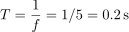 when
when  .
.![\begin{aligned}[t] \textrm{Time }t & \quad & t_1 & \quad & t_2=t_1+T & \quad & t_3=t_1+2T & \quad & t_4=t_1+3T \\ \textrm{DIsplacement }s & \quad & s_1=0 & \quad & s_2=s_1+4=4 &\quad & s_3=s_2+8=12 & \quad & s_4=s_3+12=24 \\ \textrm{Velocity }v & \quad & u_1 & \quad & u_2 & \quad & u_3 & \quad & u_4 \\ \textrm{Acceleration }a & \quad & a\textrm{ (= Const.)} & \quad & a\textrm{ (= Const.)} & \quad & a\textrm{ (= Const.)}& \quad & a\textrm{ (= Const.)} \end{aligned}](https://physicspupil.com/wp-content/ql-cache/quicklatex.com-effa2d8c3b8e25257b8976fabf10037b_l3.svg "Rendered by QuickLaTeX.com")
 ,
,  ,
,  , and
, and  ,
,

 ,
,
 and
and  .
. ,
, of an object of mass
  and speed
  is given by the formula
 .
. , it can be expected that after some time of flight
  , the object will return to its initial position, its downward speed in which is equal to the initial upward speed
  of time
![v:[0,T]\subset \mathbb{R} \rightarrow [0,u]\subset \mathbb{R}](https://physicspupil.com/wp-content/ql-cache/quicklatex.com-0f0e7e6d2e33bb3ad0132facb2eff3e1_l3.svg "Rendered by QuickLaTeX.com") given by
given by  .
.![\begin{aligned} v^2 & =(u-gt)^2\quad \big( =(-u+gt)^2\big) \\ & = u^2-2ugt+g^2t^2 \quad \big(\forall\, t\in [0,T] \big) \end{aligned}](https://physicspupil.com/wp-content/ql-cache/quicklatex.com-4d73fad5be84dfa1676a03a2ae22042d_l3.svg "Rendered by QuickLaTeX.com") .
. is
is
 are constants.
 :
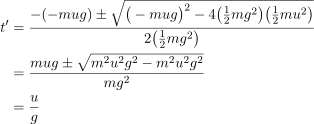
:
 for
for  :
: ,
, of an object can be given by a function
  .
. of the object from time
  is a function of time
  .
. ),
),![\begin{aligned} s(4) & = \int_0^4 (0.5t+2) \,\mathrm{d}t \\ & = \big[0.25t^2+2t\big] \big|_0^4 \\ & = 0.25(4)^2+2(4) \\ & = 12 \end{aligned}](https://physicspupil.com/wp-content/ql-cache/quicklatex.com-13d71db5db1e732d32354158d5e89082_l3.svg "Rendered by QuickLaTeX.com")

 is the e.m.f. induced,
  the number of turns in the coil,
  the magnetic flux, also (
 ) the product of magnetic flux density
  and area
  ,
,  .
.
 at point
  at point
  .
. at points
  :
: .
. is
is .
. is
is .
. .
. ,
,  , and
, and  are of charge
  ,
,  , and
, and  .
. . We keep them separated afterwards.
 .
.

