202307241011 Solution to 2023-DSE-PHY-IA-25

Two cells of negligible internal resistance are connected to two resistors as shown.


Roughwork.

Label the nodes a, b, c, and d:

Identify potential differences \Delta V_{ab}, \Delta V_{cd}, \Delta V_{ac}, and \Delta V_{bd}:

Lemma. (Kirchhoff’s 2nd law (/voltage law/loop rule))

The directed sum of the potential differences (voltages) around any closed loop is zero.

Wikipedia on Kirchhoff’s circuit laws

\begin{aligned} \Delta V_{ab}+\Delta V_{bd}+\Delta V_{dc}+\Delta V_{ca} & = 0 \\ (3)+((-I)(1))+(-(1.5))+(-(I)(2)) & = 0 \\ I & = +0.5\,\mathrm{A} \\ \end{aligned}


This problem is not to be attempted.

202212281204 Solution to 2015-DSE-PHY-IA-5

A constant net force acting on an object of mass m_1 produces an acceleration a_1 while the same force acting on another object of mass m_2 produces an acceleration a_2. If this net force acts on an object of mass (m_1+m_2), what would be the acceleration produced?


Roughwork.

Write

\begin{aligned} F_\textrm{net} & = m_1a_1 = m_2a_2 \\ & = (m_1+m_2)a_3 \\ \end{aligned}

Provided are four options. Let’s check them one by one.

A. a_3\stackrel{?}{=}a_1+a_2

\begin{aligned} (m_1+m_2)a_3 & = (m_1+m_2)(a_1+a_2) \\ & = (m_1a_1) + (m_2a_2) +m_1a_2+m_2a_1 \\ & = F_\textrm{net} + F_\textrm{net} +m_1a_2+m_2a_1 \\ & \gneq 2F_\textrm{net} \\ \therefore\enspace a_3 & \neq a_1+a_2 \\ \end{aligned}

B. a_3\stackrel{?}{=}\displaystyle{\frac{a_1+a_2}{2}}

\begin{aligned} (m_1+m_2)a_3 & = (m_1+m_2)\bigg(\frac{a_1+a_2}{2}\bigg) \\ & \stackrel{\textrm{(A)}}{=} F_\textrm{net} + \frac{m_1a_2+m_2a_1}{2} \\ & \gneq F_\textrm{net} \\ \therefore\enspace a_3 & \neq \frac{a_1+a_2}{2} \\ \end{aligned}

C. a_3\stackrel{?}{=}\displaystyle{\frac{a_1a_2}{a_1+a_2}}

\begin{aligned} (m_1+m_2)a_3 & = (m_1+m_2)\bigg(\frac{a_1a_2}{a_1+a_2}\bigg) \\ & = \frac{(m_1a_1)a_2+(m_2a_2)a_1}{a_1+a_2} \\ & = \frac{(F_\textrm{net})(a_1+a_2)}{a_1+a_2} \\ & = F_\textrm{net} \\ \therefore\enspace a_3 & = \frac{a_1a_2}{a_1+a_2} \\ \end{aligned}

D. a_3\stackrel{?}{=}\displaystyle{\frac{2a_1a_2}{a_1+a_2}} is so not to check.

Try-and-err was slower if steadier paced than fright-but-fight from head start,

\begin{aligned} a_3 & = \frac{F_\textrm{net}}{m_1+m_2} \\ & = \bigg(\frac{m_1}{F_\textrm{net}}+\frac{m_2}{F_\textrm{net}}\bigg)^{-1} \\ & = \bigg(\frac{1}{a_1}+\frac{1}{a_2}\bigg)^{-1} \\ & = \bigg(\frac{a_1+a_2}{a_1a_2}\bigg)^{-1} \\ & = \frac{a_1a_2}{a_1+a_2} \\ \end{aligned}

And the answer is C.

This problem is not to be attempted.

202212231640 Solution to 2016-DSE-PHY-IA-2

0.3\,\mathrm{kg} of water at temperature 50\,^\circ\mathrm{C} is mixed with 0.2\,\mathrm{kg} of ice at temperature 0\,^\circ\mathrm{C} in an insulated container of negligible heat capacity. What is the final temperature of the mixture?

Given: specific heat capacity of water =4200\,\mathrm{J\,kg^{-1}\,^\circ C^{-1}}; specific latent heat of fusion of ice 3.34\times 10^5\,\mathrm{J\, kg^{-1}}.


Roughwork.

For all 0.3\,\mathrm{kg} liquid water, a temperature drop of 50\,\mathrm{C^\circ} will release

\begin{aligned} \textrm{Sensible heat} & = (0.3)(4200)(50) \\ & = \textrm{63,000}\,\mathrm{J} \\ \end{aligned}

and a phase transition of freezing will release further latent heat (of fusion)

\begin{aligned} \textrm{Latent heat}& = ml_f \\ & = (0.3)(3.34\times 10^5) \\ & = \textrm{100,200}\,\mathrm{J} \\ \end{aligned}

whereas for 0.2\,\mathrm{kg} of solid ice to melt all at once, latent heat (of liquidization)

\begin{aligned} \textrm{Latent heat} & = ml_f \\ & = (0.2)(3.34\times 10^5) \\ & = \textrm{66,800}\,\mathrm{J} \\ \end{aligned}

is to be absorbed.


Lemma.

Heat always moves from hotter objects to colder objects, unless energy in some form is supplied to reverse the direction of heat flow.

Wikipedia on Second law of thermodynamics


By the inequalities

0<\textrm{66,800}-\textrm{63,000}<\textrm{100,200}

one will know.

202212201748 Solution to 2020-DSE-PHY-IA-23

Three identical resistors, a battery of negligible internal resistance, and an ideal voltmeter are connected to form Circuits (a) and (b) respectively.

Given that the voltmeter reading is 8\,\mathrm{V} in Circuit (a), what is the voltmeter reading in Circuit (b)?


Roughwork.

Redrawing a labelled diagram for (a),

and noting that

\begin{aligned} I_1=I_2 & = I/2 \\ I_3 & = 0 \\ I_4 & = I \\ R_\textrm{V}\parallel R & = R \\ R\parallel R & = R/2 \\ R_{\textrm{eq}} & = 3R/2 \\ \end{aligned}

we are about to write

\begin{aligned} I_4R & =8\,\mathrm{V}\textrm{ is given} \\ \mathcal{E} & =IR_{\textrm{eq}}\\ & = I\bigg(\frac{3R}{2}\bigg) \\ & = \frac{3}{2}(8) \\ & = 12\,\mathrm{V} \\ \end{aligned}

and obtain that the battery has an emf \mathcal{E} of 12\,\mathrm{V}. Likewise for (b),

where

\begin{aligned} I_2 & = I_4 \\ I_3 & = 0 \\ R_\textrm{V}\parallel R & = R \\ R+R_\textrm{V}\parallel R & = 2R \\ R\parallel (R+R_\textrm{V}\parallel R) & = 2R/3 \\ 12= \mathcal{E} & = I\bigg(\frac{2R}{3}\bigg) \\ \Longrightarrow\enspace IR & = 18 \\ \end{aligned}

\begin{aligned} & \quad\enspace \begin{cases} I_1R  =I_2(2R) \\ I_1+I_2 = 18/R \\ \end{cases} \\ & \Longrightarrow \begin{cases} I_1 = 12/R\\ I_2 = 6/R\\ \end{cases} \end{aligned}

being now asked for V=I_4R, the voltmeter reading, it is left to the reader.

202211250902 Solution to 2018-DSE-PHY-IA-26

A mobile phone battery labelled 2800\,\mathrm{mA\,h} capacity is fully charged initially. What percentage of capacity remains after it has delivered a current of 200\,\mathrm{mA} for 3 hours?


Background. (C-rate)

C-rate (in \mathrm{h^{-1}}) is defined the charging or discharging current (in \mathrm{A}) divided by the charge capacity (in \mathrm{A\,h}).

Background. (Capacity's)

Capacity C rated in ampere hours:

\begin{aligned} 1\,\mathrm{A\,h} & = 1\,\mathrm{A}\times 1\,\mathrm{h} \\ & = 1\cdot\mathrm{C\,s^{-1}}\times 3600\cdot\mathrm{s} \\ & = 3600\,\mathrm{C} \\ \end{aligned}

is equivalent to a measure of charge as in coulometry; whereas in watt hours

\begin{aligned} 1\,\mathrm{W\,h} & = 1\,\mathrm{W}\times 1\,\mathrm{h} \\ & = 1\cdot\mathrm{J\,s^{-1}}\times 3600\cdot\mathrm{s} \\ & = 3600\,\mathrm{J} \\ \end{aligned}

a measure of energy as in voltammetry.

Background. (state of charge/depth of discharge)

\textrm{SoC}+\textrm{DoD}=1

Background. (full/nominal/cutoff voltage)

\displaystyle{V_\textrm{nominal}=\frac{V_\textrm{full}-V_\textrm{cutoff}}{2}}


Limited in my knowledge, may I write

\begin{aligned} \textrm{SoC} & = \frac{2800-200\times 3}{2800} \times 100\% \\ & = 78.6\%\quad \textrm{(3 s.f.)} \\ \end{aligned}

202211241532 Solution to 2019-DSE-PHY-IA-6

A small ball after projection moves under the effect of gravity only. Its velocity at a certain instant is shown below. What is the speed of the ball 1\,\mathrm{s} before? Neglect air resistance. (g=9.81\,\mathrm{m\,s^{-2}})

This figure is not one original but a modified.


Roughwork.

Assume the angle of projection be \theta (t_0) =\theta_0 with speed v(t_0)=v_0 at launch time t=t_0 such that the resolved x-, y– components

\begin{aligned} v_x(v_0,\theta_0 ) & = v_0\cos\theta_0 \\ v_y(v_0,\theta_0 ,t) & = v_0\sin\theta_0 -gt \\ \end{aligned}

are combined to give the resultant speed at certain instant t:

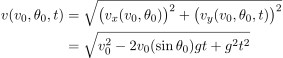
\begin{aligned} v(v_0,\theta_0,t) & =\sqrt{\big(v_x(v_0,\theta_0)\big)^2+\big(v_y(v_0,\theta_0,t)\big)^2} \\ & = \sqrt{v_0^2-2v_0(\sin\theta_0)gt+g^2t^2} \\ \end{aligned}

making with the level angle \theta (t)

\begin{aligned} \theta (v_0,\theta_0,t) & = \arctan\bigg( \frac{v_y(v_0,\theta_0,t)}{v_x(v_0,\theta_0)}\bigg) \\ & = \arctan\bigg( \frac{v_0\sin\theta_0-gt}{v_0\cos\theta_0} \bigg) \\ \end{aligned}

Now that for some instant t=T we are given

\begin{aligned} \theta (v_0,\theta_0,T) & =180^\circ -90^\circ -27^\circ =63^\circ \\ v(v_0,\theta_0,T) & =11\,\mathrm{m\,s^{-1}} \\ \end{aligned}

recall

\displaystyle{y(x) = \bigg(-\frac{g}{2v_0^2\cos^2\theta_0}\bigg) x^2+(\tan\theta_0)x}

Equating

\begin{aligned} \tan\theta \big|_{\theta =63^\circ} & = \frac{\mathrm{d}y}{\mathrm{d}x}\bigg|_{(x_0,y_0)} \\ & = \bigg(-\frac{g}{v_0^2\cos^2\theta_0}\bigg)x_0 +\tan\theta_0 \\ \end{aligned}

Differentiating on \theta (v_0,\theta_0,t) wrt time t:

\begin{aligned} \frac{\mathrm{d}\theta}{\mathrm{d}t} & = \frac{\mathrm{d}}{\mathrm{d}t}\bigg[\arctan \bigg(\frac{v_0\sin\theta_0-gt}{v_0\cos\theta_0}\bigg)\bigg] \\ & = \frac{1}{1+\Big(\frac{v_0\sin\theta_0-gt}{v_0\cos\theta_0}\Big)^2} \\ \theta'(t) & = \frac{v_0^2\cos^2\theta_0}{v_0^2-2v_0(\sin\theta_0)gt+g^2t^2} \\ \end{aligned}

and also on v(v_0,\theta_0,t):

\begin{aligned} \frac{\mathrm{d}v}{\mathrm{d}t} & = \frac{\mathrm{d}}{\mathrm{d}t}\bigg( \sqrt{v_0^2-2v_0\sin\theta_0gt+g^2t^2}\bigg) \\ v'(t) & = \frac{v_0(\sin\theta_0)g+g^2t}{\sqrt{v_0^2-2v_0(\sin\theta_0)gt+g^2t^2}} \\ & = \frac{v_0(\sin\theta_0)g+g^2t}{v_0\cos\theta_0} \cdot \sqrt{\theta'(t)} \\ \end{aligned}

(to be continued)

202111250910 Solution to 2020-DSE-PHY-1A-10

The diameter of Neptune is about 4 times that of the Earth and its mass is about 17 times that of the Earth. Estimate the acceleration due to gravity on Neptune’s surface.

Given: acceleration due to gravity on Earth’s surface g=9.81\,\mathrm{m\, s^{-2}}


Background.

From Newton’s law of gravitation, Eq. (B7):

F=\displaystyle{\frac{Gm_{1}m_{2}}{r^2}}

(pg. 15, List of data, formulae and relationship)


Solution.

On the Earth, for some object of mass m, we see that:

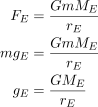
\begin{aligned} F_{E} & = \frac{GmM_{E}}{r_{E}} \\ mg_{E} & = \frac{GmM_{E}}{r_{E}} \\ g_{E} & = \frac{GM_{E}}{r_{E}} \\ \end{aligned}

Similarly, for some object of mass m on Neptune, we have

\begin{aligned} F_{N} & = \frac{GmM_{N}}{r_{N}} \\ mg_{N} & = \frac{GmM_{N}}{r_{N}} \\ g_{N} & = \frac{GM_{N}}{r_{N}} \\ \end{aligned}

We compare g_{N} to g_{E} by the assumption:

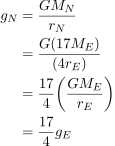
\begin{aligned} g_{N} & = \frac{GM_{N}}{r_{N}} \\ & = \frac{G(17M_E)}{(4r_{E})} \\ & = \frac{17}{4}\bigg(\frac{GM_{E}}{r_{E}}\bigg) \\ & = \frac{17}{4}g_{E} \\ \end{aligned}

And the answer is D.

202110111120 Solution to 2012-DSE-PHY-1A-5

There are two forces \mathbf{F_1} and \mathbf{F_2}, of constant magnitudes (i.e., F_1=|\mathbf{F_1}|=\textrm{Const.}; F_2=|\mathbf{F_2}|=\textrm{Const.}), acting at the same point. The angle \theta between \mathbf{F_1} and \mathbf{F_2} increases from 0^\circ to 180^\circ.Apparently from the figure, F_1>F_2.

Let the direction of \mathbf{F_2} be fixed due east.

Then,

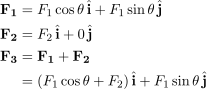
\begin{aligned} \mathbf{F_1} & = F_1\cos\theta\,\hat{\mathbf{i}}+F_1\sin\theta\,\hat{\mathbf{j}} \\ \mathbf{F_2} & = F_2\,\hat{\mathbf{i}} + 0\,\hat{\mathbf{j}} \\ \mathbf{F_3} & = \mathbf{F_1} + \mathbf{F_2} \\ & = ( F_1\cos\theta + F_2 )\,\hat{\mathbf{i}} + F_1\sin\theta\,\hat{\mathbf{j}} \\ \end{aligned}

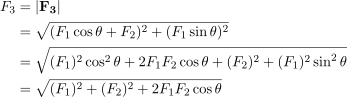
\begin{aligned} F_3 & = |\mathbf{F_3}| \\ & = \sqrt{(F_1\cos\theta + F_2)^2+(F_1\sin\theta )^2} \\ & = \sqrt{(F_1)^2\cos^2\theta + 2F_1F_2\cos\theta +(F_2)^2+(F_1)^2\sin^2\theta} \\ & = \sqrt{(F_1)^2+(F_2)^2+2F_1F_2\cos\theta} \\ \end{aligned}

If \theta =0^\circ, then \cos\theta =1 and F_3=F_1+F_2;

if \theta =90^\circ, then \cos\theta =0 and F_3=\sqrt{(F_1)^2+(F_2)^2};

if \theta =180^\circ, then \cos\theta =-1 and F_3=F_1-F_2.

By the triangle inequality,

F_1+F_2>F_3=\sqrt{(F_1)^2+(F_2)^2}.

So the magnitude F_3 of the resultant force \mathbf{F_3} decreases throughout.


(Countercheck)

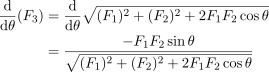
Differentiating F_3 w.r.t. \theta,

\begin{aligned} \quad \frac{\mathrm{d}}{\mathrm{d}\theta}(F_3) & = \frac{\mathrm{d}}{\mathrm{d}\theta} \sqrt{(F_1)^2+(F_2)^2+2F_1F_2\cos\theta} \\ & = \frac{-F_1F_2\sin\theta}{\sqrt{(F_1)^2+(F_2)^2+2F_1F_2\cos\theta}}\\ \end{aligned}

As \sin\theta \ge 0 for 0\le \theta \le \pi, and \sqrt{[\cdots ]}\ge 0, we have

\displaystyle{\frac{\mathrm{d}F_3}{\mathrm{d}\theta}\le 0}.

And the answer is A.