
A light ray passes through a spherical air bubble in water. Which of the following represents the path of the emergent ray?

A. 
B. 
C. 
D. 
Roughwork.
Refractive (/refraction) index of a pure substance, with some exceptions, is proportional to its density; and of a mixture of substances, as a rule, to its mass concentration.
Thus water, higher in density than air, should have a larger refractive index than air:
 ;
;
alternatively, as light travels in air faster than in water, from
 ,
,
it can be seen also.

Let  and
and  be the angle of incidence and of refraction when light is refracted through the first interface; and and
  , when through the second interface.
Assuming WLOG  and noting
  (non-negative) for
 ![\theta\in \big[ 0,\frac{\pi}{2}\big]](https://physicspupil.com/wp-content/ql-cache/quicklatex.com-eb31fdb43359ab42ea682435eb79b44f_l3.svg "Rendered by QuickLaTeX.com") . By Snell’s Law, write
. By Snell’s Law, write


Answer. Path .

Reverse the direction of incidence and emergence:

Light ray along path: bends away from and then towards the normal; bends towards the normal once and again; bends away from the normal once and again; bends towards and then away from the normal. Wits have it that and are unlikely. So we turn our attention to light rays and .

Fussy enough, path is symmetric with respect to straight line  ; but there across path is no line of symmetry were it to be
  .
.
This problem is not to be attempted.
 of a gas is contained in a vessel at
  and a pressure of
  . If the density of the gas at s.t.p. (
 and
and  ) is
) is  , what is the mass of the gas?


 (closed vessel)
 a constant. Then, that
  .
.
 (open vessel)

 ,
,  ,
,  ,
,  are the pressure, the volume, the amount of substance (/number of moles), the ideal (/universal) gas constant, and the temperature of the gas.
 , and molar mass
  , of a substance.
 ,
,

 the gas in standard temperature and pressure (s.t.p.),

 , it can be inferred that some portion of the gas was leaking from the open vessel to the atmosphere throughout the experiment.
 , we know

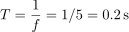 when
when  .
.![\begin{aligned}[t] \textrm{Time }t & \quad & t_1 & \quad & t_2=t_1+T & \quad & t_3=t_1+2T & \quad & t_4=t_1+3T \\ \textrm{DIsplacement }s & \quad & s_1=0 & \quad & s_2=s_1+4=4 &\quad & s_3=s_2+8=12 & \quad & s_4=s_3+12=24 \\ \textrm{Velocity }v & \quad & u_1 & \quad & u_2 & \quad & u_3 & \quad & u_4 \\ \textrm{Acceleration }a & \quad & a\textrm{ (= Const.)} & \quad & a\textrm{ (= Const.)} & \quad & a\textrm{ (= Const.)}& \quad & a\textrm{ (= Const.)} \end{aligned}](https://physicspupil.com/wp-content/ql-cache/quicklatex.com-effa2d8c3b8e25257b8976fabf10037b_l3.svg "Rendered by QuickLaTeX.com")
 ,
,  ,
,  , and
, and  in
in ,
,

 ,
,
 and
and  .
. ,
, of an object of mass
  is given by the formula
 .
. , it can be expected that after some time of flight
  of time
![v:[0,T]\subset \mathbb{R} \rightarrow [0,u]\subset \mathbb{R}](https://physicspupil.com/wp-content/ql-cache/quicklatex.com-0f0e7e6d2e33bb3ad0132facb2eff3e1_l3.svg "Rendered by QuickLaTeX.com") given by
given by  .
.![\begin{aligned} v^2 & =(u-gt)^2\quad \big( =(-u+gt)^2\big) \\ & = u^2-2ugt+g^2t^2 \quad \big(\forall\, t\in [0,T] \big) \end{aligned}](https://physicspupil.com/wp-content/ql-cache/quicklatex.com-4d73fad5be84dfa1676a03a2ae22042d_l3.svg "Rendered by QuickLaTeX.com") .
. is
is
 are constants.
 :
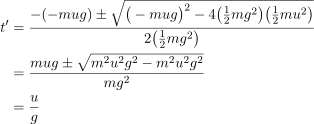
:
 for
for  :
: ,
, of an object can be given by a function
  .
. of the object from time
  to
to  is a function of time
  .
. ),
),![\begin{aligned} s(4) & = \int_0^4 (0.5t+2) \,\mathrm{d}t \\ & = \big[0.25t^2+2t\big] \big|_0^4 \\ & = 0.25(4)^2+2(4) \\ & = 12 \end{aligned}](https://physicspupil.com/wp-content/ql-cache/quicklatex.com-13d71db5db1e732d32354158d5e89082_l3.svg "Rendered by QuickLaTeX.com")