Let there be an  -axis passing through points
  and
and  . Let
. Let  at point and
  at point .
Now consider an arbitrary point  on the -axis.
The magnitude  of electric field strength due to the point charge
  at point is
 ,
,
whereas the magnitude  of electric field strength due to the point charge
  at point is
 .
.
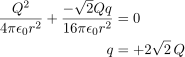
The point(s) at which  is found by solving for
  :
:

There are two points  and
and  at which
  .
.
The necessary and sufficient condition for  is that they are equal in magnitude:
  and opposite in sign:
  ,
,
i.e.,

i. and ii. the directions of  and
and  are opposite to each other.
Suffice it to check whether  and
and  at the above-mentioned two points are in opposite direction.
The first candidate , where  , is in between point and point . If a positive test charge were placed there, both the electric field strength due to at and due to at would point to the right. That is, this point fails to meet our requirement
 ii.
The second candidate , where  , is to the left of point . If a positive test charge were placed at , the electric field strength there due to at would point to the left. Whereas the electric field strength there due to at would point to the right.
We conclude that the resultant electric field strength is zero at only one point, i.e., the point .
And the answer is C.
 acting on the charge
  at
at  due to another charge
  is given by Coulomb’s Law:
 ,
, due to another charge
  is given similarly by:
 .
. is placed on
  , which is at a distance of
  from
from  is given by:
 .
. is then given by: