202112021444 Solution to 1979-CE-AMATH-I-1

Let \displaystyle{y=x+\frac{1}{x^2}}. Find \displaystyle{\frac{\mathrm{d}y}{\mathrm{d}x}} from first principles.


Solution.

From first principles,
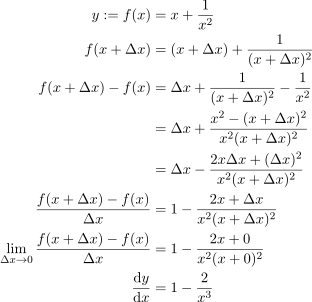
\begin{aligned} y:=f(x) & =x+\frac{1}{x^2} \\ f(x+\Delta x) & =(x+\Delta x) + \frac{1}{(x+\Delta x)^2} \\ f(x+\Delta x)-f(x) & = \Delta x + \frac{1}{(x+\Delta x)^2} - \frac{1}{x^2} \\ & = \Delta x + \frac{x^2-(x+\Delta x)^2}{x^2(x+\Delta x)^2} \\ & = \Delta x - \frac{2x\Delta x+(\Delta x)^2}{x^2(x+\Delta x)^2} \\ \frac{f(x+\Delta x)-f(x)}{\Delta x} & = 1 - \frac{2x + \Delta x}{x^2(x+\Delta x)^2} \\ \lim_{\Delta x\to 0}\frac{f(x+\Delta x)-f(x)}{\Delta x} & = 1 - \frac{2x + 0}{x^2(x+0)^2} \\ \frac{\mathrm{d}y}{\mathrm{d}x} & = 1 - \frac{2}{x^3} \\ \end{aligned}


Playground.

To make fun of calculus, do let
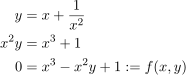
\begin{aligned} y & =x+\frac{1}{x^2} \\ x^2y & =x^3+1 \\ 0 & = x^3-x^2y+1 := f(x,y) \\ \end{aligned}

where f(x,y) is a degree 3 polynomial in two variables x and y.

The set of solutions to f(x,y)=0 is

\begin{cases} \enspace x \neq 0 \\ \enspace  y = \frac{x^3+1}{x^2} \end{cases}

Computing \partial_xf and \partial_yf as follow:

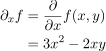
\begin{aligned} \partial_xf & = \frac{\partial}{\partial x}f(x,y) \\ & = 3x^2-2xy \\ \end{aligned}

and

\begin{aligned} \partial_yf & = \frac{\partial}{\partial y}f(x,y) \\ & = -x^2 \\ \end{aligned},

we oversee the relation

\mathrm{d}f = (\partial_xf)(\Delta x)+(\partial_yf)(\Delta y).


Definition. (Singularity and Smoothness)

A point p=(a,b) on a curve \mathcal{C}=\{ (x,y)\in\mathbb{C}^2:f(x,y)=0\} is said to be singular if

\begin{aligned} \frac{\partial f}{\partial x}(a,b) & = 0 \\ \frac{\partial f}{\partial y}(a,b) & = 0 \\ \end{aligned}.

A point that is not singular is called smooth. If there is at least one singular point on \mathcal{C}, then curve \mathcal{C} is called a singular curve. If there are no singular points on \mathcal{C}, the curve \mathcal{C} is called a smooth curve.

C.f. Definition 1.9.1, T. Carrity, et al., Algebraic Geometry: A Problem Solving Approach


That said, in our scenario

f(x,y)=x^3-x^2y+1,

the set of candidates for singularity

\{ (a,b)\in\mathbb{C}^2\enspace \mathrm{s.t.}\enspace f(a,b)=0\textrm{ and }\partial_xf(a,b)=\partial_yf(a,b)=0\}.

is empty.

\therefore The curve \mathcal{C}=\{ (x,y)\in\mathbb{C}^2:x^3-x^2y+1=0\} is smooth, thus everywhere differentiable.


Wait, the function in question should be the curve

F(x)=\displaystyle{x+\frac{1}{x^2}};

still, for better or worse, F(x) is \textrm{\scriptsize{NOT}} a differentiable function because the derivative does \textrm{\scriptsize{NOT}} exist at x=0, for that point is a discontinuity.

202111241152 Solution to 1971-CE-AMATH-3

Prove by mathematical induction that n(n^2+2) is divisible by 3 for all positive integral values of n.


Solution.

Let P(n) be the statement that

P(n):\enspace n(n^2+2)\textrm{ is divisible by }3\textrm{ for }n\in\mathbb{Z}^{+}

First, we wish to show P(1) holds true.

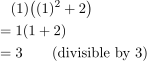
\begin{aligned} &\quad (1)\big( (1)^2 + 2\big) \\ & = 1(1+2) \\ & = 3\qquad (\textrm{divisible by }3)\\ \end{aligned}

\therefore P(1) is true.

Once we assume that P(n) is true for some positive integral values, we wish to show P(n+1) is true.

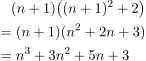
\begin{aligned} &\quad (n+1)\big( (n+1)^2 + 2\big) \\ & = (n+1)(n^2+2n+3) \\ & = n^3 + 3n^2 + 5n +3 \\ \end{aligned}

Let f(x)=x^3+3x^2+5x+3.

Suppose we can divide f(x) by 3, i.e.,

f(x)=3\cdot g(x)

for some g(x)=Ax^3+Bx^2+Cx+D where A,B,C,D\in\mathbb{R}.

Then, let’s see

\begin{aligned} \frac{f(x)}{g(x)} & = 3 \\ \frac{\mathrm{d}}{\mathrm{d}x}\bigg( \frac{f(x)}{g(x)}\bigg) & = \frac{\mathrm{d}}{\mathrm{d}x}(3) \\ \frac{g(x)f'(x)-f(x)g'(x)}{[g(x)]^2} & = 0 \\ g(x)f'(x)-f(x)g'(x) & = 0 \\ \end{aligned}

Plugging in f(x), f'(x), g(x), and g'(x), we have

\begin{aligned} &\quad (Ax^3+Bx^2+Cx+D)(3x^2+6x+5) \\ & = (x^3+3x^2+5x+3)(3Ax^2+2Bx+C) \\ \end{aligned}

\begin{aligned} &\quad \enspace \textrm{LHS} \\ & = (3A)x^5 + (6A+3B)x^4 + (5A+6B+3C)x^3 \\ &\qquad\quad + (5B+6C+3D)x^2 + (5C+6D)x + (5D) \\ \end{aligned}

\begin{aligned} &\quad \enspace \textrm{RHS} \\ & = (3A)x^5 + (9A+2B)x^4 + (15A+6B+C)x^3 \\ &\qquad\quad + (9A+10B+3C)x^2 + (6B+5C)x + (3C) \\ \end{aligned}

We have a set of five equations below:

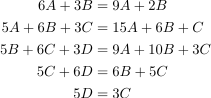
\begin{aligned} 6A + 3B & = 9A + 2B \\ 5A+6B+3C & = 15A+6B+C \\ 5B+6C+3D & = 9A+10B+3C \\ 5C +6D & = 6B+5C \\ 5D & = 3C \\ \end{aligned}

which can be summarized to

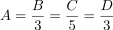
\displaystyle{A=\frac{B}{3}=\frac{C}{5}=\frac{D}{3}},

that is equivalent to saying

g(x)=\displaystyle{\frac{f(x)}{3}=\frac{x^3}{3}+x^2+\frac{5x}{3}+1},

viz. I have been wasting time over a circular reasoning of no use.

I should have tried to attest otherwise that g(x) is of some positive integral values, even though this is \textrm{\scriptsize{NOT}} proving the statement P(n) by mathematical induction firsthand.


Reformulation.

To show that the following statement Q(x) holds true:

Q(x):\quad \displaystyle{\frac{x^3}{3}+x^2+\frac{5x}{3}+1}\textrm{ is an integer for any }x\in\mathbb{Z}^{+}.

Q(1) is true because

\displaystyle{\frac{(1)^3}{3}+(1)^2+\frac{5(1)}{3}+1}=4

is an integer.

Assume Q(x) is true for some x\in\mathbb{Z}^{+}.

Then,

\begin{aligned} &\qquad \frac{(x+1)^3}{3}+(x+1)^2+\frac{5(x+1)}{3}+1 \\ & = \frac{(x^3+3x^2+3x+1)}{3} + (x^2+2x+1)+\frac{(5x+5)}{3} + 1 \\ & = \bigg( \frac{x^3}{3}+x^2+\frac{5x}{3}+1\bigg) + \bigg( \frac{3x^2+3x+1}{3}+2x+1+\frac{5}{3}+1 \bigg) \\ \end{aligned}

The first term is an integer for Q(x) is assumed to be true. We then need to check whether the second term is of integral value(s).

The second term, after simplification, is

x^2+3x+4,

obviously an integer.

\therefore Q(x+1) thus holds.

Because Q(1) is true, by mathematical induction, Q(x) is true for all positive integers x.


Escape to the original statement.

3|n^3+3n^2+5n+3\Longleftrightarrow P(n+1)\textrm{ holds true.}

Because P(1) is true, by mathematical induction, P(n) is true for any positive integers n.

202111241104 Solution to 1969-CE-AMATH-3

Prove by mathematical induction that if n is a positive integer, f(n)\equiv 3^{2n}-1 is divisible by 8.


Solution.

We wish to show that the statement is true for n=1, and also true for n+1.

When n=1, f(1)=3^{2(1)}-1=8 is divisible by 8.

Assume f(n) is true for some positive integer n, i.e.,

\{f(n):3^{2n}-1=8m\, |\, \exists \, m, n\in\mathbb{Z}^{+}\}.

For f(n+1)=3^{2(n+1)}-1, we have

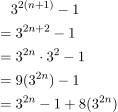
\begin{aligned} & \quad 3^{2(n+1)}-1 \\ & = 3^{2n+2} - 1 \\ & = 3^{2n}\cdot 3^2 - 1 \\ & = 9(3^{2n})-1 \\ & = 3^{2n} -1 + 8(3^{2n}) \\ \end{aligned}

As is assumed 3^{2n}-1 divisible by 8, the statement is thus also true for n+1.

We have proven by mathematical induction that for any positive integer n\enspace (\in\mathbb{Z}^+), f(n) is divisible by 8.


Afterword.

Try to prove \textrm{\scriptsize{NOT}} by mathematical induction \textrm{\scriptsize{BUT}} by direct proof.

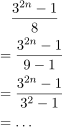
\begin{aligned} &\quad \frac{3^{2n}-1}{8} \\ & = \frac{3^{2n}-1}{9-1} \\ & = \frac{3^{2n}-1}{3^2-1} \\ & = \dots \end{aligned}

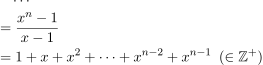
Let x=3^2, then

\begin{aligned} &\quad \dots \\ & = \frac{x^n-1}{x-1} \\ & = 1+x+x^2+\cdots + x^{n-2} + x^{n-1} \enspace (\in\mathbb{Z}^{+}) \\ \end{aligned}

\therefore f(n)\equiv 3^{2n}-1 is divisible by 8.

202110251056 Solution to 1970-CE-AMATH-1

Given that F(x)=(b-c)x^3-(a+2b-3c)x^2-(b+2c-3a)x-2(a-b). By using the remainder theorem, prove that (x-1)(x-2) is a factor of F(x). Find also the remaining factor of F(x).


Solution.

\begin{aligned} F(1) & = (b-c)(1)^3 - (a+2b-3c)(1)^2 - (b+2c-3a)(1) - 2(a-b) = 0 \\ F(2) & = (b-c)(2)^3 - (a+2b-3c)(2)^2 - (b+2c-3a)(2) - 2(a-b) = 0 \\ \end{aligned}

\therefore (x-1)(x-2) is a factor of F(x).

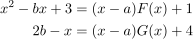
By trial-and-error,

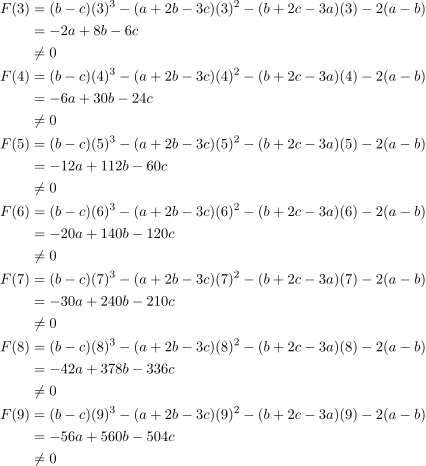
\begin{aligned} F(3) & = (b-c)(3)^3-(a+2b-3c)(3)^2-(b+2c-3a)(3)-2(a-b) \\ & = -2a+8b-6c \\ & \neq 0 \\ F(4) & = (b-c)(4)^3-(a+2b-3c)(4)^2-(b+2c-3a)(4)-2(a-b) \\ & = -6a+30b-24c \\ & \neq 0 \\ F(5) & = (b-c)(5)^3-(a+2b-3c)(5)^2-(b+2c-3a)(5)-2(a-b) \\ & = -12a+112b-60c \\ & \neq 0 \\ F(6) & = (b-c)(6)^3-(a+2b-3c)(6)^2-(b+2c-3a)(6)-2(a-b) \\ & = -20a+140b-120c \\ & \neq 0 \\ F(7) & = (b-c)(7)^3-(a+2b-3c)(7)^2-(b+2c-3a)(7)-2(a-b) \\ & = -30a+240b-210c \\ & \neq 0 \\ F(8) & = (b-c)(8)^3-(a+2b-3c)(8)^2-(b+2c-3a)(8)-2(a-b) \\ & = -42a+378b-336c \\ & \neq 0 \\ F(9) & = (b-c)(9)^3-(a+2b-3c)(9)^2-(b+2c-3a)(9)-2(a-b) \\ & = -56a + 560b - 504c \\ & \neq 0 \end{aligned}

It may be feasible to work in this manner, however endlessly, to find a zero. But it is high time for me to work in another way round.

By long division, the remaining factor is

(b-c)x+(b-a).

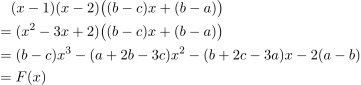
One should check that

\begin{aligned} &\quad (x-1)(x-2)\big( (b-c)x+(b-a)\big) \\ & = (x^2-3x+2)\big( (b-c)x+(b-a)\big) \\ & = (b-c)x^3 - (a+2b-3c)x^2 - (b+2c-3a)x - 2(a-b) \\ & = F(x) \\ \end{aligned}

Remark.

This remaining zero, i.e., \displaystyle{x=\frac{b-a}{b-c}}, is hard to find by trial-and-error, so long division is necessary.

Roughwork.

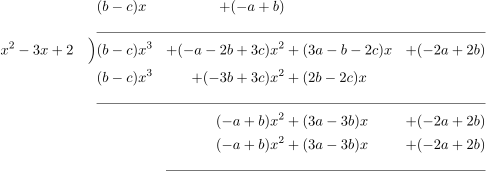
\begin{aligned} & (b-c)x & +(-a+b) & & \\\cline{2-5} x^2-3x+2\quad \Big)& (b-c)x^3 & +(-a-2b+3c)x^2 & +(3a-b-2c)x & +(-2a+2b) \\ & (b-c)x^3 & +(-3b+3c)x^2 & + (2b-2c)x & \\\cline{2-5} & & (-a+b)x^2 & +(3a-3b)x & + (-2a+2b) \\ & & (-a+b)x^2 & +(3a-3b)x & + (-2a+2b) \\\cline{3-5} \end{aligned}

202104080551 Solution to 1973-AL-AMATH-I-5

A particle of mass m moving in a straight line in a medium with a velocity v is subjected to a force mk(v^3+a^2v) in the direction opposite to the velocity, where k and a are constants. Show that, at any subsequent time t, the velocity v is related to the initial velocity v_0 by

\displaystyle{\frac{v}{(v^2+a^2)^{1/2}}=\frac{v_0}{(v_0^2+a^2)^{1/2}}e^{-a^2kt}}.

Show that for any value of the initial velocity, no matter how large, the particle will never travel a distance greater than \pi /(2ka).


Background.

Newton's second law: \textrm{Net }\mathbf{F}=m\mathbf{a}


\begin{aligned} F = -mk(v^3+a^2v) & = ma \\ -mk(\dot{x}^3+a^2\dot{x}) & = m\ddot{x} \\ \frac{\mathrm{d}\dot{x}}{\mathrm{d}t} & = -k(\dot{x}^3+a^2\dot{x}) \\ \frac{\mathrm{d}\dot{x}}{\dot{x}^3+a^2\dot{x}} & = -k\,\mathrm{d}t \\ \dots \textrm{integrating from }& (v=v_0,\, t=0)\textrm{ to }(v=v,\, t=t) \\ \int_{v_0}^{v} \frac{1}{\dot{x}(\dot{x}^2+a^2)}\,\mathrm{d}\dot{x} & = \int_{0}^{t}-k\,\mathrm{d}t \end{aligned}

(to be continued)


Roughwork.

Let u=\dot{x}. Then,
\begin{aligned} \int \frac{1}{u(u^2+a^2)}\,\mathrm{d}u & \stackrel{\textrm{def}}{=} \int \bigg(\frac{A}{u} + \frac{Bu+C}{u^2+a^2} \bigg) \,\mathrm{d}u \\ & = \int \frac{A(u^2+a^2)+Bu^2+Cu}{u(u^2+a^2)}\,\mathrm{d}u \end{aligned}

\begin{aligned} 1 & \equiv A(u^2+a^2)+Bu^2+Cu \\ 1 & \equiv (A+B)u^2+Cu+Aa^2 \\ A+B & = 0 \\ C & = 0 \\ A & = \frac{1}{a^2} \\ \Rightarrow B & =  -\frac{1}{a^2} \end{aligned}
Thus,
\displaystyle{\int \frac{1}{u(u^2+a^2)}\,\mathrm{d}u = \int \bigg(\frac{1}{a^2u} - \frac{u}{a^2(u^2+a^2)}\bigg) \,\mathrm{d}u}


(continue)

\begin{aligned} & \quad \int_{v_0}^{v} \frac{1}{\dot{x}(\dot{x}^2+a^2)}\,\mathrm{d}\dot{x} \\ & = \int_{v_0}^{v} \bigg(\frac{1}{a^2\dot{x}} - \frac{\dot{x}}{a^2(\dot{x}^2+a^2)}\bigg) \,\mathrm{d}\dot{x} \\ & = \int_{v_0}^v\frac{1}{a^2\dot{x}}\,\mathrm{d}\dot{x} - \int_{v_0}^v \frac{\dot{x}}{a^2(\dot{x}^2+a^2)}\,\mathrm{d}\dot{x} \\ \end{aligned}

The first term is

\begin{aligned} \int_{v_0}^v\frac{1}{a^2\dot{x}}\,\mathrm{d}\dot{x} & = \bigg[ \frac{\ln \dot{x}}{a^2} \bigg]\bigg|_{v_0}^{v} \\ & = \bigg( \frac{\ln v}{a^2} \bigg) - \bigg( \frac{\ln v_0}{a^2} \bigg) \\ & = \frac{1}{a^2}\ln \bigg( \frac{v}{v_0} \bigg) \end{aligned}

and the second term is

\begin{aligned} &\quad -\int_{v_0}^v \frac{\dot{x}}{a^2(\dot{x}^2+a^2)}\,\mathrm{d}\dot{x}\\ \dots & \textrm{ let } \dot{x}=a\tan\theta \enspace\dots \\ \dots & \textrm{ let } \theta = \tan^{-1}\bigg(\frac{v}{a}\bigg) \textrm{ and }  \theta_0 = \tan^{-1}\bigg(\frac{v_0}{a}\bigg) \\ & = -\int_{\theta_0}^{\theta} \frac{a\tan\theta}{a^2(a^2\tan^2\theta +a^2)}\cdot (a\sec^2\theta)\,\mathrm{d}\theta \\ & = -\int_{\theta_0}^{\theta} \frac{\tan\theta}{a(a^2\sec^2\theta)}\cdot (a\sec^2\theta )\,\mathrm{d}\theta \\ & = -\int_{\theta_0}^{\theta} \frac{\tan\theta}{a^2}\,\mathrm{d}\theta \\ & = -\bigg[ -\frac{\ln |\cos\theta |}{a^2} \bigg]\bigg|_{\theta_0}^{\theta} \\ & = \frac{1}{a^2} \bigg[\ln \bigg| \frac{a}{\sqrt{\dot{x}^2+a^2}} \bigg|\bigg]\bigg|_{v_0}^{v} \\ & = \frac{1}{a^2} \bigg( \ln\bigg| \frac{a}{\sqrt{v^2+a^2}} \bigg| -\ln\bigg| \frac{a}{\sqrt{v_0^2+a^2}} \bigg| \bigg) \\ & = \frac{1}{a^2} \ln \bigg( \frac{\sqrt{v_0^2+a^2}}{\sqrt{v^2+a^2}} \bigg) \\ \end{aligned}

Back to an earlier line

\displaystyle{\int_{v_0}^{v} \frac{1}{\dot{x}(\dot{x}^2+a^2)}\,\mathrm{d}\dot{x} = \int_{0}^{t}-k\,\mathrm{d}t}

we have

\begin{aligned} \frac{1}{a^2}\ln\bigg( \frac{v}{v_0} \bigg) + \frac{1}{a^2}\ln \bigg( \frac{\sqrt{v_0^2+a^2}}{\sqrt{v^2+a^2}}\bigg) & = -kt \\ \ln\bigg( \frac{v}{v_0} \bigg) + \ln \bigg( \frac{\sqrt{v_0^2+a^2}}{\sqrt{v^2+a^2}}\bigg) & = -a^2kt \\ \ln\bigg( \frac{v}{v_0}\frac{\sqrt{v_0^2+a^2}}{\sqrt{v^2+a^2}} \bigg) & =-a^2kt \\ \frac{v}{v_0}\frac{\sqrt{v_0^2+a^2}}{\sqrt{v^2+a^2}} & = e^{-a^2kt} \\ \end{aligned}

or,

\boxed{\displaystyle{\frac{v}{\sqrt{v^2+a^2}}=\frac{v_0}{\sqrt{v_0^2+a^2}}e^{-a^2kt}}}

as desired.

It remains to be shown that for any value of the initial velocity, no matter how large, the particle will never travel a distance greater than \pi /(2ka).


(to be continued)